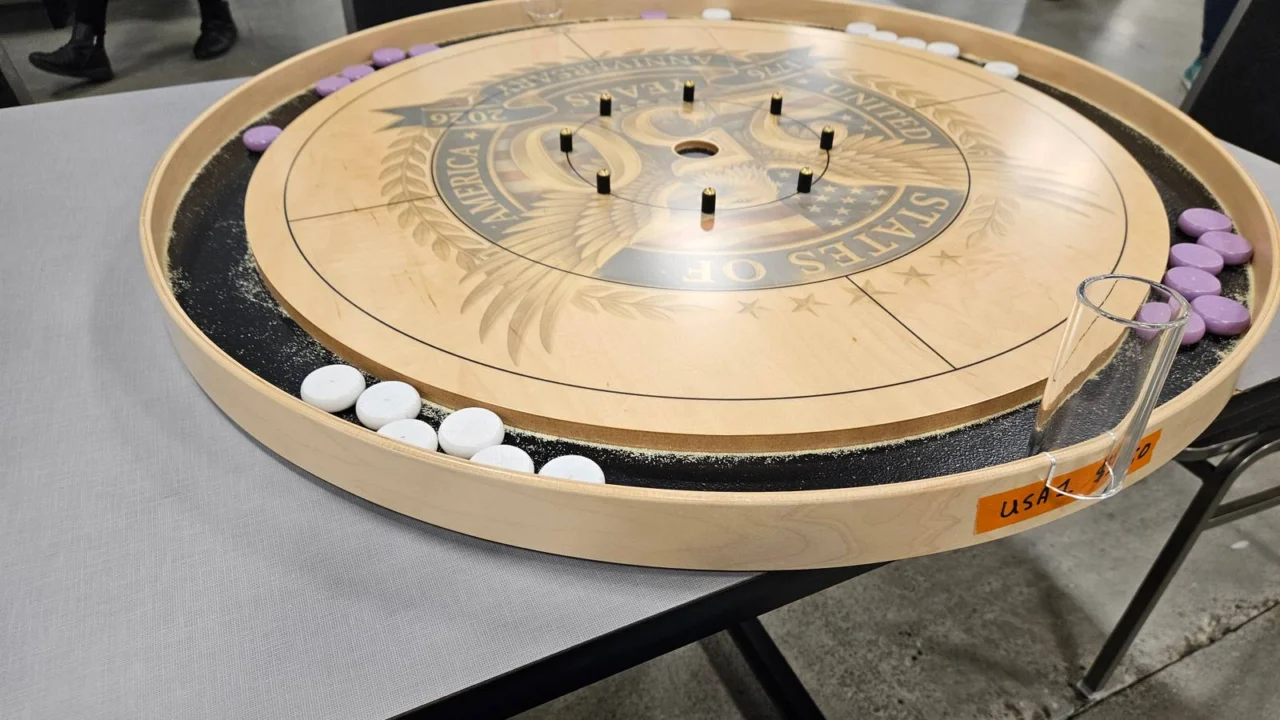
PAX West 2026’s Most Surprising Hit Was a 150-Year-Old Board Game Combining Darts and Woodworking
I arrived fashionably—and dangerously—late to this particular gathering. When my editor suggested I check out a game of crokinole during the Penny Arcade Expo in Seattle, citing its surging popularity, my immediate assumption was that he had entirely fabricated the word. Yet, when I brought up my confusion to my board-gaming circle, not only were they intimately familiar with the game, but several actually owned their own boards. One friend even remained steadfastly convinced that we had played it together before.
Upon venturing down to the subterranean demo hall of the Washington State Convention Center, I encountered roughly a dozen tables dedicated exclusively to crokinole. Surrounded by seated crowds, these games unfolded across stunning, handcrafted wooden boards. It felt akin to stepping into a bizarre timeline adjustment—as if an unseen hand had quietly rewritten reality to accommodate the sudden, ubiquitous presence of an obscure Canadian tabletop pastime.
Naturally, I realize nothing so cosmic occurred. I was simply profoundly out of the loop. Still, the sensation was undeniably surreal.
For those entirely uninitiated, crokinole is a head-to-head test of dexterity where adversaries compete to flick wooden discs into the highest-scoring zones of a circular board. *(Editor’s Note: I personally prefer calling it Ping-Puck!)* It blends elements of billiards, darts, and childhood table games into an experience that is wonderfully intuitive yet demands exceptional spatial reasoning and fine motor control.
Historical accounts suggest the game originated in Canada during the mid-19th century. Its moniker likely stems from the French term “croquignole,” which traditionally describes the act of snapping or flicking an object with one’s fingertips.
Gameplay begins with each participant receiving a designated allotment of discs—typically 12—which they propel from the perimeter of the outer quadrant toward the coveted center. Discs landing squarely in the central hole are retrieved and safely banked for points, while those sliding entirely off the playing surface are eliminated from the round.
If any opponent discs occupy the board, your subsequent shot must legally engage them. You might attempt to knock them into lower-scoring rings or utilize them as banking surfaces to improve your own position. Failing to make contact with an adversary’s disc constitutes a foul, resulting in the forfeiture of your turn.
Once all players exhaust their ammunition, remaining pieces are tallied according to the chosen scoring convention before resetting for the subsequent round. The match continues until one competitor achieves the predetermined victory threshold.
Mastering the basic mechanics takes mere moments, though nuance exists regarding shot placement rules and legal angles. Beyond that, progression relies entirely on refining your technique.
Perhaps the most significant hurdle to entry is financial. Premium tournament boards, such as those showcased at PAX by Tracey Boards, typically command anywhere from $250 to $300, while budget online alternatives rarely drop below $70.
That said, for anyone possessing even modest woodworking inclinations, building a crokinole board serves as a rewarding DIY project. Fundamentally, you require little more than a polished, waxed playing surface, painted concentric circles, and sturdy central pegs. Much of the retail markup stems from artisanal craftsmanship—tailor-made for enthusiasts seeking heirloom pieces fashioned from exotic hardwoods.
Having thoroughly enjoyed my introductory matches, I am already contemplating gifting a few boards this season. It successfully captures the engaging appeal of pub games like pool or darts while occupying minimal floor space and remaining approachable for younger players. While commercial boards carry a steep price tag for the uninitiated, crokinole is a remarkably satisfying, tactile addition to any tabletop collection.
Source: Polygon
Related articles
 Matt Reeves Releases New Image for The Batman Part II on Batman Day
 PlayStation 3 Emulator Runs Twisted Metal at 70 FPS on PC
 World of Warcraft: Forever Beta Launch Crashes Servers, Developers Express Surprise at Popularity
 New Galaxy Express 999 Anime Movie Announced
 Valve Developers Express Surprise Over Players’ Joy at Minor Updates
 EA Sports FC 27 Receives Mixed Reviews on Steam Amid Criticism
 Arc Raiders Developers Release Teaser for Frozen Trail Major Update
 Trailer Released for Second Part of Batman: Knightfall Animated Film