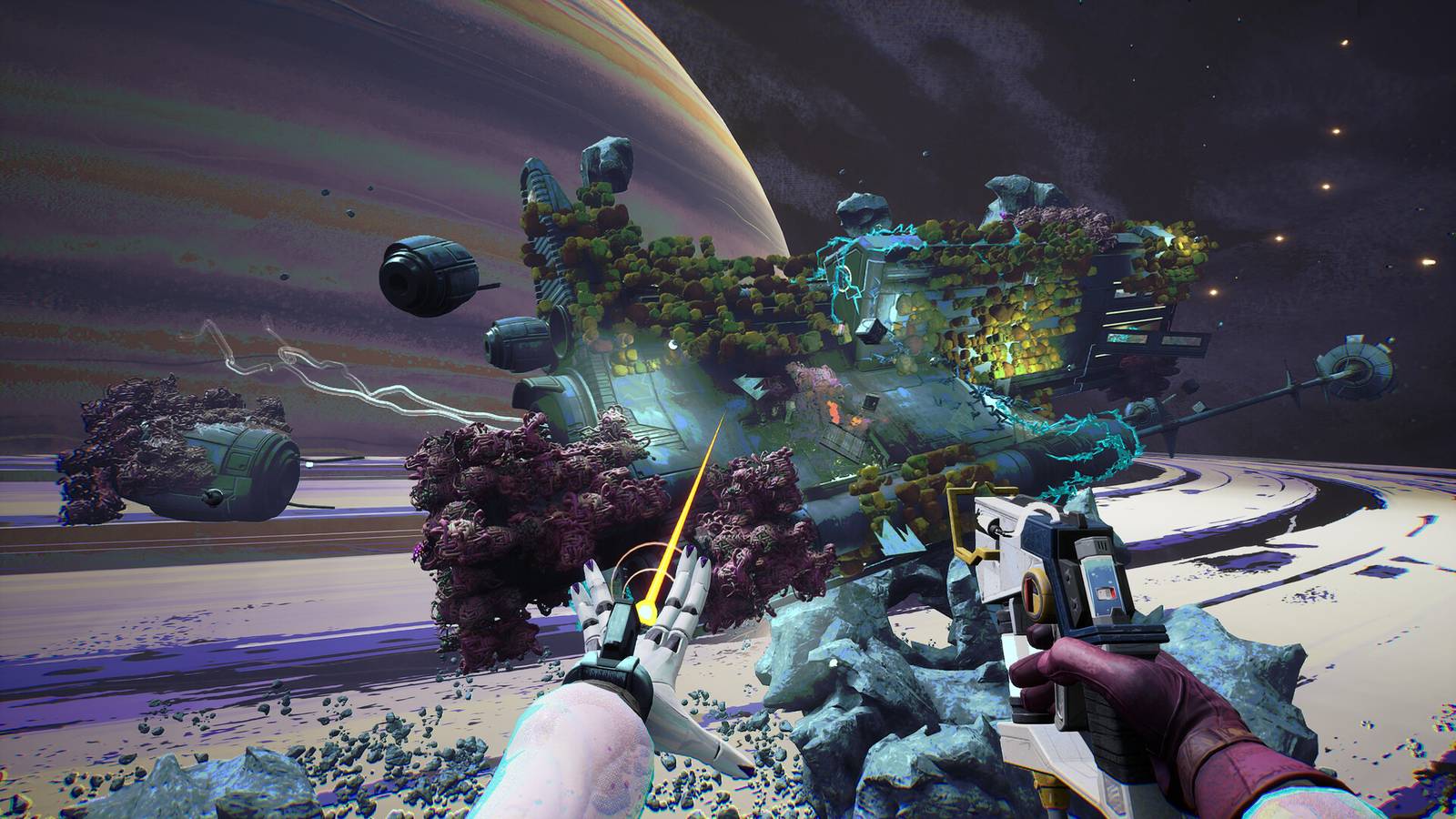
Metroid Prime Meets Powerwash Simulator in Steam’s Weirdest New Sci-Fi Shooter
“Why on earth didn’t they just leave?” Whenever disaster strikes a community, that same incredulous refrain inevitably surfaces. I remember hearing it growing up whenever news reports broadcasted footage of hurricane victims stranded in waterlogged neighborhoods, and again as death tolls surged during the height of COVID-19 outbreaks. Why would anyone remain in the path of mortal peril? Why wouldn’t they simply pack up and get out?
Ambrosia Sky—developer Soft Rains’ fully realized debut following its initial Part One launch—tackles that difficult question with the profound care and nuance it demands. This first-person sci-fi adventure casts you as a specialist tasked with sanitizing the devastating aftermath of an extraterrestrial fungal infestation known as the Cluster, which has ravaged an isolated asteroid colony. Ghostly, abandoned spacecraft are littered with the remains of those who either delayed their evacuation too long or chose to stay behind altogether. To truly comprehend the catastrophe, you cannot judge the deceased from afar; you have to experience the tragedy through their eyes. This deeply empathetic premise drives a moving exploration of human resilience during crises, even if the narrative occasionally loses its footing amid an overabundance of science-fiction subplots.
Originally envisioned as a sprawling three-part episodic journey, Ambrosia Sky wisely abandoned that cumbersome release model for the Part Two update, synthesizing everything into a complete narrative experience. If you bypassed the initial chapter last year, you’re honestly better off waiting for the full package. Though I played through the opening act upon its debut, I chose to restart from scratch to reimmerse myself in its hard sci-fi lore and mechanics, discovering a far sharper, more cohesive adventure—minor flaws notwithstanding. Ambrosia Sky presents a fascinating cross-pollination of Metroid Prime and Powerwash Simulator, tasking you with boarding spore-choked vessels and scouring away the toxic blooms using a high-pressure hydrodynamic tool. Maneuvering is managed via a tether system, occasionally throwing you into disorienting, cavernous zero-gravity environments.
The core gameplay loop that made Part One so inventive translates brilliantly into Part Two. There is a strange, meditative joy in carving sterile pathways through corridors choked in poisonous spores, painstakingly restoring corrupted hulls to pristine condition. Genuine tension arises when you must carefully excise bulbous seed pods to harvest valuable suit upgrades without inadvertently triggering explosive flora that could engulf the room in flames. Part Two even introduces clever mechanical wrinkles, such as corrupted root networks that can only be eradicated by tracking down the pulsing source of the infection.
The standout moments function almost like interconnected environmental puzzles. One memorable sequence required me to float in zero-g around the exterior of a vessel wrapped entirely in fungal webbing. Clearing away enough organic gunk to safely reroute power generators brought back the tense, industrial dismantling thrills of Hardspace: Shipbreaker—the acclaimed 2020 physics simulator born right in the midst of the pandemic era. (Notably, that game’s developer, Blackbird Interactive, lent support to Soft Rains for this final release.) Later chapters dispatch you into labyrinthian starships to hunt down and collect specific organic specimens. These segments represent the decontamination gameplay running at absolute peak performance, contrasting sharply with the occasionally formulaic nature of more linear stages.
Less successful is Ambrosia Sky’s upgrade apparatus, which still feels underdeveloped even with the expanded scope of Part Two. While you can modify your chemical cleanser with specialized electrical or incendiary spray configurations, I rarely encountered scenarios where these alternative tools were genuinely necessary. The game styles itself as an immersive simulator granting you tactical agency over your cleanup methods, yet it rarely presents obstacles that cannot be easily bypassed with the standard water stream. It also introduces a single, repetitive adversary type to spar with, representing a somewhat awkward and superficial nod to traditional combat.
Fortunately, these minor combat shortcomings are easy to forgive because the true beating heart of Ambrosia Sky lies in its deeply reflective storytelling. Your primary directive is to piece together the etiology of the outbreak by sifting through digital correspondence left behind on derelict hulls and extracting genetic markers from the victims entombed beneath the mold. Initially, I found myself slipping into harsh judgment toward those who ignored evacuation orders. *Why didn’t they just leave?* But every discovered data log, personal journal, or recovered memory reframes that inquiry with profound compassion. Some stayed behind to research a cure against all odds; others refused to abandon the sanctuaries they had built. Each unearthed detail strips away the sterile veneer of scientific disaster to reveal the pulsating humanity underneath. The deeper you delve into their reasons for staying, the more insight you gain into the very crisis you are trying to resolve.
Ambrosia Sky is ultimately about clearing away the wreckage while keeping the memories of those we’ve lost at the absolute forefront.
That strong emotional core occasionally gets bogged down by extraneous narrative threads orbiting the main plot. The true narrative anchor, explored much more thoroughly in Part Two, revolves around the protagonist, Dalia. Her lingering guilt over abandoning her home in her youth ultimately becomes the emotional focal point, even as the broader mythology surrounding the Cluster veers into cosmic surrealism. Loose plot threads regarding fringe religious cults and shadowy corporate entities drift in and out of the periphery, struggling to pay off some of Part One’s most compelling cliffhangers. It leaves you wondering if pivotal story beats fell victim to the cutting room floor when Soft Rains restructured its release strategy.
Even if every piece of the fragmented narrative doesn’t snap perfectly into place by the credits, Ambrosia Sky succeeds as a remarkably timely and evocative piece of science fiction. Its themes have only grown more pertinent in the years since Part One’s debut, as our society continues to grapple with the long-term fallout of the COVID-19 pandemic. That historic health crisis has steadily been sanitized and stripped of its human cost, with history rewritten to serve cold political theater. Ambrosia Sky is ultimately about clearing away the wreckage while keeping the memories of those we’ve lost at the absolute forefront. We cannot afford to let complex, breathing lives be reduced to callous, manipulated statistics.
Ambrosia Sky is available now on Windows PC. The game was reviewed using a pre-release download code provided by Soft Rains. You can read more about Polygon’s ethics policy and review standards here.
Source: Polygon
Related articles
 Saber Interactive Releases Patch for Warhammer 40,000: Space Marine 2 Adding Steam Workshop Support
 Cozy Fantasy Shop Cleaning Simulator Attacked by Evil Wizard Released on Steam
 Nikita Buyanov Shows New Containers and Weapons in Escape from Tarkov Teasers
 Rockstar Launches Brand War Event and Bonuses in GTA Online
 Owlcat Games Releases New Teasers for Warhammer 40,000: Dark Heresy
 SCS Software showcases new Atlas POI mechanic in American Truck Simulator gameplay
 The Video Games And More You Should Play This Weekend – August 14, 2026
 Why Kingdom Hearts Deserves an Anime Adaptation After 25 Years