
Unbreakable Deserves More Credit as a Great Superhero Movie

Every time I revisit M. Night Shyamalan’s Unbreakable, I think of Quentin Tarantino naming it among his favorites and describing it succinctly as a Superman film in which the hero doesn’t yet realize he’s Superman — an apt shorthand. Released in 2000, Unbreakable arrived just before Hollywood’s superhero tidal wave and so missed the chance to shape the genre’s mainstream trajectory.
Shyamalan later returned to this universe with Split (2017) and Glass (2019), though the trilogy rarely appears in lists of top superhero cinema — partly because Unbreakable was quietly ahead of its time, partly because Glass disappointed many viewers, and partly because the story isn’t tied to Marvel or DC. Its restrained reimagining of the Superman template, however, deserves to sit alongside the strongest, more conventional superhero films from other studios.
The film centers on David Dunn (Bruce Willis), an unassuming man who emerges unscathed from a devastating train wreck. Elijah Price (Samuel L. Jackson), a comic-book collector whose fragile bones make him David’s physical foil, becomes convinced David is a real-world superhero. As David tentatively explores the limits of his abilities, Shyamalan peels back a grounded mystery about identity, fate, and the tenuous boundary between protector and perpetrator.

Despite being promoted as a psychological thriller, Unbreakable is fundamentally a superhero film. In the wake of The Sixth Sense, the studio pushed for a slow-burn approach and a marketed identity that emphasized mystery — and the movie ultimately preserves a Shyamalanian twist. Shyamalan has said Disney worried the material wouldn’t attract a broad audience if sold as a comic-book picture, so it was positioned more like a thriller. Still, he treated the premise seriously, grounding superhero conventions in a realist register that makes the film feel unusually plausible.
The movie juxtaposes the origin of Elijah Price with David’s discovery of invulnerability, framing the story as a study of opposites — a hero and his mirror-image antagonist whose destinies are entwined. Price, later called Glass, treats comic books with a near-religious reverence: they are cultural artifacts that record larger-than-life figures and validate the existence of extraordinary people. In that way, he embodies a certain kind of devoted fan whose attachment to fictional worlds stems from a need for order and meaning.
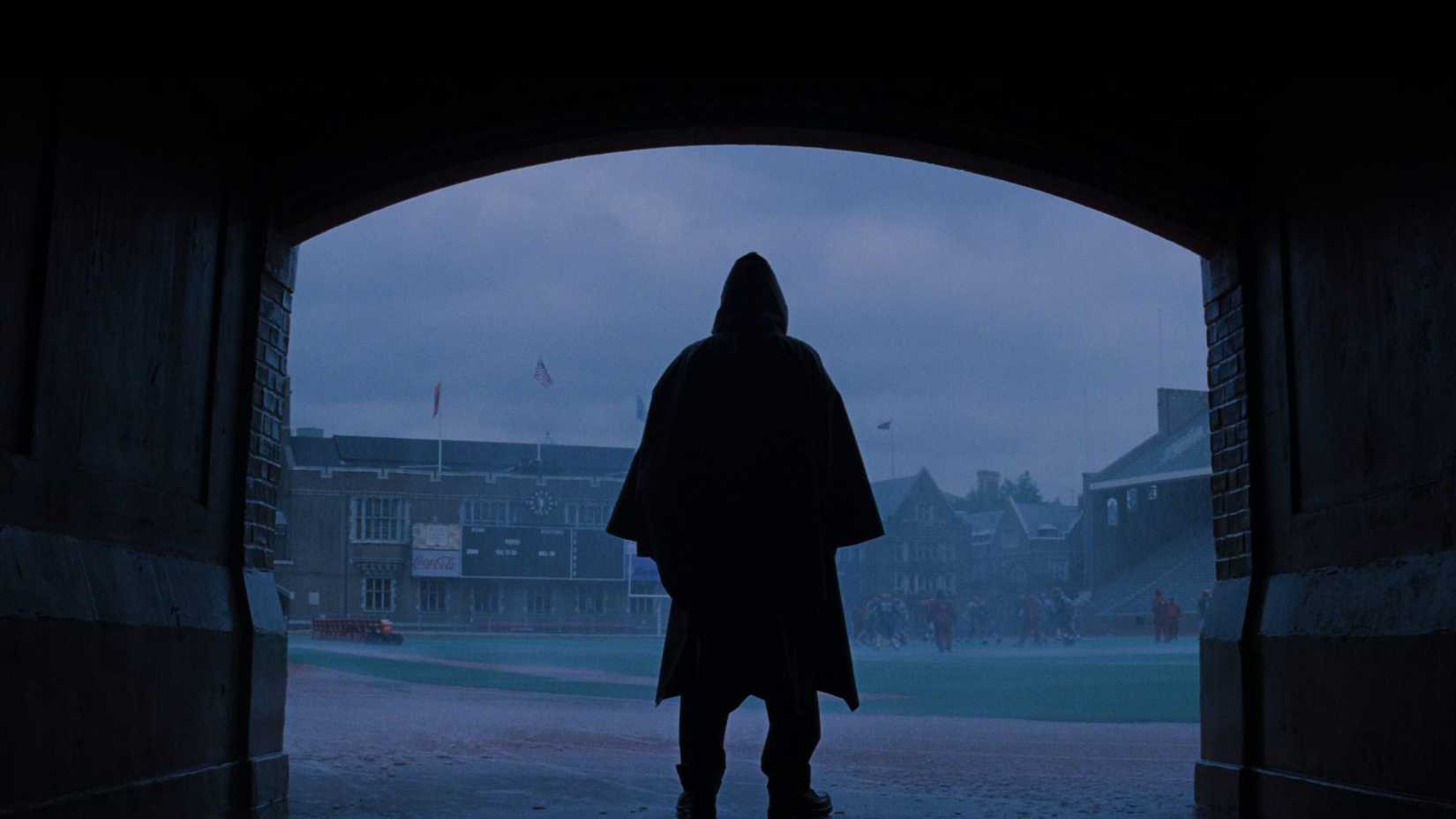
Eduardo Serra’s cinematography offers several memorable compositions, notably the silhouette of David in the raincoat — a visual shorthand that becomes his vigilante uniform throughout the series. That coat functions as a proto-costume: austere, practical, and emotionally resonant. Watching Bruce Willis play a man who bears both strength and fragility can feel especially poignant today; the role foregrounds vulnerability as much as power.
Those quieter beats make the father-son moments particularly affecting. When David’s son, Joseph (Spencer Treat Clark), witnesses his father’s strength — the bench-press scene, in particular — the discovery reads as pure wonder: fear, pride, and astonishment layered into one look. David’s growth in confidence becomes a mirror for the audience’s own investment in his journey.
David’s abilities extend beyond brute force: he perceives malice in others, which prompts him to go on his first patrol. The rescue he performs is raw and unglamorous — improvised, imperfect, and almost entirely without special effects. It’s the human scale of the moment that lands: being a hero, the film suggests, is often about showing up and doing the work when no one else can.
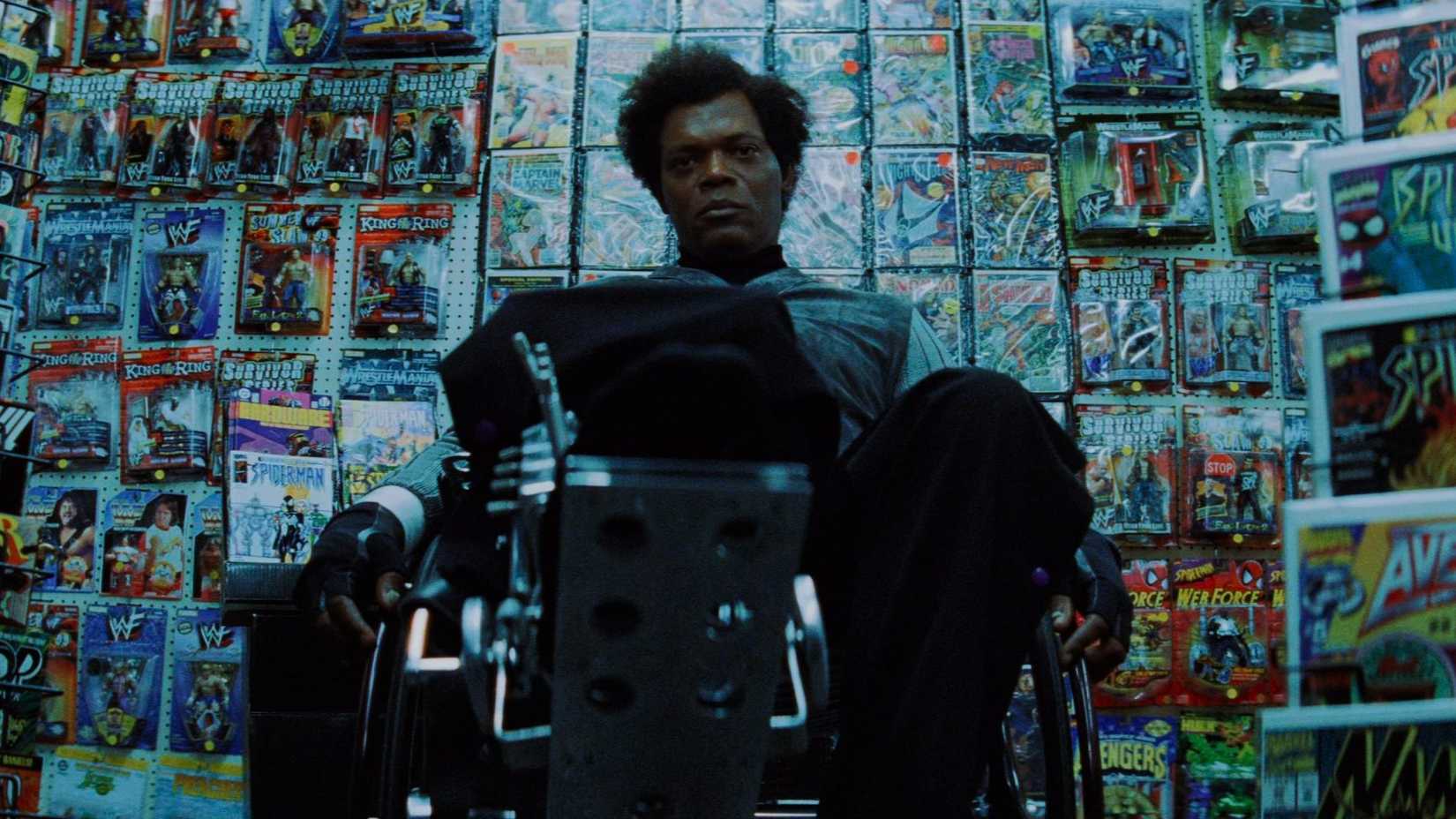
Shyamalan anticipated and refined superhero storytelling long before it became a studio formula. Unbreakable pares the archetype down to essentials: minimal spectacle, sparse effects, and an emphasis on character and consequence. The film uses genre conventions as thematic tools rather than mere ornamentation, and the final revelation — restrained but devastating — still lands as an effective twist that underscores why audiences were captivated by Shyamalan’s early work.
Shyamalan also managed to build a self-contained superhero tale in under two hours without leaning on preexisting intellectual property. For nearly twenty years the film stood alone until Split’s mid-credits scene confirmed a shared continuity, bringing David Dunn back and positioning James McAvoy’s character as a new rival — a move that surprised many viewers in a way rivaling the post-credits culture of modern franchises.
Though Glass left many viewers unsatisfied, time has shown whole cinematic universes can crumble for much less. There’s value in forgiving the trilogy’s weakest installment to preserve the hard-earned admiration for Unbreakable and the singular, quietly ambitious world it introduced.
Quentin Tarantino listing Unbreakable among his favorite films
Why Unbreakable wasn’t marketed as a comic-book movie
Shyamalan on studios’ early reluctance to call it a comic-book picture
Source: Polygon
Related articles
 Actors cast as Dobby and Tom Riddle for Harry Potter season two
 International “Doker” Film Festival Kicks Off in Moscow
 Milla Jovovich to Appear in the New Season of “Hot Rivalry”
 The first excerpt from Zach Cregger’s “Companion” has been released
 “Obsession” Star to Play Waitress in Apple Sci-Fi Series
 Paul Thomas Anderson is working on a new project
 Gal Gadot’s “Heart of Stone” receives scathing reviews
 Netflix and Alfonso Cuarón Developing Dungeons & Dragons Horror Series