
Netflix Fantasy Action Film Ribbon Hero Fails to Live Up to Source Material
Writer and illustrator Osamu Tezuka helped establish many tropes of shōjo manga with his 1953 series Princess Knight. In that story, a cross-dressing princess protects the medieval kingdom of Silverland. Netflix released a very loose anime adaptation called The Ribbon Hero. Yûki Igarashi directed the feature film debut after previously directing the Star Wars: Visions episode “Lop & Ocho.” The new movie is dull and incoherent, focusing so much on paying homage to Tezuka that it ignores what made his original work remarkable.
Tezuka based his androgynous and swashbuckling princess Sapphire on the all-female Takarazuka Revue musical theater group. Igarashi nods to that inspiration by giving his film a theatrical framing. Curtains parting on a stage break the story into multiple acts. The film includes a montage of adventures that Sapphire, voiced by Saaya Kadokura, experiences in her adopted home of Goldland. This montage transitions into an in-world puppet show. The gender-bending elements of her story are cut entirely, apart from some confusing imagery of two racing hearts. That imagery references the source material where Sapphire derives power from possessing both a male and a female heart.
Vague flashbacks show Sapphire’s mother training her hard to survive in a harsh world. Monsters called Nergul attack at random and destroy entire kingdoms. That preparation proves useless when a Nergul destroys Silverland and kills everyone except Sapphire and Zirco, played by Mayumi Shintani. Zirco is an old woman and engineering whiz who acts as Sapphire’s guardian. They wander for seven years begging for food even though Zirco can build bionic arms and laser-shooting swords.
Pine, a kind but friendless baker voiced by Seiran Kobayashi, takes pity on the two women and secures them jobs mining crystals. Another Nergul attacks the mine, causing Sapphire to fall into a pool of water and crystals. Instead of dying like a normal person, she emerges with inexplicable powers tied to her giant hair ribbon, much like a Marvel superhero. This ribbon allows her to undergo a magical girl transformation complete with a new outfit and a laser sword. Sometimes she turns into a swan.
Goldland operates as a theocracy that prohibits fighting back against the Nergul out of fear that it will anger their mysterious boss, the King of Ash. Velvet, the chief enforcer for Goldland’s pope voiced by Koki Uchiyama, wants to change policy and teams up with Sapphire. Monologues deliver vast amounts of dull exposition about the Nergul, their origins, and how to stop them. Characters deliver these speeches against entirely static backdrops while looking at the landscape or sitting inside the Goldland palace. Sapphire is entirely femme, while Velvet presents as female but is voiced by a man and addressed as a man. The film never comments on this dynamic. The immigrant-hating theocracy raises orphans to sacrifice to monsters while maintaining surprisingly progressive gender politics.
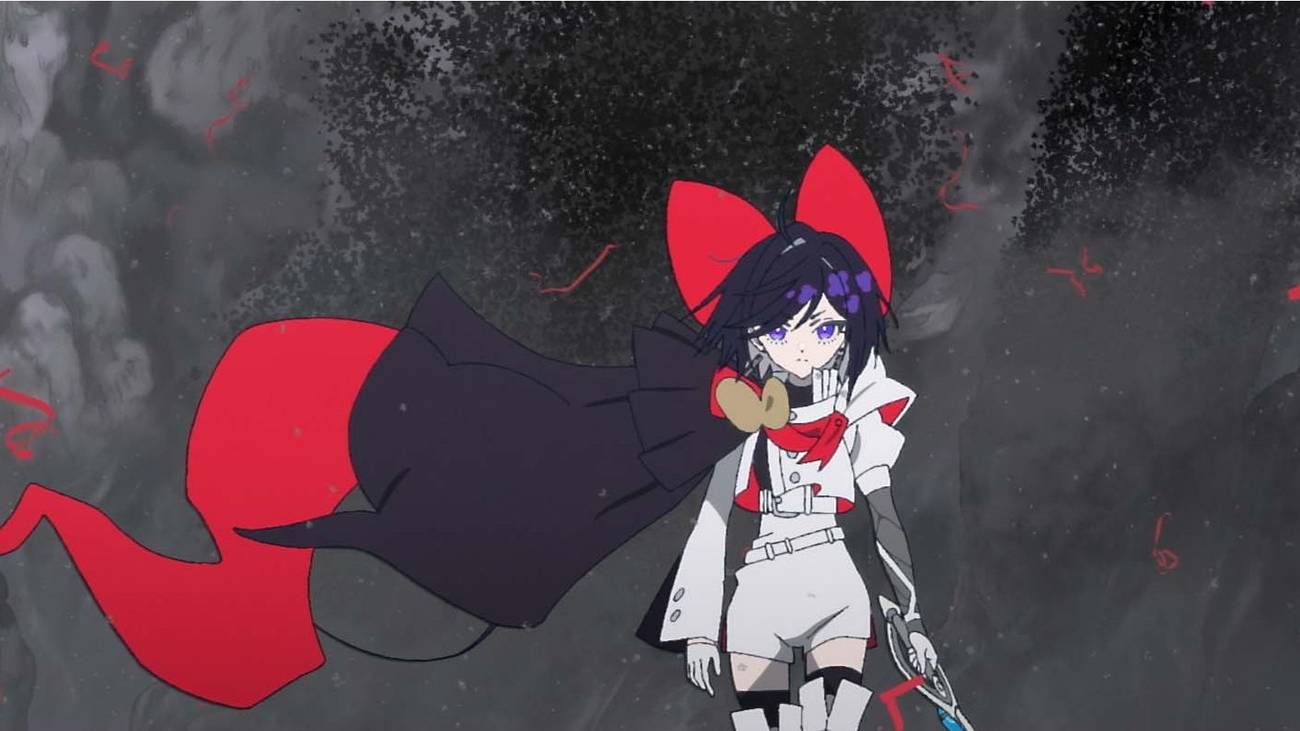
Outline and Twin Engine experiment with multiple animation styles, which ultimately makes the film feel incoherent. Most art features a hand-drawn quality that complements the Disney fairy-tale setting. Repetitive flashbacks depicting Sapphire’s traumatic childhood use black-and-white or sepia tones to mimic old video footage. The Nergul appear as jagged computer-generated models that look alien and very ugly. The movie also features exaggerated anime freakouts, a 1920s-style sequence involving angels, and a live-action segment connecting Sapphire’s power directly to Tezuka’s manga. The production attempts a meta-message about theater, religion, and inspiring art, but trite dialogue and dull action sequences bury those themes.
The most terrifying attribute of the Nergul is their aura of fungal spores, which kills and rots everything in the vicinity. After the first two fights, that element vanishes along with any acknowledgment of why Sapphire is uniquely immune. This disappearance allows Sapphire’s bland allies to pitch in. The tone shifts just as abruptly as the visuals. A demonic monster devours hearts and souls during a religious ritual in one scene, while Sapphire’s friends engage in slapstick battles to retrieve her magical ribbon in the next.
Princess Knight was a controversial and groundbreaking work. Living up to that source material was always going to be difficult, but The Ribbon Hero fails on almost every level. It is pretentious and uninspired, offering only a collection of tropes and confusing cosmology devoid of compelling characters or memorable fights. Anyone curious about Tezuka’s work should skip this adaptation and instead watch anime he inspired, such as Sailor Moon, Revolutionary Girl Utena, or Magic Knight Rayearth.
The Ribbon Hero releases on Netflix on Aug. 8.
Source: Polygon
Related articles
 Sony Reveals Another DualSense Controller Design As Fans Again Demand Games
 Silent Hill: Townfall Receives First Reviews as Horror Game Earns Early Praise
 Spider-Man 5 Reportedly to Feature Peter Parker and Miles Morales
 Crowdfunding Campaign for Origins of Light: A Final Fantasy Board Game Set to Launch in October
 Double Fine Raises $50,000 for Voice Actress Who Agreed to Work for Free
 Why The Greatest Sci Fi Opening Line From The 1950s Still Endures
 DayZ Developers Explain Why Bicycles Were Cut and Motorcycles Added for Badlands DLC
 Demon Slayer Infinity Castle Movie Leaked Release Date Points to September 2027