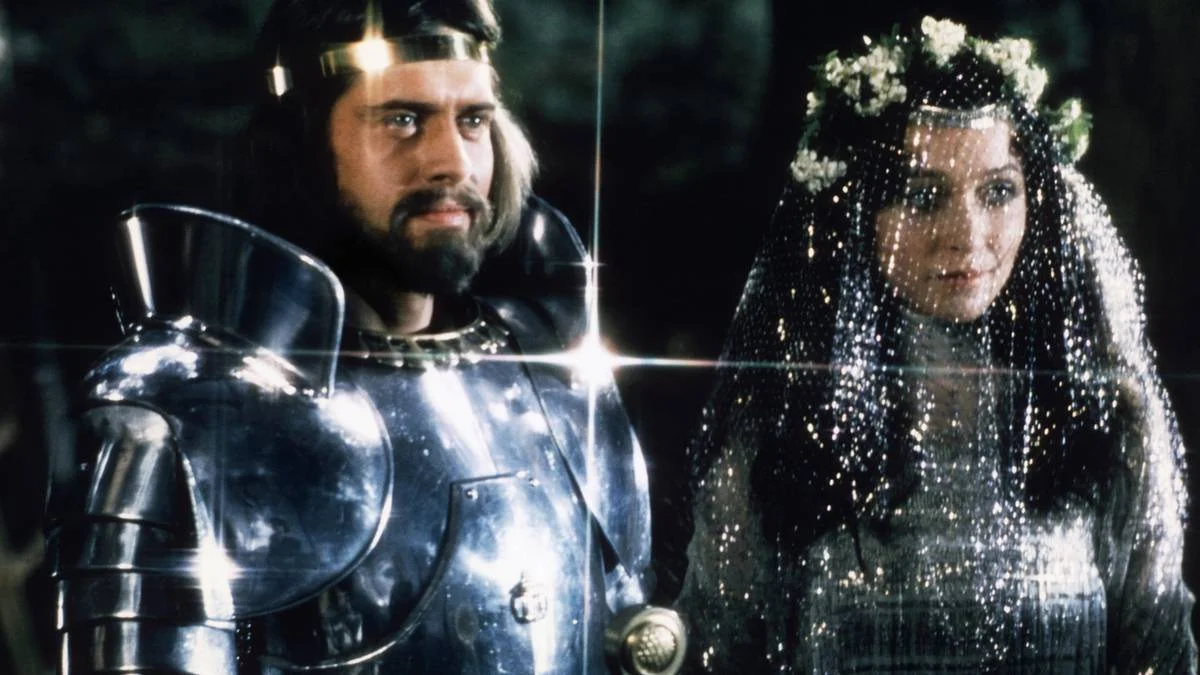
John Boorman’s Excalibur Transcends Fantasy Genre 45 Years After Release
In the late 15th century, a writer named Thomas Malory created Le Morte d’Arthur. His identity remains debated by scholars today. The work compiled legends, chivalric poems, and folklore concerning King Arthur and the Knights of the Round Table. Five centuries later, British director John Boorman adapted that source material into a motion picture. Boorman had previously directed Deliverance and Hope and Glory. His film version remains a milestone in the history of fantasy cinema, although the movie itself defies easy classification. Excalibur is bold, ambitious, and uncompromising. Forty-five years later, the picture stands as a testament to a director presenting his artistic vision to audiences without filters.
As some critics observed, Boorman’s epic can disorient viewers with its disjointed flow and unusual dialogue. Reviewers have criticized the characters for lacking consistency due to frequent time jumps. The plot has also faced accusations of lacking dramatic intensity. Yet these qualities stem from deliberate artistic design rather than incompetence. Excalibur feels closer to a stage play than a standard film. Every scene functions as a set piece or a tableau where fragments of the Arthurian world come alive. The movie does not attempt to tell a story in the traditional sense. Instead, the production achieves something few works of visual media manage: telling an actual myth.
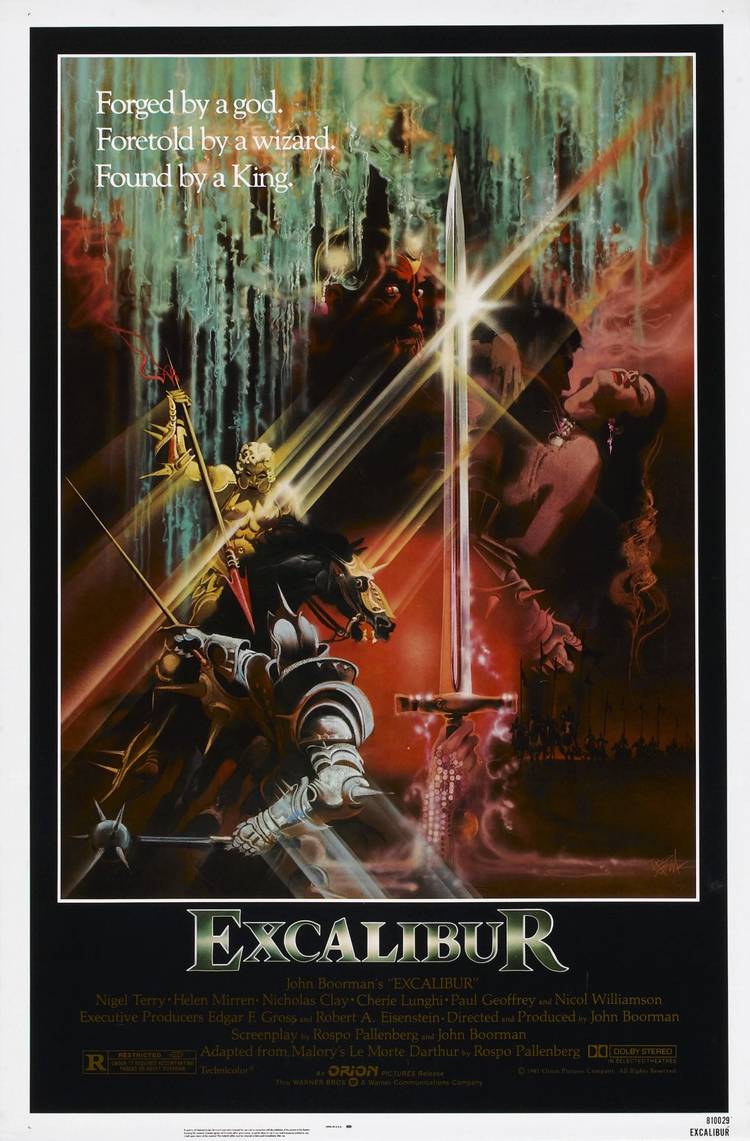
Much like Homer’s Iliad and Odyssey, Malory’s Le Morte d’Arthur collated centuries of evolving myths. Homer relied largely on an oral tradition, whereas Malory drew from extensive written sources. These efforts to record myths into narratives allowed ancient stories to survive. However, myths from both the Mycenaean civilization and the European Early Middle Ages express themselves in ways fundamentally different from modern narratives. Any attempt to translate myths into cinema must respect that distinction. John Boorman and co-writer Rospo Pallenberg understood this challenge.
Excalibur looks and sounds like a myth, drawing heavily from mythographic works. When King Arthur falls ill in the movie, the land withers and weeps. This imagery originates from the Fisher King figure in Arthurian legend. The connection between a monarch and the earth reaches back much further, a concept explored in James George Frazer’s comparative mythology study The Golden Bough. Frazer’s work heavily inspired Excalibur, likely more so than Malory’s text. As Boorman stated in an interview with journalist Harlan Kennedy in 1981, the film addresses mythical truth rather than historical truth. Discussing the setting, Boorman added that he was placing the story in an imaginative realm comparable to J.R.R. Tolkien’s Middle-earth.
That reference holds significance. According to Boorman’s memoirs, Adventures of a Suburban Boy, Excalibur initially began as an adaptation of The Lord of the Rings commissioned by United Artists. Boorman and Pallenberg wrote a full script before United Artists canceled the project due to high costs. That earlier effort later resurfaced as an animated movie directed by Ralph Bakshi.
Boorman eventually returned to an earlier concept for a film about Merlin. When that project secured funding, he reused much of the imagery and set design originally conceived for The Lord of the Rings. Boorman explained in his 1981 interview that the setting forms a contiguous world, similar to ours yet distinct. He sought a primal clarity where human emotions, nature, and landscapes feel fresh. This visual clarity gives the movie its unmistakable aesthetic. The knights and dames in Excalibur appear as though they stepped out of Pre-Raphaelite paintings. They are simultaneously tempting and imposing, erotic and heroic. Greenery and light frame these characters continuously, with light serving as the most crucial element in the film.
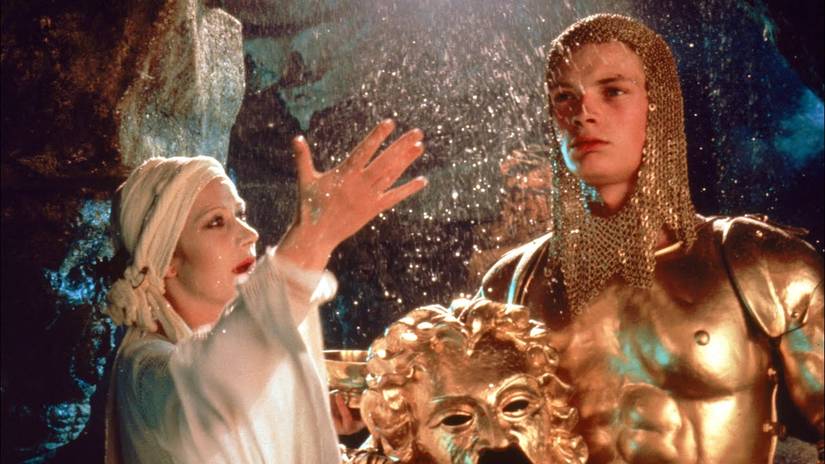
In a brief essay, art historian Jean-Marc Elsholz analyzed Excalibur through the lens of a theology of light running through the Arthurian cycle. The glimmering green light visible on armor and on the surface of the lake represents a reflection of divine light. Yet the God of Excalibur departs from the traditional Christian God of Arthurian literature. Boorman recognized the power of myth to transform across eras. In the movie, the Celtic Sacred King, the Arthurian Fisher King, and the Holy Grail all converge into King Arthur. When Perceval completes his quest, he discovers the secret of the Grail, and the cup is replaced by the image of the King. The religious icon transforms from a symbol of Christianization into a representation of political authority, which previously fueled interpretations of the film as a Thatcher-era conservative apology.
Excalibur’s legacy lives on
Decades after its release and the arrival of later fantasy franchises, Excalibur remains recognized for anticipating an era of sword-and-sorcery cinema, despite having little in common with standard genre tropes. The film’s deep conceptual roots also make it a frequent subject of academic study. Above all, Excalibur deserves celebration for its cinematography and composition. Memorable examples include Arthur finding Lancelot and Guinevere in the forest and leaving Excalibur between their sleeping bodies, alongside the final ride of the Knights of the Round Table, where spring returns to the kingdom accompanied by Carl Orff’s Carmina Burana.
Myths carry meaningful symbolism across generations through powerful imagery, and Boorman’s ambitious adaptation of King Arthur’s tale endures through the strength of its visuals.
Excalibur is available to rent on Prime Video and Apple.
Source: Polygon
Related articles
 Rumor: AMD is Developing New Ryzen Z3 Chip for Gaming Handhelds
 PlayStation Creator Cites Modern Gaming Industry Problem
 Warner Bros. New Owners Will Retain DC Studios Leadership, Keeping James Gunn Safe
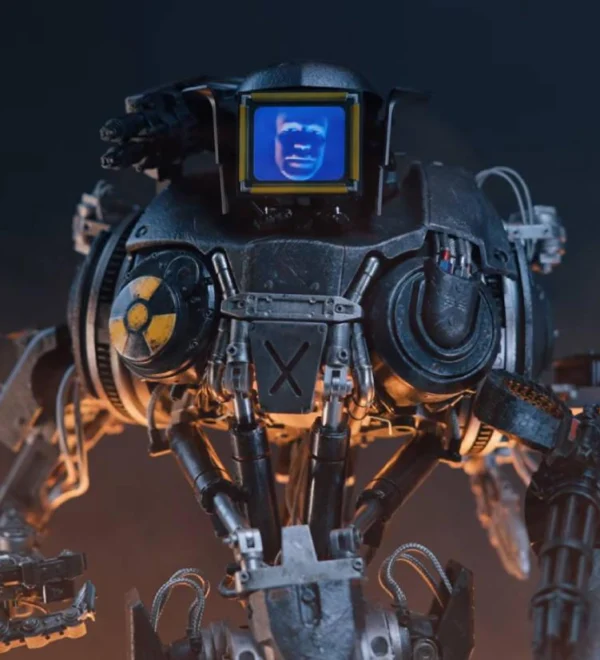 Hot Toys Adds Interactive Tech to Robocop and RoboCain Figures From Robocop 2
 Creator of Heroes 3 Plays Remake and Shares Feedback
 Dead by Daylight Announces Collaborations with Diablo IV and Stranger Things in VHS-Style Trailer
 Sicario 3 in Development with Taylor Sheridan Writing Script
 Guide to the Best Dimension 20 Seasons for New Viewers