
Does the Dog in “Good Boy” Die? Director Explains the Ending and the Film’s Meaning

Good Boy has quietly emerged as one of 2025’s most surprising indie successes. Ben Leonberg’s haunted-house film — which features his own Nova Scotia Duck Tolling Retriever, Indy — pulled in over $2.25 million its opening weekend on a roughly $2.3 million production budget, and has been met with generally favorable notices on aggregators like Metacritic. Part of the film’s buzz stems from ongoing conversations about its ambiguous final moments.
Marketing for the picture leaned on a simple, emotionally resonant promise: viewers want to know whether the dog survives. That impulse — the need for reassurance about Indy’s fate — helped the movie spread by word of mouth. Leonberg, who also cares for Indy in real life, spoke with Polygon to explain his take on the film’s ending and to shed light on what those closing scenes mean.
Spoiler warning: The following discusses the ending of Good Boy.

Good Boy traces the relationship between Indy and his owner Todd (Shane Jensen) after they leave urban life for the isolated farmhouse of Todd’s late grandfather. Indy soon begins to sense unnerving phenomena — darkness that clings to corners, noises that humans cannot place, and presences that slip just outside human comprehension. As Todd grows weaker and increasingly unhinged, Indy’s devotion is tested in ways neither animal nor owner expects.
When Todd finally falls victim to the house’s malign influence, he is carried down into the basement and Indy follows. The dog tries to pull Todd back, but Todd is consumed by a spreading black substance. Covered in that goo, Todd murmurs that Indy is a “good dog” and insists he “can’t save him” before collapsing into something like a skeletal husk and vanishing into the darkness. Indy is left whimpering, trapped below with the basement doors shut and no apparent escape.
Moments later, the next scene reveals Vera — Todd’s sister — opening the basement doors as she searches for her brother and his dog.
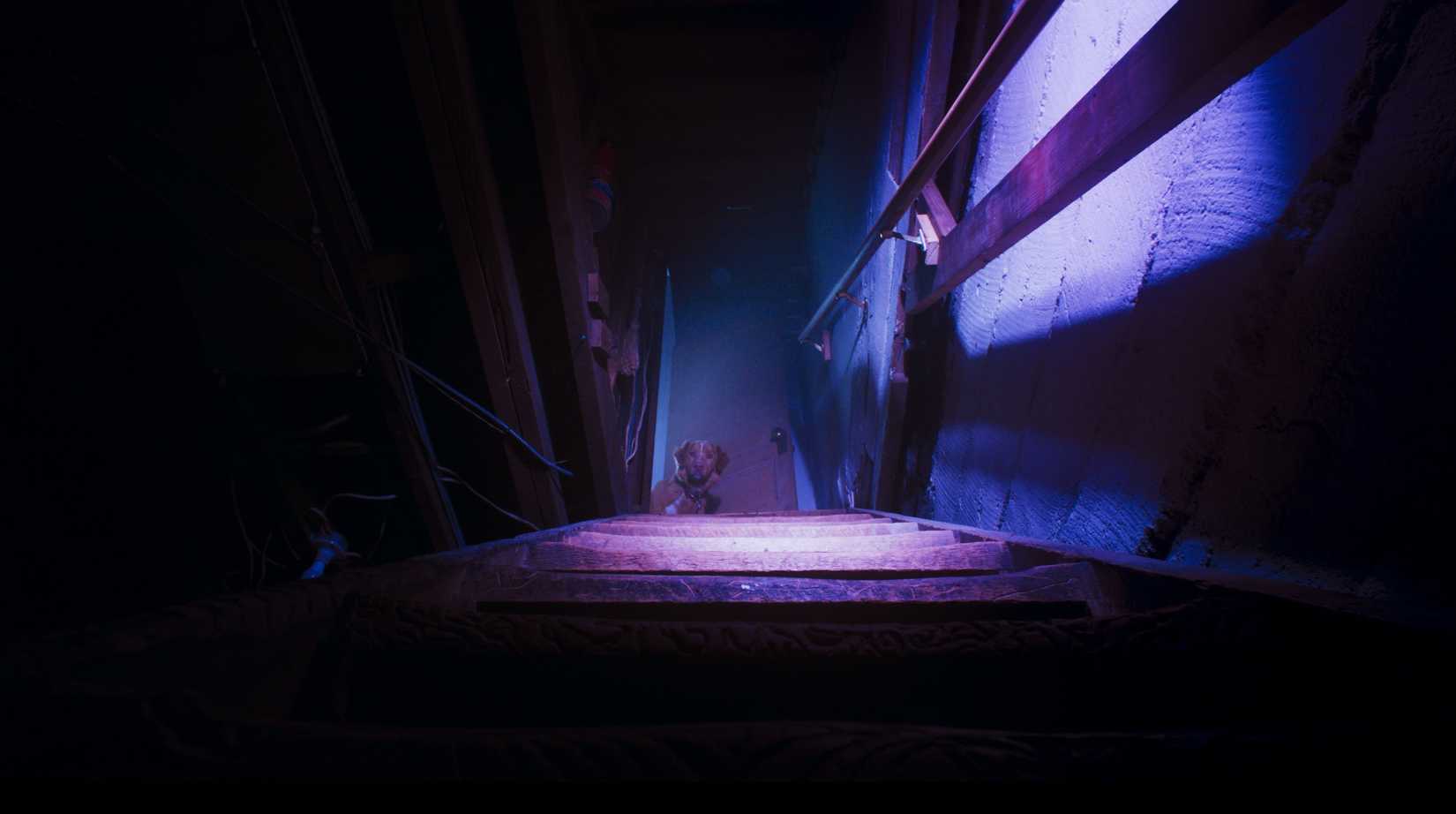
Leonberg frames that sequence as a pivotal decision point for Indy: remain in the darkness with his lost owner, or accept the chance to leave with Vera into a life beyond grief. “With the sister showing up, it’s the final choice: ‘Do I stay in the darkness, or do I go into the light?’” he says. “Ultimately, he chooses to go to the light… I always look at it as a happy ending — that there’s more life ahead for Indy’s character.”
On a thematic level, the film positions that choice as an embrace of life over surrender. The grandfather’s own supernatural demise — and the fate of his dog — echo Todd’s fate, and Indy’s decision to go with Vera undoes the pattern that trapped the previous generation’s companion. By shifting the haunted-house perspective to a dog, Leonberg also upends genre expectations: instead of centering human grief and cognition, the film imagines what loss and danger look like through an animal’s sensibility.
“This story is an inversion of how most people learn about death,” Leonberg explains. “[Good Boy] just imagines the shoe being on the other foot. What would it be like for a dog who is sensing an ever-growing, closer and closer, invisible, dark force? What would that story be like for them?”
Source: Polygon
Related articles
 Lilly Wachowski disavows involvement in the new “Matrix” film
 Kane Parsons to Return to The Backrooms
 First Emmy Award Winners Announced
 Robert Pattinson calls ‘The Batman’ sequel ‘radical’
 A24 to release documentary on Elizabeth Holmes
 Nolan’s “Oppenheimer” Surpasses “Spider-Man” at the Box Office
 Natalie Portman Becomes a Mother for the Third Time
 Zach Cregger Will Not Direct Franchises After “Resident Evil”