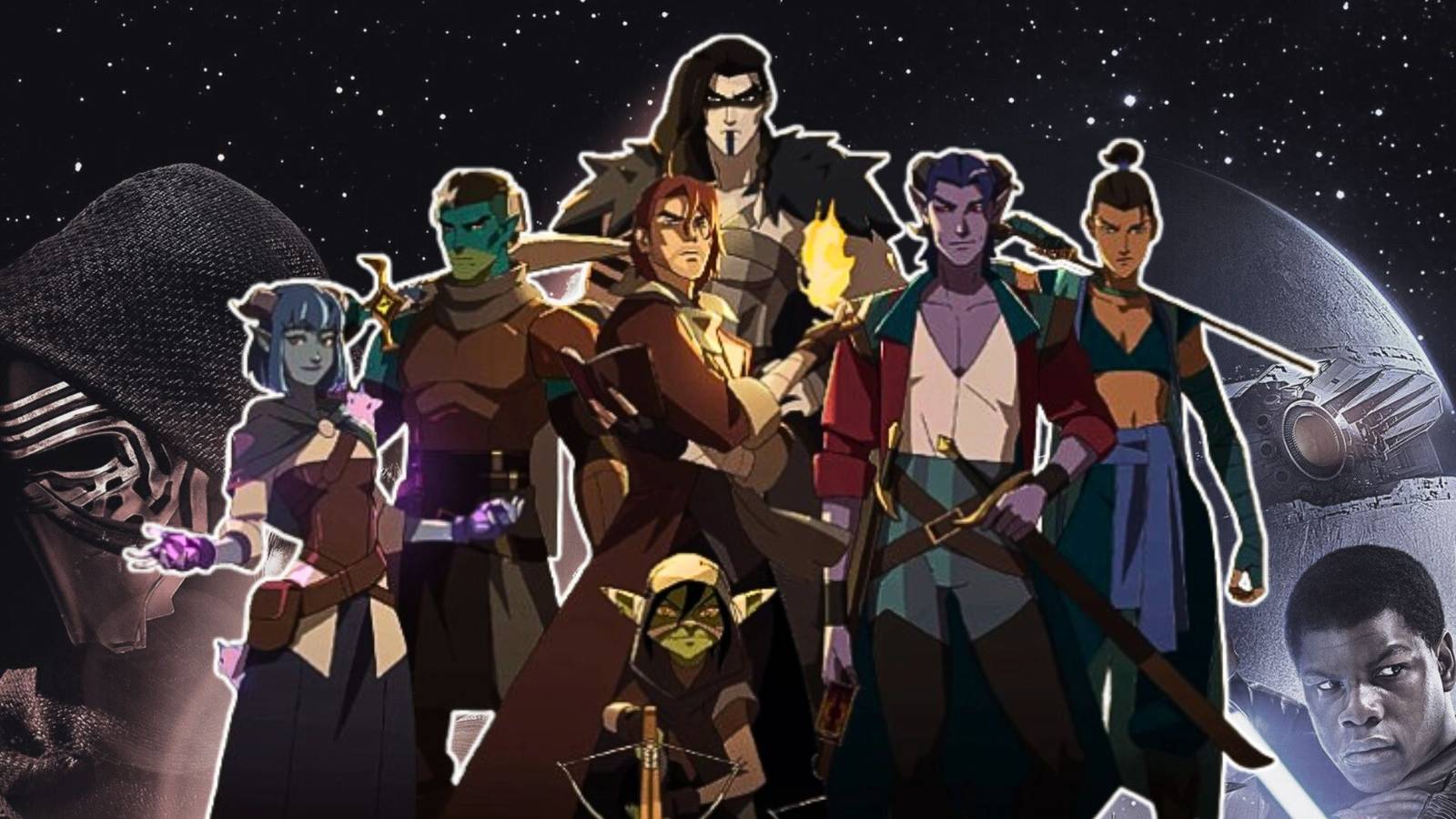
Do the Mighty Nein Have a Star Wars Problem?

The first three episodes of Critical Role’s new animated adaptation, The Mighty Nein, have arrived, presenting a condensed and reworked version of the troupe’s sprawling 100+ hour second campaign. After watching season one in full, it’s apparent the showrunners intentionally reshaped key moments and relationships from the original live-play material — choices that, intentionally or not, draw echoes of another beloved franchise: Star Wars.
Ed note. Spoilers ahead for The Mighty Nein episodes 1–3 and Critical Role’s Campaign 2.
On balance, the alterations largely benefit the series. Critical Role’s tabletop episodes typically run three to five hours each, which makes a direct one-to-one translation to a half-hour or hour-long animated format impractical. To streamline the narrative, the adaptation adjusts origins and early connections: characters’ backstories are tightened, some meetings are re-situated, and certain relationships are established differently to suit a serial television pace.
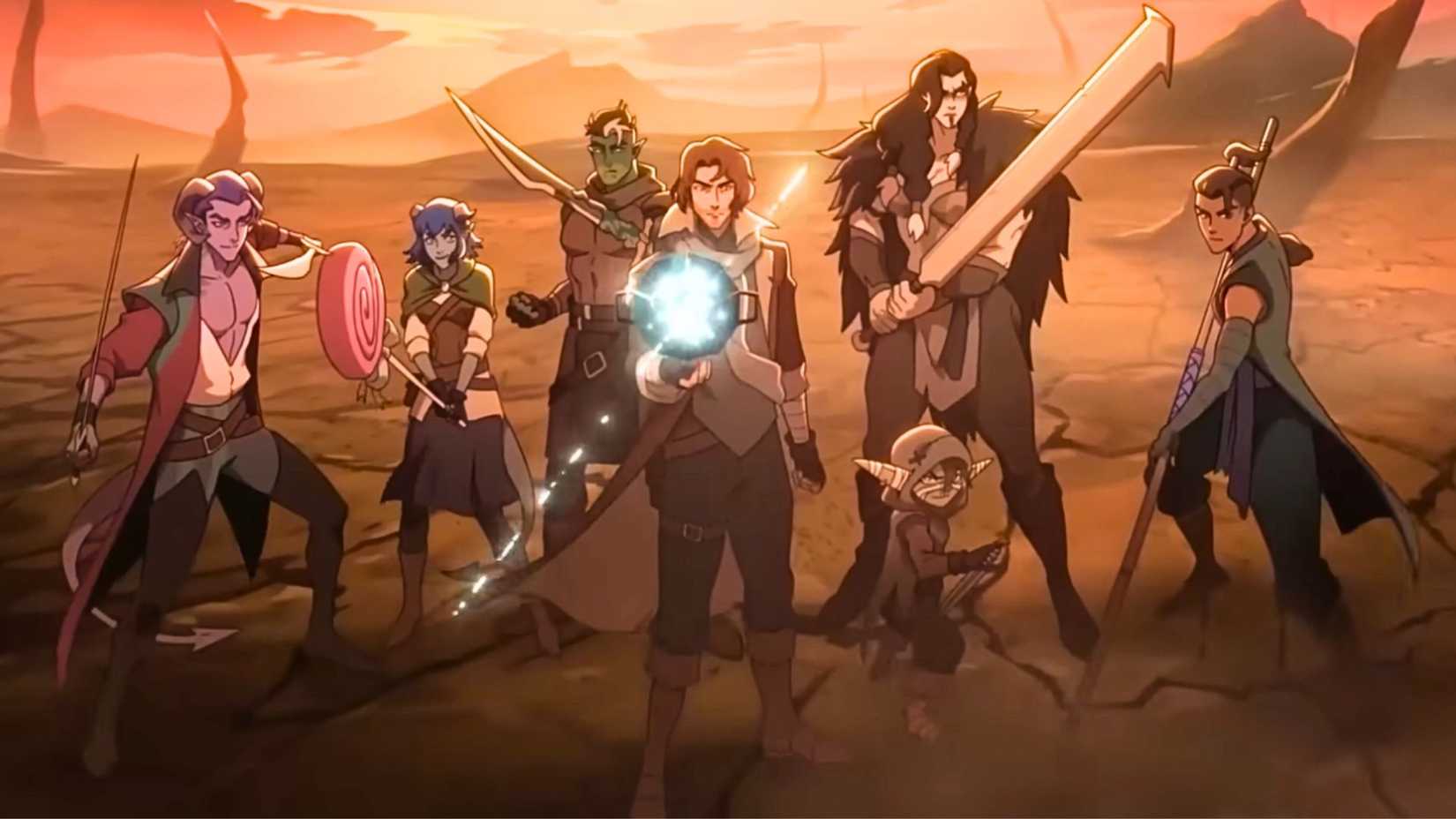 Image: Prime Video
For example, Beauregard Lionett (Marisha Ray) begins her arc alone as a Cobalt Soul operative working with Daeron (Ming-Na Wen) to expose corruption in the Dwendalian Empire, rather than debuting alongside Fjord Stone (Travis Willingham) and Jester Lavorre (Laura Bailey). Caleb Widogast (Liam O’Brien) and Nott the Brave (Sam Riegel) are introduced through a bungled theft instead of meeting in a prison cell, and Mollymauk Tealeaf (Taliesin Jaffe) appears disengaged from Yasha Nyo’orin (Ashley Johnson), contradicting their established bond in the original campaign’s opening episodes.
Those changes produce a tighter, more coherent storyline: we see character histories more clearly and watch mistrust and differences slowly give way to genuine found-family dynamics. But they also complicate a thornier question for fans: which account should be treated as the definitive version of The Mighty Nein’s story — the animated series or the long-form actual-play campaign?
Complicating matters further is Critical Role’s frequent habit of revisiting and remixing characters across formats. Members of Vox Machina and The Mighty Nein have resurfaced in Campaign 3 and in one-shots; Jester and Fjord even celebrated a live wedding at Radio City Music Hall. The cast sometimes swaps roles mid-episode or combines characters from different campaigns into a single session, so these figures keep appearing in new contexts. That fluidity is what makes this situation resemble the debate once central to Star Wars fans over Legends versus Canon.
 Image: 2025 Amazon Content Services LLC
To put the parallel in context: Star Wars Legends encompassed decades of novels, comics, games, and animated projects produced between roughly 1976 and 2012. After Disney acquired Lucasfilm and reshaped the franchise, much of that Expanded Universe was relabeled Legends and separated from the new unified canon, which led to occasional retcons and continuity adjustments as new films and shows were commissioned. Coordinating many creators and corporate goals inevitably produces contradictions.
In 2025, Critical Role finds itself navigating a smaller-scale version of that same tension. The Mighty Nein’s world now exists in two distinct incarnations — the original actual-play campaign and the newly streamlined animated series — each telling overlapping but not identical stories.
 Image: Prime Video
Yasha’s arc exemplifies the divergence. Ashley Johnson’s intermittent availability during Campaign 2 limited how much the live game could explore her storyline early on; when she returned full-time, there was room to expand the character. The animated series gives Yasha a largely separate thread that runs alongside the others before converging, altering how her bond with Beau develops compared with the campaign. Fans who found Beau and Yasha’s romance in the live-play moving but uneven may see it handled differently here — and only time will tell if that reshaping succeeds.
This isn’t a wholesale reboot. Critical Role clearly values its tabletop origins, and it’s unlikely the company will treat one format as superior to the other. More plausibly, the actual-play sessions and the TV adaptations will coexist as parallel interpretations of the same material, each with its own continuity. For devoted lore hounds who prioritize a single, consistent canon, that multiplicity will make things more complicated — but it also means there are more ways to experience these characters and their stories.
Source: Polygon
Related articles
 Filming for the Ocean’s Eleven prequel has begun
 Johnny Depp’s ‘Ebenezer’ receives high scores at test screenings
 Hollywood Prepares for the Third Installment of Denis Villeneuve’s Sicario
 The New “Narnia” Will Be One of Netflix’s Most Expensive Projects
 New Cameron Diaz Film to Be Released in December
 “Obsession” Has Grossed $500 Million
 “Spider-Man: Brand New Day” Eyes Historic Record
 National Treasure 3 Officially in Development