
What the 2025 Reimagining of The Hand That Rocks the Cradle Does Better — and Worse — Than the 1992 Original

The early 1990s felt saturated with domestic paranoia — films that turned ordinary homes into sites of menace. After the likes of Sleeping with the Enemy and Cape Fear, 1992 alone handed audiences a string of paranoid thrillers: Single White Female, Basic Instinct, Unlawful Entry, and, most notably, The Hand That Rocks the Cradle. Now the latter has been officially reimagined for 2025. It’s a timely choice for reinvention, but the new version repeatedly teases sharper, more unsettling possibilities before retreating from them.
In the 1992 original, Peyton Flanders (Rebecca De Mornay) fixates on Claire (Annabella Sciorra), Claire’s husband Michael (Matt Bartel), and their children — not merely to work for them, but to replace Claire and appropriate the family life she perceives as rightfully hers.
Peyton’s fury has a detailed origin: Claire’s complaint of sexual misconduct against Peyton’s husband, Victor Mott, destroyed his career and precipitated his suicide. The trauma of those events induced premature labor, causing Peyton to lose her child; her grief and rage are directed squarely at Claire. The film doesn’t bury this motive — it opens by laying it all out.
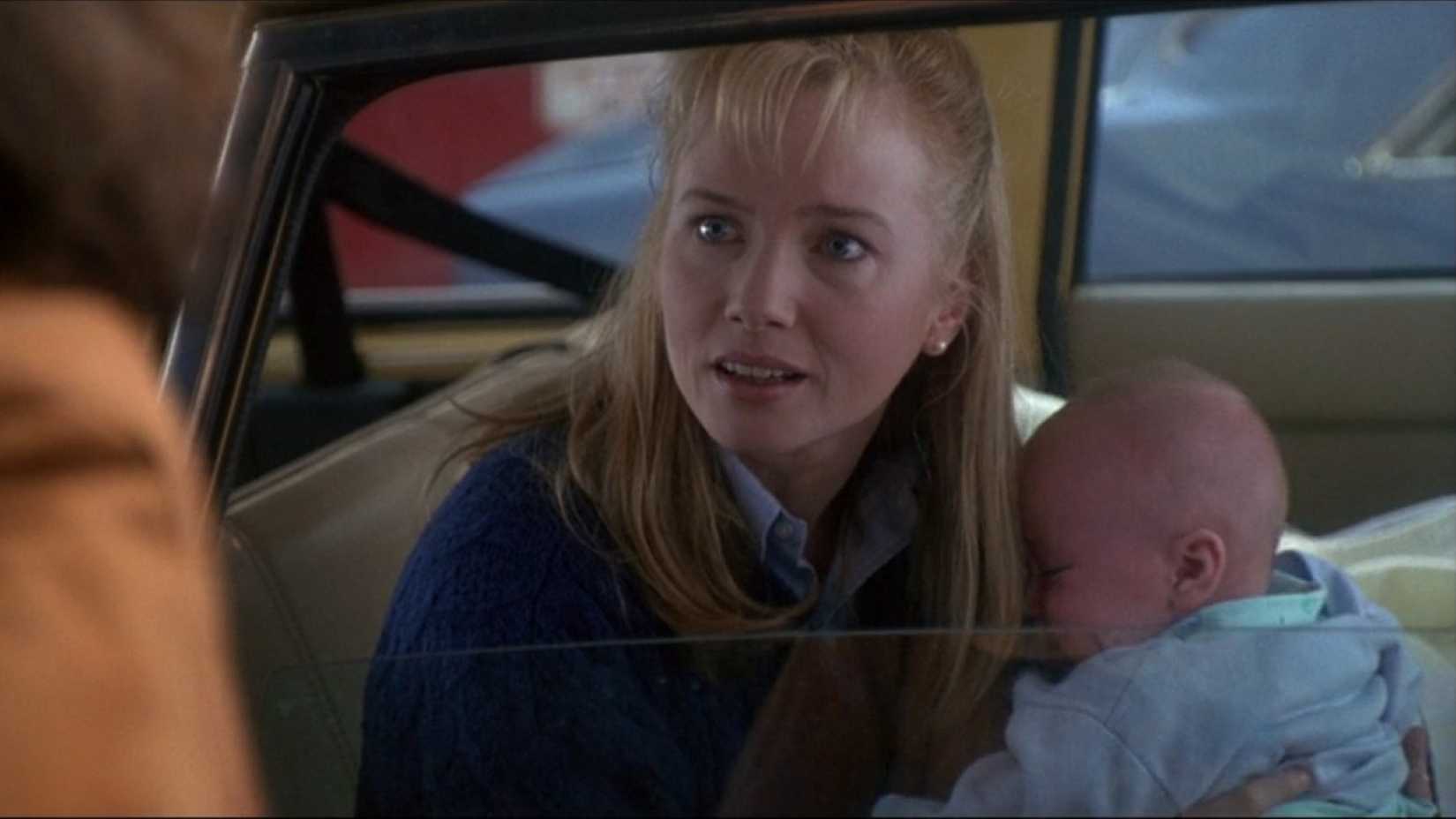 Image: Disney
Despite its commercial success, the original often feels oddly defanged. Because Peyton’s vendetta is disclosed upfront, viewers spend little of the film’s runtime in anxious identification with her perspective — the story lacks sustained ambiguity about motive or method. There are undeniably chilling moments, like Peyton clandestinely nursing Claire’s baby, but much of the film substitutes overt plot mechanics for psychological menace. Peyton’s objective reads more like appropriation than annihilation, so the sense of imminent, escalating danger is muted.
That gap suggests room for a retelling that probes the interior anxieties of domestic life more incisively. The 1992 picture traffics in a specific home‑invasion fear: an attractive outsider encroaches on a settled housewife’s role, threatening to make the labor and authority that sustain family life invisible. That premise has fertile psychological ground to explore.
Yet the original often externalizes its conflict into discrete acts of sabotage rather than lingering on the erosion of identity. Claire’s threat is dramatized through tampered inhalers and other plot devices, rather than through a prolonged disorientation about what it means to be displaced within one’s own household. Michael’s marriage appears untroubled except for Peyton’s machinations; Peyton is presented as radiantly alluring yet never a credible rival, and she ultimately sits somewhere between pitiable and monstrous without ever reaching either extreme convincingly.
 Image: 20th Century Studios
The 2025 reimagining reverses that tendency and centers its unease inside the family. Caitlyn (Mary Elizabeth Winstead), who stands in for Claire, is a lawyer on leave trying to juggle a 10-year-old, Emma (Mileiah Vega), and an infant, Josie. She is fastidious to the point of exhaustion — glass bottles only, exclusively breast milk, strict rules about solids and sugar — and those exacting standards turn routine errands into ordeals.
Caitlyn hires Polly (Maika Monroe) after meeting her through a tenants’-rights initiative run by Caitlyn’s law firm. Polly’s caregiving résumé and her ability to mirror Caitlyn’s moral fixations on microplastics and dietary purity make her an alluring, seemingly perfect hire. Before long, Polly becomes the family’s live‑in nanny.
Monroe’s Polly reads less like an archetypal, cartoonishly evil interloper and more like someone calibrated to unsettle: grounded, quietly invasive, and liable to undermine trust without overt spectacle. Winstead matches that complexity with a performance that makes Caitlyn less an innocent victim and more a layered, sometimes prickly parent. Director Michelle Garza Cervera (Huesera: The Bone Woman) and screenwriter Michael Bloomberg frame Caitlyn as a conflicted figure — a parent negotiating professional identity, moral certitude, and the constant dread of falling short.
This remake often resembles the psychological posture of Scorsese’s Cape Fear rather than a straight domestic thriller. In Scorsese’s film, Max Cady acts as a dark mirror to Sam Bowden’s moral compromise; similarly, Caitlyn harbors a late-unspooled secret that complicates any tidy reading of victim and perpetrator. Polly’s calculated acquiescence to Caitlyn’s rules — and her later, private subversions of them — threaten Caitlyn’s sense of competence, turning common parental anxieties into a persistent, personified dread.
The film also probes the fissures of intimate life. When Caitlyn mentions a prior relationship with a woman, and Polly casually reveals she is dating another woman, that history lingers in subsequent interactions. Polly’s rapport with Emma — including conversations about the girl’s own sexuality — provokes defensiveness and sharp reactions from Caitlyn, exposing tensions about identity, boundaries, and who gets to shape a child’s understanding of themselves.
On paper, the 2025 Hand That Rocks the Cradle is bolder than its 1992 predecessor: it engages sexuality, parental guilt, and role performance with greater sophistication. It’s neither as lurid as Single White Female nor as erotically explicit as Basic Instinct, nor is it the pure suspense of Unlawful Entry — but its characters and dilemmas feel smarter and more contemporary than many of that earlier era’s thrillers.
 Image: Disney
Where the original offered little more than a surface-level moral — someone comfortable can be made afraid by someone desperate — Cervera’s remake tries to dig deeper. It articulates fertile questions about mothering, culpability, sexuality, and gender performance, and those threads make the film intellectually richer than its source material. Still, many of those ideas remain episodic rather than woven into an emotionally coherent throughline that lingers after the credits.
There are sequences that hint at the film breaking toward a rawer, more transgressive climax — moments when Monroe and Winstead appear ready to shred the polite veneer. Instead, Cervera frequently reins the impulse in, seeking a tone that registers empathy without fully embracing provocation. She avoids the kind of grotesque, iconic image the original produced — that notorious fence scene — and concludes the story with an ambiguity that sometimes reads like an evasive shrug rather than a deliberate choice about consequence.
Ultimately, the remake’s preoccupation with Caitlyn’s efforts to micromanage her household — shielding her child from sugar and plastic until the outside world inevitably intrudes — captures a contemporary version of home‑invasion anxiety. Polly’s small, corrosive interventions feel less like a takeover than like magnified reflections of fears Caitlyn already harbors. It’s a persuasive premise, and the filmmakers aim for nuance, but their restraint often turns potential upheaval into tidy resolution: complicated feelings, folded and put away.
Source: Polygon
Related articles
 Zach Cregger Will Not Direct Franchises After “Resident Evil”
 The Rolling Stones to Receive a Biopic
 “Spider-Man: Brand New Day” breaks all-time US record
 “Prime Time” starring Robert Pattinson receives critical reviews
 Robert Pattinson Responds to Chris Hansen’s Complaints About the Movie “Primetime”
 Ryan Reynolds’ “Mayday” receives positive reviews from critics
 Michael Keaton to Direct Western Starring Morgan Freeman
 “Daddy’s Daughters” wedding sequel to be released in 2027