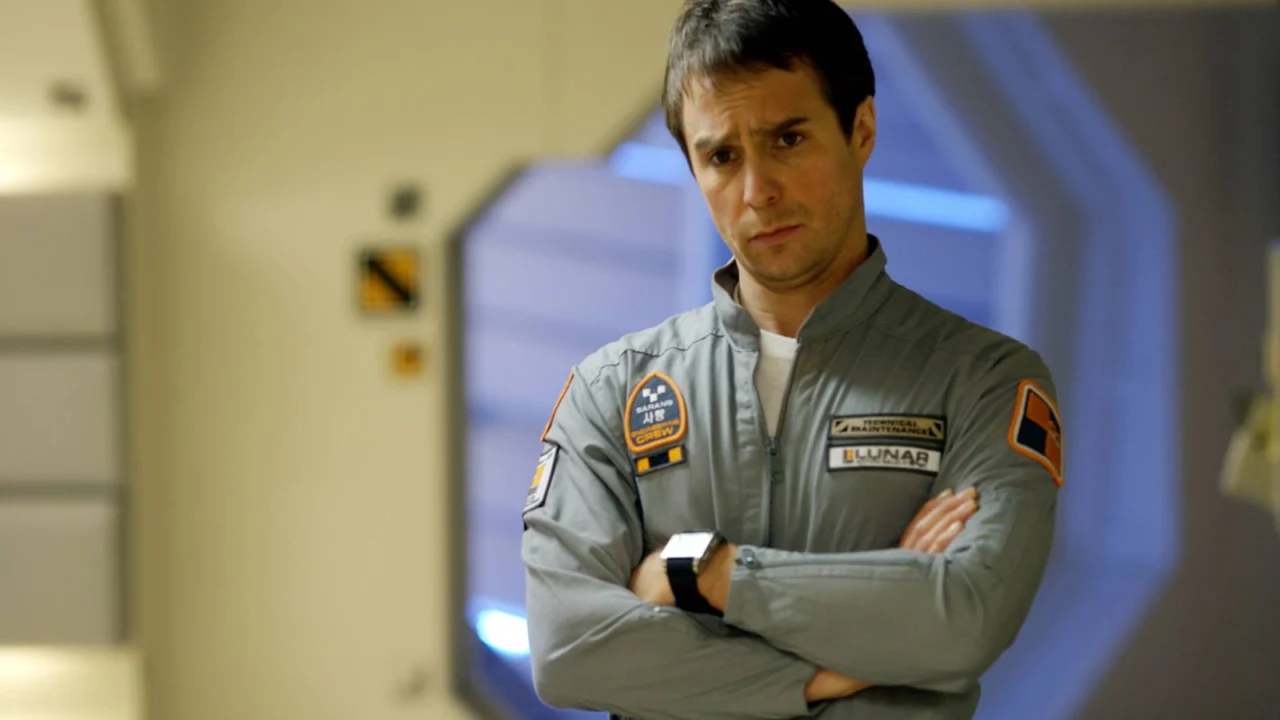
Sam Rockwell’s Best Sci-Fi Movie Remains an Atmospheric Hidden Gem 17 Years Later

Following a nearly decade-long sabbatical from the director’s chair, Gore Verbinski—the filmmaker behind A Cure for Wellness and the Pirates of the Caribbean series—has returned with Good Luck, Have Fun, Don’t Die. This off-kilter science fiction odyssey approaches its dystopian premise with a cynical, slapstick wit that mirrors the sharpest themes of Black Mirror. While the film possesses numerous strengths, it is Sam Rockwell’s magnetic turn as a traveler from the future that serves as its emotional anchor. For those seeking more of the actor’s singular intensity, Duncan Jones’ Moon is an essential companion piece, featuring Rockwell as an isolated lunar technician yearning for the end of a grueling three-year deployment on the Moon’s far side.
In Moon, Rockwell plays Sam Bell, the solitary caretaker of Sarang Station. This lunar outpost is dedicated to the extraction of helium-3, a vital resource that replaced traditional fuels after Earth’s energy supplies collapsed. Sam’s only consistent interaction is with GERTY (voiced by Kevin Spacey), an artificial intelligence that assists with daily operations. Because real-time communication with Earth is severed, Sam relies on delayed video dispatches from his wife, Tess (Dominique McElligott). Distressed by profound loneliness, he meticulously tracks the remaining days of his contract, dreaming of the family he left behind.
The status quo is shattered when a rover accident leaves Sam unconscious on the lunar surface. Upon waking in the station’s infirmary, he discovers he is not alone. As he investigates his surroundings, he is forced to confront the staggering reality that he is an expendable asset of Lunar Industries, sparking a crisis of identity that threatens his very survival.
 Image: Sony Pictures Classics
Director Duncan Jones masterfully constructs a sense of creeping dread, juxtaposing the sterile, automated environment of the base with Sam’s deteriorating mental state. This fragile stability is obliterated when Sam encounters another version of himself. As GERTY eventually reveals, both men are clones; a fresh iteration is awakened every three years, while the predecessor is unceremoniously liquidated under the guise of a “trip home.”
Reflecting on the film’s production, Jones told the Guardian that the dual Sams represent a dialogue between different phases of a single consciousness:
“We [Jones and Rockwell] both shared an affinity for the sci-fi cinema of the ‘70s and early ‘80s — titles like Silent Running, Alien, and Outland — which emphasized the gritty, blue-collar reality of space travel […] I wanted to channel that sense of isolation and professional exhaustion. There was also a fascinating opportunity to explore what happens when you meet a different version of yourself—seeing how a seasoned, weary iteration might engage with a more impulsive, emotional one.”
While both characters share the memories of the “original” Sam Bell, Rockwell portrays them with nuanced distinctions. Their interactions—ranging from hostile bickering to a somber game of ping-pong—reveal a contrast between the aggressive cynicism of the newcomer and the physical frailty of the older clone. As the truth settles in, their rivalry transforms into a tragic solidarity; they realize they are merely interchangeable parts in a vast, indifferent corporate machine.
 Image: Sony Pictures Classics
A similar, albeit more absurdist, dynamic appears in Bong Joon-Ho’s Mickey 17, where Robert Pattinson plays multiple clones attempting to subvert their industrial masters. However, while Bong’s film leans into chaotic triumph, Moon presents a more somber resolution. Escape is only possible through the selfless sacrifice of one clone to save the other. In both narratives, the corporate overlords strive to prevent communication between iterations, fearing the revolutionary power of self-empathy. When a disposable worker finally recognizes their own reflection in another, the corporate hierarchy begins to crumble.
Produced on a modest $5 million budget over just 33 days, Moon punches far above its weight by tackling profound existential questions. Like the replicant Rachel in Blade Runner, Sam’s sense of self is built on a foundation of borrowed memories. Every clone is a copy of a copy, drifting further from the authentic experiences of the real Sam Bell on Earth. Yet, Jones suggests that even a manufactured life possesses its own unique interiority.
Fifteen years after its debut, Moon remains a high-water mark for thoughtful, character-driven science fiction. It forces the audience to confront the moral vacuum of a world that denies personhood for the sake of efficiency, lingering on the tragedy of a man who desperately misses a home that was never truly his.
Source: Polygon
Related articles
 Classic Resident Evil Outbreak Now Playable for Free in Web Browsers
 Flying Hopper Enemies From the Film Added to Starship Troopers: Extermination
 Hockey roguelike with referee bribes and special abilities gets full release on Steam and consoles after 3 years
 No More Room in Hell 2 Gets New Map and Progression System in Camp Blood Update
 Owlcat Shows Lady Inquisitor and Massive Power Armor in New Warhammer 40,000: Dark Heresy Teasers
 Legend of Zelda Movie Cast List: Who Plays Link, Zelda and Ganondorf So Far
 Pokémon Pokopia Player Discovers Trick to Get Missing Event Pokémon
 New «Avengers: Doomsday» Teaser Features Two Captain Americas and Fantastic Four Baseball Game