
Netflix’s JoJo: Steel Ball Run anime promises a Bizarre Adventure unlike any other

It has been nearly four years since Stone Ocean, the sixth installment of the legendary JoJo’s Bizarre Adventure saga, reached its polarizing conclusion in 2022. While Hirohiko Araki’s long-running manga is famous for its reality-warping abilities, the end of Stone Ocean fundamentally restructured the series’ universe, creating a blank canvas for future narratives. With the highly anticipated anime adaptation of Part 7, Steel Ball Run, preparing to debut on Netflix, understanding this cosmic shift is vital for both newcomers and returning fans.
[Warning: The following contains major spoilers for the Stone Ocean and Steel Ball Run story arcs.]In the final moments of Stone Ocean, the antagonist Father Pucci utilized his Stand, “Made in Heaven,” to accelerate time until the universe reached its inevitable expiration and subsequent rebirth. Although Pucci intended to create a world where everyone knew their destiny, the intervention of Emporio Alniño resulted in a second reset. This birthed the “Irene-verse”—a reality where Pucci never existed, allowing the Joestar bloodline to escape their cycle of tragic fate. While this served as a thematic closure for the original six-part epic, it left fans wondering where the series could possibly go next.
When Steel Ball Run began serialization in 2004, it initially sparked confusion regarding its place in the timeline. Contrary to popular belief, the world of Steel Ball Run is not the “Irene-verse” seen at the end of Part 6. Instead, it exists within a completely separate continuity. Rather than a traditional reboot that negates previous lore, it serves as a spiritual reimagining. Araki, feeling a sense of creative exhaustion after two decades of the original timeline, opted for a fresh start. This allowed him to explore the core pillars of the franchise—Stands and the Joestar legacy—with newfound artistic freedom and a significantly more mature narrative lens.
 Image Source: Jump Comics/Viz Media
Netflix’s adaptation of Steel Ball Run, set for release on March 19, marks a monumental milestone for the franchise. Widely considered Araki’s magnum opus, the story follows Johnny Joestar—a former star jockey now paralyzed from the waist down—as he enters a grueling horse race across 19th-century North America. Alongside the enigmatic Gyro Zeppeli, Johnny pursues the secrets of “The Spin,” a mystical technique that parallels the Hamon energy of earlier parts, while uncovering a government conspiracy of biblical proportions.
By establishing a new canon that continues into Part 8 (JoJolion) and Part 9 (The JoJoLands), Steel Ball Run thrives in its independence. It leans heavily into the Spaghetti Western aesthetic, utilizing the vast, unforgiving landscapes of the American frontier to heighten the drama. While viewers don’t strictly need to have seen the previous six parts to enjoy this new beginning, veteran fans will find the subtle echoes of familiar names and concepts deeply rewarding.
 Image Source: David Production/Netflix
Part 7 captures the adventurous spirit of Stardust Crusaders but trades the globe-trotting journey for a linear, high-velocity trek from San Diego to New York. This structure allows for a more focused narrative that balances grandiose supernatural battles with the intimate, psychological growth of its protagonists. Johnny Joestar is perhaps the most complex “JoJo” to date; his journey is one of physical and spiritual rehabilitation, making the stakes feel profoundly personal even as the world hangs in the balance.
The introduction of “The Spin” showcases Araki’s intellectual curiosity, grounding the supernatural elements in the mathematics of the Golden Ratio. This new power system, combined with increasingly inventive Stand abilities, ensures that the combat remains fresh and unpredictable. Gyro Zeppeli serves as the perfect mentor figure, guiding Johnny (and the audience) through the intricate mechanics of this rotating energy, which finds power in the natural geometry of the world.
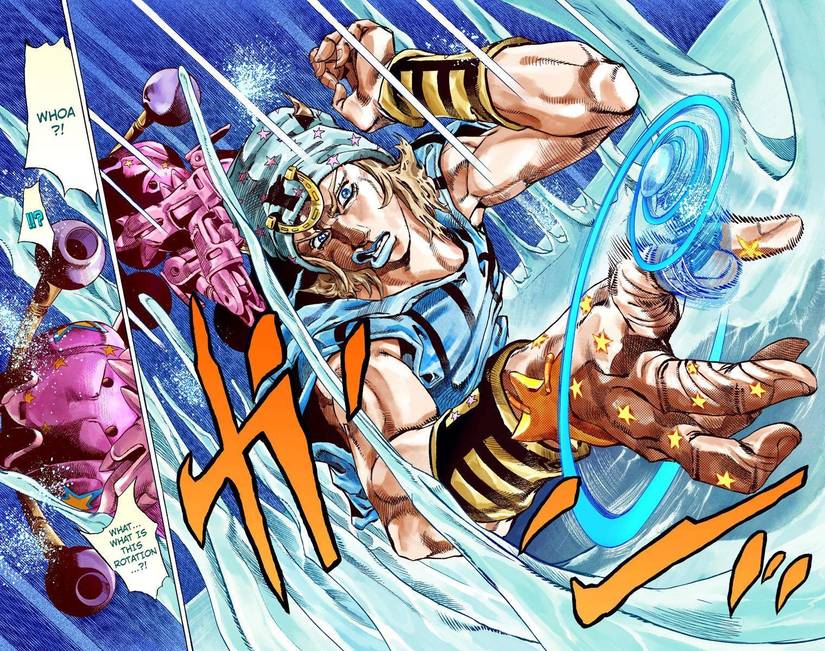 Image Source: Jump Comics/Viz Media
Visually, Steel Ball Run represents a seismic shift in Araki’s style. Moving away from the hyper-muscular designs of the early ’80s, the characters now possess a more lithe, fashion-forward anatomical precision. Johnny’s design is a masterclass in detail, using eccentric patterns and delicate facial features to convey a sense of vulnerability that was rarely seen in predecessors like Jotaro Kujo. The sprawling Western landscapes, from sun-bleached deserts to desolate ghost towns, are rendered with a cinematic density that the anime aims to replicate.
If the Netflix adaptation can preserve the thematic depth and visual splendor of the source material, it will undoubtedly become a pivotal moment in anime history. Steel Ball Run is more than just a race; it is a profound exploration of human ambition and the “spin” of fate itself. Whether you are a dedicated fan or a curious newcomer, the trek across the American frontier promises to be an unforgettable ride through one of fiction’s most bizarre and beautiful worlds.
Steel Ball Run arrives on Netflix on March 19.
Source: Polygon
Related articles
 Sandra Hüller Played a Role in Avengers: Doomsday
 Warhammer Team Showcases Golden Demon 2026 Miniature Painting Winners at SPIEL Essen
 Delicious in Dungeon Season 2 Character Illustrations Shown
 Report: Sucker Punch, Developer of Ghost of Yōtei, Hit by Layoffs
 Inscryption Developers Announce Mobile Version, Answer Questions About Sequel and Add-Ons
 Aaron Paul Mostly Cut From “Clayface,” Director James Watkins Explains Why
 Anne Hathaway’s A24 Film “Mother Mary” Finds Streaming Audience After Box Office Struggles
 Fan-Made NFS: Most Wanted Port for Android Adds Online and Local Multiplayer Support