Looking Back at The X-Files Three-Part Anasazi Arc 31 Years Later
When the United States entered World War II, the military faced a major obstacle because Germany, Italy, and Japan intercepted American messages. The armed forces needed a code that could not be easily broken. Early in 1942, Los Angeles civil engineer Philip Johnston proposed a solution. Having spent much of his youth on a Navajo reservation, Johnston was one of the few non-Navajo people on Earth who understood the Navajo language. He suggested that the military recruit Navajo speakers and use their language to transmit vital war information.
The strategy worked. The code talkers proved instrumental in many American victories, including the Battle of Iwo Jima. U.S. Major Howard Connor stated, “Were it not for the Navajos, the Marines would never have taken Iwo Jima.”
Despite their patriotic contributions during World War II, the author did not learn about the code talkers in history class. Instead, the discovery happened on The X-Files during a three-part story that stands as a high point for the series mythology.
Like every other season of The X-Files, the second season concluded with a cliffhanger that remained unresolved until the next season began. On May 19, 1995, the episode “Anasazi” closed out season two. Season three then kicked off with “The Blessing Way” and “Paper Clip,” the latter of which aired 31 years ago this week.
The X-Files turned real history into an alien conspiracy
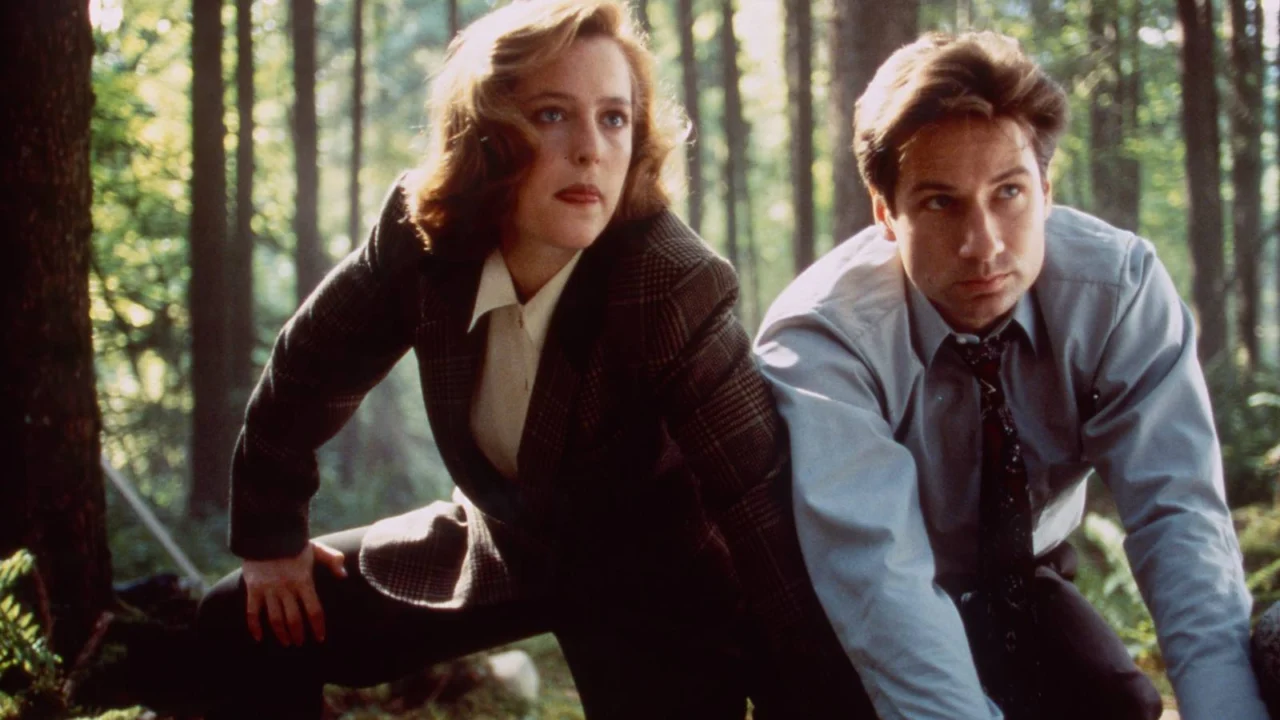
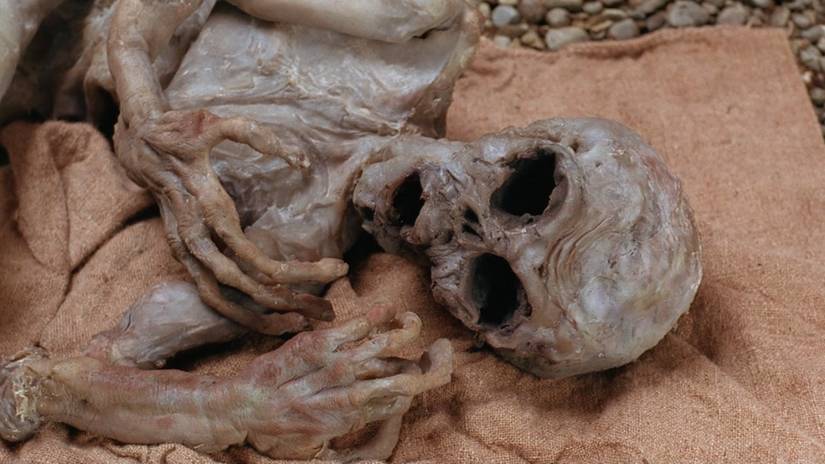
“Anasazi” begins with two separate plot threads that converge across the three-part story. A teenage boy discovers a UFO on a Navajo reservation and finds a long-dead, alien-like body inside. Separately, a hacker infiltrates the Department of Defense UFO files and gives a tape of the information to Agent Mulder (David Duchovny). Mulder initially struggles to understand the contents, but Agent Scully (Gillian Anderson) suggests the language is Navajo. She eventually refers him to Albert Hosteen (Floyd “Red Crow” Westerman), an elderly Navajo man who served as a code talker during World War II.
Meanwhile, the Cigarette Smoking Man (William B. Davis) seeks to retrieve the tape. He turns to his old associate, Mulder’s father (Peter Donat), to convince his son to surrender the recordings. When Mulder meets with his father, his father is killed. Scully brings Mulder to New Mexico to meet Hosteen, who guides Mulder to the UFO site. Inside what turns out to be a railroad car, Mulder finds dozens of dead bodies that resemble aliens. Soldiers working for the Cigarette Smoking Man suddenly blow up the boxcar, leaving Mulder presumed dead as season two ends.
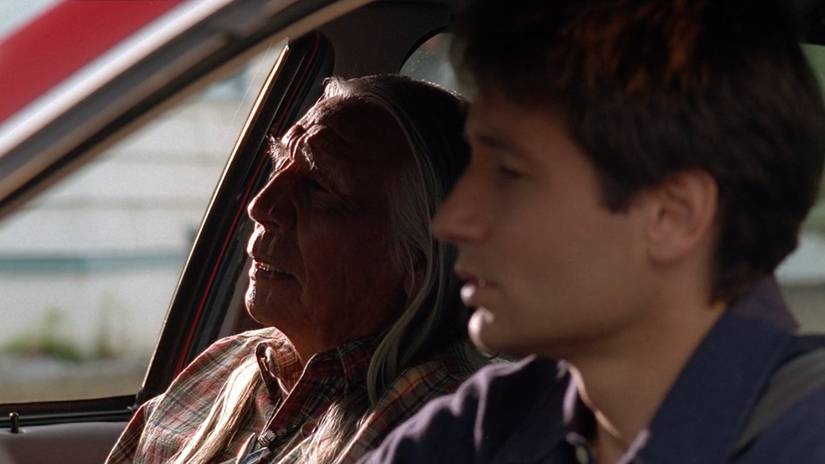
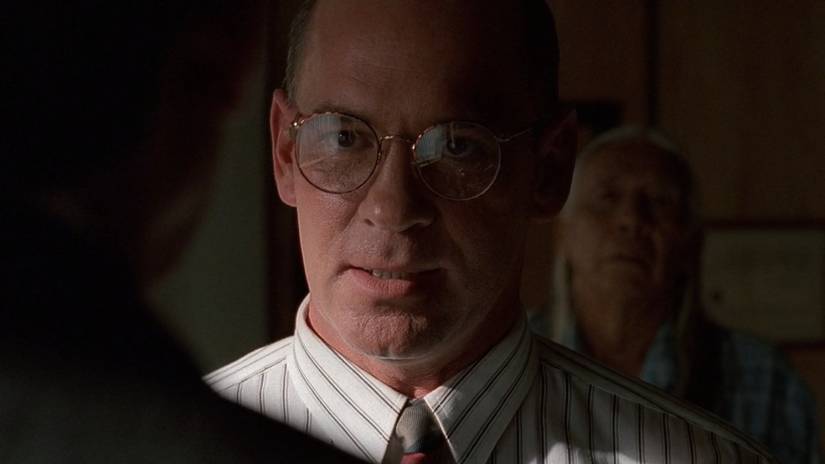
When season three opens with “The Blessing Way,” viewers learn that Mulder survived and is being nursed back to health by Hosteen. Scully returns to FBI headquarters and receives warnings that her life is in danger because colleagues believe she possesses the tape. She does not have it, nor can she find the tape where Mulder hid it. Scully’s sister (Melinda McGraw) is then murdered at Scully’s apartment after being mistaken for Scully. FBI Assistant Director Walter Skinner (Mitch Pileggi) soon reveals that he took the tape and kept it for safekeeping.
The trilogy concludes with “Paper Clip.” Mulder and Scully travel to a mining facility in West Virginia to find proof backing up the digital files. There they discover thousands of paper files. Mulder sees a UFO up close, and Scully encounters dozens of apparent aliens in a dark tunnel. The episode features a memorable standoff when Skinner hands the digital tape over to the Cigarette Smoking Man in exchange for reinstating Mulder and Scully into the FBI, as both agents had been fired for unauthorized activities. Despite retrieving the tape, the Smoking Man learns that Hosteen has memorized the files and already shared their contents with 20 other Navajo individuals who will go public if Mulder and Scully are harmed.
The show’s mythology never felt this satisfying again
All three episodes were written by The X-Files creator Chris Carter. Part of their success comes from fusing real-world history with the show mythology. The code talkers introduce fascinating World War II history, and Floyd “Red Crow” Westerman portrays Albert Hosteen as an intriguing character far removed from the typical evil federal agents on the show. “Paper Clip” also takes its name from the real-life “Operation Paper Clip,” in which the U.S. government employed Nazi scientists after World War II to advance American science and weaponry. Weaving this history into the narrative made the grand scale of the show seem more plausible.
These episodes also cemented Assistant Director Skinner as an ally to Mulder and Scully, solidifying a bond that remained uncertain throughout his debut in season two. Afterward, the agents frequently turned to him when they needed trusted support.
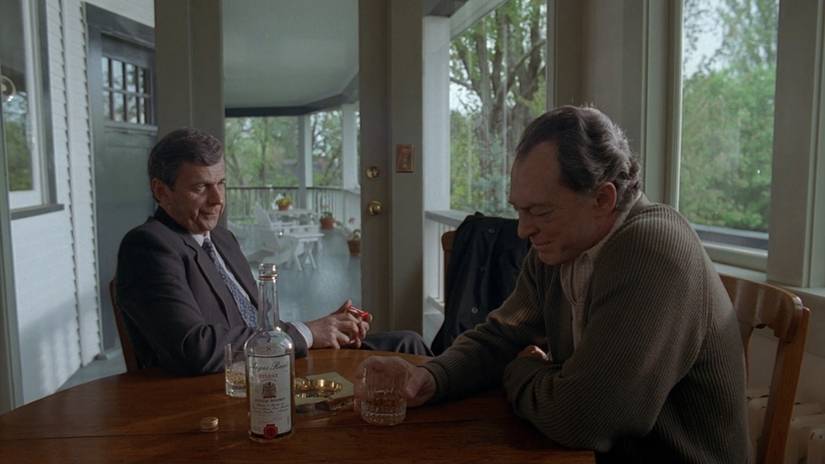
Together, these three episodes represent the peak of The X-Files central mythology concerning aliens and government cover-ups. Many dedicated fans ultimately conclude that the standalone monster-of-the-week episodes are the best parts of the series, largely because the overarching mythology never reached a satisfying conclusion. This three-parter, however, felt deeply satisfying and played out like a major feature film before the series made the jump to the movies. In several ways, it outperforms both X-Files films. The life-or-death stakes and direct ties to series lore make this a standout story, whereas the theatrical films required a more standalone approach to appeal to mass audiences.
Future X-Files mythology episodes never reached this level of excitement again. Having killed off Mulder’s father and Scully’s sister in the same story, the writers had fewer family members left to threaten. The show lore continued to pile up with minimal resolution. While these three episodes did not answer every question, they arrived at a point when viewers still believed the overarching narrative was building toward a clear destination. Just a couple of seasons later, the lore became convoluted, and answering questions clearly mattered less to the writers than posing them.
High points still arrived after this trilogy, and the show did not decline immediately. These three episodes simply mark the absolute peak of the X-Files mythology for better and for worse.
The X-Files is available to stream on Pluto TV, Hulu, and Disney Plus.
Source: Polygon
Related articles
 AION 2 Pre-Registrations Surpass 100,000 Players
 Silent Hill 2 to be removed from PS Plus ahead of Halloween
 Gears of War: E-Day Developers Pleased Game is Not Coming to PS5
 Five Soviet-Era Sci-Fi Movies Available on Streaming Services
 Total War: Warhammer III Mod Creator Breaks Mod in Protest Against AI Repacks
 Gran Turismo 7 Developers Show New Track and Cars in Spec IV Update Part 1 Trailer
 Gameplay Footage of Marvel’s Wolverine Emulated on PC Shows Performance Approaching 30 FPS
 10 Erotic Thrillers to Watch After Verity