
Iconic Sci-Fi Anime Returns with New Movie After Long Wait
Four years have passed since the cinematic debut of Mobile Suit Gundam: Hathaway, the opening chapter of a highly anticipated film trilogy based on Yoshiyuki Tomino’s acclaimed novels, Mobile Suit Gundam: Hathaway’s Flash. Fans finally have a glimpse of the next installment, Mobile Suit Gundam: Hathaway – The Sorcery of Nymph Circe, which recently unveiled its primary trailer. The footage features a striking new musical collaboration between Yohei Kawakami and SennaRin, with Shukou Murase returning to the director’s chair to maintain the first film’s distinct vision.
This sequel picks up the mantle of Hathaway Noa’s journey as he spearheads a defiant insurgency against the authoritarian Earth Federation. As he orchestrates a daring aerial assault on the Adelaide conference, his convictions are complicated by the presence of Gigi Andalusia, a mysterious woman he met during the hijacking of Haunzen Flight 356. While The Sorcery of Nymph Circe promises to escalate the stakes within the Universal Century (UC) timeline, it’s worth revisiting how Mobile Suit Gundam: Hathaway successfully translated the franchise’s dense political intrigue into a modern masterpiece.
[Ed. note: The following contains significant spoilers for Mobile Suit Gundam: Hathaway.]For the uninitiated, the Gundam franchise can feel like an impenetrable fortress of expansive lore and convoluted continuities. With various disparate timelines to navigate, the Universal Century remains the franchise’s backbone, and Hathaway serves as a surprisingly accessible entry point. Rather than requiring decades of homework, the film invites newcomers into its world through atmospheric storytelling and grounded stakes.
However, this 2021 feature does more than just simplify a complex mythos; it provides a sobering look at a dystopian future defined by systemic inequality and bureaucratic corruption. The tension between the celestial colonies and a decaying Earth creates a backdrop where every action feels heavy with consequence.
Hathaway Noa himself is a fascinatingly elusive lead—a man of many masks who operates in the shadows of interstellar conflict. The Earth Federation’s iron-fisted control over human migration has sparked a violent backlash from the underground group Mafty, led by the enigmatic Mafty Navue Erin. The film’s emotional core lies in Hathaway’s internal struggle: whether his radical path is a necessary evil or a tragic mistake as he attempts to forge a future out of the ashes of the past.
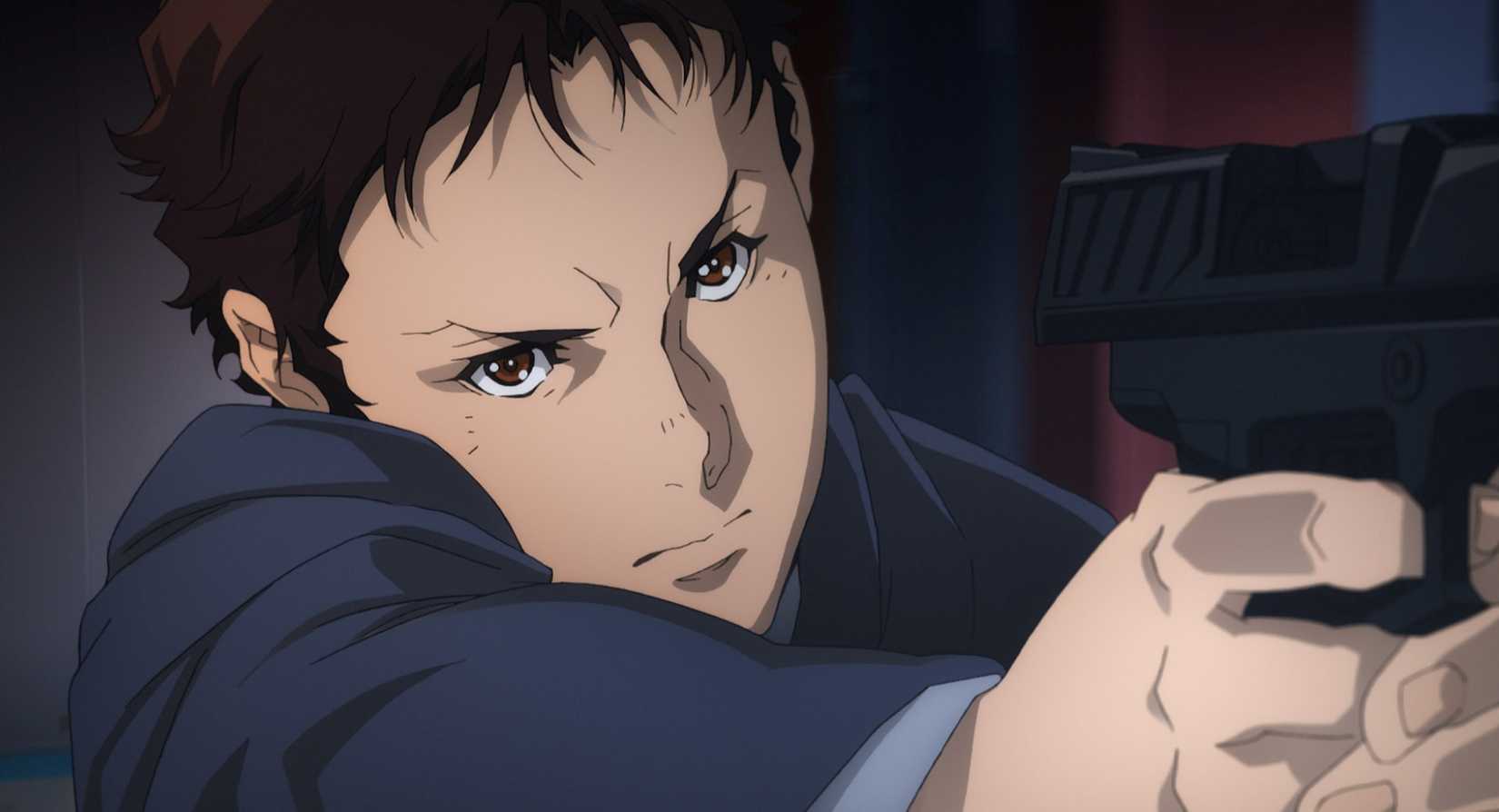
When the narrative shifts focus from psychological depth to kinetic action, Mobile Suit Gundam: Hathaway delivers some of the most visceral mecha combat in the franchise’s history. By blending traditional hand-drawn artistry with sophisticated CG, the film achieves a sense of immense scale. Crucially, these battles are framed from the terrifying perspective of civilians on the ground, stripping away the “cool” factor of giant robots and replacing it with the raw horror of urban warfare. This grounded approach ensures the spectacle never eclipses the human cost.
Chronologically, the story follows the landmark events of Char’s Counterattack, the 1988 film that famously integrated the first instances of computer graphics in the series. Hathaway honors that legacy by adopting a similarly mature, sophisticated aesthetic while pushing the boundaries of moral ambiguity. The film excels in the quiet spaces between explosions, where tense conversations carry as much weight as a beam saber clash.
With The Sorcery of Nymph Circe on the horizon, the trilogy has the potential to solidify itself as a modern classic. Mobile Suit Gundam: Hathaway stands as a masterclass in adaptation, offering an experience that resonates with long-time enthusiasts and curious newcomers alike. Regardless of Hathaway’s ultimate fate, the series continues to prove that in the world of Gundam, the ghosts of past trauma are the most persistent enemies of all.
Source: Polygon
Related articles
 PlayStation Store Launches Gamescom Sale With Discounts Up to 75 Percent
 Riot Games and Hypixel Studios to Fund Technoblade Documentary
 Sony Adapts Pixel Adventure Game The Drifter Into Film
 Netflix Sets Avatar: The Last Airbender Season 3 for 2027 Release and Reveals Fire Lord Ozai
 FX Releases First Behind-the-Scenes Video for Season 2 of Alien: Earth
 CDPR Reveals Number of Developers Working on The Witcher 3 Expansion
 Experts Explain How Ray Tracing Impacts GTA VI Visual Quality
 CD Projekt Red Begins Development on New Game Outside The Witcher and Cyberpunk Franchises