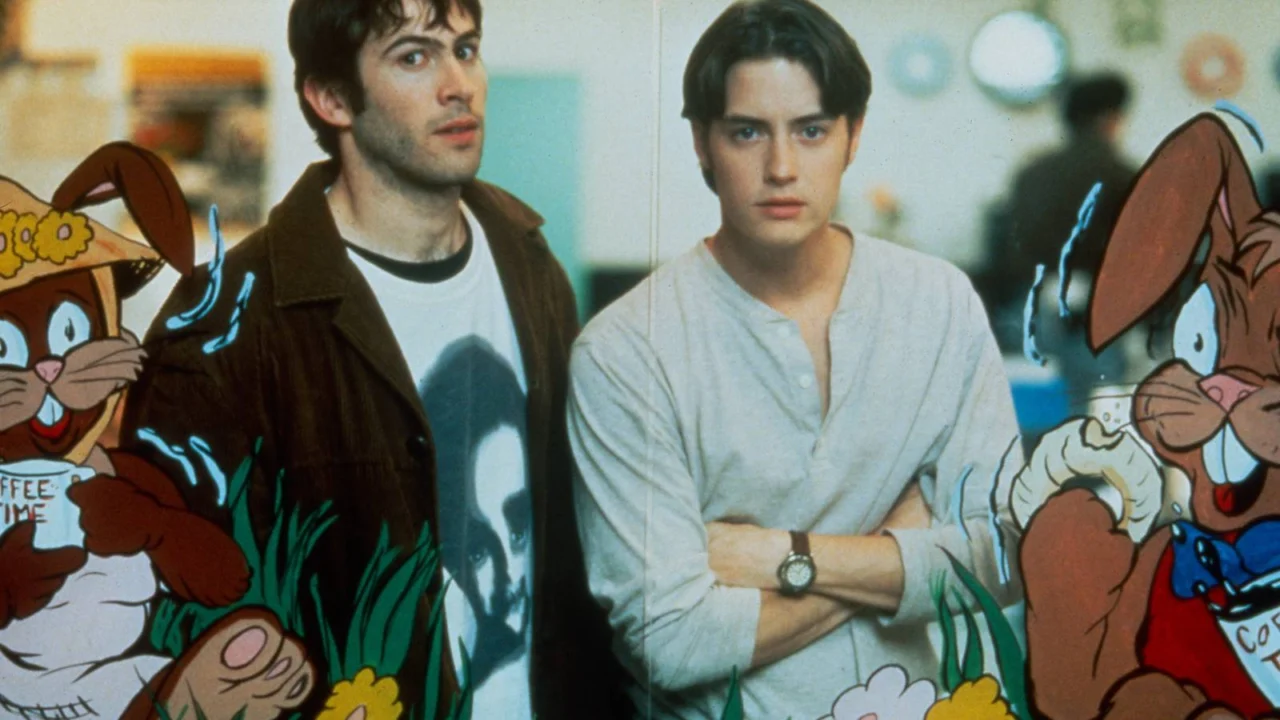
How Kevin Smith’s Mallrats Predicted a Geekier Future

Thirty years on, one of Mallrats’ most memorable lines — a belligerent boast from Brodie Bruce — still sounds like something plucked from today’s online hot takes. Brodie, portrayed by former pro skateboarder Jason Lee, quickly eclipses the film’s ostensible protagonist, T.S. Quint (Jeremy London). Though T.S. is written as the conventional leading man, Brodie’s cocky charisma and filigreed pop-culture chatter turn him into the movie’s most enduring presence, and into a character who prefigures several changes in how nerd culture would surface in mainstream life.
In 1995 superhero cinema was hardly ubiquitous— the summer’s biggest draw was Batman Forever, which succeeded by leaning into the campy, televised sensibility of the 1960s rather than contemporary comic-book developments. Back then the presence of comic-book fandom in a teen-oriented movie felt unusual; Kevin Smith’s film, by contrast, celebrated that devotion. Brodie rattles off references to Superman, Wolverine, The Thing and even Punisher: War Journal, demonstrating a deep, unapologetic affection for the medium that still read as niche at the time.
That fandom is also the reason Brodie spends so much time at the mall’s comic shop. T.S. is preoccupied with getting back together with his ex, Brandi (Claire Forlani), who appears on a low-budget game show at her father’s behest; Brodie’s own romantic subplot involves his ex, Rene (Shannen Doherty), who accuses him of living inside video games and comic runs. Today the gripe might be that he hasn’t turned those hobbies into followers or subscribers, but in the film his collections and obsessive knowledge define him as more lovable than pitiable.
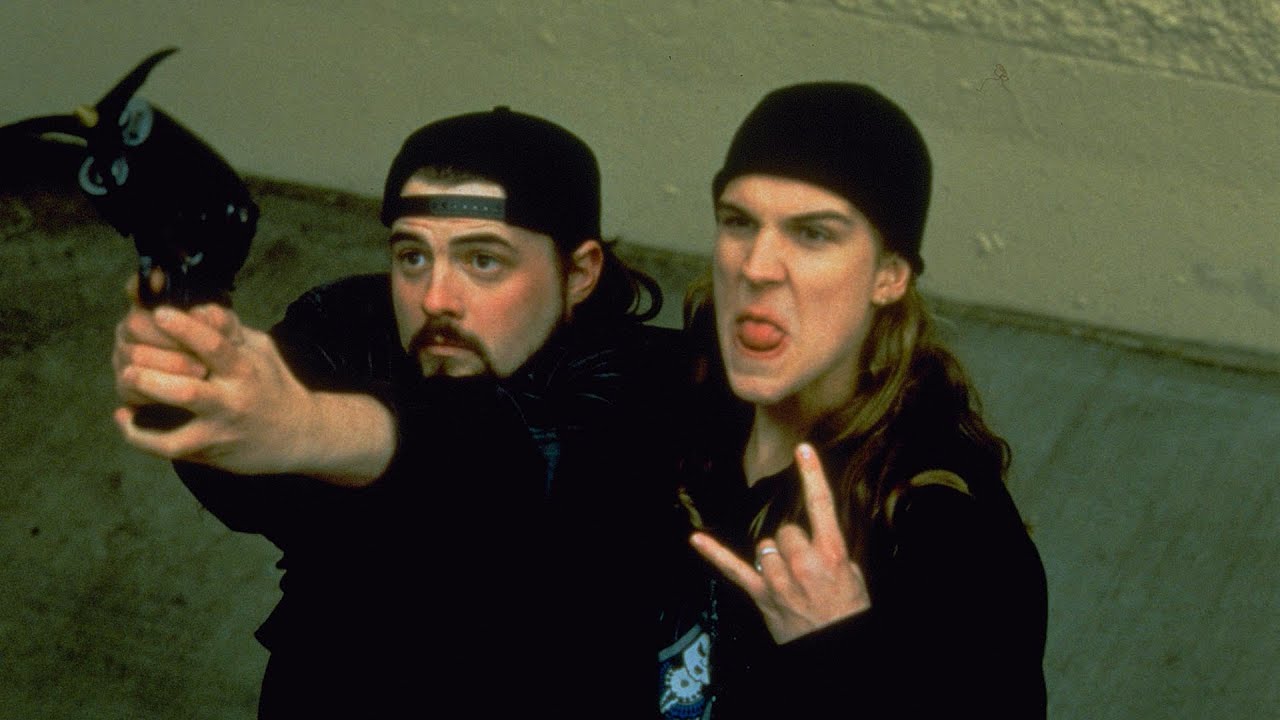
Rather than presenting the comic-reader as a social outcast, Smith gives Brodie a movie-star kind of presence: he’s loud, confident and often wrong in ways that are entertaining rather than humiliating. Smith gently ribs Brodie’s clueless moments — his misuse of words or comic-theory musings — but still rewards him with wins that feel earned by personality rather than contrivance. The film’s most absurd beat — Brodie getting an overnight TV gig in the wake of a public stunt — satirizes the then-recent Leno-and-Letterman talk-show wars while foretelling how media exposure could elevate an everyday loudmouth into a platformed figure.
Smith frames the movie as a successor to both John Hughes’s teen sensibilities and John Landis’s anarchic spectacle, aging the characters into their twenties so the romantic melodrama reads differently: not quite adolescent, not fully adult. Those tonal choices make Mallrats a kind of bridge—call it a proto-Apatow text—mixing juvenile chaos with a spritz of adult anxieties.

Smith’s affection for pop-culture minutiae makes the film feel like a love letter to fan communities; Brodie isn’t a cautionary exhibit so much as an emblem of how geekdom could be performative and magnetic at once. The movie indulges his sillier impulses — mistaking the meaning of words, fixating on small details — while still permitting him moments of real charm, like his half-hearted concessions when trying to patch things up with Rene.
There’s also an early-connecting-universe impulse here: recurring names, shared backstories and cameos (including a Stan Lee appearance well before comic-book blockbusters became the norm) prefigure the interlinked franchises that followed. Smith’s approach is looser and funnier than the later, more industrious franchise-building that dominated the 2000s, and his affectionate comic-book pastiches — the film’s opening-credit art was produced by working comics creators — often feel like better homages than many modern adaptations.

Still, the film’s mall setting sometimes feels more like a theatrical stage than an authentic habitat for its characters. Brodie’s encyclopedic knowledge of mall layout and store economics is played for laughs, as is Ben Affleck’s snarling “Fashionable Male” manager, who mocks aimless shoppers. Smith treats the mall as a public commons — a social arena rather than a shrine to consumption — and that perspective undercuts the film’s occasional retail-satire beats.
Later releases complicate the movie’s identity: the expanded cut issued for the film’s 25th anniversary in 2020 emphasizes that T.S. and Brandi are college-aged, nudging the story further away from teen comedy and into a more ambiguous “in-between” territory. That liminality is where Mallrats is at its best: caught between adolescent pratfalls and adult regrets, its characters feel plausible and, at times, surprisingly modern.

Ultimately, Mallrats endures because it presented a new model for the comic-loving protagonist: loud, lovable and able to command a room without surrendering his obsessions. What once felt like a niche novelty—an earnest, unabashed fan at the center of a studio comedy—helped open the door for the mainstreaming of geek culture. Brodie Bruce may not be the last loudmouth nerd we remember fondly, but he was one of the first to feel like someone you’d want to hang out with, flaws and all.
Source: Polygon
Related articles
 Natalie Portman Becomes a Mother for the Third Time
 Zach Cregger Will Not Direct Franchises After “Resident Evil”
 The Rolling Stones to Receive a Biopic
 “Spider-Man: Brand New Day” breaks all-time US record
 “Prime Time” starring Robert Pattinson receives critical reviews
 Robert Pattinson Responds to Chris Hansen’s Complaints About the Movie “Primetime”
 Ryan Reynolds’ “Mayday” receives positive reviews from critics
 Michael Keaton to Direct Western Starring Morgan Freeman