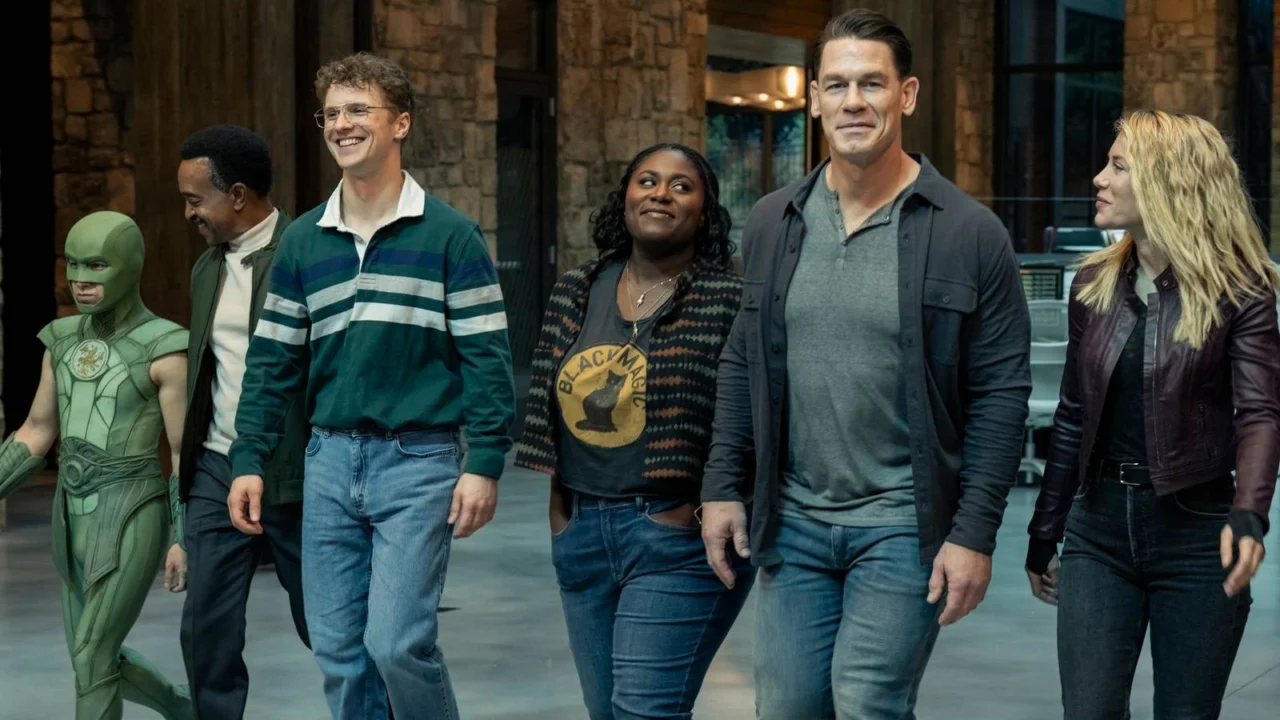
Checkmate: How It Connects Peacemaker to the DCU
How Peacemaker’s Season 2 Repackages the Team as Checkmate — and Why That Matters for the DCU
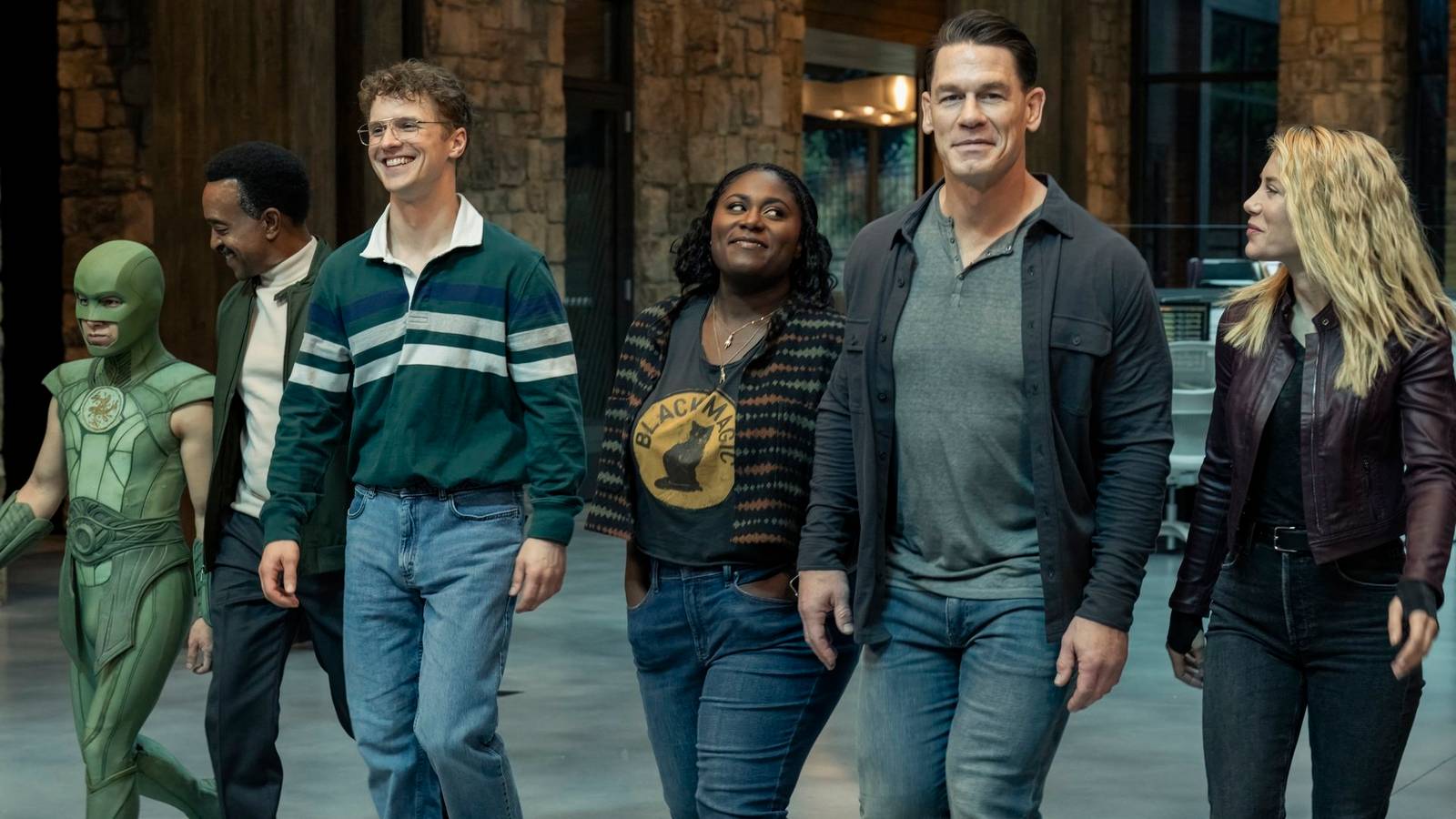
From the beginning, Peacemaker has been a series about misfits and mavericks chafing against the institutions that employ them. Amanda Waller (Viola Davis) assembled the original roster as a punitive response to their failures in James Gunn’s 2021 film The Suicide Squad, and by the close of season one the ensemble openly exposed Waller’s abuses — a decision that left many of them professionally adrift. Leota Adebayo (Danielle Brooks) and Emilia Harcourt (Jennifer Holland) struggle to find work, while John Economos (Steve Agee) clings to his post and to his friends.
Rather than accept disillusionment, the core players reinvent themselves. In the season-two finale the group formalizes a new agency, Checkmate, dedicated to the blunt promise of “making the world better.” That move not only reshapes the show’s moral compass but also anchors Peacemaker more firmly in DC Comics lore.
Ed. note: Full spoilers for Peacemaker season 2 below.
Season two exposes corruption at a deeper level than Waller alone. Rick Flagg Sr. (Frank Grillo) replaces her and becomes consumed by vengeance for his son’s death — an obsession that corrupts his judgment. He surveils Chris, nearly kills him while he’s in custody, and even turns to Lex Luthor (Nicholas Hoult) for assistance locating an extradimensional portal. Flagg’s downward spiral culminates in the finale, where he callously dispatches ARGUS teams to hostile worlds, sacrificing agents in a hunt for a planet that can be repurposed as a metahuman prison.

Seeing what Flagg is willing to do unsettles even the most jaded ARGUS operatives. Langston Fleury (Tim Meadows) and Sasha Bordeaux (Sol Rodriguez), who spent much of the season sniping at their teammates, are unnerved by the human cost. Bordeaux confides her unease to Harcourt, who connects her with Adebayo. Adebayo convinces Vigilante (Freddie Stroma) to redirect the illicit “blood money” he’s hoarded from beating criminals into funding a legitimate — if unconventional — alternative.
That alternative is Checkmate: a covert intelligence outfit formed from the 11th Street Kids plus allies like Bordeaux, Fleury, and Judomaster (Nhut Le), who reveals a more honorable side when he rescues Adebayo in episode seven. Though newly minted on the show, Checkmate is a familiar name to comic-book readers — a United Nations–linked covert operations force first introduced in 1988.
In the comics, Checkmate often operates in the same shady twilight as Task Force X, and several Peacemaker characters — including Vigilante and Sasha Bordeaux — have histories with the organization. The roster has at times overlapped with Suicide Squad figures such as Deadshot and Deathstroke, and its ranks have intersected with detectives like Harvey Bullock.

Yet Checkmate’s reputation isn’t purely heroic. Much of that ambiguity stems from one of its most influential figures: Maxwell Lord. Introduced in Superman (portrayed by Sean Gunn in James Gunn’s DCU), Lord appears in Peacemaker’s season-two premiere as a benefactor auditioning candidates for the Justice Gang. On the surface he’s a philanthropic antagonist to Lex Luthor — a billionaire who bankrolls metahuman protectors rather than incarcerating them — but his philanthropy often masks darker ambitions.
In the comics, Lord’s tenure at Checkmate proved perilous. In the 2005 miniseries The OMAC Project (Greg Rucka, Jesus Saiz), Lord commandeers Checkmate and leverages an AI satellite and sleeper cyborgs to neutralize metahumans worldwide — even temporarily subjugating Superman — until he’s finally stopped by Batman, Wonder Woman, and allies including Bordeaux.
James Gunn has described Peacemaker season two as an important connective tissue for the DCU, linking Superman to its sequel, Man of Tomorrow (2027). Early promotional images suggest Superman and Luthor align against a looming threat — and Maxwell Lord is a prime candidate to fill that role, especially if he leverages technology to control or eliminate metahumans that ARGUS and Luthor haven’t already exiled to Salvation. If Lord does rise as a systemic threat, the newly independent Checkmate — forged from the team’s willingness to abandon ARGUS — could find itself fighting to defend the very world it vowed to improve.
Source: Polygon
Related articles
 Lilly Wachowski disavows involvement in the new “Matrix” film
 Kane Parsons to Return to The Backrooms
 First Emmy Award Winners Announced
 Robert Pattinson calls ‘The Batman’ sequel ‘radical’
 A24 to release documentary on Elizabeth Holmes
 Nolan’s “Oppenheimer” Surpasses “Spider-Man” at the Box Office
 Natalie Portman Becomes a Mother for the Third Time
 Zach Cregger Will Not Direct Franchises After “Resident Evil”