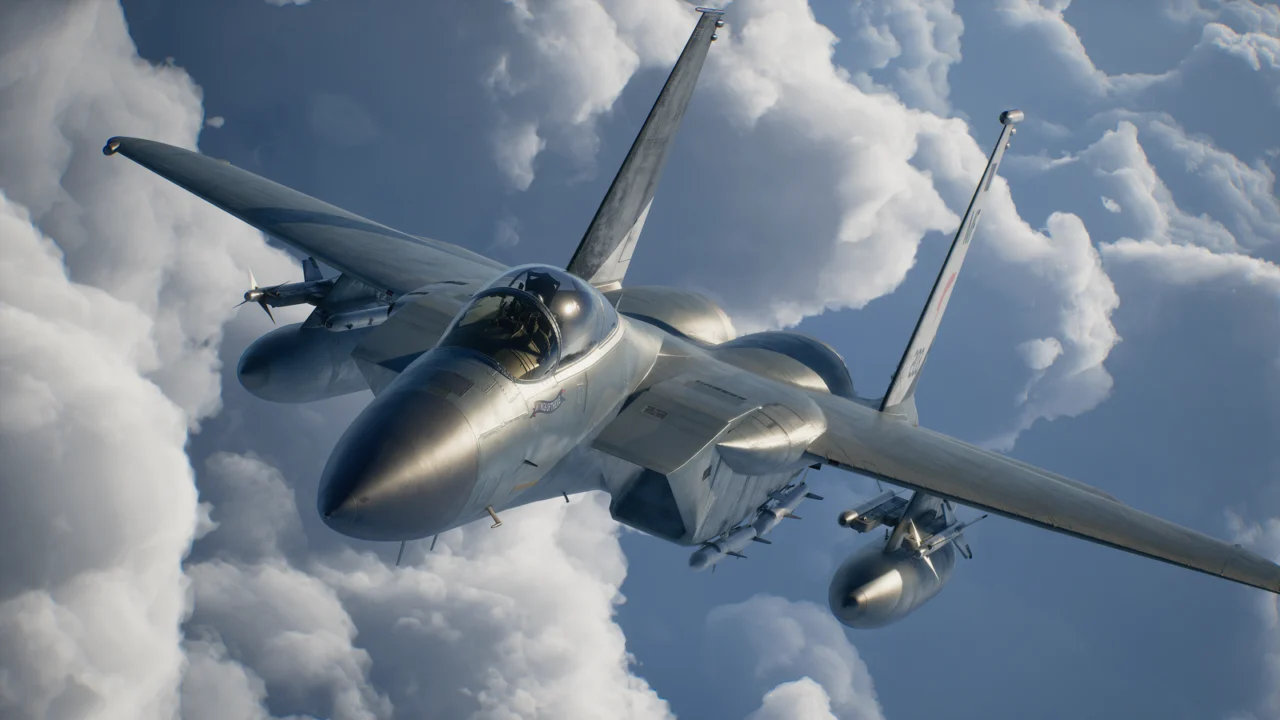
Ace Combat 8 Developers Are on a Mission to Create the Perfect Clouds
I had never genuinely stumped a translator during an interview until I sat down with the creators behind Ace Combat 8: Wings of Theve. When the term “cumulonimbus” entered the conversation, the Bandai Namco interpreter instinctively paused to consult a Google search on his mobile device. Looking over his shoulder, I watched him sketch out a hand-drawn diagram of atmospheric cloud structures for brand director Kazutoki Kono to ensure my inquiry was accurately conveyed.
That level of hyper-focused precision defines the entire Ace Combat franchise. The legendary flight simulation series approaches its craft with such meticulous dedication that every minute detail is treated as a scientific endeavor. Wings of Theve proudly carries forward that tradition when it launches on October 2, elevating the franchise to unprecedented heights. If you need proof, just gaze at the atmosphere—literally.
Leading up to the release of Wings of Theve, Kono and producer Manabu Shimomoto guided me through the opening and fourth missions. There was plenty to admire during our hands-on time: the aircraft handle with immaculate precision, the auditory landscape is exceptional, and the narrative—centering on a manufactured propaganda icon forced to earn his reputation as a genuine ace—is delightfully engaging. Yet, what truly captured my imagination was the development team’s unwavering commitment to atmospheric realism as I cut through billowing vapor and watched fine condensation streak across my cockpit canopy.
Atmospheric rendering in a video game might sound like a trivial background detail, but for the Ace Combat team, it represents the core of the experience. Without them, a game of this nature risks feeling remarkably monotonous.
“This is a title fundamentally set in the open sky,” Kono explained to Polygon. “When you analyze it, the sky is essentially an empty container—a vast expanse devoid of traditional level design elements. Consequently, to establish meaningful ‘maps’ within the air, we rely entirely on clouds. They serve an invaluable role by providing tactical cover. You can utilize them for evasive maneuvers and concealment, despite lacking solid collision geometry.”
Two major developments at the onset of production proved vital in helping the studio master cloud technology. The first was the founding of Bandai Namco Aces in 2022. This dedicated studio was formed to act as a permanent headquarters for the Ace Combat franchise, ensuring developers remained fully invested in its ongoing evolution. From Kono’s perspective, this marked a massive philosophical shift. Historically, previous development teams would disband and pivot to separate ventures once an entry wrapped up.
“That approach prevents institutional knowledge from staying centralized,” Kono noted. “Aces was envisioned as a permanent repository where accumulated experience is preserved, allowing for a much more sustainable, long-term strategy when mentoring incoming talent.” (When I remarked that this sounded like he had assembled his own elite squadron of wingmen, he delivered a playful quip referencing the game’s squad mechanics: “I press the D-Pad, but nobody ever listens to my directions!”)
Establishing an in-house studio empowered Bandai Namco to invest heavily in proprietary technology. One major breakthrough resulting from this initiative is Cloudly, a custom middleware engine layered on top of the primary game engine. This innovative software allows the team to render strikingly lifelike atmospheric formations—a distinct departure from the methods used in the 2019 predecessor, Ace Combat 7: Skies Unknown.
“During the development of Ace Combat 7, we relied on a third-party tool named Truesky,” Shimomoto told Polygon. “We applied heavy modifications to it in order to achieve our desired cloud rendering. While we considered returning to Truesky, pushing visual fidelity to our targeted standard required far greater creative control and customization options.”
For the record, the clouds in Wings of Theve look phenomenal. Their astonishing realism practically beckons you to plow straight through them just to witness the visual payoff. During the opening campaign sortie, I steered my fighter toward a massive towering bank alongside my squadron. The DualSense controller pulsed with haptic feedback as I slipped into the vapor, simulating subtle air resistance. The deeper I ventured inside, the heavier the condensation built up across my viewing glass. It felt genuinely immersive.
The addition of these advanced cloud systems drastically broadens the tactical possibilities during combat.
Does a project truly require such intricate technology just to generate impressive visuals? The development team firmly believes so, emphasizing that this goes far beyond superficial graphical fidelity. Shimomoto noted that getting atmospheric density right is essential for helping pilots gauge relative altitude. Cloudly unlocked a layer of nuanced environmental interactions that ultimately enriched the core mechanics, seeing as clouds are among the few physical elements your jet directly engages with.
“You can now observe realistic shadows cast across neighboring cloud formations,” Shimomoto noted. “If you maintain strong situational awareness, tracking the orientation of those shadows allows you to deduce whether adversaries are positioned above or below you. Similarly, skimming through the mist, a sudden micro-glint might reveal sunlight reflecting off an enemy canopy—providing vital intelligence. These meteorological mechanics vastly expand tactical diversity.”
Naturally, engineering a system of this caliber demands serious scientific backing. Kono credits the atmospheric engine to a “collaborative triumph between two masterminds” within the studio: one researcher who approached the challenge from an academic perspective by pouring over scholarly papers, paired with an ingenious systems programmer capable of translating those theoretical concepts into practical code.
Get Polygon’s Wishlister newsletter
A weekly cheat sheet to upcoming titles you’ll eagerly want to play. No financial commitment—just curating future favorites.
Free. Unsubscribe anytime.
This exact technical hurdle sparked the aforementioned cumulonimbus discussion. When I inquired whether certain cloud variations proved exceptionally difficult to recreate, Kono soon found himself reviewing diagrams illustrating cirrus and stratus differentiations. Ultimately, no single cloud type stumped the crew, though Shimomoto offered an even deeper technical dive regarding sheer volumetric rendering.
“Optimizing processing performance was paramount,” Shimomoto elaborated. “We established a strict target of a locked 60 frames per second, meaning every single frame operates within a roughly 16-millisecond window. All computational calculations must adhere to that strict constraint. During early Cloudly prototypes, when we populated a 100-square-kilometer combat arena with dynamic clouds, our rendering times far exceeded that 16-millisecond limit. Fortunately, our lead engineer successfully optimized rendering speeds down to a fraction of the initial overhead.”
Getting developers to speak candidly about technical architecture during a press circuit is a rare occurrence. Frequently, interviewees gloss over complex science to keep discussions broadly accessible. That certainly wasn’t the case with Shimomoto, who practically beamed while breaking down performance metrics down to the millisecond. When I inquired about other engineering achievements he is eager for players to experience in Wings of Theve, he offered an extensive breakdown of the game’s acoustic design, structured around a theater-grade 7.1.4 spatial audio configuration.
“[The sound team] literally visited testing grounds alongside industry professionals to record actual gunpowder detonations,” Shimomoto shared. “They detonated charges and captured samples across multiple distances, integrating those raw recordings directly into our 7.1.4 sound architecture. Our audio designers are wonderfully relentless. They are utterly consumed by this level of authenticity.”
It is safe to conclude that the entire Ace Combat development division is deeply passionate about their craft—Kono and Shimomoto certainly are. You simply do not invest that degree of meticulous effort into engineering pristine skies unless you truly believe in the mission.
Get Skyrim looking like a modern game, without spending thousands on a GPU
Source: Polygon
Related articles
 Danganronpa 2×2 System Requirements Include RTX 4070 and 32 GB RAM
 Genshin Impact Version 7.1 Livestream Codes
 Director Na Hong-jin Discusses Transition from Slow-Burn Horror to Monster Movie Hope
 Set Photos From The People v. Gorilla Grodd Hint at King Solovar Appearance
 Cosplayer Portrays Sniper Wolf From Metal Gear Solid
 Developers of Moss Shut Down Studio Despite Cross-Platform Release
 Rockstar Documents Reference 32-Player Limit for GTA VI Online
 Zach Cregger’s Resident Evil Projected to Set Franchise Opening Record After Second Forecast Increase