
A Forgotten Fantasy Gem Might Finally Get the Animated Movie It Deserves

Sometimes a headline strikes a chord so personal it feels tailored just for you. That was my reaction when Goodman Pictures unveiled their new animation studio, Underneath the Umbrella Productions, with plans to adapt Walter Wangerin’s cult fantasy classic, The Book of the Dun Cow. Though the L.A. Times once hailed it as a peer to Animal Farm and The Lord of the Rings, the novel has largely drifted into obscurity. I suspect I am one of the very few modern readers who stopped scrolling in pure disbelief at the announcement.
For years, I have mused on how one might translate Wangerin’s hauntingly dark and darkly comedic prose onto the screen. Now, there is a glimmer of hope that we might actually witness it. Even better, this news might finally introduce a new generation to a profound, singular piece of fantasy literature.
In my youth, I was captivated by this National Book Award winner, though it never quite achieved the household status it deserved. I grew up on a steady diet of talking-animal tales—from Narnia to The Jungle Book—but as I matured, those stories began to feel increasingly like juvenile diversions. The Book of the Dun Cow, however, served as a bridge into something more sinister and complex. By subverting the familiar tropes of children’s fiction, Wangerin crafted a narrative so steeped in cosmic, Lovecraftian dread that it felt genuinely perilous to a teenage reader.
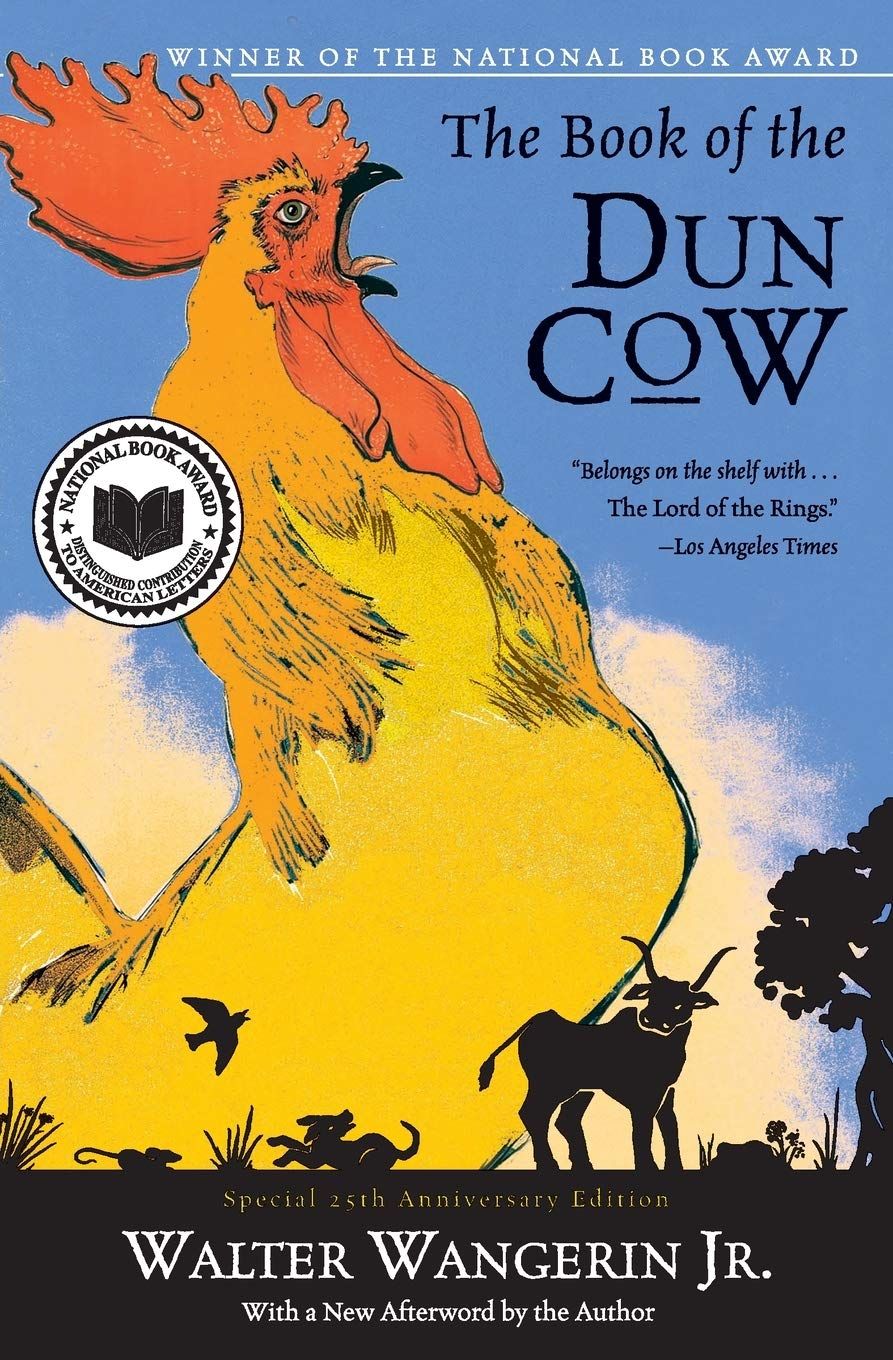
Image: HarperOne Books
The world of The Book of the Dun Cow is one devoid of humanity, existing in some primordial past or distant future. Unlike the anthropomorphized creatures of Redwall or Mouse Guard, these characters don’t walk on two legs or don waistcoats; they are animals in a world that operates more like a timeless fable than a rigid high-fantasy setting.
The inhabitants reside on the earth’s crust, blissfully ignorant that their collective innocence acts as a seal against a primordial evil buried deep within the planet’s core. This entity, the Wyrm, is a serpentine monstrosity that resents the “lowly” animals keeping it imprisoned. Wangerin captures the creature’s chilling ambition with unsettling clarity: it dreams of shattering the mantle to wreak havoc among the stars, “bloodying the sun” and challenging the divine order. Consequently, the Wyrm sets into motion a plan to corrupt and destroy the natural order.
Wangerin, drawing on Chaucer and ancient Irish manuscripts for tone and nomenclature, anchors his story in the rooster Chanticleer. He is a protagonist defined by contradictions: vain, arrogant, and prone to self-pity, yet undeniably valiant and fiercely protective of his flock. When the Wyrm unleashes a catastrophic horror, the resulting struggle for survival is brutal and heartbreakingly costly.
The book’s spiritual undercurrents are inescapable, echoing the theological depth of C.S. Lewis but with a far more jagged edge. God is a distant, often silent architect in Wangerin’s cosmos, offering no easy interventions, only the difficult path of sacrifice. It is a bleaker, more agonizing look at faith than many readers might expect, populated by characters who are deeply flawed, fragile, and intensely human—despite their feathers and fur.
Crucially, the book is also darkly funny. From the canine philosopher obsessed with his own ugliness to the belligerent John Wesley Weasel, the character work is sharp and idiosyncratic. Wangerin even devotes time to the comically dim-witted turkey population. It is these moments of levity that make the encroaching darkness all the more devastating.
While the New York Times once labeled it a children’s book, that classification feels like a misnomer today. It is a visceral, bloody narrative that tackles the binary of good and evil with a nuance few “youth” novels dare attempt. It is inherently eccentric—a narrative style that feels almost impossible to replicate on screen. Yet, the prospect of an adaptation is undeniably alluring.
Whether this project will ever see the light of day remains an open question. The studio’s current slate includes the comic strips B.C. and The Wizard of ID—a wildly disparate lineup that leaves me questioning their creative direction. Given that animation is an immensely costly, high-risk endeavor, one has to wonder if this new studio will be able to sustain a vision as dark and uncompromising as Wangerin’s. After all, even major streamers have recently cut their losses on ambitious animated fantasy projects.
Even if an adaptation is eventually produced, I fear it will likely succumb to the industry trend of softening the rough edges, sanitizing the horror, and aiming for a broader, family-friendly demographic. The Book of the Dun Cow is a rare beast—a singular literary experience that defies easy categorization. Perhaps instead of holding our breath for a film that might be a shadow of the source material, we should simply revisit the original text. It remains, after all these years, one of the most haunting and courageous fantasies ever put to paper.
Source: Polygon
Related articles
 Insider Claims Resident Evil Code Veronica Will Get Separate Ways-Style DLC
 Developers Fall Into Debt Amid Rising Popularity of “Teach Your Sister How to Drive” Simulator Demo
 Arc Raiders Creator Admits Fan Divide Risk Over Requested Game Modes
 Modder Working on RTX Remaster of Call of Duty: World at War Releases First Screenshots
 Digital Foundry Releases Optimized PC Settings Guide for The Witcher 3 Remaster
 Archive Materials Suggest Wing Commander 3 Remaster May Be in Development After 32 Years
 Hacker leaks gameplay of nude Lucia from GTA VI, but players focus on other details
 New 90% Positive Steam Roguelike Is a Faithful PSP-Era Comeback