
Where Was Edgar Wright in the Stephen King Adaptation “The Running Man”?

Edgar Wright has long been a singular filmmaker — a restless stylist who hops between genres with gleeful irreverence. His work is recognizable for razor-sharp editing, slyly chosen pop cues, and an appetite for dissecting a genre’s tropes until they feel fresh again. Wright’s films usually invite the audience in on the joke while also probing the form he’s playing with, whether that’s horror, action, or musical-inflected cinema.
So how does that sensibility translate to his take on Stephen King’s 1982 novel, The Running Man? For a long stretch — roughly the first two-thirds — Wright’s adaptation treats the material with a straighter, more earnest hand than we often expect from him. Then, disconcertingly, the movie starts to lose its bearings: the late sections feel patched together and oddly devoid of the filmmaker’s characteristic mischief, as if studio-safe choices and outside mandates smoothed away the sharper edges.
 Image: Paramount Pictures
Glen Powell — coming off roles in Top Gun: Maverick and Hit Man — anchors the film as Ben Richards, a man driven to extremes in a near-future America split by wealth and desperation. The country’s last major broadcaster, the Free-Vee Network, fills airtime with merciless contests in which contestants can gamble their safety for prize money. Richards enrolls, seeking funds for urgent medical care for his child; mogul Dan Killian (Josh Brolin) spots Richards’ righteous fury and casts him as the perfect target for The Running Man, a show that pits contestants against hunters and a vengeful populace.
Rather than leaning fully into the arcade-game, gimmick-driven tone of the 1987 Schwarzenegger version — with its cartoonish combatants — Wright and co-writer Michael Bacall (Scott Pilgrim vs. the World, 21 Jump Street) steer toward topical satire. The movie foregrounds how media manipulation, surveillance tech, and social animus can be weaponized against a single person rather than embracing the old-school, over-the-top spectacle.
 Image: Paramount Pictures
The film intentionally nods to contemporary concerns: producers weaponize footage (including deepfakes) to smear Richards, socioeconomic divisions and gaps in affordable health care push him into the arena, and the hunters adopt a masked, paramilitary presentation that feels uncomfortably current. See related coverage on manipulated media and inequality for context: Forbes on deepfakes, reporting on income gaps, and recent journalism about immigration-enforcement aesthetics.
Still, Wright’s trademark wit and visual bravado rarely dominate. A few sequences — a frantic scramble back to a tiny hostel room, a risqué-but-playful scene where Richards must fight while scantily clad, and the presence of an underground vlogger spreading dissent — reveal the director’s comic timing and kinetic instincts. The show-within-the-film, including a blisteringly satirical take on celebrity reality TV called The Americanos, supplies moments of acidic humor. Michael Cera turns up in a sizable, intentionally absurd role, and Martin Herlihy from Please Don’t Destroy contributes a memorable cameo that leans into the movie’s comedic possibilities.
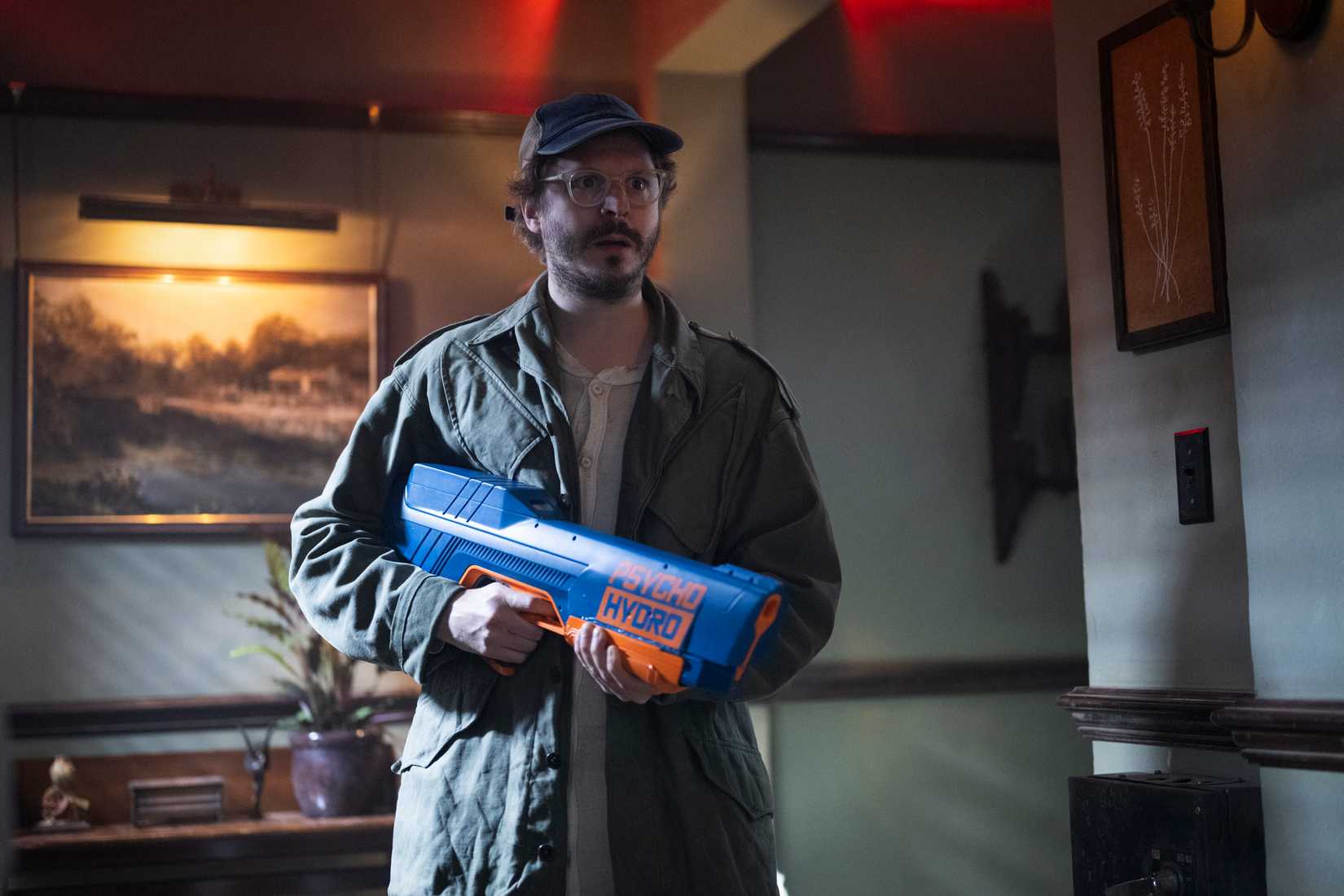 Image: Paramount Pictures
Still, those flashes of inventiveness are sporadic. The film largely forgoes the big, audacious flourishes — the needle-drop choices and kinetic montages that punctuate Wright’s best work — and the visual palette often settles into safe, generic territory. Small futuristic touches such as hovering camera-drones exist more as set dressing than as tools for satire or plot payoff. Powell gives a committed, empathetic performance as Richards: you believe his anger and his tenderness. Yet as the story progresses he gradually becomes an archetypal action lead rather than the uniquely combustible protagonist introduced early on.
 Image: Paramount Pictures
The climax feels especially hurried and uneven — a collage of plot maneuvers that don’t cohere emotionally. Public opinion swings toward Richards in a manner that’s narratively convenient but insufficiently earned. Lee Pace appears as a secondary antagonist, but his role arrives late and never accumulates real menace. Emilia Jones, who has key scenes meant to catalyze major developments, is given material that teases significance without delivering follow-through.
Ultimately, the movie flirts with a sharper, politically charged take on spectacle, media control, and collective resistance, but it rarely commits. Threads that could have provided razor-edge commentary are trimmed or abandoned, leaving a picture that sometimes feels like an outline of its own ambitions. Wright, who has a knack for steering films into daring creative corners, seems less in command here; too many potentially interesting beats stop short of becoming something memorable.
The Running Man opens in theaters on Nov. 14, 2025.
Source: Polygon
Related articles
 Ryan Reynolds’ “Mayday” receives positive reviews from critics
 Michael Keaton to Direct Western Starring Morgan Freeman
 “Daddy’s Daughters” wedding sequel to be released in 2027
 Halle Berry and Colin Firth to Star in New Rom-Com
 Netflix Begins Filming New Dan Brown Adaptation
 Spider-Noir series canceled after first season
 Actors cast as Dobby and Tom Riddle for Harry Potter season two
 International “Doker” Film Festival Kicks Off in Moscow