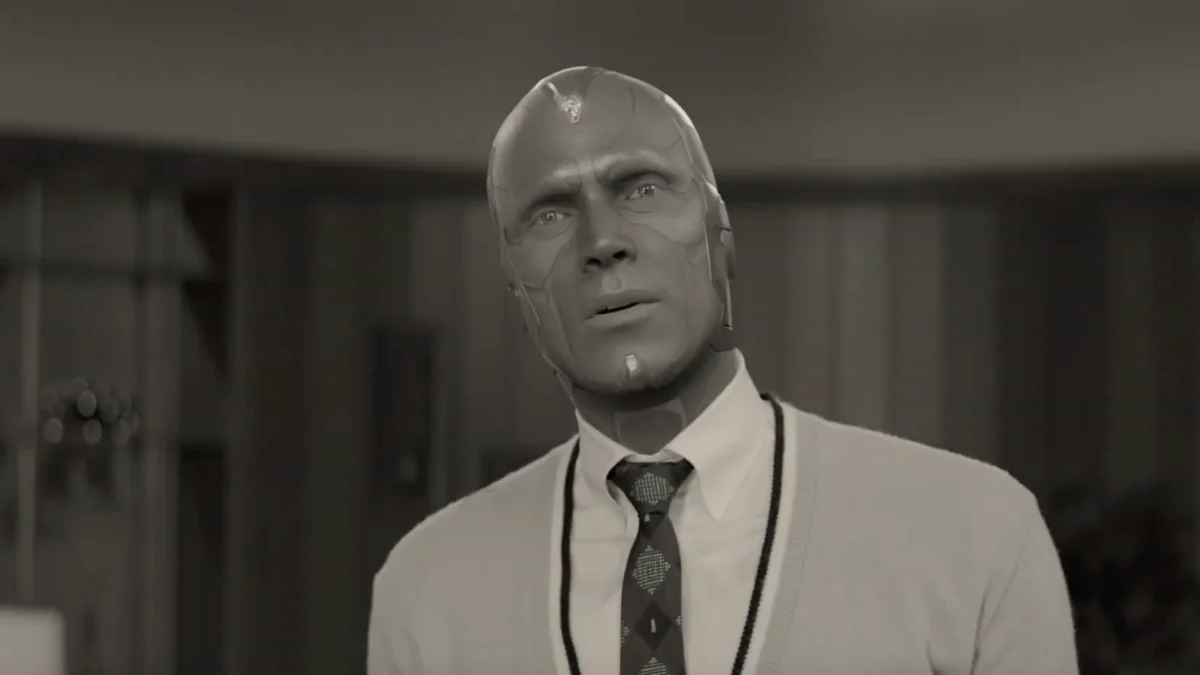
VisionQuest Brings Marvel’s Original Human Torch Phineas Horton Into MCU Canon
During episode four of VisionQuest, longtime Marvel Comics fans got a name drop that reached deep into the company’s history.
A subplot in the show involves a series of murders by a killer known as the Butcher Bird. The victims all founded a company named AI Research and Development, which was sold to Stark years ago, before the events of Iron Man. Vision (Paul Bettany) and the AIs living in his head determine that the next victim will be the last surviving founder of the company. Vision and Tommy (Ruaridh Mollica) attend a benefit where she is speaking.
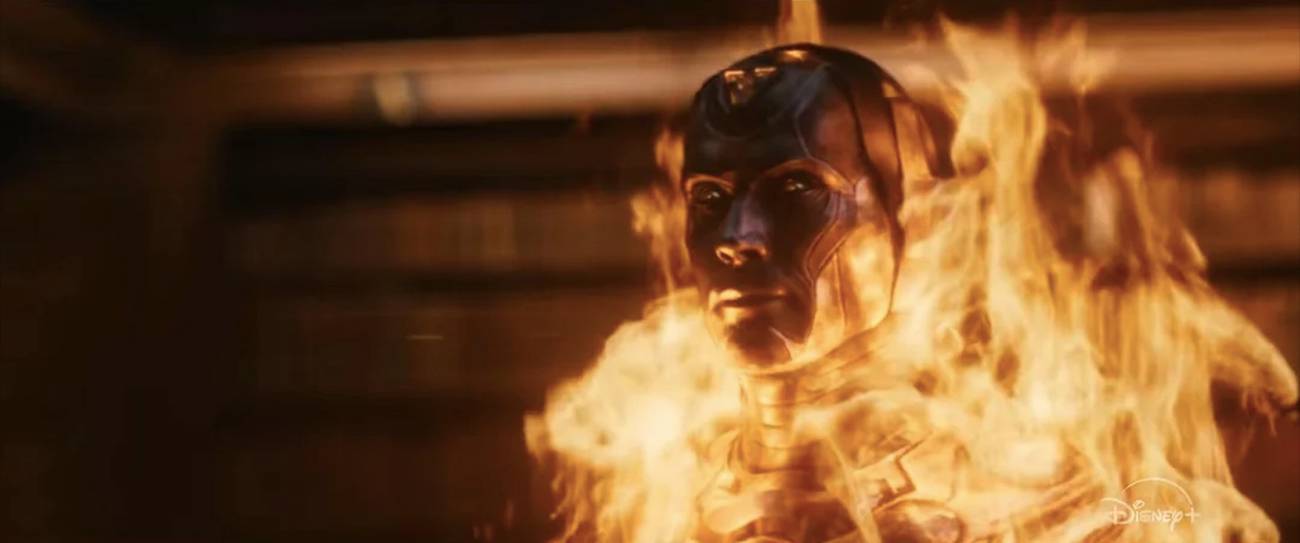
On stage, the co-founder mentions Dr. Phineas Horton, whom she calls “the great-grandfather of robotics.” She says he built “the first automaton AI,” known as “JIM” or “the synthetic man.” Vision then tells Tommy that JIM was the first AI, and that he was “miraculous and flawed. His mind was obsolete from conception.” Vision explains that JIM’s “inability to process complex emotions spun his clockwork too quickly, [and this] flooded his solar cells with oxygen until his entire being was consumed in fire.”
Marvel also released a VisionQuest promo on Oct. 17 that shows JIM’s look in the series. He is a copper-colored robot covered in flames, played by Paul Bettany. So who are Dr. Phineas Horton and JIM? The answer goes back to the earliest days of Marvel.
Marvel’s original Human Torch
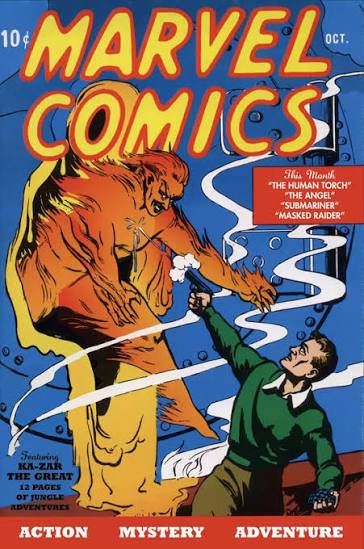
Before Marvel Comics was named Marvel Comics, it was Timely Comics, a company founded in 1939 by publisher Martin Goodman. Its first publication was Marvel Comics #1, which featured a story with Namor the Submariner and the origin of a hero called the Human Torch. He is not the Human Torch from the Fantastic Four. This one came decades earlier.
The original Human Torch was invented by a scientist named Dr. Phineas Horton. On the first page of Marvel Comics #1, Horton gathers members of the press to unveil what he calls a “synthetic man,” an exact replica of a human being. He admits the being has one major design flaw. When it is exposed to oxygen, it bursts into flames. The reporters consider that a dangerous defect. Horton resists their calls to destroy the being, but he eventually agrees to entomb it in a cement block until he can perfect the science.
The block is buried, but unknown to Horton, a small leak lets air into the tomb. Once enough oxygen builds up, the synthetic man reactivates by catching fire and bursting out of the block. At first he doesn’t know who he is or why everything he touches turns to flames. Over a few issues of Marvel Comics, he becomes the hero known as the Human Torch. When he learns to control his powers and can look like a normal man, he takes the human identity of Jim Hammond. Eventually he also gets a kid sidekick named Toro.
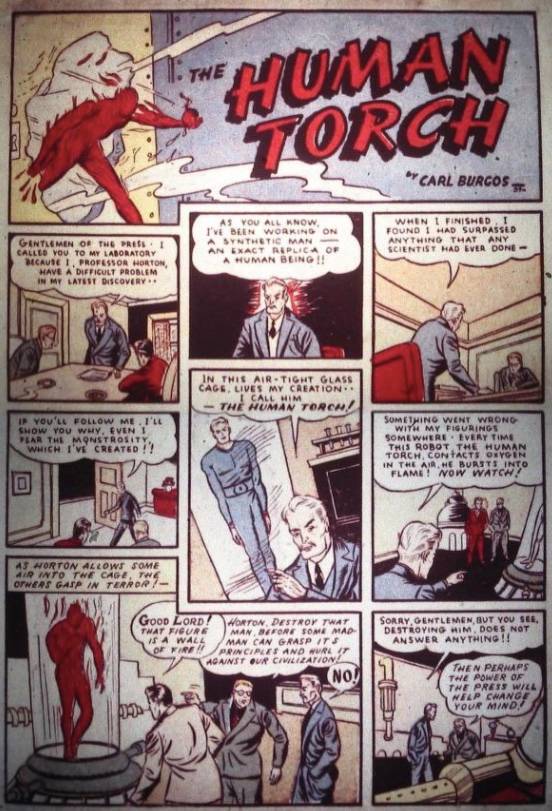
Along with Submariner and Captain America, the Human Torch was one of Timely’s signature superheroes in the 1940s. He even got an Easter egg in Captain America: The First Avenger. When Steve Rogers (Chris Evans) and Bucky Barnes (Sebastian Stan) visit the 1943 World Expo at the start of the film, an exhibit is labeled “Dr. Phineas Horton Presents: The Synthetic Man.” It shows what looks like a man in a red suit inside a glass tube, the same kind of tube he appears in within the 1939 comic.
Like many other superheroes, Cap included, the Human Torch fell into obscurity in the 1950s and stopped appearing in comics for more than a decade. Horton faded away too, but neither character was finished.
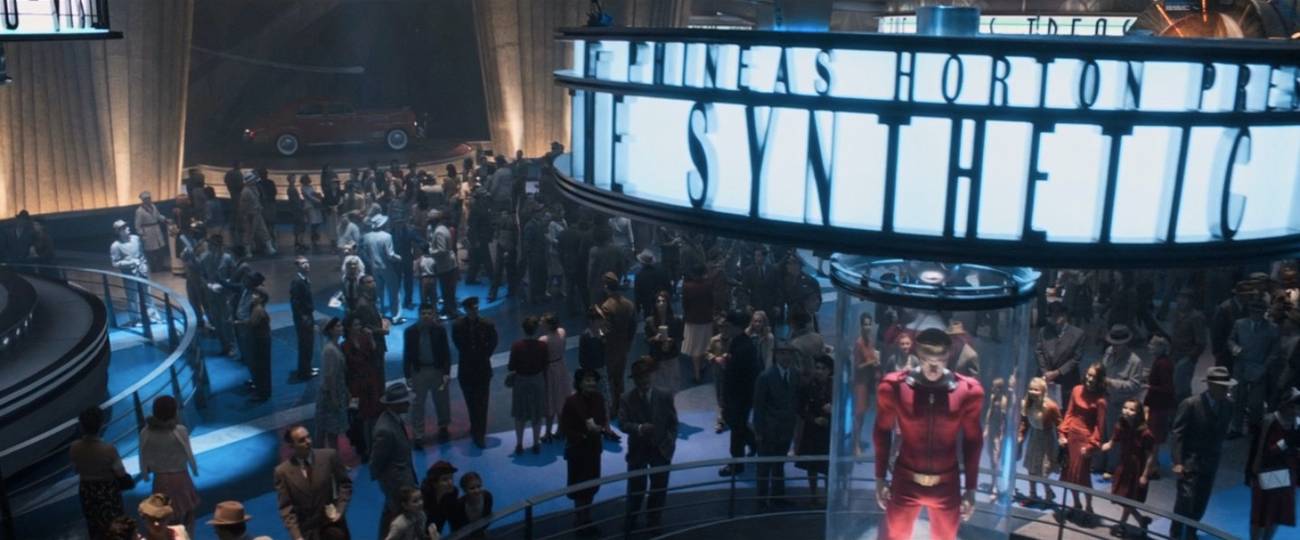
Marvel Comics as we understand it today was born in 1961 with the debut of the Fantastic Four. It was later explained that Johnny Storm knew about the earlier Human Torch and named himself in honor of the original hero. In a 1966 issue, Horton confronted Johnny for taking the name of his creation. By then the original Human Torch lay buried in the Nevada desert after burning himself out in 1954. That changed when a Fantastic Four villain called the Thinker revived him, minus some of his memories, and pitted him against Johnny Storm. The original Human Torch lost the fight and was buried in the wreckage of the lab. Horton returned to obscurity and fell into alcoholism, frustrated by his failures. It was later revealed that Horton had been working for the Kang variant Victor Timely when he made the Human Torch, though that reveal came decades afterward.
In 1968, Ultron recovered the Human Torch’s body. He also kidnapped the disgraced Horton to help repair the Torch and create his perfect body. That may sound like Ultron’s plan in Avengers: Age of Ultron, and it should. In the comics, Ultron ends up creating Vision from the body of the original Human Torch. He also kills Horton after Horton fails to fully comply with his plans.
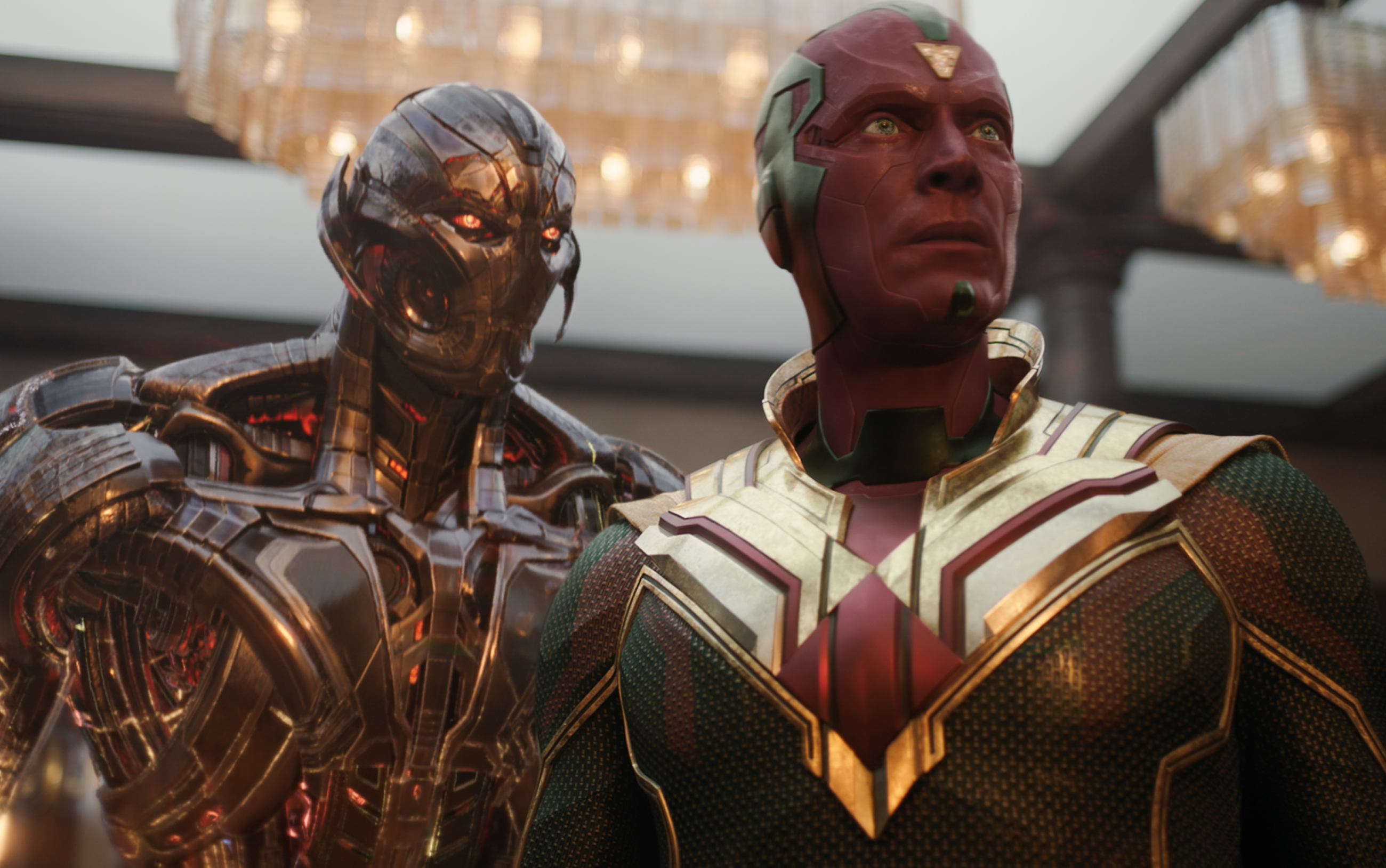
That history makes Horton and the original Human Torch a fitting reference in a show about Vision and the history of synthetic life in the Marvel Cinematic Universe.
In the comics, the Human Torch eventually comes back in his own right, appearing in various forms, but he stays tied to the history of Vision. It is interesting to see the MCU do the same.
The MCU seems to be calling the hero simply “JIM” rather than the Human Torch, which makes sense given how easily the two Torches get confused. The Human Torch’s human identity was Jim Hammond, and Paul Bettany plays JIM, so the character is clearly connected to Vision in some way. All these years later, the MCU is making a sincere effort to honor a character who is important to Marvel’s history but whom many may not know exists.
Source: Polygon
Related articles
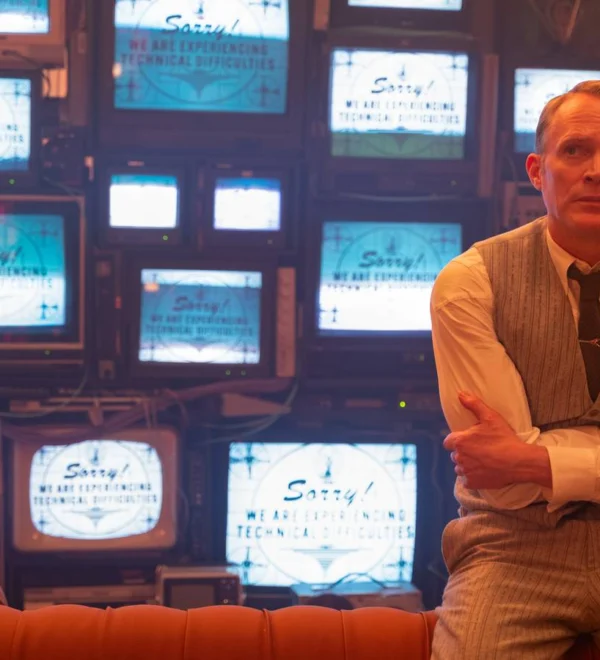 VisionQuest Episode 4 Ending Explained: Who Jocasta Is in Marvel Comics
 Crimson Desert: Charting the Unknown DLC Features Overview
 Modder Is Building Bully “Remake” in Unreal Engine 5 With NPCs Given Conscious AI and Speech
 GTA VI-Style Game in Development on Roblox, Players Surprised by Gameplay Footage
 20 Best Board Wipes in Magic: The Gathering
 Esports Player Faces Possible Prison Term Over Income From Counter-Strike 2 Virtual Item Sales After Tax Authority Questions
 Steam Next Fest Draws Player Complaints Over Number of AI-Generated Games in Demos
 The Prestige Returns to Theaters in 2027