How Eyes Without a Face Inspired Halloween
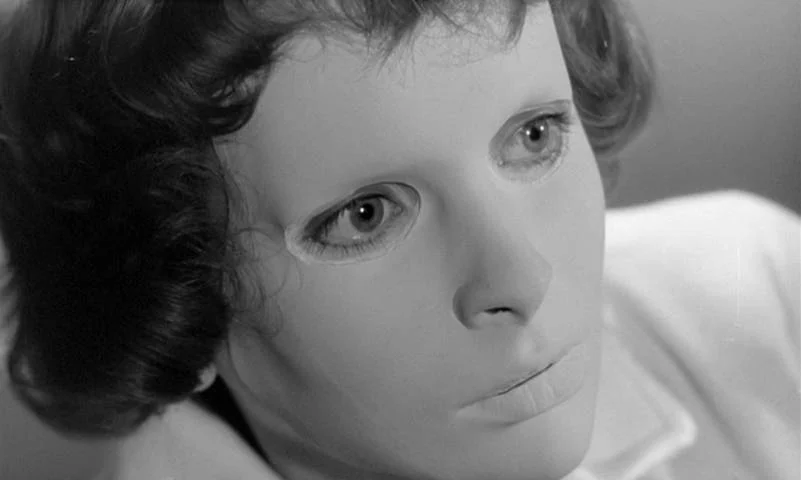
Discussing the terrifying blankness of the killer Michael Myers mask in his seminal 1978 horror movie Halloween, John Carpenter once joked that it was because he didn’t have any money to make a mask. But he also conceded he might have been influenced by an older film. “Maybe it was because of an old movie called Eyes Without a Face,” he said in a 2003 DVD special feature (per Wikipedia).
The mask in that film, a French classic from 1960, is white and featureless, and if anything, even more haunting. It is molded to the face of Christiane, played by Édith Scob, a young woman who suffered terrible facial disfigurement in a car accident. The mask replicates Scob’s delicate, ethereal beauty, but its lack of expressions and immovable smoothness render it frightening and sad. Christiane’s eyes stare out from the mask as if imprisoned, filled with tragic, awful wonder.
Christiane’s father, Dr. Génessier, played by Pierre Brasseur, is an experimental plastic surgeon. We first see him lecturing a rapt audience of Paris socialites about his revolutionary heterograft techniques in his emotionless baritone, promising a future without aging. In reality, he colludes with his mysterious assistant Louise, played by Allida Valli, to abduct young women and steal their faces in the hope he can restore Christiane’s.
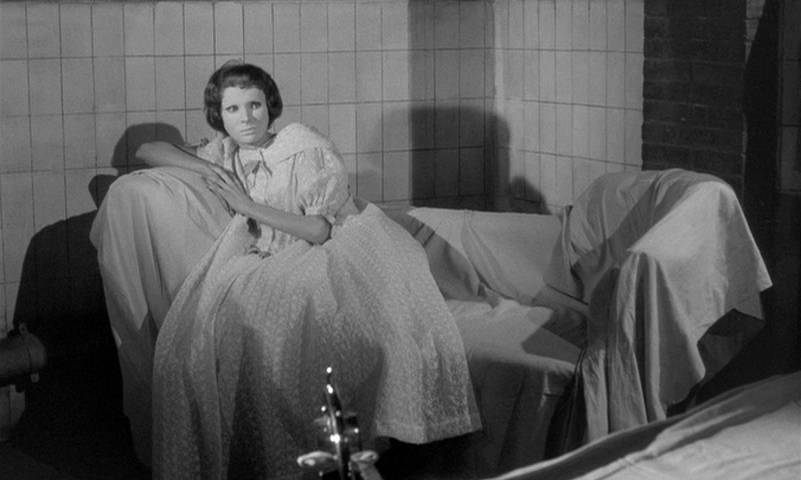
After one such failed experiment, Génessier and Louise pass off the victim’s body as Christiane’s. If they succeed in the future, she will need to become someone else. Christiane exists in a terrible limbo, without a face, without a name she can use, and maybe without a self. In some of the eeriest scenes ever put to film, she glides around Génessier’s empty mansion like a specter, wearing her inscrutable mask and strangely regal white housecoats, as if searching for a reality to inhabit. In the background, we hear the constant yelps of the dogs the doctor keeps in a dungeon-like cellar to perform his experiments.

Eyes Without a Face is based on a lurid horror novel. You can imagine it adapting into something very Gothic and histrionic. But that is not how it panned out, partly to appease European censors and partly because of the artistic instincts of its director, Georges Franju. Franju saw himself as belonging to the fantastical traditions of early French silent serials and filmmakers like Jean Cocteau.
To adapt the novel, Franju hired writers whose own books turned into two of the greatest psychological thrillers of the 1950s: Les Diaboliques and Alfred Hitchcock’s Vertigo. If you have seen those movies, you will have some idea of the haunted psychic terrain Eyes Without a Face drifts into. Beneath an almost placid surface, there is a deep, frightening well of obsession, cruel mastery, and loss of self.
Eyes Without a Face lives on most of all in its imagery. The movie contains a few brief, genuinely horrifying sights that are all the more disturbing for their contrast with the film’s sober, poetic atmosphere. But the frightening blankness of the mask and the pleading of the eyes that stare through it have echoed through the last 65 years as one of the most indelible images in all horror.
Eyes Without a Face is available to stream on Tubi and HBO Max. It is also available on 4K and Blu-ray from the Criterion Collection.
Source: Polygon
Related articles
 Indie Navarrette Promises to Portray Rogue Well in New X-Men Film
 Fifth Season of Ascendance of a Bookworm Announced
 Engineer builds oversized Game Boy Color Special Edition with giant Pokémon Yellow cartridge
 Chris Mars Piliero Discusses Making Upcoming Thriller Appofeniacs
 Marvel Launches New Digital App to Make Thousands of Comics Easier to Read
 Control Resonant and Silent Hill Townfall Reviews Are the Week’s Top Stories
 Star Wars: Galactic Racer Is the Hades of Racing Games for One Ultimate Reason
 Magic Is Planning Another Kpop Demon Hunters Collab After Secret Lair Drop