How a Two-Decade-Old Meme Shapes the New Green Lanterns Series
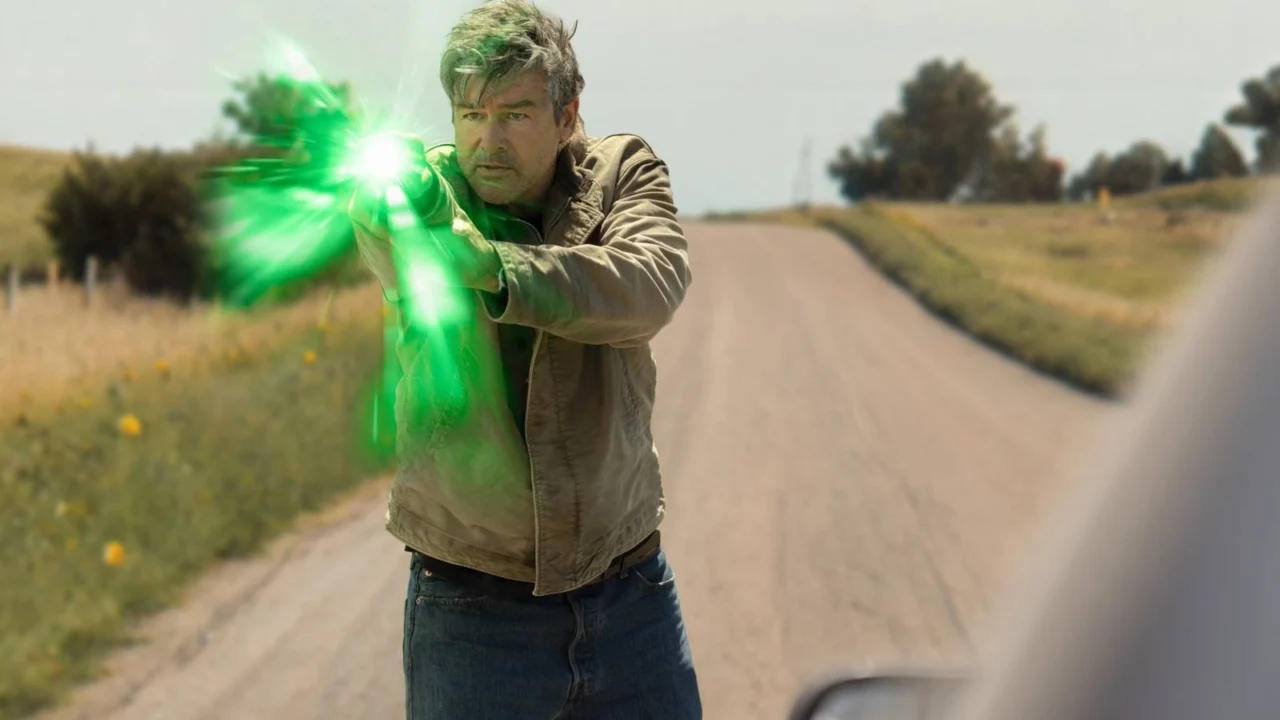
HBO Max’s Lanterns has made the cosmic side of the DC Universe more popular than it’s been in a while. Due to the adventures of the Green Lantern Corps, DC features a well-established galactic scene filled with feuding aliens, killer robots, space cops, and a giant wall made from dead gods that marks the far edge of existence.
Some elements remain a little too complex for a live-action television show, but Lanterns still packs a great deal into its first season, including a reference to the planet-sized Green Lantern Mogo. Notably, the series remembers to include the most important part of the entire Green Lantern mythos: Hal Jordan spends a significant amount of time unconscious.
By coincidence, the first episode of Lanterns debuted one month after the 20-year anniversary of one of the internet comic book community’s longest-running gags: the Hal Jordan Head Injury Project. More surprisingly, due to the inexplicable persistence of both Flickr and Blogspot accounts, most of the HJHIP remains online today.
Put together by Sleestak, who still blogs occasionally at Lady, That’s My Skull, the HJHIP tracks the sheer number of times that Hal Jordan, across nearly 70 years of character history, has taken a blow to the head.

To be fair, long-running superheroes frequently get knocked unconscious under ridiculous circumstances. Spider-Man holds a record roughly around 0 and 4 against Aunt May beaning him with a vase. The difference is that Hal Jordan, unlike many of his superheroic contemporaries, was traditionally depicted as a reckless maniac for the better part of his existence, much like his portrayal in Lanterns. Hal typically runs head-first into situations with a zeal and lack of foresight usually reserved for heroes with some degree of invulnerability, healing factors, and/or suicidal tendencies. Especially in the Silver Age or in stories featuring a younger Hal, he caught a disproportionate number of direct hits to the chin. If his ring lacked healing abilities, Hal would have ended up medically retired by 1970.
Two of the greatest Hal Jordan skull cracks are currently missing from the archive, but the best one included stems from a wild Silver Age story.
“Crisis in Triplicate!”
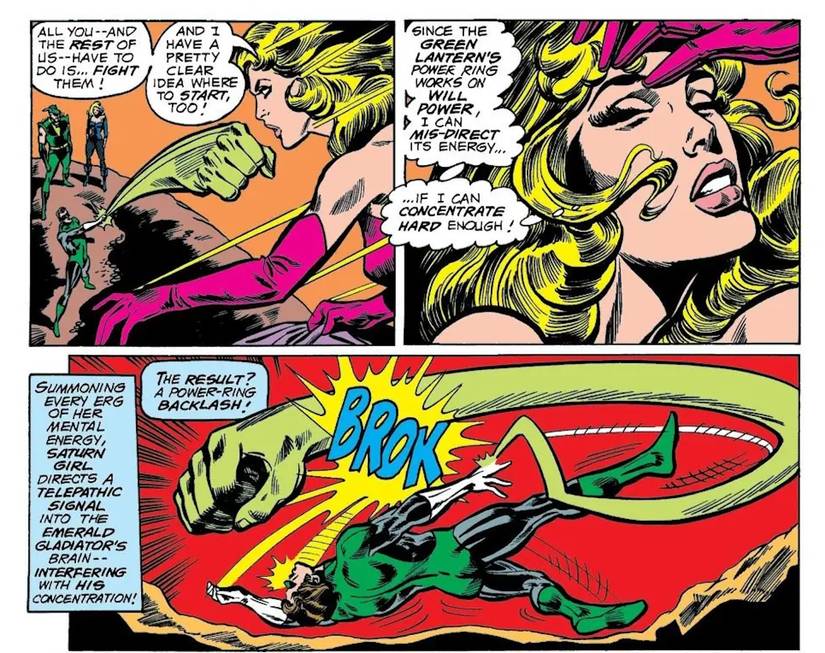
Justice League of America vol. 1 #148 (1977), written by Martin Pasko and Paul Levitz with art by Dick Dillon and Frank McLaughlin, exemplifies the crazy inter-universal crossovers that eventually sparked Crisis on Infinite Earths. The issue features two alternate timelines and time travel.
The Justice Society and the Justice League fall under demon mind control, forcing them to fight the Legion of Super-Heroes. At one point, Saturn Girl uses her telepathic powers to make Hal punch himself out.
The action is not a knockout blow, and Black Canary defeats Saturn Girl three panels later, but the moment remains a useful visual metaphor for how Hal Jordan has historically acted as his own worst enemy.
“The Sign”
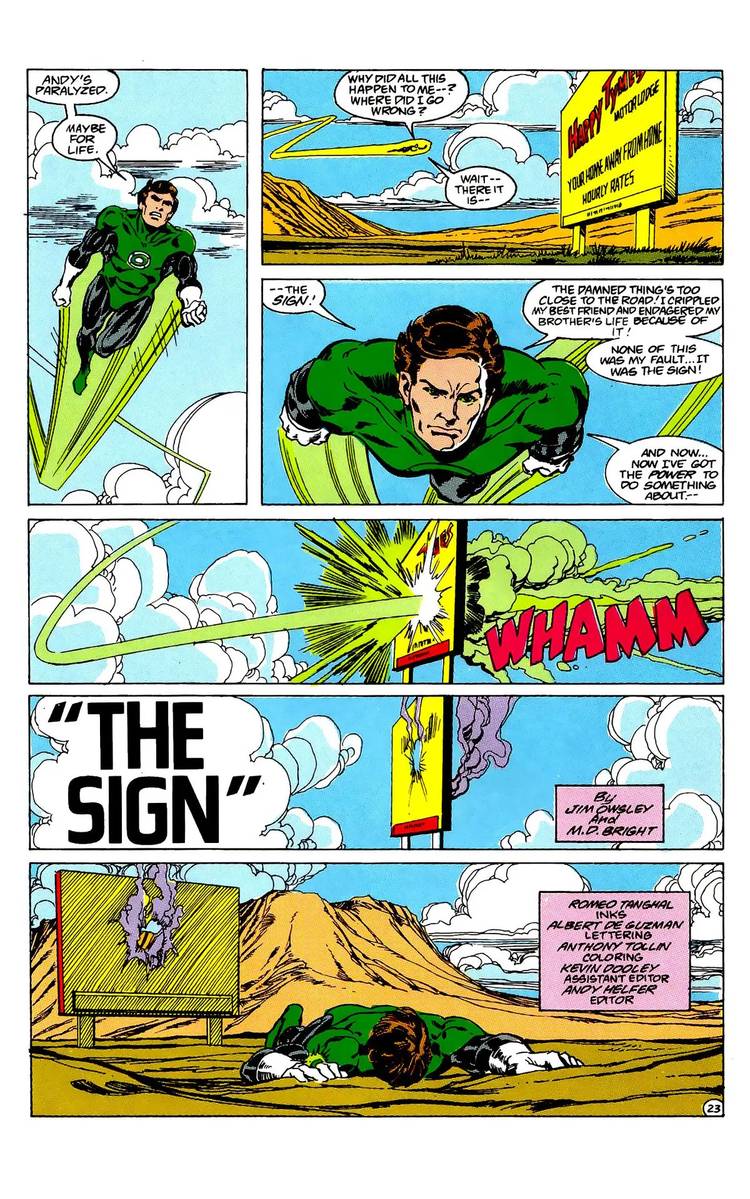
Green Lantern: Emerald Dawn is a six-issue limited series from 1989. Following Crisis on Infinite Earths, the DC Universe received a full reset, so Emerald Dawn served as a deck-clearing exercise to establish Hal Jordan’s origins in the new continuity.
Issue #1, created by Jim Owsley (now known as Christopher Priest) and M.D. Bright, follows a young Hal Jordan tracking his father’s footsteps as a test pilot. Because he is young, he makes poor choices. When Hal tries to drive home drunk, he rolls his car, landing in the hospital and badly injuring his brother Andy.
Still fuzzy from head trauma, Hal is chosen by Abin Sur to become Earth’s first official representative in the Green Lantern Corps, and he struggles with the transition.
This sequence explains why Hal blames a random road sign rather than his own poor decisions, and why his attempt to destroy the sign leaves him flat on the ground. Canonically, post-Crisis Hal Jordan’s first superhero fight involved an ordinary billboard, and he lost.
“The Man Who Murdered Santa Claus!”
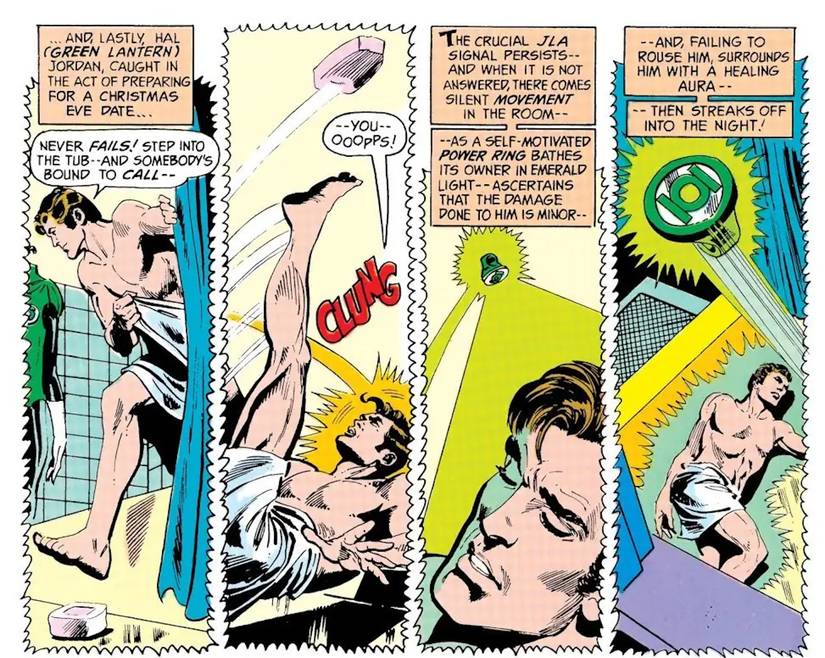
Justice League of America v1 #110 (1974), written by Len Wein with art by Dick Dillin and Dick Giordano, marks the debut of John Stewart on the team. Recently introduced in Green Lantern’s own comic as Hal’s official substitute in the Corps, John would receive the ring and tag in whenever Hal remained unavailable or unresponsive. John did not receive his own ring until years later.
Batman and Superman attempt to assemble the team on Christmas Eve after the murder of an actor playing Santa Claus. A note and key found near the body suggest that if the heroes fail to find the matching door before midnight, a bomb will destroy a city block anywhere on Earth.
Unfortunately for Hal, the Justice League signal goes off just as he enters the shower. Distracted, he slips on a bar of soap and knocks himself unconscious. His ring answers the call autonomously, fetching John and leaving Hal in a heap on the bathroom floor. Hal sits out the rest of the adventure while John joins the Justice League to help find the source of the mystery key.
Hal faces fewer knockouts in modern DC stories. The ring operates more reliably in current comics, leaving fewer opportunities for random thugs or yellow bricks to render Hal unconscious. Nevertheless, whenever someone strikes a superhero in the back of the head, Hal Jordan and the Hal Jordan Head Injury Project endure in spirit.
Source: Polygon
Related articles
 Total War: Warhammer III Mod Creator Breaks Mod in Protest Against AI Repacks
 Gran Turismo 7 Developers Show New Track and Cars in Spec IV Update Part 1 Trailer
 Gameplay Footage of Marvel’s Wolverine Emulated on PC Shows Performance Approaching 30 FPS
 Valorant Anti-Cheat Developer Responds After Gamer Buys Used CPU with Hardware Ban
 The Witcher 3 Modder Streamlines Graphics Customization Process
 Enthusiast Ports Hideo Kojima’s Silent Hills P.T. to PC
 Stephen King Movie The Mist Available Free on Streaming
 Netflix Renews The Witcher for Fifth and Final Season