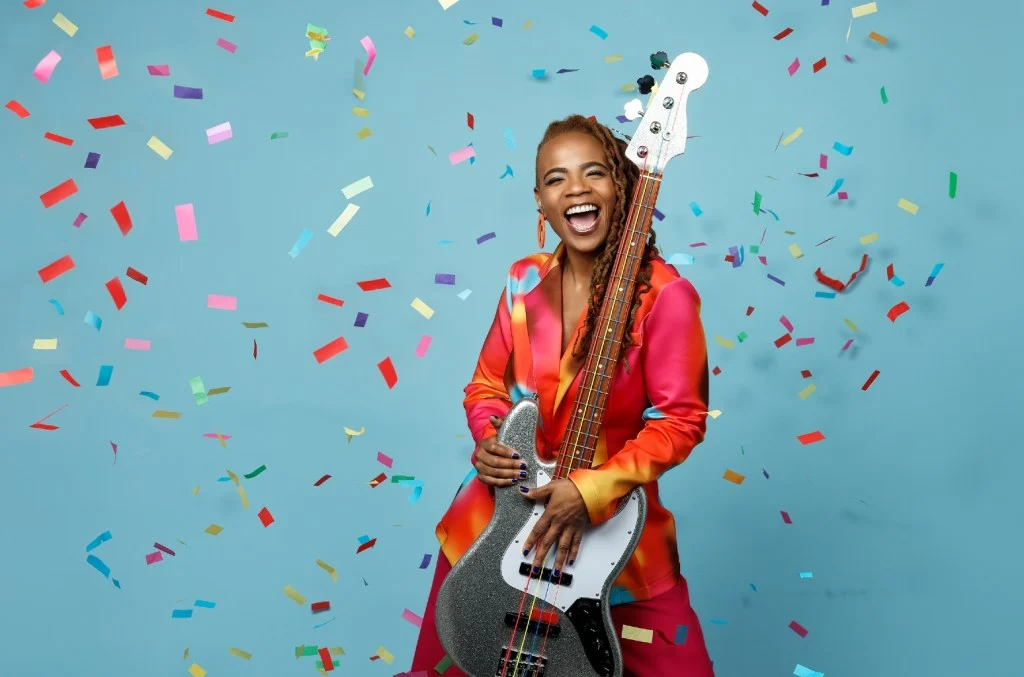

Divinity Roxx mastered the bass guitar in total secrecy. Years later, she would find herself commanding the stage at the BET Awards, delivering a powerhouse performance alongside Beyoncé for a global audience of millions.
Raised in Atlanta, Georgia, Roxx’s early life was defined by a rhythmic intensity—writing rap verses and refining her craft with relentless dedication. Her artistic trajectory eventually brought her into the orbit of legendary bassist Victor Wooten and led to a world tour as part of a groundbreaking all-female ensemble. That group served as a powerful testament, proving that women belong at the very epicenter of the musical landscape. Today, Roxx channels her expertise into vibrant, rhythm-heavy compositions for children and families, a mission that has already garnered two Grammy nominations for Best Children’s Music Album.
Defining a Unique Sound
You’ve shared stages with icons like Beyoncé and received prestigious accolades. Was a professional music career always your endgame?
It was more of an organic evolution than a planned destination. Music has always been my heartbeat. I started with the clarinet in elementary school and pivoted to writing raps as a teen. During college, I recorded with various artists, but I was strictly limited to rapping; I wasn’t allowed to influence the instrumental composition. That lack of creative autonomy was stifling. I realized that to be truly respected as a creator, I needed to master an instrument, so I picked up the bass. I never looked back.
What defined your experience in your high school rap collective?
I had things to say. My inaugural rap was a commentary on respect. When you’re a young girl, you begin to observe the dichotomy between how you are treated by others and how you perceive yourself. It was an exercise in self-assertion—believing in my inherent worth and taking ownership of my own narrative.
The Breakthrough
How did your collaboration with the iconic Victor Wooten come to fruition?
I was practicing the bass in the shadows while fronting as a rapper. Discovering Victor’s work was a revelation; I was captivated by his musicianship and yearned to absorb his perspective. I eventually attended his bass camp, where I showcased both my rapping and bass skills, though I wasn’t convinced I had made a lasting impression. Months later, he reached out with an invitation to join his tour.
What were the most vital lessons gleaned from the road?
Touring is fundamentally about collective effort. It’s less about the glamour and more about the discipline of showing up prepared and supporting the team. Reliability is the ultimate currency. Being part of an ensemble of women who were shattering glass ceilings was transformative. Seeing young girls look up at us and realize that they, too, could command an instrument was profoundly moving.
At what point did the reality of your success set in?
It clicked during my first performance with Beyoncé. I had been grinding for years and was genuinely contemplating stepping away from the industry. Then, suddenly, I was bathed in the lights of the BET Awards, looking out at a sea of people with millions more watching at home. Knowing my family was witnessing that moment was the turning point. It validated the years of struggle.

How did you cultivate your signature sonic identity?
Hip-hop is my bedrock, but once I incorporated the bass, I naturally gravitated toward the textures of funk and rock. As a songwriter, I synthesize those disparate influences into a sound that feels authentically mine.
A New Chapter: Music for Kids
What prompted your transition into children’s music?
I was commissioned by Scholastic to write songs, and two of those tracks were adapted into books. It was a lightbulb moment—I realized the immense power of music as an educational and emotional bridge for children. That was the catalyst for producing my first family album.
How do you approach writing for a younger demographic?
I prioritize musicality that feels joyful and carries a message of positivity. My goal is to craft songs that resonate with kids but also possess the complexity and heart that adults can genuinely appreciate.
What is it like performing for children compared to other audiences?
Children are perhaps the most discerning audience imaginable because they are relentlessly honest. When a connection is made, it is instantaneous and palpable. Earning their attention is a challenge, but when you succeed, it’s an incredibly special exchange. Creating this music gives me a profound sense of purpose—it allows me to serve as a visible, positive representative for kids who rarely see themselves reflected in mainstream media.
The Universal Language
What advice do you have for someone who believes they lack musicality?
That’s a misconception. Everyone is inherently musical. We all respond to rhythm and possess unique tastes. People often don’t realize how deeply integrated they already are into the fabric of music.
Why is music vital?
Music is omnipresent—it’s in the rhythm of a passing train, the ambient noise of a city, and the ebb and flow of our environment. It is the bridge that connects us even when we lack a common language. Music bypasses the mind and speaks directly to the soul.
 Justin Bieber and Hailey Bieber celebrate eighth wedding anniversary
 Ariana Grande Gets Stuck in Elevator After Final Eternal Sunshine Show
 My Chemical Romance Teases Possible New Album During Tour-Closing Show
 Pink Addresses Backlash Over Comments About Macklemore’s Pro-Palestine Stance
 Stray Kids Make Historic Debut at Rock in Rio
 Ocean Way Festival in Santa Monica Canceled Weeks Before Planned Debut
 Zach Bryan Joins Kings of Leon to Perform Collaboration During Nashville Show
 Tatsuya Kitani and Silica Gel Discuss Their Collaboration in a Billboard Japan Monthly Feature Interview