
Director Explains Why Netflix’s The Twits Cuts Most of Roald Dahl’s Book

When Netflix acquired the Roald Dahl Story Company four years ago, it secured the screen rights to one of the most imaginative—and occasionally troubling—bodies of children’s literature: from Charlie and the Chocolate Factory to Matilda and The Witches. Aside from a handful of idiosyncratic short adaptations (notably a series of miniature films by Wes Anderson), the streamer has mostly sat on the catalog. That changes this month with The Twits, an animated feature that reimagines Dahl’s notoriously spiteful 1980 picture book for a broad family audience.
The film, directed and co-written by Phil Johnston (a writer on Wreck‑It Ralph and Zootopia and co‑director of Ralph Breaks the Internet), departs sharply from the original in almost every respect: plot structure, supporting characters, tone, worldbuilding and even how it frames the grotesque central couple, Mr. and Mrs. Twit.
In the book, Dahl’s Twits are defined by mutual loathing and a relentless series of repulsive practical jokes—then receive an appropriately comic comeuppance at the hands of the creatures they torment: a family of Muggle‑Wumps the Twits force to stand on their heads, and a flock of birds the couple plans to glue to a tree for a pie. The story is concise and gleefully savage.
Johnston’s adaptation keeps the spirit of mischief but relocates and enlarges the world. In the film the Twits (voiced by Margo Martindale and Johnny Vegas) run a dilapidated American theme park called Twitlandia in the tiny town of Triperot. The park runs on the magical tears of captured Muggle‑Wumps—here rendered not as monkeys but as small turquoise, fluffy beings voiced by Natalie Portman and Tim Simons. When a group of local orphans liberates the Muggle‑Wumps on opening day, chaos follows: an onslaught of slapstick calamities, a flood of meat slurry, a mayoral campaign undone by an explosive prank, and an unlikely found family that forms between the children and the freed creatures. The film’s narrators are the fleas living in Mr. Twit’s beard—one of many imaginative choices that expand the book’s framework.

Johnston says he picked The Twits because the book’s brevity offered creative latitude. Given the story’s spare structure, he could use its two outrageously unpleasant protagonists as a launchpad for a wholly new narrative. “There wasn’t a lot of narrative to adapt, so I wanted to use those two amazing, awful characters to build a larger, stranger world,” Johnston told Polygon. He wanted to preserve the book’s anarchic energy—its grossness, its bite—while aiming for a film that could also carry emotional weight.
That emotional ambition is explicit: Johnston describes the movie as “anti‑hate, pro‑empathy.” He frames portions of the plot around abandonment and belonging—particularly through Beesha, the eldest orphan—and sharpens the story’s satirical teeth by lampooning small‑town politics and media spectacle. Making the Muggle‑Wumps magical allowed the filmmakers to turn their exploitation into a literal theft of feeling: the Twits harvest the creatures’ tears as fuel, and that theft becomes the movie’s central moral engine.
The filmmakers also relocated the story to the United States. While Mr. Twit keeps an English accent, Mrs. Twit adopts a Southern cadence and cowboy boots—an aesthetic the Dahl estate supported. Johnston argues that some textual cues in the original book already pointed toward an American setting, and that the move allowed the adaptation to play with recognizable American cultural touchstones.
Those changes alter the Twits themselves. Where Dahl’s couple are almost purely vicious toward one another, Johnston’s version redirects much of their nastiness outward—at the town and its children—while still letting the pair share grotesque, oddly tender moments. Johnston suggests that the film allows children to feel empathy for someone without assuming that empathy will magically redeem them: the Twits remain despicable in many ways, but the movie offers a glimpse at why their hatred festers.
The feature’s larger scope is a byproduct of its origins as a limited series; early treatments included deeper backstories (Mr. Twit as a circus victim, Mrs. Twit’s foiled opera ambitions) that would have explained how two damaged people amplified each other’s worst impulses. Those subplot ideas were pared back for the movie, though traces of them survive in moments that hint at the Twits’ personal histories.
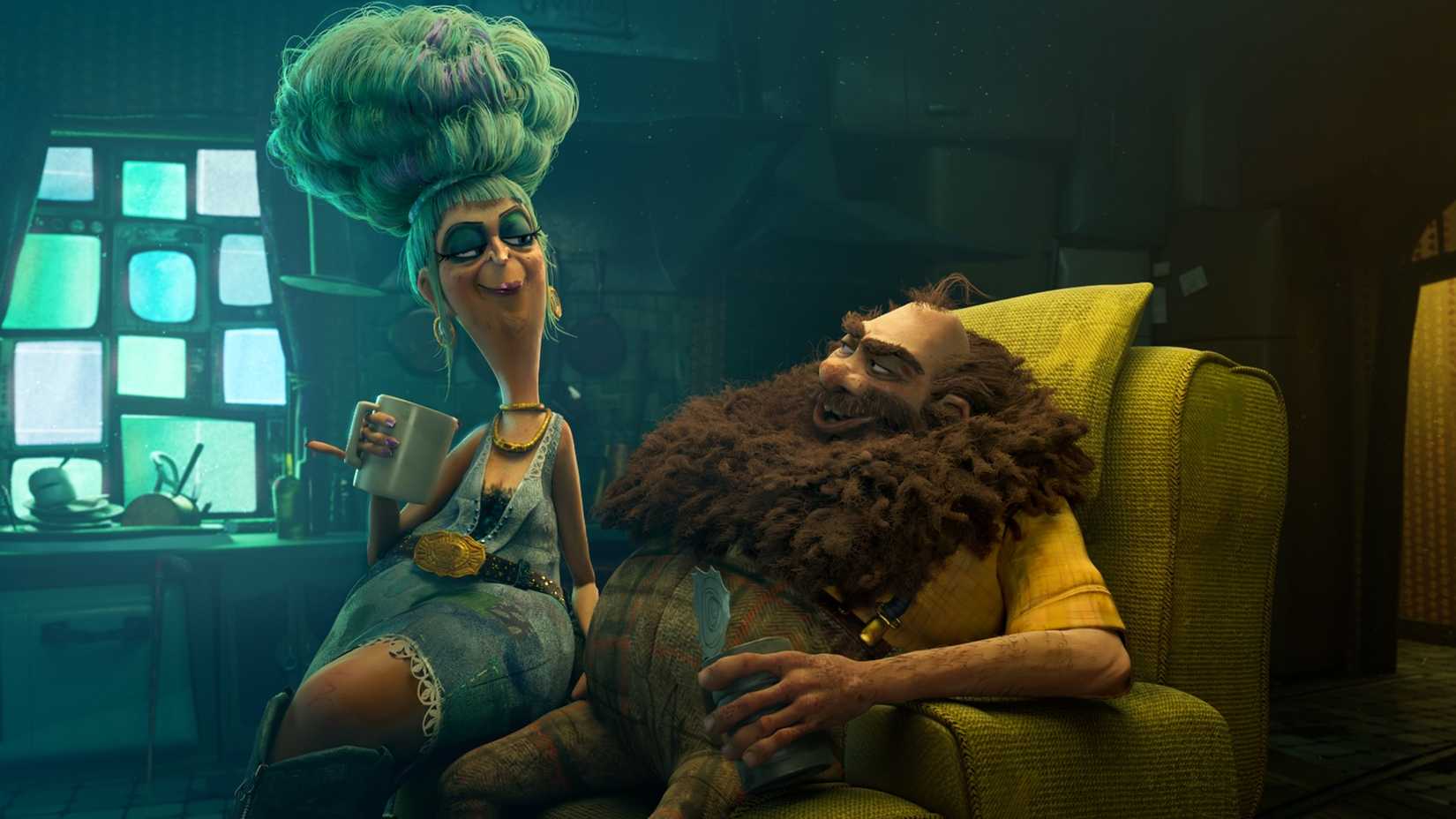
Visually and tonally, the film is a collage of influences. Johnston shared concept art that nodded to everything from Monty Python and the anarchic British sitcom The Young Ones to the oddball surrealism of Jean‑Pierre Jeunet’s Delicatessen and The City of Lost Children. Other touchstones included Raising Arizona, Shaun of the Dead, Parasite, and even the maximalist carnival sensibility of Fellini. That eclectic stew helps explain the movie’s darker palette: Johnston deliberately avoided the saccharine brightness common to children’s animation, favoring shadow, grime and tactile detail so the world feels lived‑in—the wallpaper soaked in chicken grease, the faint stink of cigarettes—rather than sanitized.
That approach raises an important question: how faithful is this to Dahl? Johnston leans into Dahl’s mischievous cruelty but softens some edges in service of empathy. Dahl’s work is beloved for its moral clarity and blunt comedic nastiness, but it also carries offensive attitudes present in the author’s private views and, at times, his prose. Johnston says he liked Dahl’s idea that good thoughts can transform a person, but he deliberately avoided literalizing physical ugliness; instead he opted to apply the sentiment to the film’s broader emotional landscape.
It’s a delicate balance. The very things that make Dahl’s stories thrilling—their sharpness, their refusal to forgive adult corruption—can be blunted when an adaptation trades absolutes for nuance. Johnston cites Gene Wilder’s Willy Wonka as a guiding touchstone: dark, strange, funny and tender all at once. Translating that tonal tightrope to the present day is a challenge the film’s creators clearly embraced, but how audiences respond remains to be seen.

Adaptation has always required tradeoffs. Dahl’s books remain wildly popular because they deliver sharp moral punch and unbridled imagination; they also reflect attitudes that modern adaptors must confront. Johnston opted to preserve the inventiveness and wicked humor while reworking elements that felt morally or tonally out of step. The result is a bold, sometimes messy reinvention that aims to be entertaining, provocative and emotionally clear—if not strictly faithful to every detail of the source material.
The Twits premieres on Netflix on October 17, 2025.
Source: Polygon
Related articles
 Lilly Wachowski disavows involvement in the new “Matrix” film
 Kane Parsons to Return to The Backrooms
 First Emmy Award Winners Announced
 Robert Pattinson calls ‘The Batman’ sequel ‘radical’
 A24 to release documentary on Elizabeth Holmes
 Nolan’s “Oppenheimer” Surpasses “Spider-Man” at the Box Office
 Natalie Portman Becomes a Mother for the Third Time
 Zach Cregger Will Not Direct Franchises After “Resident Evil”