
Developer Diary: The Dutch East Indies
Selamat siang, Sugeng sonten, Wilujeng sonten, Rahajeng sore, and Goedemiddag to you all! I’m Pdx_lily, and it’s a pleasure to host today’s developer diary focused on the Dutch East Indies—or as it is commonly known, Indonesia. Throughout this piece, I’ll be using these names, along with “the East Indies” or simply “the Indies,” interchangeably.
Historical Context: Legacy and Evolution
By 1936, the Dutch East Indies stood as one of the longest-enduring colonial territories in history, having remained under Dutch administration for nearly three and a half centuries. Spanning a vast archipelago of over 17,000 islands, the region is a tapestry of hundreds of distinct ethnic groups, languages, and cultural traditions.
Despite this immense internal diversity, the shared experience of colonial subjugation has forged a unified national identity. “Indonesian” is a relatively modern term, gaining significant traction only since the 1920s as a symbol of collective resistance and unity.
The Princely States
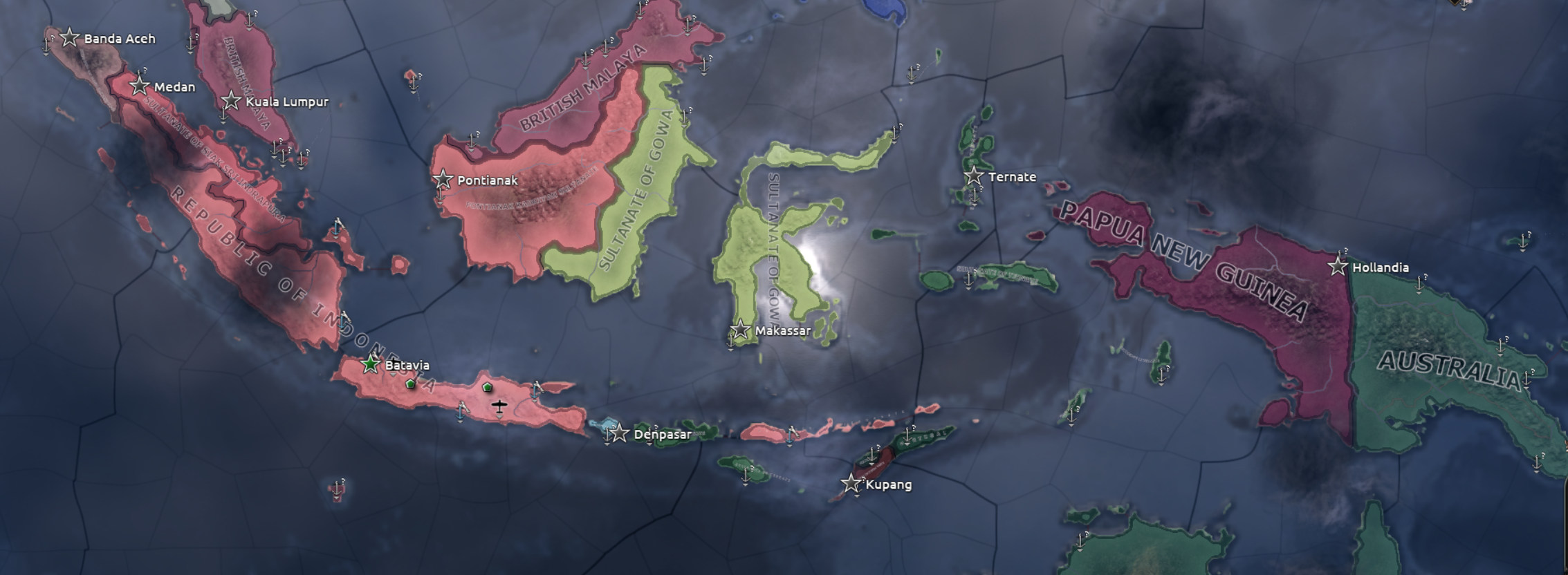
Given the sheer scale of the archipelago, the Netherlands exerted varying degrees of control. While some regions were firmly under direct administration, others—particularly in the eastern reaches—were classified as “Self-ruling regions” (zelfbesturende landschappen). In these areas, local sultans and monarchs retained a measure of autonomy.
We have chosen to model these territories similarly to the princely states of India. They begin as non-core regions boasting high compliance and minimal resistance. Players will find multiple pathways within the political and generic focus trees to integrate or core these states as their influence grows.
Economic Challenges and Potential
The East Indies are an economic powerhouse, responsible for over a third of global rubber production and serving as a vital source of oil, bauxite, tin, quinine, and sugar. However, in 1936, the lingering effects of the Great Depression have crippled international trade. Relying heavily on a single-market export strategy has left the Indonesian economy in a precarious state.
As global demand slowly recovers, the East Indies find themselves at a crossroads. Will you prioritize the revival of your export sector, or will you pivot toward economic diversification?
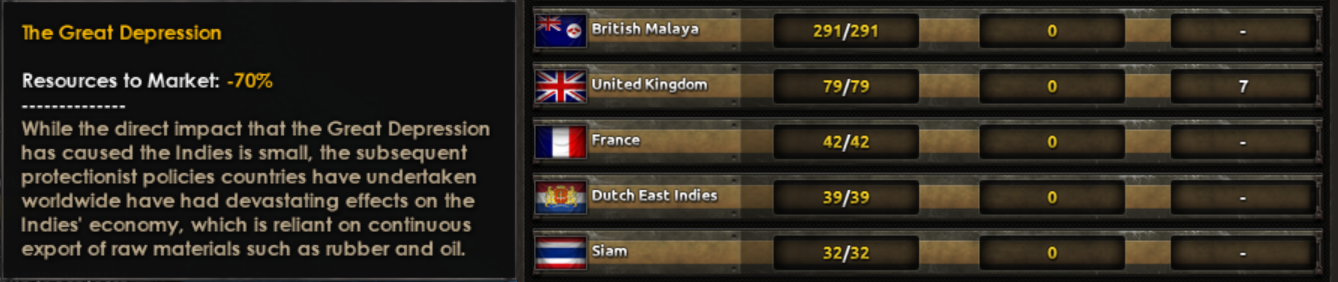
Mechanically, we’ve introduced a national spirit that caps resource exports. The industrial focus tree allows players to mitigate these limits, though often at the expense of true diversification. Furthermore, while the Bangka and Belitung islands are rich in bauxite—essential for aluminum production—the lack of local infrastructure forces the player to choose between immediate profit from raw material exports or long-term investment in refining capabilities.
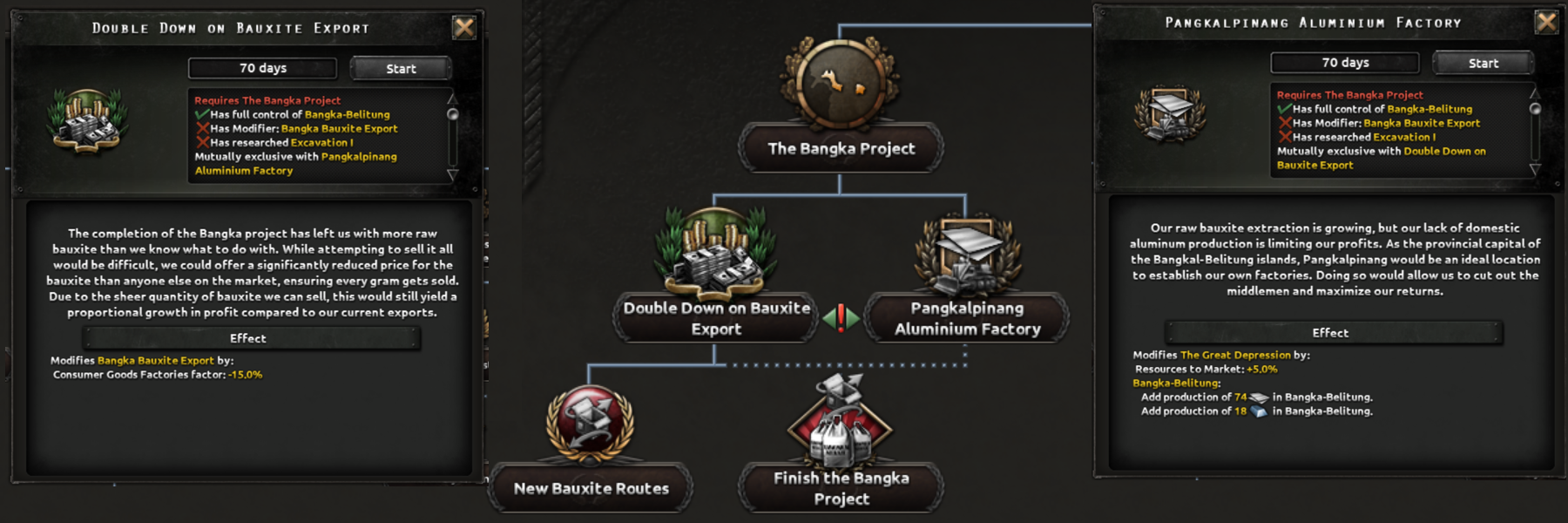
The industry branch offers a pivotal choice: collaborate with Western firms to offload resources cheaply while fostering local growth, or forge new trade deals within the Asian market—potentially at the cost of Dutch diplomatic favor.
The Soetardjo Petition
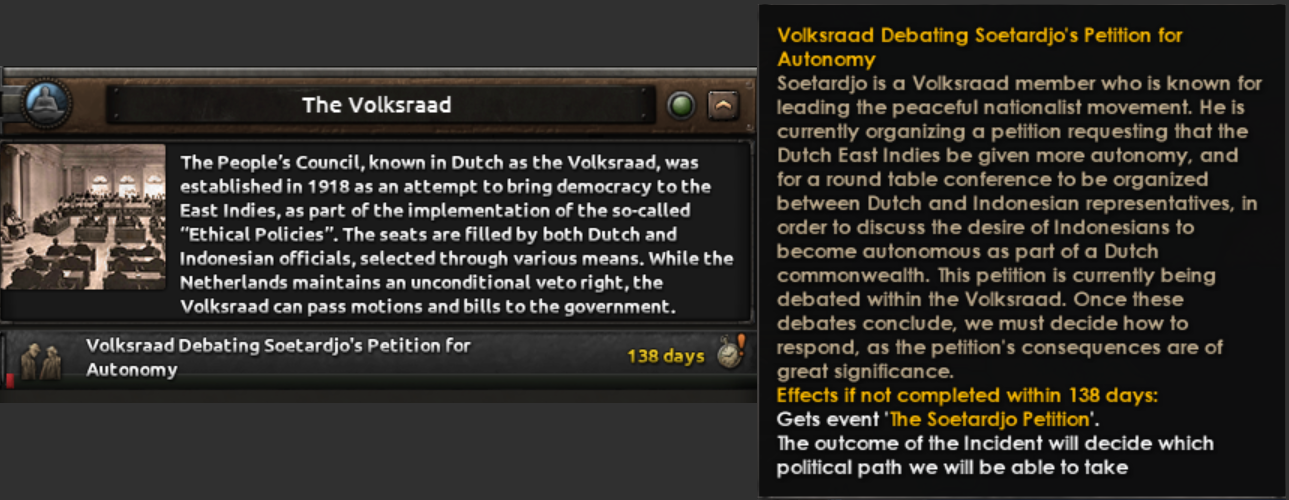
In 1936, the legislative landscape was dominated by the debate over the Soetardjo petition, which advocated for gradual autonomy under the Dutch crown, mirroring the status of the British Dominions. Players will have 140 days before a vote determines their path—whether to align with the Loyalist movement, oppose the petition, or denounce the government entirely in favor of revolution.
The Loyalist Branch
If the Loyalist path is chosen, both the Netherlands and the Indies gain access to shared focus trees covering political, economic, and military development. This creates a fascinating tug-of-war: the Netherlands can invest to tighten their control, while the Indies can work toward the objectives of the Soetardjo petition to secure autonomy. These capstone focuses are mutually exclusive, forcing a race between the two nations to cement their influence.
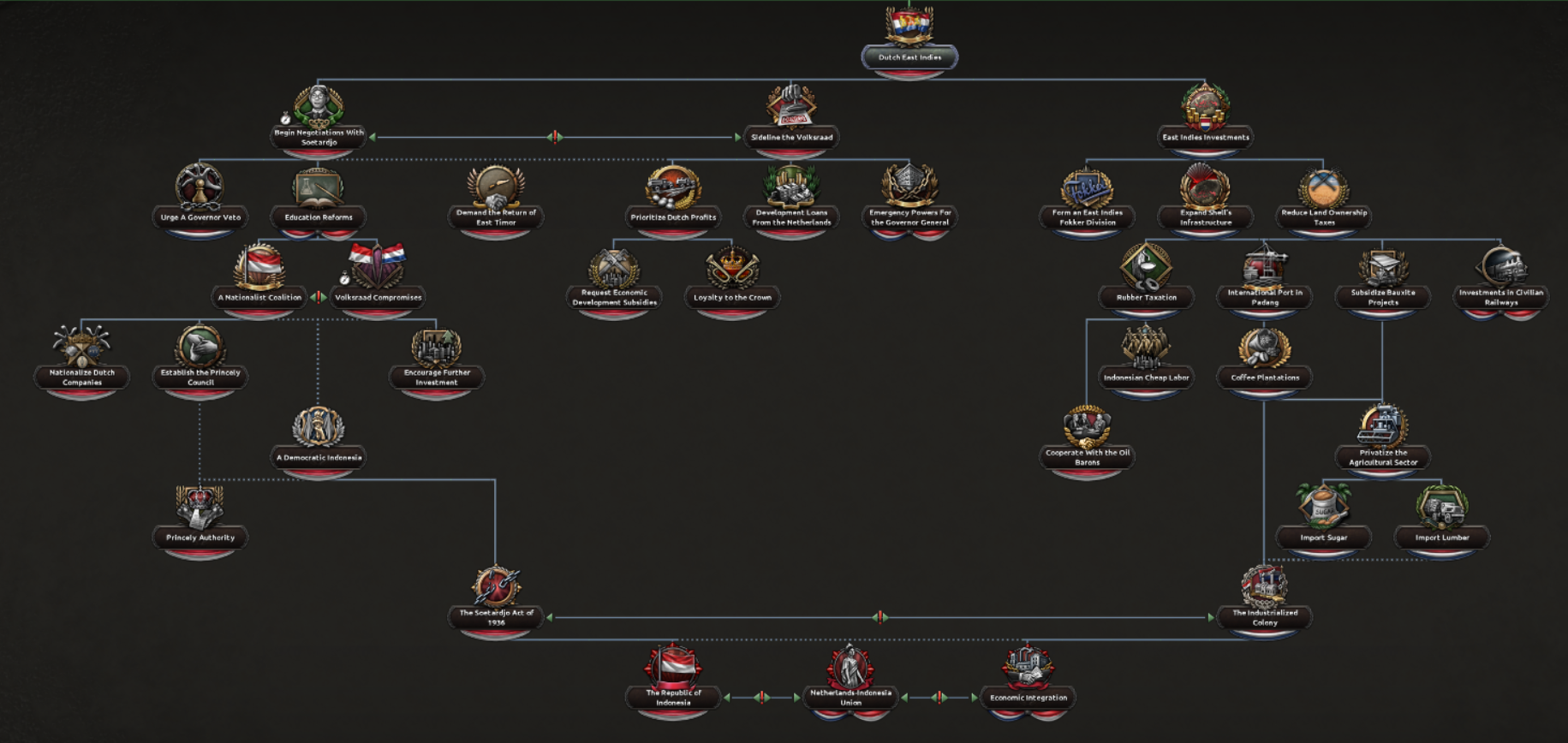
To ensure this mechanic isn’t disrupted by AI unpredictability, we’ve added modifiers that allow players to influence the likelihood of the AI engaging with these joint focuses, ensuring a more dynamic gameplay experience.
The Volksraad
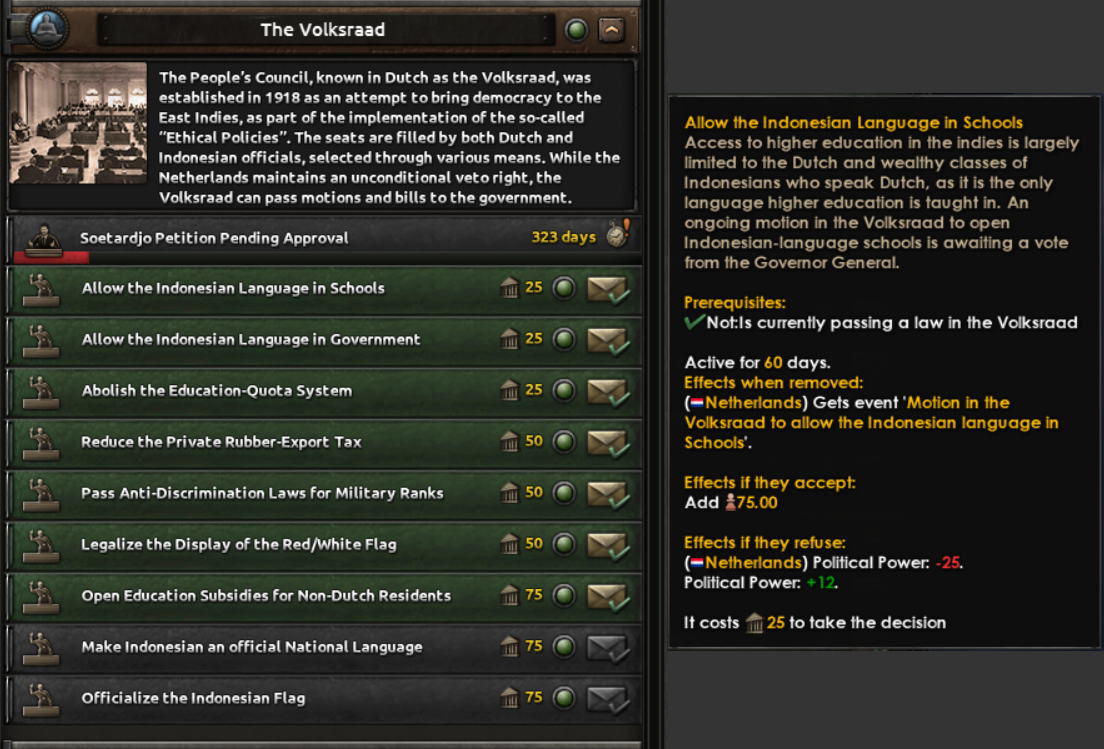
The Volksraad (People’s Council) was the most significant semi-legislative body in the colony. We’ve implemented a decision system where players can navigate this council to pass autonomy-boosting legislation, though the Dutch retain the power to veto these petitions, forcing the player to re-strategize their political approach.
Military Cooperation and Occupation
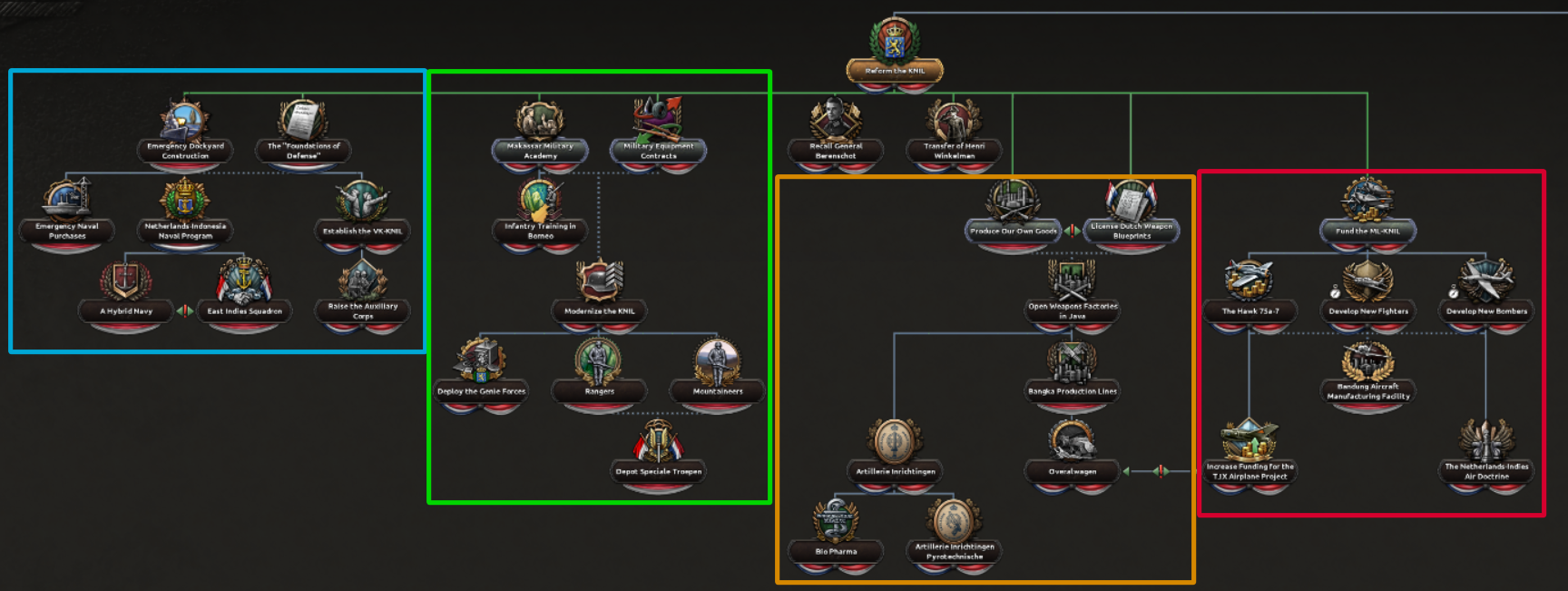
Given the interconnected nature of the Royal Netherlands East Indies Army (KNIL) and the Dutch military, we’ve replaced generic army branches with a joint tree. This system rewards both the initiator and their partner, ensuring both nations evolve in tandem. Additionally, if you find yourself occupied, a specialized “Resisting Occupation” branch activates, offering distinct strategic choices for defending the archipelago.
For those occupied by Japan, the “Seize the Opportunity” focus provides a way to break free from the puppet status once the tide of the war shifts, allowing a mid-game transition to the revolutionary path.
Thank you for following along with this deep dive. Stay tuned for our next diary, where we will explore the intricacies of the revolutionary path. I look forward to answering your questions in the comments below!
Related articles
 HOI IV Developer Diary | Romania: A Flawed Democracy
 Developer Corner & Open Beta: Energy #2
 Hearts of Iron IV Dev Corner | Strikes!
 Hearts of Iron IV Dev Corner: Old Canada Questions Before New Canada
 Hearts of Iron IV Dev Corner | Energy
 Steam Autumn Sale 2026
 HOI IV Dev Corner | The Great Depression
 Hearts of Iron IV | Patch 1.19.3