
City Corner #14 – Shaping the Environment

Greetings, Mayors!
Welcome back to another edition of City Corner, doubling as our latest Developer Diary. Following our deep dive into the design philosophy behind Park Adventures, we are shifting our focus to a feature that transforms your metropolis long before you lay down your very first asphalt road: the natural environment. From sprawling regional horizons to the very soil beneath your citizens’ feet, there is far more depth to the world than meets the eye. Who better to walk us through these updates than the creators crafting them?
For today’s feature, we sat down with two members of the development team—an artist and a programmer—to discuss the intricate process of shaping the world of Cities: Skylines II, the hurdles we overcame along the way, and what players can anticipate from the environmental enhancements in Park Adventures.
Without further ado, let’s dive right in!
Reimagining Biomes
Our work on the overhauled biomes began with a critical look at the vanilla maps. Our consensus? “They feel a bit uniform, don’t they?” Fortunately, the foundational architecture for climate settings and basic biomes was already woven into the codebase of Cities: Skylines II. Our mission was to harness these systems more effectively, giving distinct environments a much sharper, more authentic identity.
A biome should be far more than just a label assigned at the start of a new campaign. It ought to dictate local flora, geology, and surrounding atmospheric elements, ensuring the landscape feels entirely cohesive and lifelike. To achieve this, we developed four brand-new biomes tailored to the upcoming maps in Park Adventures: arid, tropical, alpine, and Mediterranean—each featuring bespoke characteristics and vegetation sets.
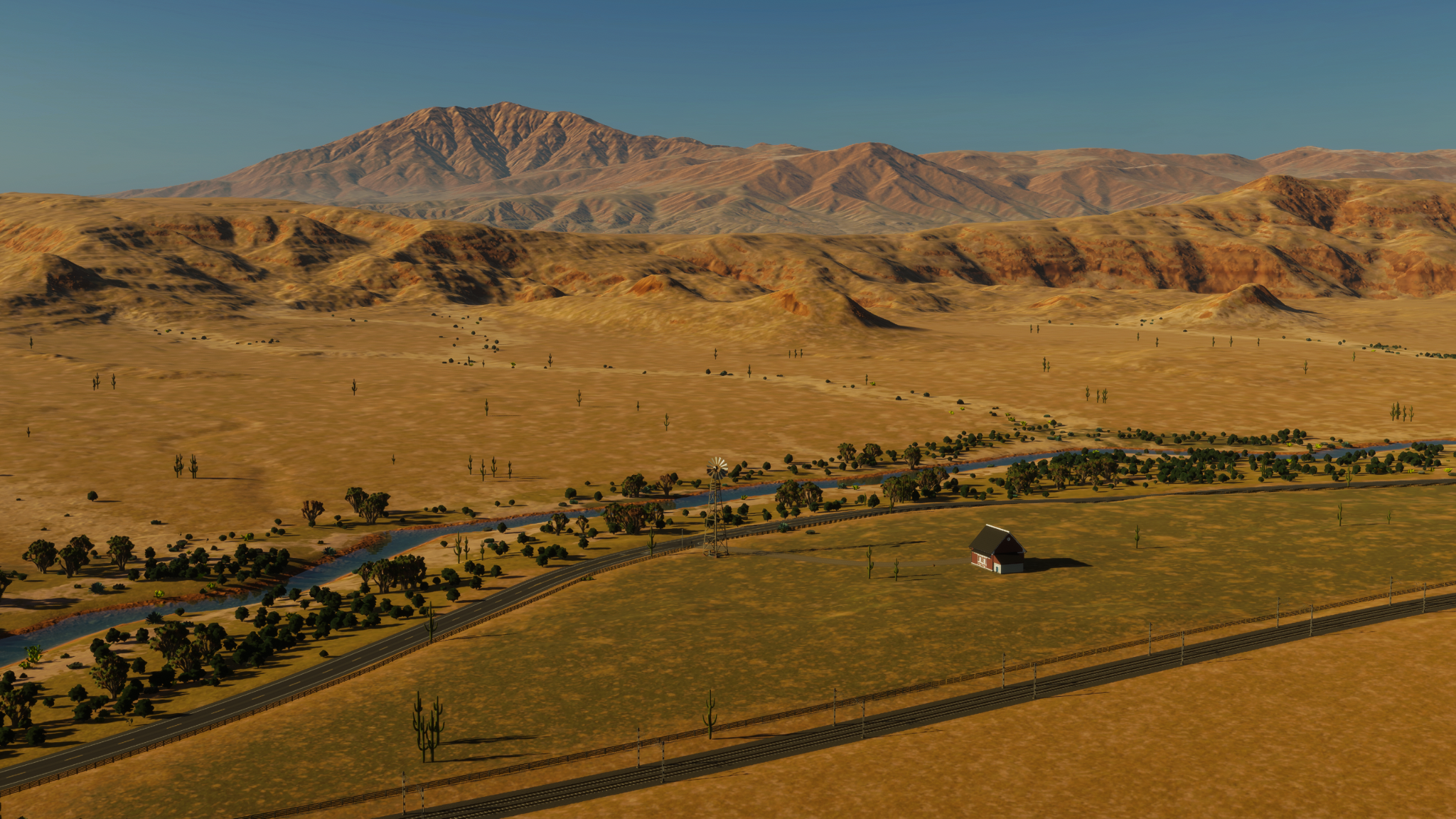
An early look at the newly designed arid biome.
In practice, this means your chosen biome influences naturally occurring elements throughout your city, from the shrubbery sprouting near zoned developments to the mineral formations scattered across the wilderness. In an arid region, for example, residential landscaping adapts to the climate, sprouting resilient cacti rather than the moisture-loving foliage typical of cooler zones. Geological features follow suit, swapping out familiar grey stone for warm, sun-baked red rock formations. Of course, you are never strictly bound by these rules. While the biome dictates natural generation, you remain entirely free to mix and match flora, crafting custom landscapes that defy their natural surroundings.
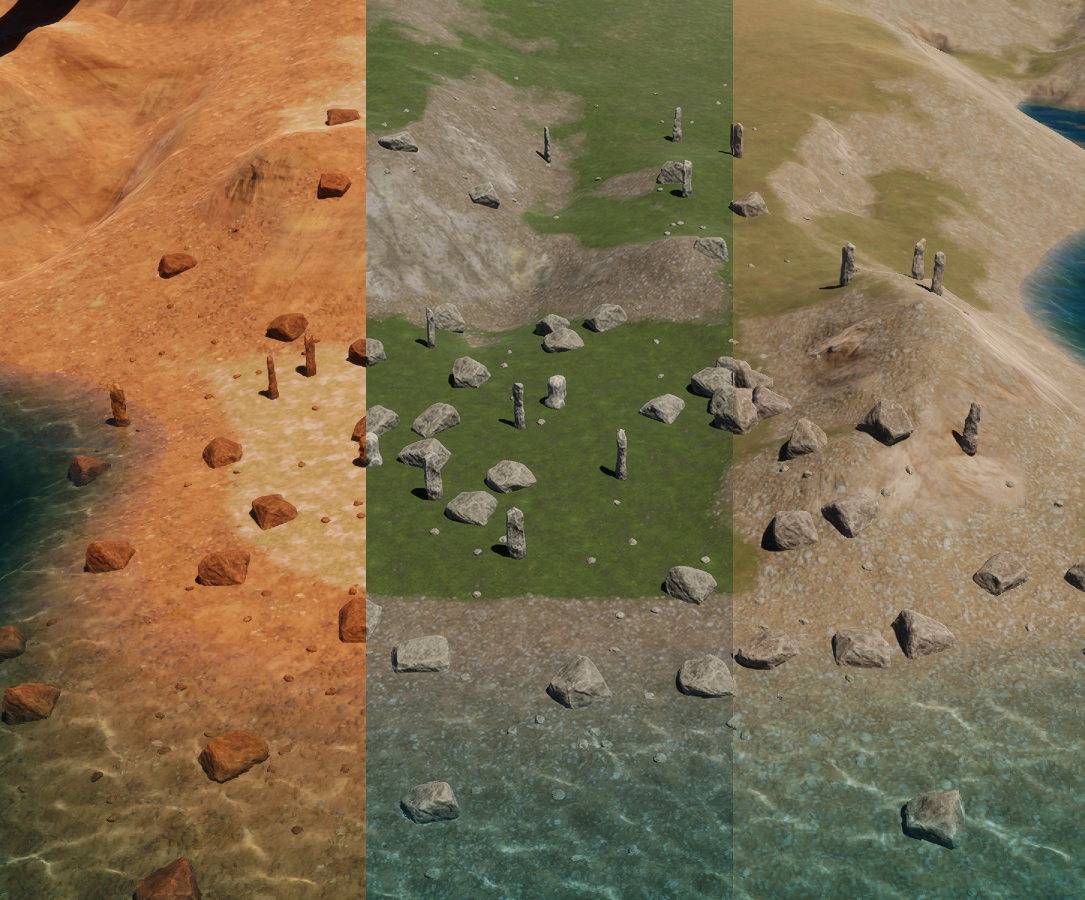
Even mineral and rock tones dynamically adapt to match the local biome.
Achieving this level of harmony requires much more than simply swapping asset packs; the terrain engine itself must support the overarching aesthetic. Ground textures—such as grass, dirt, and sand—must blend seamlessly into one another. Even if individual textures look stunning in isolation, harsh transitions can make a landscape feel disjointed and artificial. Consequently, our new biomes, vegetation libraries, and terrain textures were designed in tandem. A convincing desert requires more than just sandy ground colors; the surrounding plant life and minute details must work together to tell a unified story.
Oh, and one more exciting detail: while the new maps debut alongside Park Adventures, all of these newly minted biomes will be accessible to everyone via the Editor in a free upcoming update!
A Closer Look at Trees
Introducing richer biomes and varied vegetation highlighted an urgent need to elevate the visual fidelity of our trees, particularly how they render across different viewing distances. Up close, our foliage boasts incredible detail. However, when you zoom out to survey your entire skyline, the game must render those same trees much more efficiently. This is where Level of Detail (LOD) systems come into play, dynamically swapping complex 3D assets for streamlined representations based on camera distance.
Rather than manually modeling traditional, high-poly LODs containing thousands of individual branches and polygons, we utilize smart multi-angle photographic representations. This clever technique keeps rendering performance exceptionally smooth, even when dense forests stretch all the way to the horizon. We have fine-tuned these distant models for a crisper look while simultaneously upgrading close-up textures for our new flora. While you might barely notice these refinements on a single isolated sapling, pulling back to gaze over a sprawling urban park or a dense woodland reveals a dramatic leap in visual quality.
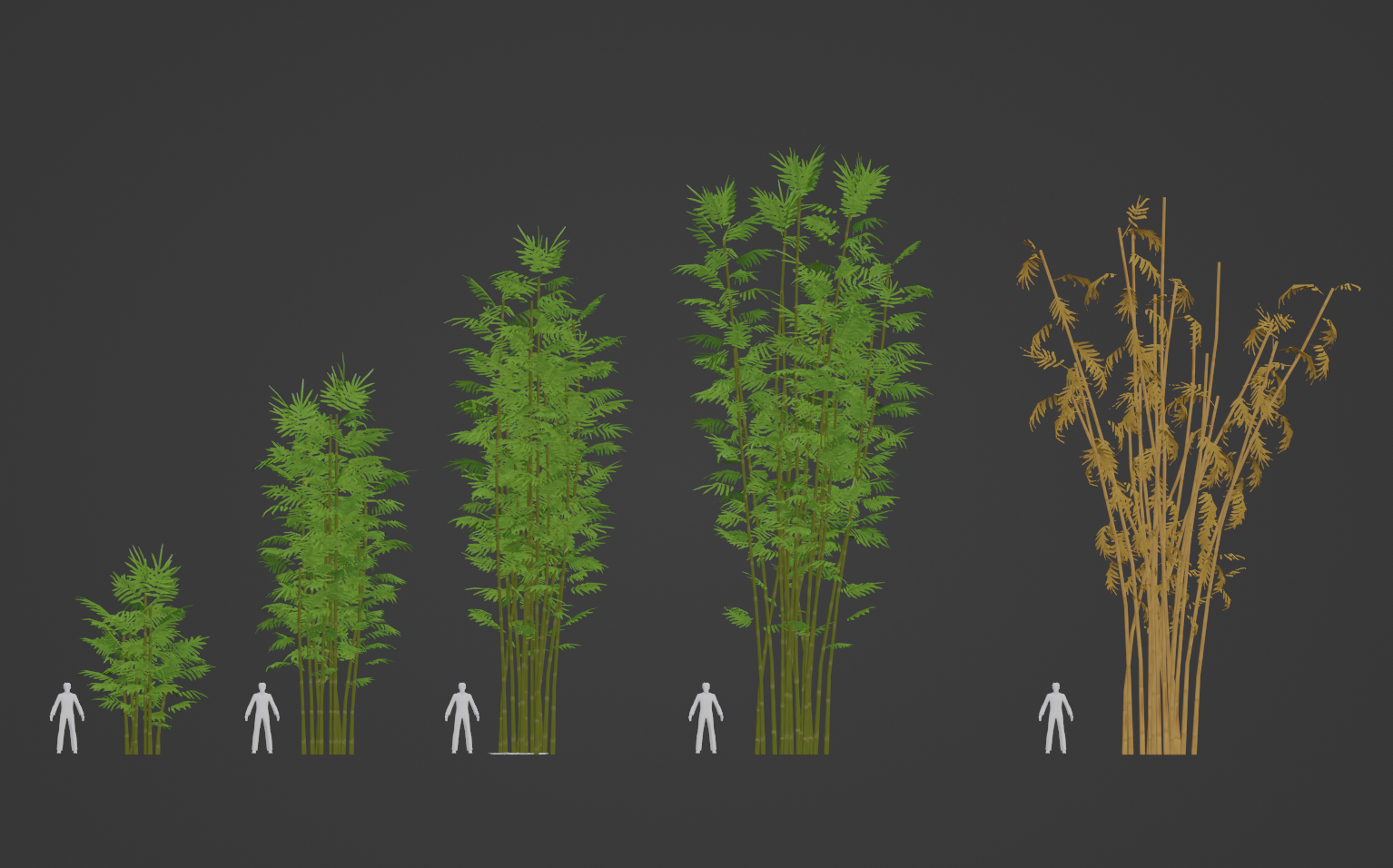
Bamboo is just one of many exciting tree species arriving in the free patch!
Of course, visual upgrades must always be balanced against performance overhead. Alongside our artistic overhaul, we implemented significant structural optimizations—particularly regarding how textures are handled across a tree’s various growth stages. Previously, each phase required a dedicated texture; now, trees of differing ages can intelligently share a single, optimized texture set.
Our ultimate goal is to dramatically enhance environmental realism without inflicting unnecessary performance costs. Every tweak is rigorously monitored and tested to ensure that whether you are strolling down a leafy avenue or capturing a sweeping aerial screenshot from miles above, your forests always look their absolute best.
Teamwork Makes the Dream Work
Much of our environmental engineering happens quietly behind the scenes. Some upgrades immediately catch the eye, while others quietly elevate the experience without demanding the spotlight. Introducing a robust new biome might sound straightforward on paper, but it requires countless moving parts to function in unison. Terrain textures must complement the regional style, vegetation must adapt to local climates, and assets need to scale gracefully across varying distances—all while maintaining absolute technical stability behind the scenes.
This is precisely where tight collaboration between our art and programming departments proves invaluable. Crafting a brilliant texture or modeling a new tree is only half the battle; ensuring it behaves flawlessly within the live game engine is another challenge entirely. Environmental design is an iterative loop of testing, feedback, and refinement until every element clicks into place.
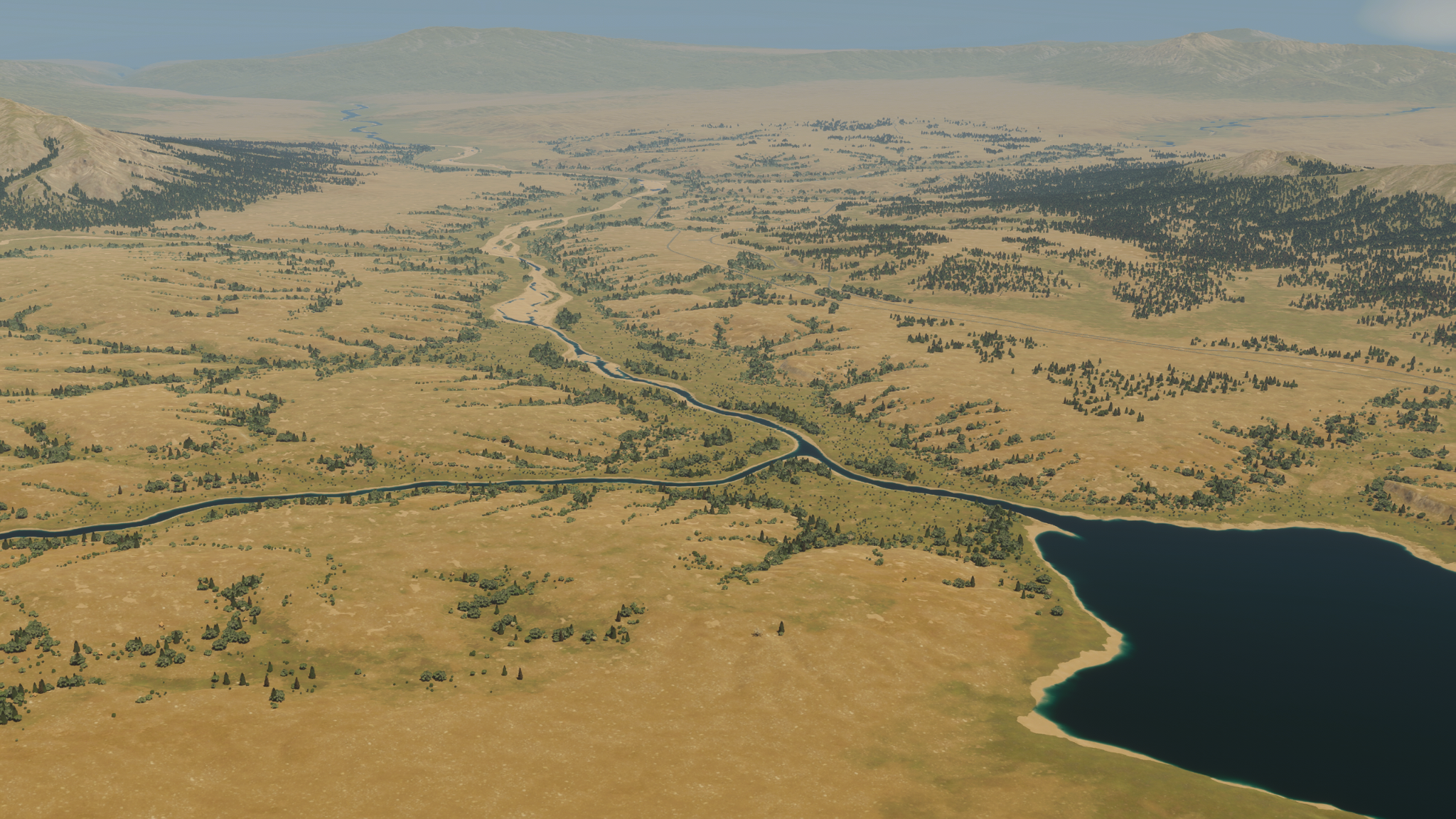
Furthermore, much of this foundational work paves the way for features extending far beyond Park Adventures. Upgraded terrain textures not only support our new biomes but also grant us greater creative flexibility for future environmental expansions. The same philosophy applies to our underlying tools, which continually streamline how we sculpt and refine landscapes.
You may recall earlier updates, such as the terrain painting tool. Improvements like those establish the framework for deeper, more intricate environments, even if their full potential isn’t immediately obvious at launch. Often, what appears to be a single feature is actually a vital building block for everything that follows.
On the Horizon
Developing these dynamic new biomes, textures, and botanical assets has been an exhilarating journey—one we are eager to continue well into the future. We are genuinely thrilled to witness what you create with these new tools and maps. Handing over the building blocks is only part of the fun; seeing how our community combines and plays with them is where the real magic happens. Whether you are constructing a coastal city buried in tropical palms, carving out a secluded alpine village, or experimenting with entirely eclectic landscapes, the creative possibilities are virtually endless.
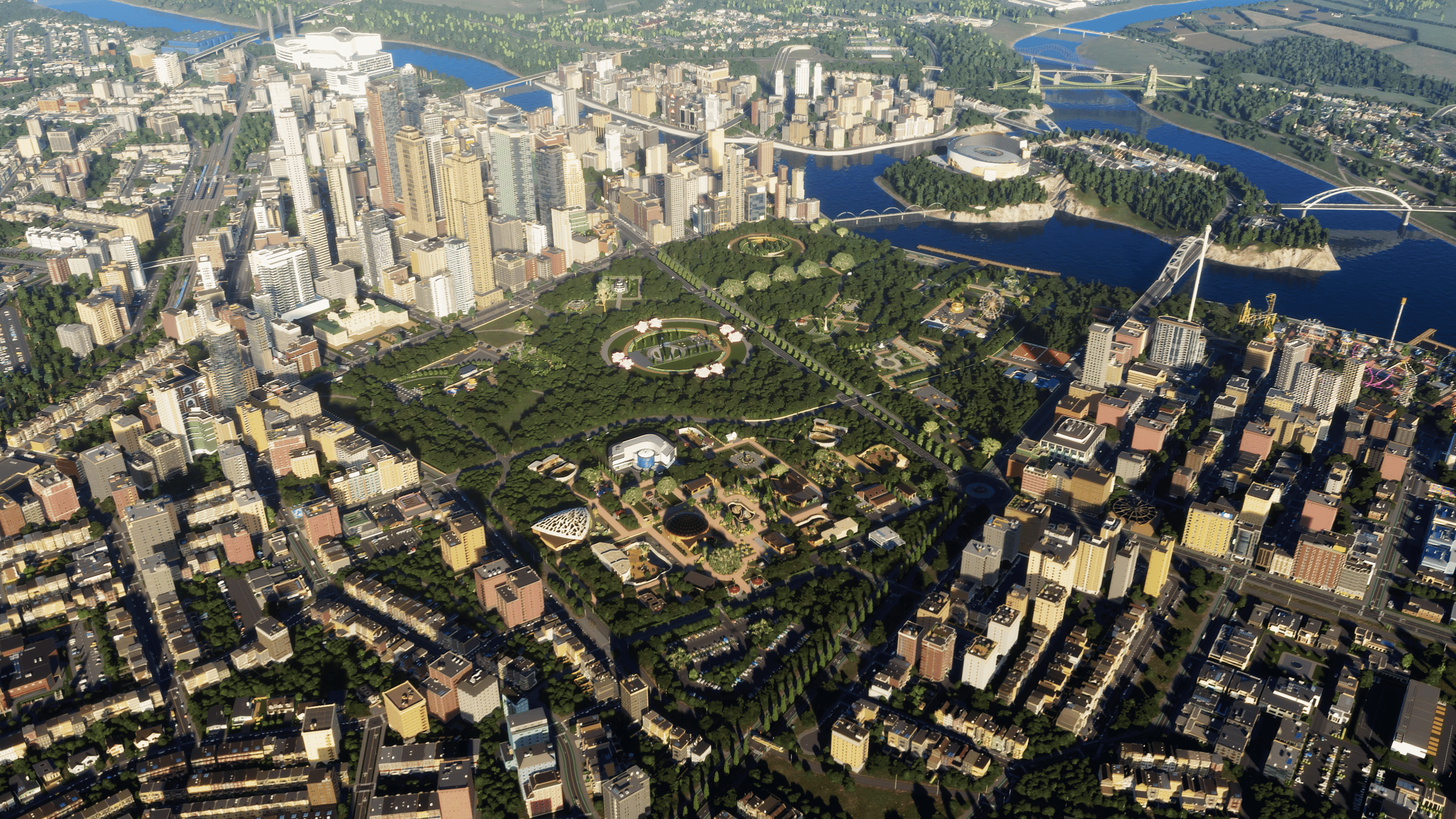
While we have plenty of long-term ideas waiting in the wings, these new biomes, ground textures, and graphical upgrades represent a monumental stride toward making the world of Cities: Skylines II feel richer and more cohesive. Some improvements will catch your eye the moment you pause to admire the scenery, while others will quietly work their magic in the background.
And with that, we have reached the end of today’s City Corner! Don’t worry, though—we will be back very soon with another installment as we still have plenty of exciting developments to share. Until then, happy building!
Related articles
 Designing Park Adventures: City Corner #13
 Cities: Skylines II is featured in the Paradox Interactive Autumn Sale!
 Patch 1.6.2f1 – Autumn Breeze
 Official Q&A Thread | 2026
 City Corner #12: Collected Questions
 City Corner No. 11: Autumn Breeze
 City Corner #10 – Expanding the Modding Tools
 City Corner #9 – Happy Six-Month Anniversary!