
Designing Park Adventures: City Corner #13

Greetings, Mayors!
It is time for another edition of City Corner, though we are shaking things up today with something entirely different: a dedicated Developer Diary! We recently sat down with our designer, Jesse, and programmer, Marko, to discuss our upcoming expansion, Park Adventures. Specifically, we explored how the DLC originated, where the initial concepts took shape, what our core objectives were, and how those early ideas evolved into the experience you see today.
This article marks the first installment in an upcoming series of developer insights. Over the coming weeks, various members of the team will share their personal perspectives and experiences regarding the development of Park Adventures. There is a wealth of ground to cover, so you can look forward to many more updates soon!
We hope you are just as thrilled as we are for this upcoming journey. Sit back, unwind, and let’s dive straight into the details!
Building from the Ground Up
One of the earliest and most consequential decisions in designing Park Adventures was the concept that a park should be a completely player-defined space. We toyed with several initial concepts—such as establishing a single anchor building to serve as the main hub. However, after brainstorming various approaches, we moved away from letting a solitary structure or entrance dictate the boundaries of a park. Instead, we drew inspiration from a mechanic you are already familiar with: districts.
The foundational idea evolved into drawing a designated park district to establish the zone, while leaving the internal layout entirely in your hands. Rather than forcing a rigid template, the district provides a cohesive framework for various park features. This grants immense flexibility: multiple park categories can coexist within the same zone, buildings can be freely combined, and you can lay out pedestrian paths and roads however you see fit. Even public transport networks can route directly through the park rather than merely terminating at a predefined gate.
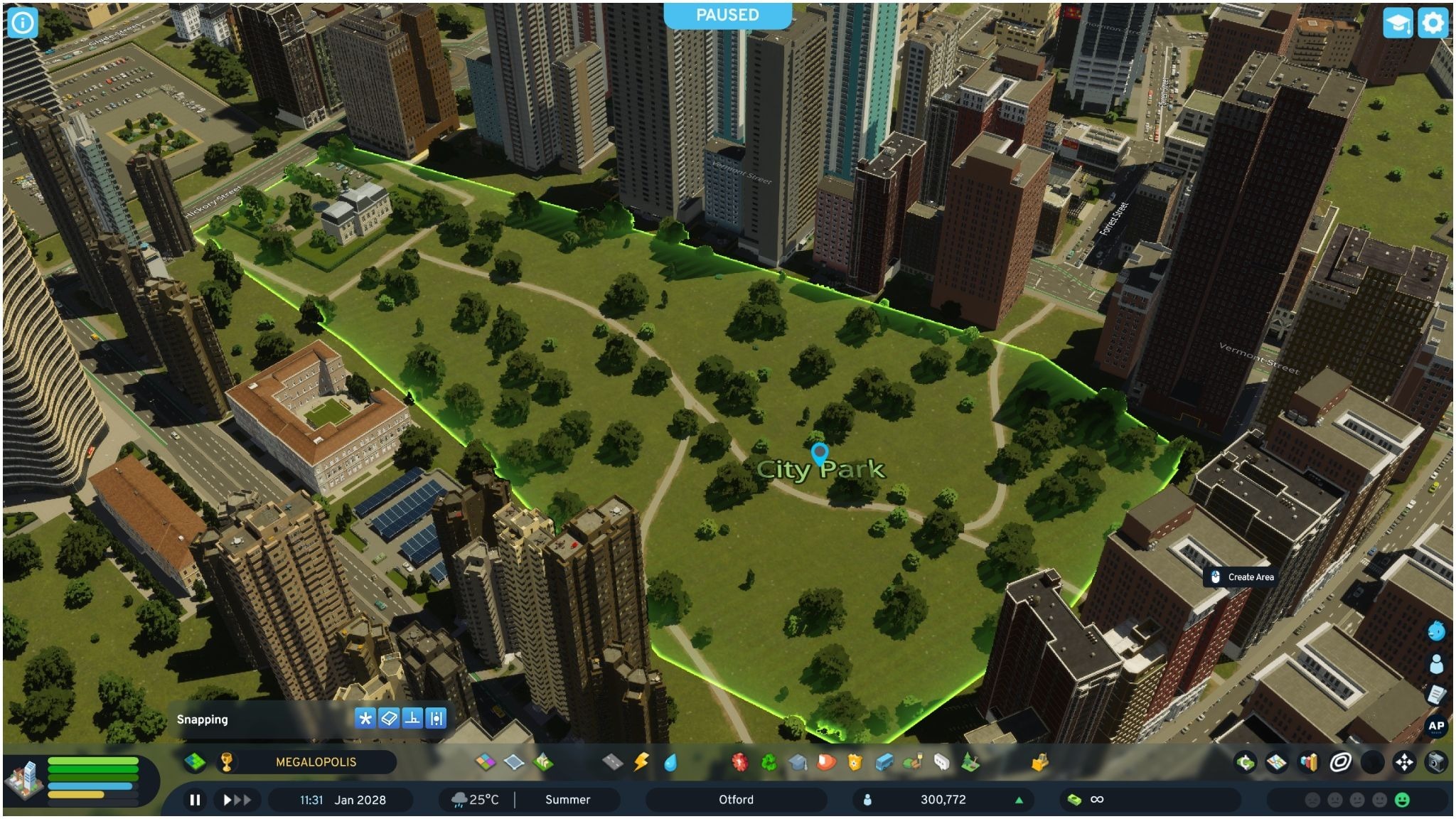
Once you outline your park district, it highlights as a vibrant green zone within your metropolis.
This adaptability became a core priority early in production. We wanted the system to seamlessly complement the organic city-building style of Cities: Skylines II, where you might have a specific aesthetic in mind for a particular location and use existing tools to bring it to life. This philosophy led us to another major choice: park assets do not necessarily need to be restricted inside a park district.
Individual props and buildings can be placed anywhere across your city if you so choose. For example, a carousel intended primarily for an amusement park can easily be integrated into a bustling downtown commercial plaza. During testing, we noticed a neat emergent scenario: a bus station was placed in an established urban district to handle incoming tourists, flanked by an information kiosk, with bus lines ferrying visitors directly to the nearby park. While we hadn’t specifically envisioned that exact use case during asset creation, it perfectly highlighted why maintaining asset versatility was so crucial.
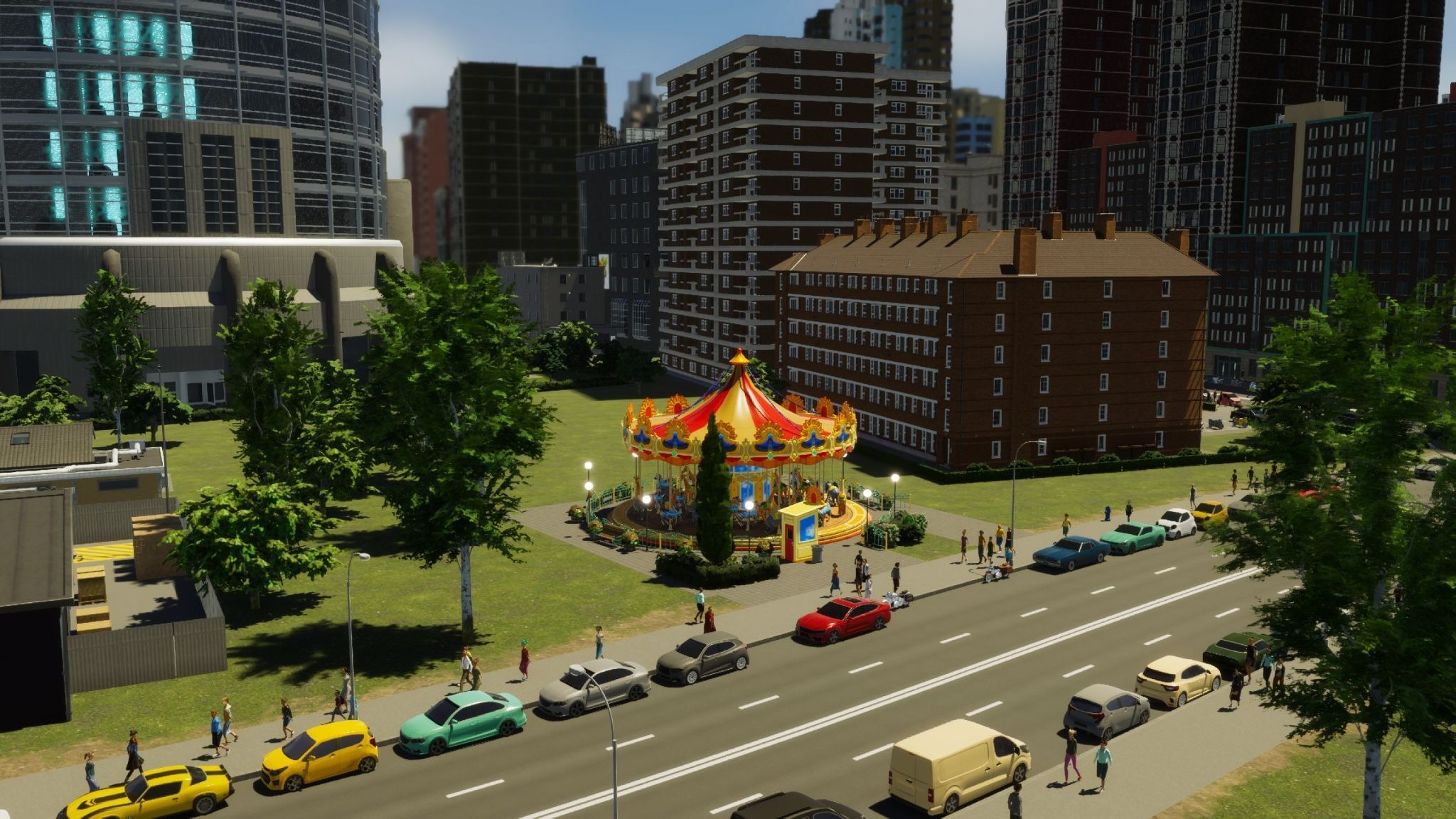
Want to drop a merry-go-round right next to a corporate skyscraper? Go right ahead!
This same flexibility extends to smaller decorative props. Park benches and fixtures can be positioned independently, and many feature functional interactions. Citizens will readily utilize a stray bench even if it sits miles away from the nearest designated park zone. This overarching design philosophy remained our guiding light: provide the simulation with enough structure to understand what is happening, without ever dictating what your city must look like.
The Core Gameplay Loop
Once we finalized the district system, we turned our attention to the actual gameplay experience of populating these areas. The core loop is intuitive: draw your park zone, place your preferred attractions, and observe your citizens as they explore and interact with the space. Visitor foot traffic generates experience points for specific park types, gradually unlocking new structures as the facility prospers.
We ultimately designed four distinct park specializations: Amusement Parks, Zoos, Nature Reserves, and City Parks. Crucially, the zone itself doesn’t lock you into a single category; instead, the buildings you choose dictate the park’s focus, and these styles can be freely blended together. This allows you to pivot your design philosophy organically over time rather than committing to a strict master plan before placing your very first asset.
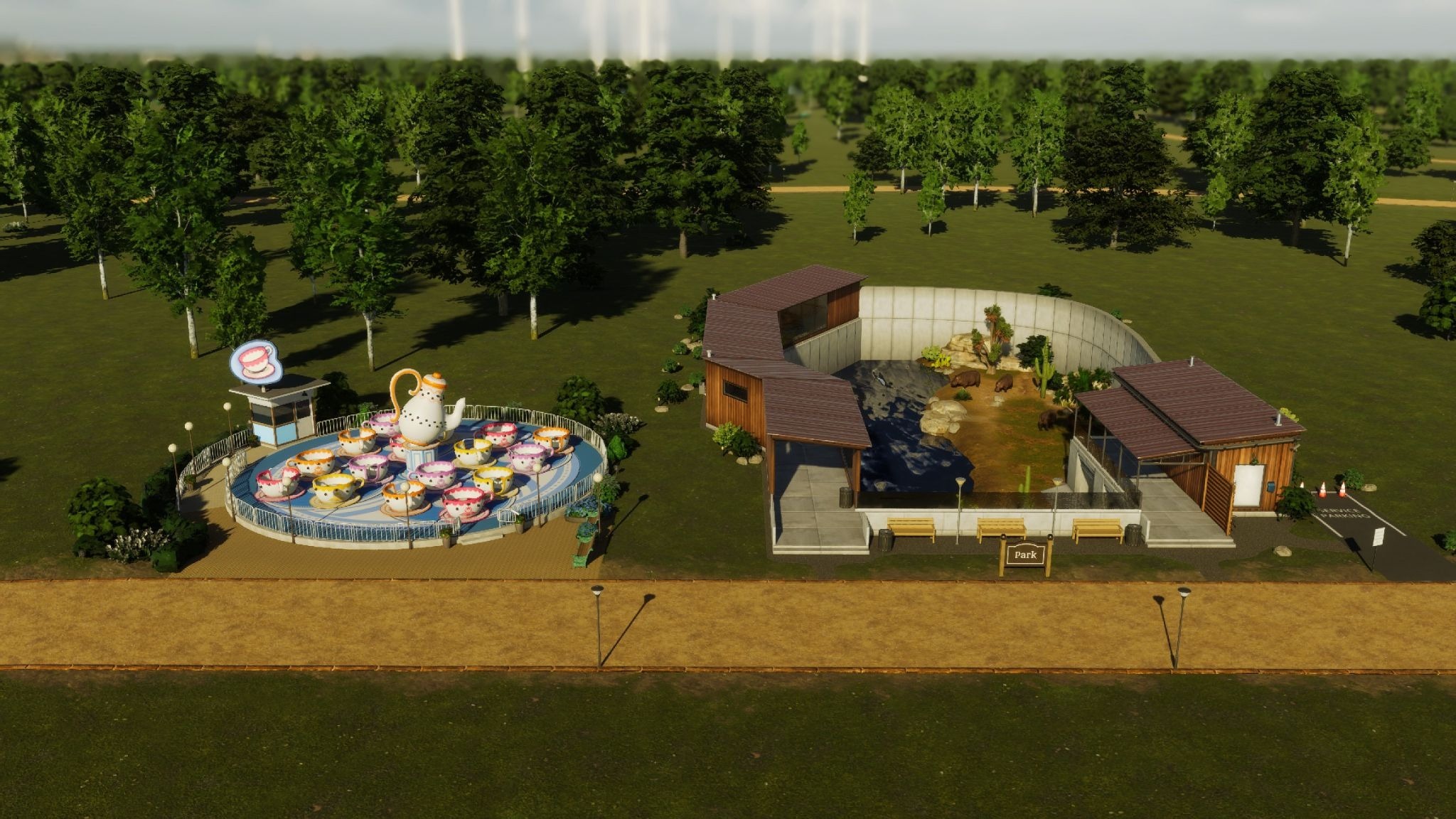
Spinning tea cups and a hippo enclosure showcasing the distinct styles of amusement parks and zoos.
Amusement parks revolve around thrilling rides and attractions, whereas zoos focus on immersive animal habitats. Nature Reserves encourage creative integration with the native terrain, while City Parks are tailored for dense, urban integration. Our progression system mirrors these themes, unlocking specialized assets dynamically based on the specific type of park you are cultivating.
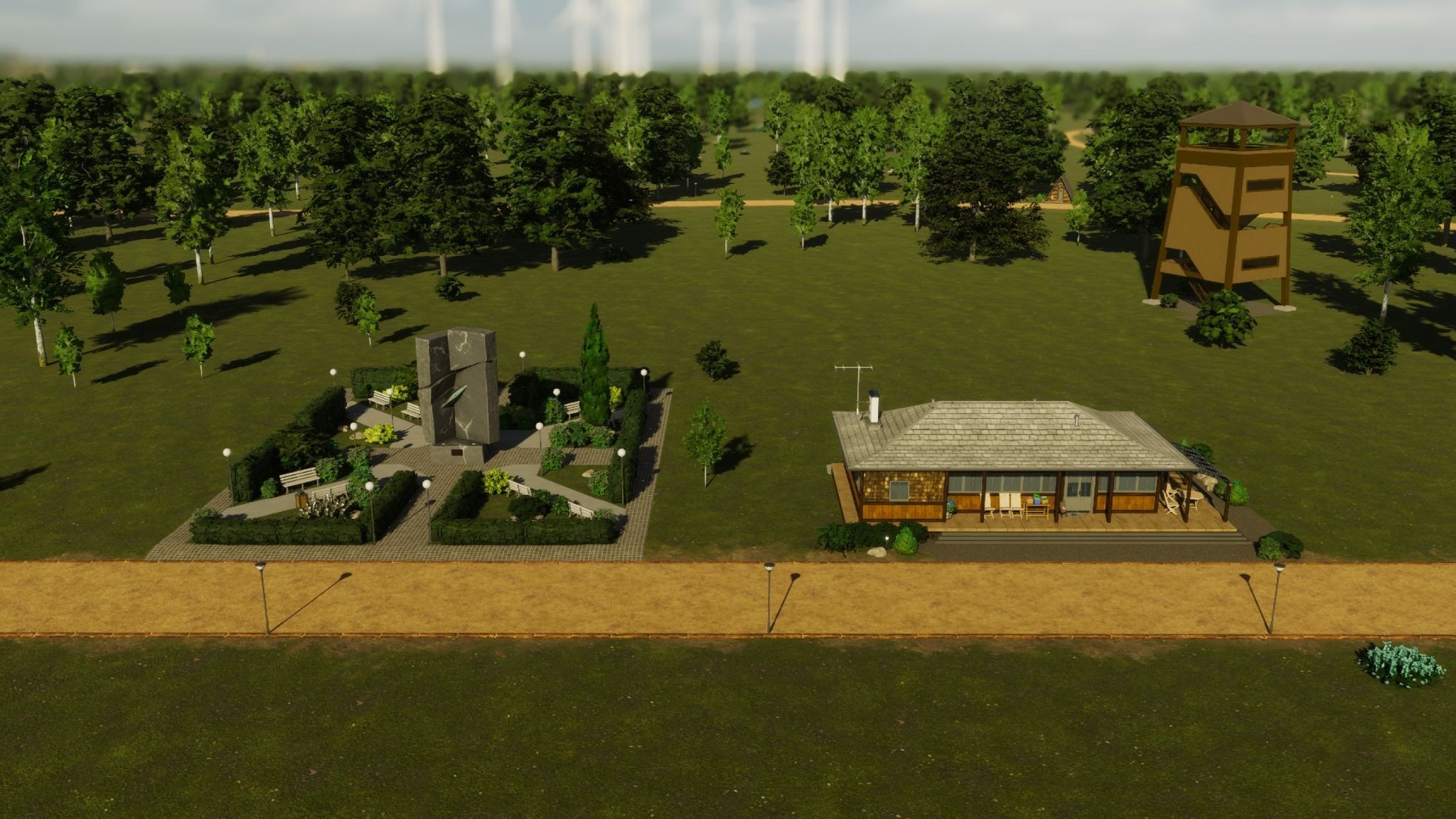
A memorial sculpture and guest lounge highlighting the aesthetic of city parks and nature reserves.
Naturally, placing attractions is merely the first step. A thriving park requires active management—facilities demand staff and maintenance, and operational efficiency directly impacts guest satisfaction. Essential amenities like restrooms, eateries, and information kiosks play a vital supporting role. While they might not be the primary draw for visitors, they are indispensable to the overall guest experience. Furthermore, management levers such as staffing budgets, maintenance allocations, entry fees, and park policies allow you to fine-tune operations. We wanted Park Adventures to offer engaging management depth without ever feeling disconnected from the broader city ecosystem.
Reimagining Leisure
As development progressed, we encountered a broader systemic challenge that could no longer be ignored: the game’s leisure mechanics required a comprehensive overhaul. Previously, the system was quite rudimentary—a citizen would identify a leisure need, find the nearest suitable destination based strictly on distance, and visit it without ever reconsidering their options. This left very little room for the authentic experience of spending a leisurely afternoon in a park.
Our initial experimental approach assigned specific leisure preferences to individual citizens. We explored traits like a desire for excitement, socialization, or relaxation, mapping them roughly to different age groups—children seeking thrills, adults looking to socialize, and elders desiring tranquility.
While intriguing on paper, this quickly introduced complications. If a visitor held a rigid preference and a park lacked that exact activity, they would invariably leave disappointed. Moreover, we wanted to avoid micro-managing every citizen’s hyper-specific needs. Given that working adults make up roughly 60–70% of the demographic distribution, this approach would have essentially funneled every player into building just one type of park.
Striking a balance between believable individual behavior and a legible, macro-level simulation was essential. Consequently, we shifted our focus toward evaluating the park as a holistic entity while still empowering individual visitors to make autonomous choices. A major breakthrough was factoring in more than just proximity. Destination capacity now plays a vital role; if a particular venue is overwhelmingly crowded, a citizen may wisely opt for an alternative park further down the road. Furthermore, the overall condition and quality of leisure spots heavily influence their decisions.
Visitors continuously reassess their surroundings as they navigate a park. They weigh travel distances against queue lengths and alternative options, dealing with the tangible consequences of those choices. That enticing hot dog stand suddenly loses its appeal if a massive queue forms by the time the hungry citizen reaches the front.
Amenities add yet another layer of complexity. Restaurants function as major attractions, whereas restrooms and snack bars fulfill secondary needs that arise during a long visit. The availability and quality of these conveniences directly influence guest satisfaction, which in turn dictates your park’s overall rating.
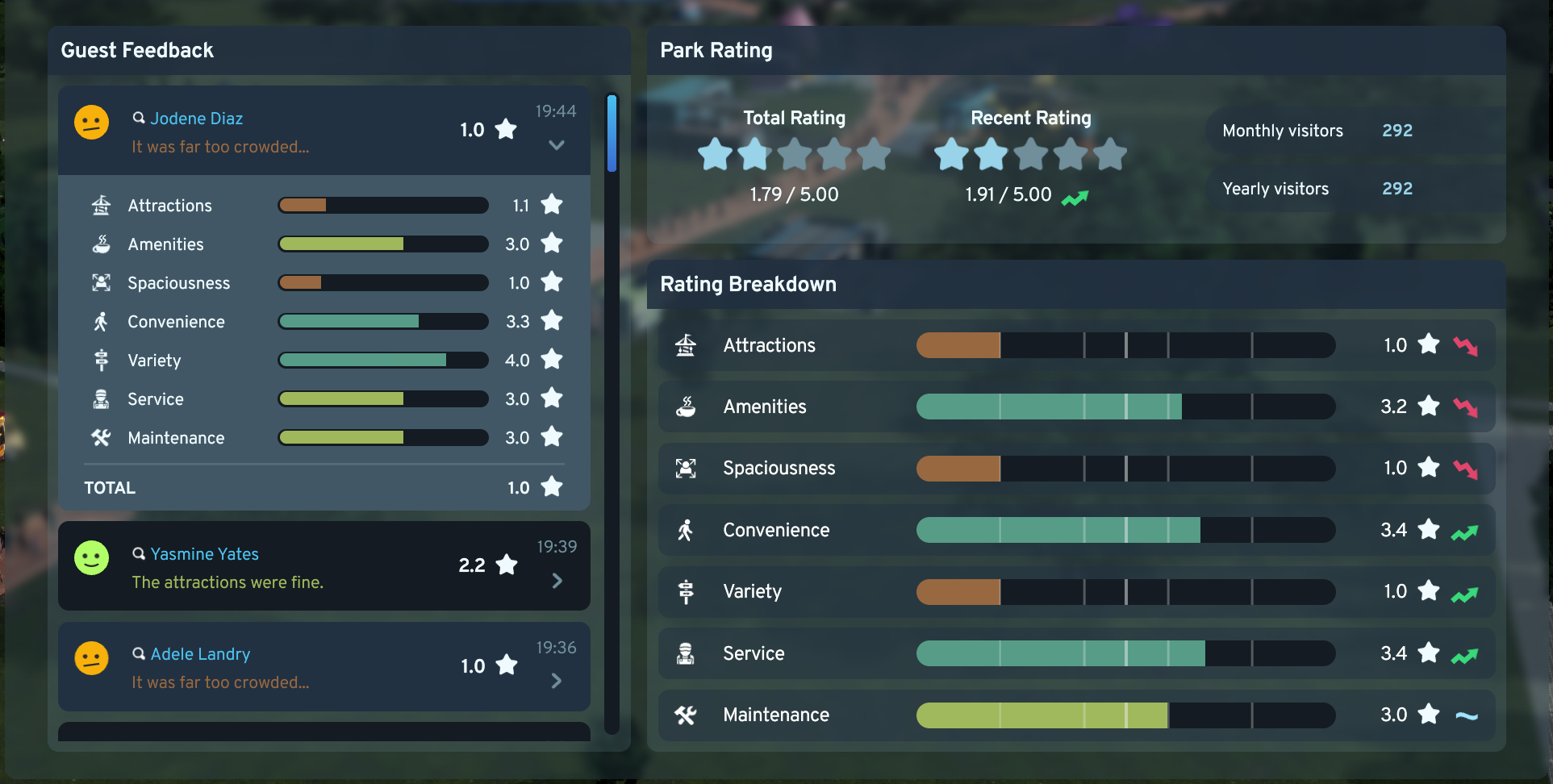
Monitoring guest feedback and park ratings provides clear direction for your next development steps.
Ratings and reviews are designed to make these operational hurdles transparent. Instead of the simulation working entirely behind the scenes, visitor feedback acts as a diagnostic tool to highlight infrastructure bottlenecks. If walking distances are overly punishing, guest reviews will reflect it, empowering you to adjust layouts accordingly. While we continue to refine how this information is presented, the core philosophy remains: citizens are not merely statistics representing foot traffic; they are living barometers of your park’s success.
This distinction is paramount because our overarching goal was to transform leisure from a simple checklist destination into an active, observable activity.
Observing Citizen Life
Naturally, this focus on behavior led us straight to a fundamental question: what do citizens actually do once they arrive? A persistent goal for us has been enhancing the visibility of everyday life within the simulation. While a citizen commuting between two buildings is vital for traffic flow, watching those same individuals pause, interact with their environment, and linger in public spaces breathes incredible life into the world. Leisure proved to be the ideal proving ground for this concept.
Citizens will now visibly queue for attractions, board rides, and observe animal enclosures. While these animations appear seamless during gameplay, they rely on complex underlying systems working in concert. This same logic inspired our interactive props. Rather than deciding to use a specific bench before leaving home, a citizen strolling toward a destination may encounter a suitably placed prop along their route, pause to use it, and then resume their original journey.
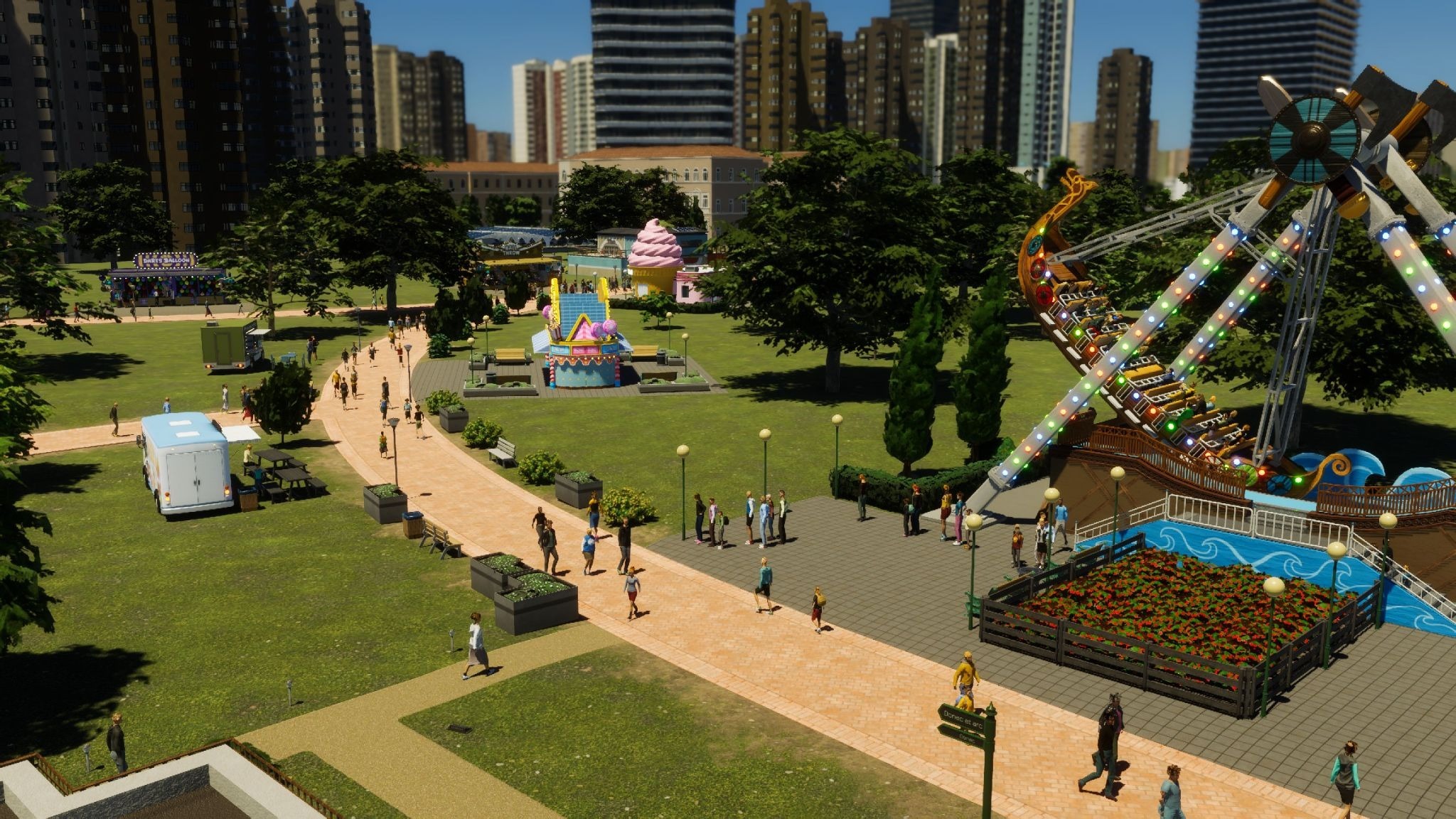
Internally, we refer to this as “Divert” logic. The core idea is that interactions happen organically as part of an ongoing journey rather than completely overriding it. While this remains an ongoing work in progress—we aren’t promising that every single prop in the game will immediately feature swarming crowds—the underlying architecture is fully operational, establishing a robust foundation for future expansions of this mechanic.
This is where simulation mechanics and visual presentation beautifully intersect. We require the park to function logically as a simulation, but we also want the fruits of that simulation to be visually rewarding. If a park boasts countless attractions yet visitors mechanically march to a single building before heading home, much of the underlying complexity goes unnoticed. Seeing crowds disperse, queue up, and engage with their surroundings makes the simulation tangible—a principle that guided every piece of content we crafted.
Final Thoughts
There is one crucial aspect of Park Adventures that is easy to overlook amidst the excitement of the new expansion: a vast majority of these systemic improvements are also arriving as part of the free base game update.
The leisure rework is the prime example of this philosophy. While it originated as a foundational requirement for building immersive parks, these enhancements are not locked behind the DLC. The revamped leisure mechanics, alongside smarter citizen decision-making regarding recreational destinations, will be accessible to all players regardless of whether you purchase Park Adventures.
And that is merely scratching the surface! We are introducing a wealth of visual enhancements and quality-of-life upgrades to the base game, which we will explore in greater detail in upcoming Developer Diaries. Tremendous effort is being poured into these complimentary updates alongside our paid content, ensuring that the benefits extend far beyond parks alone. While Park Adventures is fundamentally about crafting magnificent recreational spaces, the ripples of its development have elevated the entire game.
Related articles
 Cities: Skylines II is featured in the Paradox Interactive Autumn Sale!
 Patch 1.6.2f1 – Autumn Breeze
 Official Q&A Thread | 2026
 City Corner #12: Collected Questions
 City Corner No. 11: Autumn Breeze
 City Corner #10 – Expanding the Modding Tools
 City Corner #9 – Happy Six-Month Anniversary!
 Patch 1.6.0f1 – Summer Solstice