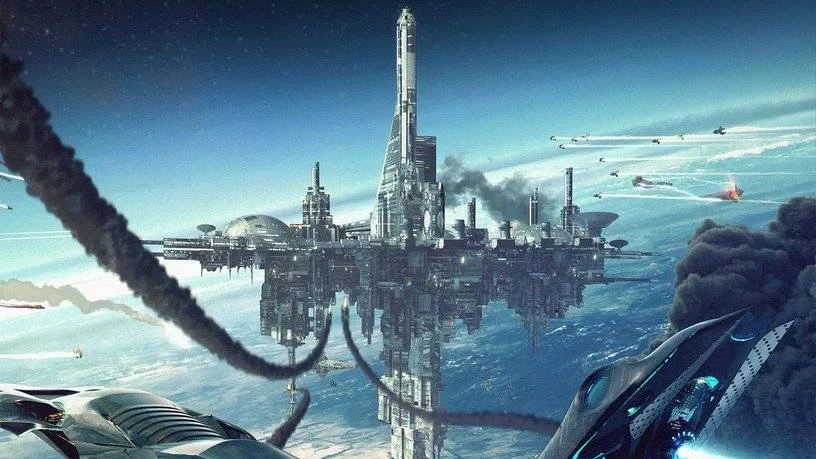
Beyond the Cosmere: Brandon Sanderson Proves His Mastery of Science Fiction

As 2025 drew to a close, Brandon Sanderson took a sabbatical from his sprawling Cosmere mythos to release a new anthology, Tailored Realities. Surprisingly, the collection largely eschews his signature high fantasy tropes. Aside from a solitary draconic tale, the volume pivots toward ambitious science fiction themes, exploring simulation theory, temporal displacement, and the existential weight of humanity’s cosmic footprint. In a departure from his reputation for rigid systems, Sanderson’s sci-fi feels more intuitive and atmospheric, trading granular world-building for intricate, character-led enigmas. While the author is notoriously prolific, Tailored Realities suggests a promising future should he choose to further explore the boundaries of speculative fiction.
The distinction between science fiction and fantasy has always been porous in Sanderson’s bibliography. Unlike many contemporaries who use magic to evoke a specific mood, Sanderson treats his systems with the precision of natural laws—a design philosophy he attributed to his background in tabletop RPGs. He has effectively constructed a proprietary branch of physics where magical properties fluctuate across the Cosmere based on the presence of divine “Shardholders” rather than universal constants like electromagnetism.
This dedication to structured logic was shared by the late Robert Jordan. After Jordan’s passing in 2007, Sanderson was selected to complete The Wheel of Time, inheriting a world fascinated by technological decay and forgotten lore. The cyclical “Desolations” found in Sanderson’s Stormlight Archive echo the eternal struggle between the Dragon and the Dark One in Jordan’s epic. Both series utilize a post-apocalyptic framework within a high-fantasy setting, forcing protagonists to navigate current crises by unearthing the “magi-tech” remnants of lost civilizations.

Fantasy worlds are often criticized for their technological stagnation, yet Sanderson introduces dynamism by documenting societal and industrial evolution. His Mistborn saga transitioned from medieval aesthetics to a frontier Western setting; he is now developing a third era inspired by the 1980s, centered on the dawn of the digital age. This commitment to progress makes his universes feel alive and reactive.
In Tailored Realities, however, Sanderson adopts a more minimalist approach to world-building. In the standout story Perfect State, he playfully deconstructs his own narrative habits while using simulation theory to examine heroism and the price of agency. The anthology proves that Sanderson can be just as effective when he leans on established genre archetypes rather than building a universe from the ground up.
The novella “Moment Zero,” a haunting time-travel mystery, was crafted specifically for this collection. Sanderson notes in the postscript that while he developed complex quantum rules for the story, he chose to omit them to keep the focus on the human cost of temporal interference. This restraint allows the narrative to breathe, prioritizing emotional resonance over technical exposition.

By trusting the reader to accept concepts like wormholes and entanglement as narrative catalysts, Sanderson focuses on character sacrifice and global stakes. The ambiguity surrounding the origins of certain “voices” in the story adds a layer of cosmic dread that might have been diminished by over-explanation. This “vibe-forward” approach yields a rich, high-stakes mystery.
Similarly, “Snapshot” presents a noir-tinged thriller where detectives utilize short-term historical simulations to solve crimes. While the technology is powered by a cryptic, suffering entity, Sanderson avoids deep-diving into the mechanics, instead focusing on the ethical discomfort of the protagonists. Interestingly, before partnering with Apple TV for his larger works, Sanderson noted that “Snapshot” was the closest of his stories to receiving a cinematic adaptation—a testament to its lean, character-driven structure.
While his young adult Cytoverse series has faced criticism for leaning too heavily on YA clichés and eccentric dialogue, the anthology includes its progenitor: “Defending Elysium.” Originally written in 2001, years before his debut novel Elantris, this short story feels more like a sophisticated noir. It follows an investigator untangling a web of alien diplomacy and forbidden technology, showcasing a mature space-opera sensibility that many fans hope he will return to.

Sanderson’s relentless creative curiosity sets him apart. While most authors would remain tethered to their primary success, he continues to pivot between genres. With a Mistborn screenplay for Apple TV in the works, a contemporary fantasy titled Songs of the Dead, and the standalone Cosmere novel The Fires of December on the horizon, his schedule is packed. Since he won’t return to the Stormlight Archive until 2030, there is ample room for him to keep refining his voice in the realm of science fiction.
Source: Polygon
Related articles
 Sony Pulls Its Last UHD Blu-ray Player From Sale in Japan
 Players Launch Petition Hoping to Save Mass Effect 5
 Assassin’s Creed Black Flag Resynced Developers Confirm New Mode
 Best Visions to Use in Final Fantasy Resonance
 Activision’s Polish Studio Reportedly Developing Open-World RPG to Rival GTA VI and Cyberpunk 2077
 The 25 Best Switch 2 Games
 Amazon’s Mass Effect TV Series Reportedly Still in Production Despite BioWare Closure
 Shadow of the Tomb Raider Unexpectedly Launches on Switch 2, Making Full Trilogy Available