
Twenty Years On: Cillian Murphy’s Near-Perfect Thriller Was Ahead of Its Time

Many viewers say they prefer shorter films, yet few understand what it takes to pare runtime down without sacrificing cohesion.
It’s simple to declare that a picture would be better trimmed by 15 or 20 minutes — I find myself thinking that often — but experienced editors will warn that lopping off that much can leave a film feeling disjointed or incomplete.
That’s why it’s notable when a contemporary studio picture truly thrives at under 90 minutes. Wes Craven’s Red Eye, released in 2005, is a compact example that anticipated the appetite for what Pete Davidson jokingly called “short-ass movies.” Watch the clip on YouTube.
https://youtube.com/watch?v=V6VvqTc8yf8%22+title%3D%22YouTube+video+player%22+frameborder%3D%220%22+allow%3D%22accelerometer%3B+autoplay%3B+encrypted-media%3B+gyroscope%3B+picture-in-picture%22+allowfullscreen+style%3D%22position%3Aabsolute%3Btop%3A0%3Bleft%3A0%3Bwidth%3A100%25%3Bheight%3A100%25%3B
By modern standards Red Eye is streamlined. Most of the action unfolds in an airport and aboard a single flight as Lisa (Rachel McAdams) discovers that the affable stranger she’s been flirting with, Jackson (Cillian Murphy), is not a romantic serendipity but a blackmailer. He needs Lisa, a hotel manager, to move a guest to a different room so that an assassination becomes easier — and if she refuses, he threatens her father’s life.
Craven delivers the story in roughly 86 minutes, already below contemporary averages; subtract the end credits and the running time tightens to about 77 minutes. Two decades after its release, it remains unusually concise for a major-studio thriller aimed at adults.
Part of the film’s economy comes from its leads. McAdams and Murphy were both rising in profile at the time, and their chemistry — charismatic but never indulgent — lets the audience accept the characters without lengthy exposition. Craven frames their interactions with a sly visual cue: when they share the same shot, one of them is frequently a touch soft, undermining the surface romance and keeping tension simmering beneath the talky moments.
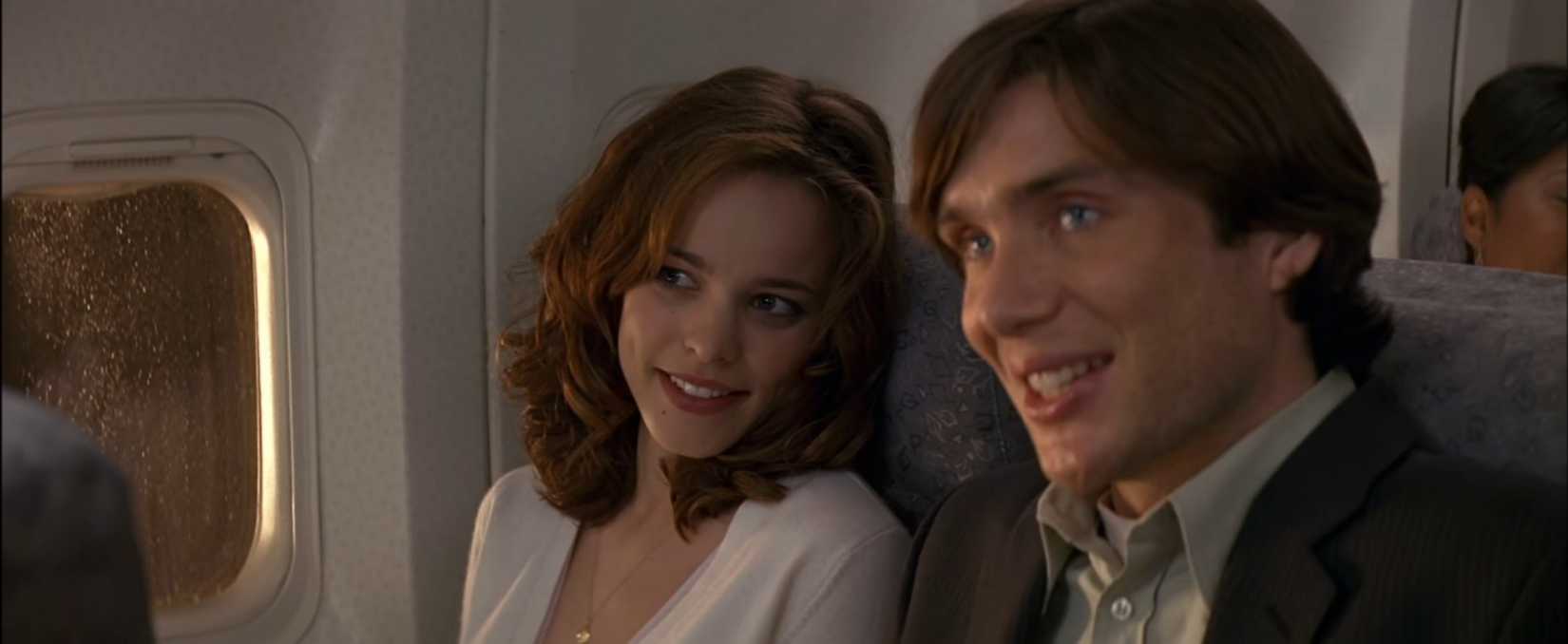 Image: DreamWorks Pictures
The script concentrates the action around the two principals in a way that feels almost like a two-hander — not because supporting players vanish, but because Craven channels the drama tightly through Lisa’s perspective. The pacing reads like a precise itinerary: roughly 17 minutes of preflight setup to establish Lisa’s job and motivations; about 40 minutes aboard the eponymous red-eye, where Jackson’s scheme is revealed and Lisa scrambles for options; and roughly 20 minutes of tense post-flight resolution and a spare denouement.
There’s nothing mystical about that structure, yet a sub-90-minute runtime carries a pressure-cooker intensity reminiscent of midcentury crime pictures. Shorter thrillers can feel dreamlike, letting audiences accept implausibilities because the momentum barely leaves time to dwell on them. Red Eye benefits from precisely that forward motion.
 Image: DreamWorks Pictures
Short runtimes were far more common during the 1940s and 1950s, when many crime films and mysteries wrapped up in under 90 minutes. As critics have noted, the average runtime across all films hasn’t dramatically grown in recent decades; what has changed is the prominence of long-form tentpoles. Length now often signals a major, event-style release — think superhero spectacles, sprawling Oscar contenders, or globe-trotting action — and runtimes under two hours make headlines when they’re absent from such films. A Slate overview examined these trends in recent years.
Streaming has added another wrinkle: platforms measure success in minutes watched, which can discourage ruthless trimming. A film stretched toward the two-hour mark yields more total minutes across viewers, even if portions of that runtime are padding. That commercial logic helps explain why recent streaming thrillers with compact premises sometimes still run closer to two hours; Netflix’s Carry-On, for instance, follows a similar air-travel-blackmail template but clocks in near 120 minutes. Read more on Carry-On.
All of which makes Red Eye feel unexpectedly refreshing. Craven’s late-career thriller is taut, purposeful, and brisk — the sort of self-contained film that slips easily into an evening’s schedule. Shorter runtimes aren’t intrinsically superior, but when a movie like Red Eye finds the right balance of momentum, performance, and clarity, the brevity becomes one of its greatest strengths.
Source: Polygon
Related articles
 Paul Thomas Anderson is working on a new project
 Netflix and Alfonso Cuarón Developing Dungeons & Dragons Horror Series
 Critics approve of the second season of Guy Ritchie’s The Gentlemen
 “Gangsterland” starring Tom Hardy renewed for a third season
 Martin McDonagh Presents “Wild Horse” Starring Malkovich and Rockwell in Venice
 Werner Herzog dedicates the film “Bad Lieutenant” to David Lynch
 First still from the film “The Luckiest Girl Alive” featuring Kate and Rooney Mara
 First still from the film “The Luckiest Girl Alive” featuring Kate and Rooney Mara released