Twenty Years Ago, a Master Director Opened His Greatest Film with a Mind-Bending Montage

The indelible mark Satoshi Kon left on the world of animation is truly profound. Before rising to fame as the visionary director of Perfect Blue and Tokyo Godfathers, Kon sharpened his craft in the early ’90s as a layout artist and screenwriter for Koji Morimoto’s Magnetic Rose and Mamoru Oshii’s Patlabor 2: The Movie. Throughout his career, Kon developed a signature avant-garde style that challenged the boundaries of the medium, frequently utilizing surrealist dream logic to navigate experimental narratives.
Kon’s bold visual aesthetic has been a frequent source of inspiration for Western filmmakers. Darren Aronofsky, for instance, famously incorporated sequences into Requiem for a Dream and Black Swan that mirror Perfect Blue with striking precision. Other nods to his genius are more subtle; while Christopher Nolan’s Inception shares thematic DNA with Kon’s Paprika, it maintains a distinct narrative path that avoids direct imitation.
Paprika is an intricate psychological labyrinth steeped in high-concept science fiction. Released in 2006, the film rejects linear interpretation in favor of abstract symbolism and hallucinatory pacing. Set in a near-future society, the story follows Dr. Atsuko Chiba, a researcher who treats psychiatric patients through a revolutionary, yet untested, device known as the DC Mini—a tool that grants direct access to the human subconscious.

Outside the confines of her professional environment, Atsuko adopts the persona of “Paprika,” a spirited dream-detective. Through breathtaking animation and dizzying transitions, Kon expertly dissolves the boundary between the dreamscape and the waking world. As the plot unfolds, the distinction between Atsuko’s analytical self and her uninhibited alter-ego begins to evaporate.
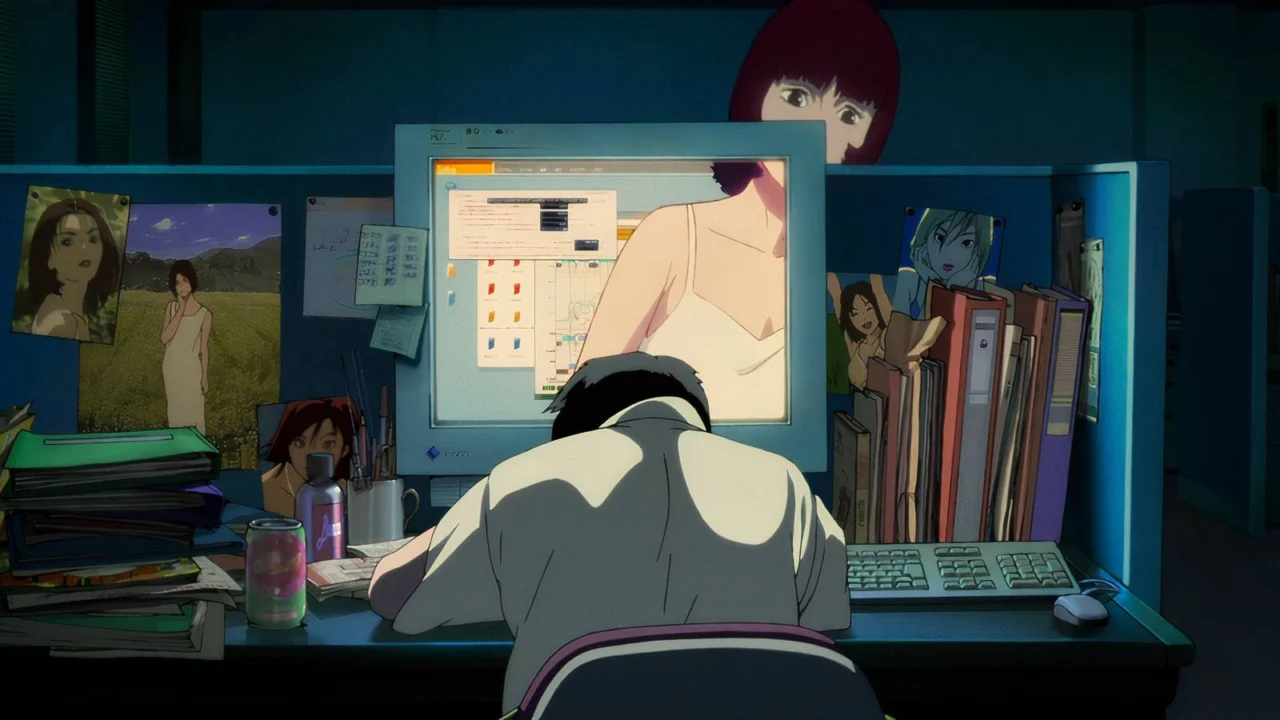
The film’s complex narrative ambition is evident from the very first frame. Kon utilizes the spectacular opening sequence to define the story’s whimsical yet unsettling tone in less than two minutes. We witness the effervescent Paprika gliding through Tokyo, ignoring gravity and social norms alike. She leaps across digital billboards, freezes time at a busy crosswalk, and effortlessly steps out of computer monitors as if she were a living hologram.
These fluid transitions are more than just visual flourishes; they establish Paprika as the personification of Atsuko’s repressed unconscious. Even in a seemingly mundane setting, such as a diner where she is bothered by two men, her internal irritation is visually represented through four mirror reflections, each capturing a distinct, fragmented reaction.

Before the audience even meets Dr. Atsuko Chiba, the prologue sets expectations for her enigmatic dual life. Paprika explores the psychological friction between the stoic, disciplined scientist and her vibrant, boundary-less alter-ego. The film’s core tension arises from trying to merge these two conflicting personas and the vastly different realities they inhabit.
Kon’s mastery of the medium shines in these opening moments, where Paprika’s freedom is limitless. She dodges unwanted attention by vanishing behind a stranger and reappearing as a graphic on a T-shirt. This meta-textual approach to animation serves as a brilliant commentary on the malleable nature of shared dreams and collective consciousness.

The sequence is elevated by Susumu Hirasawa’s “Mediational Field,” a kinetic, synth-heavy track that perfectly mirrors the film’s frantic energy. As the credits conclude, a final image of Paprika’s hair flowing wildly in the wind dissolves into a shot of Atsuko, whose tightly pinned hair symbolizes her rigid self-control.
This sudden shift serves as a jarring return to reality. The colorful, exhilarating dream is over, making way for a descent into the dark and fractured nightmares that threaten to consume the protagonist’s mind.
Source: Polygon
Related articles
 Noah Jupe Cast in Secret Role for Avengers: Secret Wars, Reports Say
 New Harry Potter Reboot Trailer to Release on September 2 Following Teaser Preview
 Analysts Warn GTA VI Release Could Damage Economy
 Kingdom Come: Deliverance II Creator Discusses DLSS and Defends Technology
 GTA 6 Soars to No. 1 on Netflix’s Movie Chart
 Fan-Made GTA IV RTX Remaster Receives Version 1.5.1 Update
 GTA V Actor Ned Luke Defends Rockstar and Responds to GTA VI Criticism
 GTA 6 Detail Compared to Sleeping Dogs, Red Dead Redemption 2, and Previous GTA Games