
The Summer’s Biggest Hit Is All About Destruction
 |
Polygon 2026 Summer Preview Your essential guide to the next three months of gaming, cinematic releases, television, and beyond. |
| Explore the issue→ | |

In the world of gaming, players generally fall into two camps: the meticulous architects and the pure agents of chaos. The former might dedicate entire afternoons to obsessively refining a character’s aesthetic in Tomodachi Life or perfecting the botanical grid of their Stardew Valley farm. The latter, however, finds catharsis in the mindless destruction of a sedan in Street Fighter 2 or the relentless, earth-shattering punches of Donkey Kong Bananza.
If you find yourself gravitating toward the latter style of play, keep your eyes on Virtue and a Sledgehammer, a standout indie title arriving this summer. As the protagonist, Pratelle, you’ll navigate a narrative-heavy journey through the Spanish countryside, grappling with complex familial ties to your mother, Merche, and your sister, Nina—all while systematically dismantling a town now overrun by belligerent, block-headed robots. You’ll have to experience the narrative firsthand to uncover why these mechanical trespassers have taken over. Developed by the combined forces of Deconstructeam and Selkie Harbour, the game recently earned a spot in the 2026 Tribeca Festival’s curated gaming lineup. We sat down with Jordi de Paco of Deconstructeam and Guille Fernando of Selkie Harbour to discuss how this project morphed from a simple, visceral destruction simulator into a profound, layered experience.
There is an undeniably restorative quality to digital demolition. Unlike the physical world, where wrecking things carries the risk of exhaustion or injury, gaming offers a consequence-free outlet. “You’re physically exerting yourself to the limit, but you’re also leaving room for something new,” Fernando explains. “There’s a unique potential in the act of destruction—perhaps you’re actually clearing the path for the future.”
Yet, the road from concept to finished product was far from poetic. De Paco admits that the initial prototype was born purely from the satisfaction of breaking things, without an overarching plot. The robotic enemies were largely a pragmatic design choice, as they were easier to animate and iterate upon than human models. “We realized we had this sandbox, and we began questioning what stories we could tell within it,” de Paco notes. “We considered transhumanism, but felt SOMA had already perfected that narrative. Instead, we pivoted toward themes of alienation from one’s roots, which felt like a much stronger foundation.”
Designing a narrative around destruction posed significant technical hurdles. “Structure was our biggest challenge,” says Fernando. “When everything is breakable, level design becomes incredibly complex. How do you guide the player? We decided to allow linear progression for those who want it, while using environmental design to constantly pull the player’s focus elsewhere. The narrative feels organic—it reacts to how you interact with these robots, and in doing so, reveals who you are in their eyes.”
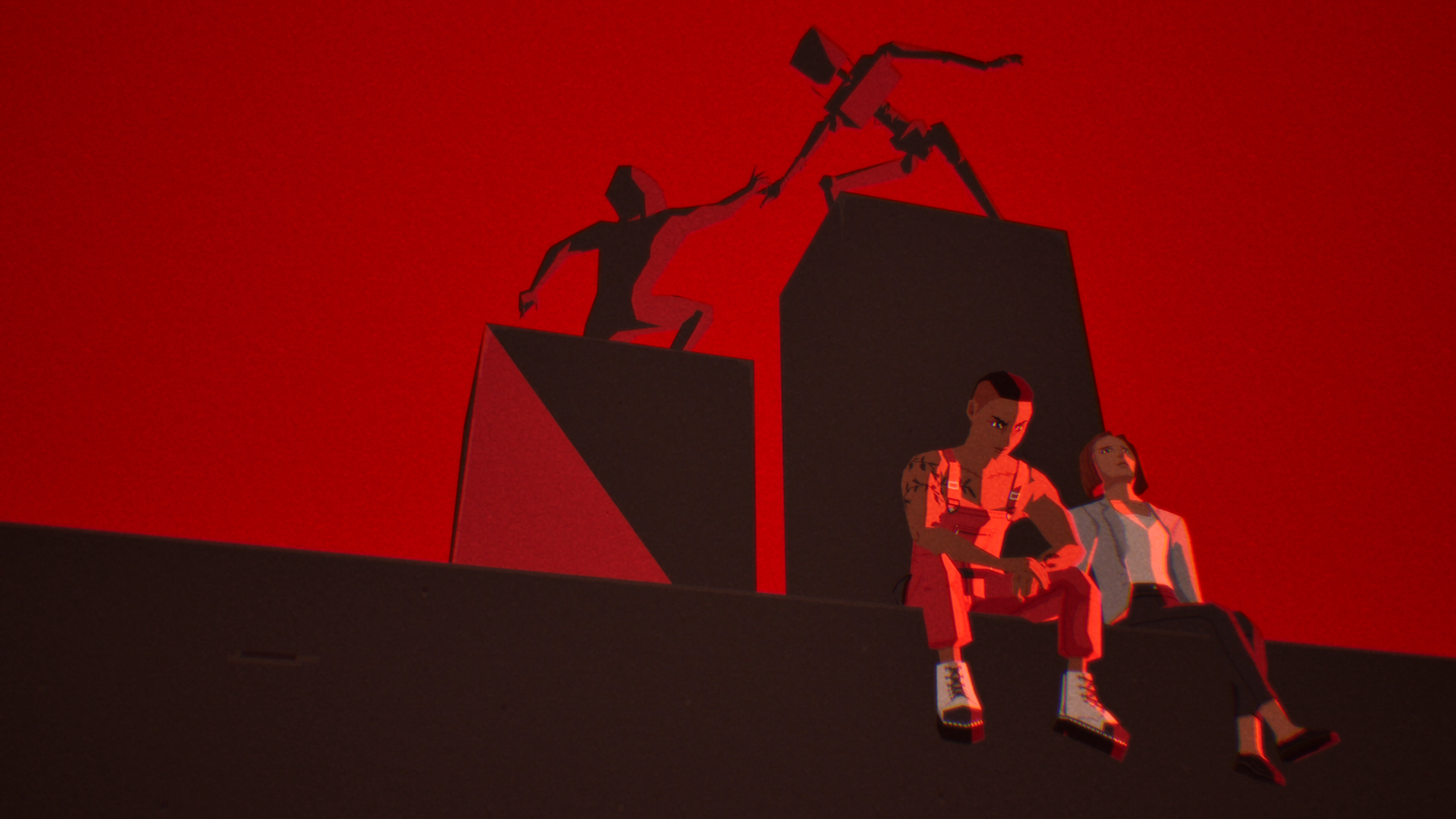
Image: Deconstructeam / Selkie Harbour / Devolver Digital
The game possesses a striking aesthetic, reminiscent of a low-poly fever dream. De Paco credits this to a desire to break away from the “Unreal Engine look.” By pulling visual cues from the moody, vibrant color palettes of Alan Wake 2 and the minimalist, sharp aesthetic of Signalis, the team crafted something distinct. At a time when hyper-realism is often treated as the gold standard, the developers felt it was important to prioritize artistic intent over technical fidelity.
“I think it’s time to move away from the pursuit of photorealism, if only for the sake of the developers themselves,” de Paco adds. “Chasing pure realism is taxing, and it rarely makes a game objectively better. True art direction will always carry more weight than a higher polygon count.”
Their stance on artificial intelligence is equally uncompromising. When asked if the game serves as a balanced debate on the subject, de Paco is blunt: “AI is not a question we’re asking; it’s a problem. We don’t want to experience art crafted by ‘no one.’ I want to engage with work created by a person with genuine intention. When you strip away the human process, you destroy the communication between creator and player.”
This authentic, human-centric approach is likely why the game caught the eye of the Tribeca Games Festival. As a selection among the festival’s top 12, it stands alongside past luminaries like Thirsty Suitors and Despelote. For the team, this recognition feels like a milestone. “We’ve been in this industry for 15 years, and festival accolades have always seemed just out of reach,” de Paco reflects. “It feels like we’ve finally graduated to the big leagues.”
Virtue and a Sledgehammer is slated for release on Windows PC later this summer.
Source: Polygon
Related articles
 Modders Convert Diablo II Resurrected into Virtual Reality First Person Game
 Modder Ports Quest Overhaul Mod for The Witcher 3 Remaster
 Dan Houser Calls GTA Comparisons a Compliment but Wants New Games to Stand on Their Own
 Fan creates 3D first-person version of Terraria
 Amazon Prime Members Can Officially Claim 10 Free Games in October
 Crimson Desert Fan Concept Imagines Dynamic Seasons Based on Game Progress
 Insider Details Story and Characters of Assassin’s Creed Codename Hexe
 EA Teases Official Dead Space Return in New Battlefield Trailer