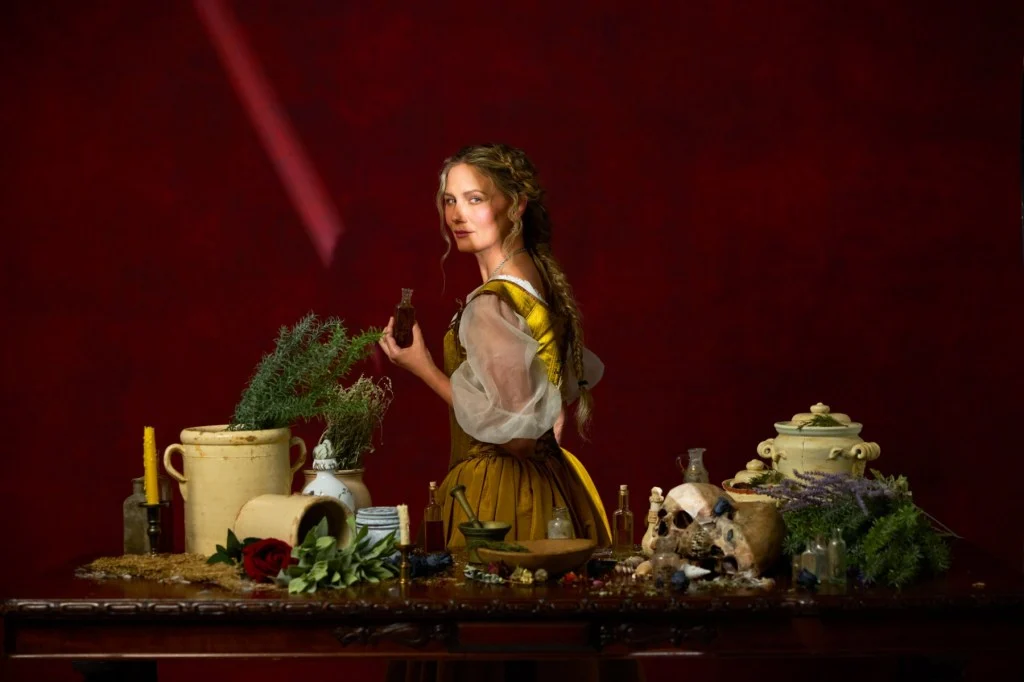

A decade ago, a casual online browsing session led Jennifer Nettles down a dark historical path. She stumbled upon the account of Giulia Tofana, a 17th-century Sicilian woman rumored to have provided arsenic to hundreds of oppressed women seeking a lethal escape from their abusive marriages.
“There was very little information available—just a couple of scattered articles,” the Grammy and Emmy winner explains. “While her existence was historical fact, the specific details of her life remained shrouded in mystery. It was enough to ignite my imagination without restricting me to a rigid narrative.”
The story haunted the Sugarland frontwoman for years. When the pandemic forced a global pause, Nettles found the stillness she needed to transform that lingering fascination into a full-length play. It wasn’t until a suggestion from producer Adam Zotovitch—asking if Giulia might want to express herself through song—that the project blossomed into a musical. Nettles took on the daunting trifecta of writing the music, lyrics, and book, while stepping into the title role herself.
Giulia: The Poison Queen of Palermo, helmed by Tony Award-winning director Mary Zimmerman, premieres this Sunday, June 28, at New York City’s Perelman Performing Arts Center (PAC) for a four-week engagement.
From Obsession to Opening Night
You have taken on the monumental task of writing an original musical and starring in it. Was this an all-encompassing journey?
It was a blend of artistic inspiration and pure obsession. I’ve referred to it for years as my ‘Great White Whale.’ Initially, I tried the traditional route of finding a collaborator for the book, but nothing clicked. Looking back, I’m relieved it didn’t, as this has been the most deeply rewarding creative labor of my career because of its singular, total immersion.
When did you realize this project was ready for the stage at the Perelman?
We held several readings to hear how the material lived in the mouths of other performers. The feedback was remarkably strong. As an artist, I am my own harshest critic; if I hadn’t believed it was ready, it would never have left my desk. Adam Zotovitch eventually brought it to the attention of Bill Rauch at the PAC, who saw the potential immediately. It’s been an organic evolution ever since.
The Moral Complexity of a Villain
How do you frame a character like Giulia—who is historically linked to hundreds of deaths—as a protagonist?
History is often told through a lens that vilifies women who exert their own agency. When you look at the ‘hidden’ side of history, you see women forging their own paths to survive. To me, Giulia is a warrior who saw women in desperate, life-threatening situations and decided to intervene. That’s a hero’s arc. She essentially looked at a broken system and declared, ‘Not on my watch.’
Do you find her morally ambiguous?
Absolutely. Humans crave a binary of black and white, but life exists in the gray. We have a song called “Something Holy, Something Broken,” which captures that tension—the idea of committing a transgression for what you believe to be the right reasons.
Collaborating and Mentorship
You reached out to Lin-Manuel Miranda for advice on balancing these creative roles. What did he say?
He was incredibly gracious. His best piece of advice was simple: once you assemble your creative team, you have to truly trust them. I’ve taken that to heart. Working with Mary Zimmerman has been a joy; her confidence in the material and her trust in the actors have made all the difference.
After starring in major productions like Chicago and Waitress, how does it feel to originate a role from scratch?
Stepping into an existing show is about honoring what has already been built. Creating something entirely new is far more exhilarating and risky. There is no blueprint; we are carving the path as we walk it.
 Becca Hatch and Lewis Love tapped for Spotify RADAR program
 J-Hope Thanks ARMY After BTS Win Three MTV Video Music Awards
 Former American Idol Contestant Caleb Flynn Found Guilty of Murdering His Wife
 Niall Horan Marks 10th Anniversary of His Song This Town
 HALCALI Discuss Otsukare Summer Going Viral and Returning to Music After a Fourteen-Year Career Gap in Billboard Japan Women in Music Interview
 BTS Member Jimin Posts on TikTok
 RAYE Addresses Michael B. Jordan Dating Rumors After Six Flags Outing Sparks Speculation
 LISA of BLACKPINK Adds New Dates to Las Vegas Residency Due to Demand