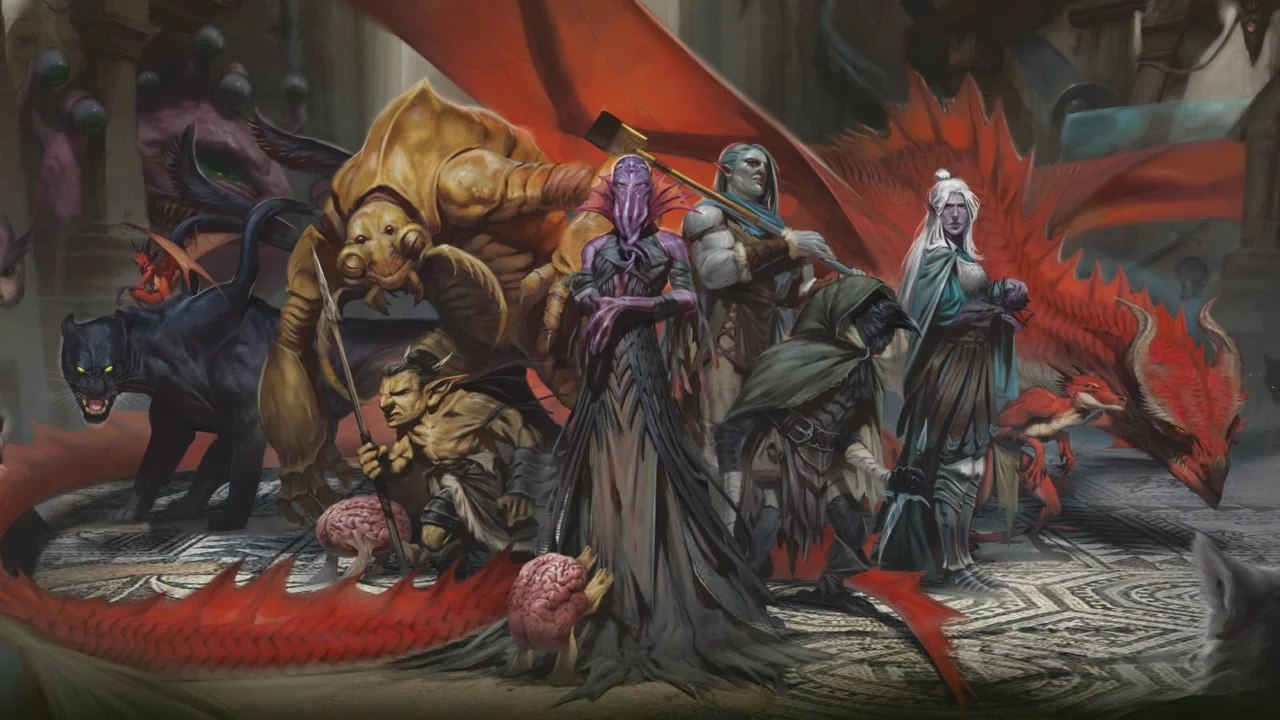
I Had a D&D Designer Create the Ultimate Monster to Torment My Party
Stepping into the role of a Dungeon Master (DM) in Dungeons & Dragons is immensely rewarding, yet it comes with its fair share of hurdles. While crafting captivating narratives, designing expansive worlds, and managing logistics are skills every DM hones over time, orchestrating genuinely thrilling combat remains a persistent challenge—even for veterans of the craft.
Designing an encounter that pushes a party to their limits without feeling cheap or dragging on indefinitely is a delicate balancing act. Unfortunately, the guidelines found in standard rulebooks often fall short. Thankfully, veteran designers and tabletop experts—such as ENnie Award-winning author Keith Ammann—have stepped up to help DMs select and run the ideal adversaries to ensure maximum tactical depth and memorable battles.
Ammann’s foundational volume, The Monsters Know What They’re Doing, has revolutionized encounter prep by teaching DMs to think like their adversaries and formulate coherent tactical strategies beforehand. An expanded and completely revised version, titled Remonstered!, hits shelves on Oct. 6.
Following up on his previous work, Making Enemies serves as an invaluable blueprint for anyone looking to homebrew custom creatures. Ammann’s methodical approach explores how a monster fits into a living ecosystem, using threats not merely as obstacles, but as catalysts to let player characters shine. To mark the release of Remonstered!, I enlisted Ammann’s expertise to design a brand-new, exclusive D&D monster for Polygon—and the result is brilliantly terrifying.
Keith Ammann designed a D&D monster for Polygon
I needed a creature capable of presenting a moderate challenge for my current homebrew campaign. The party had recently attained 5th level—a notorious milestone in both the 5th edition and its 5.5 update. As class power spikes drastically at this stage, balancing encounters using standard Challenge Rating (CR) tables can become an uphill battle for DMs.
My group consists of a Path of the World Tree Barbarian, a Battlemaster Fighter, a support-focused custom Bard, and a Way of Shadow Monk. While this squad dominates in melee combat, they are notably lacking in ranged attacks and arcane spellcasting. To ground the creature firmly in my setting, I shared a few worldbuilding details: the realm is trapped in a permanent solar eclipse, resulting in a desolate landscape starved of light and warmth. Nature here is volatile and hostile, forcing intelligent civilizations into a perpetual war for survival against mutated, grotesque wildlife.
Here is what Ammann came up with, along with the brilliant rationale driving its design.
In response to the setting, Ammann categorized the creature as a Monstrosity, with Fey and Aberration serving as thematic runners-up. Imagining open plains as its hunting grounds, he envisioned an aerial predator with exceptional vision capable of exploiting the party’s blind spots. “This isn’t a group that’s going to be subscribing to *The New Yorker*,” Ammann joked, correctly guessing that Intelligence was the chosen dump stat for most of the party. Because of this, illusions would prove devastatingly effective—hence the inclusion of spells like Mirror Image and Phantasmal Force. To keep the threat viable, a high Armor Class was essential, while innate access to Bane would systematically penalize everyone except the Bard by shaving 1d4 off their attack rolls.
The concept evolved into a chilling hybrid of a raptor and a Cloaker—a classic D&D monster known for projecting false duplicates. Clad in light-absorbing black or semi-translucent charcoal grey to camouflage against the shadowed sky, the creature was christened the **Mooncrow**.
Next came the matter of scale: should this be a solitary boss or a flock hunter? Eschewing a single massive target, Ammann designed a smaller creature intended to dive-bomb individual characters in packs of two or three. For 5th-level adventurers, a CR of 1 or 2 fits the sweet spot, translating to roughly 200–450 XP per foe. According to modern encounter-building guidelines, a moderate-difficulty challenge for four level 5 PCs allows for 2,000 to 3,000 total XP—which could mean five or six CR 2 creatures or up to fifteen CR 1s. Out of sheer mercy for any DM forced to track fifteen independent combatants, Ammann settled on CR 2.
When drafting the stat block, Ammann consulted the Monster Statistics by Challenge Rating charts from *The Lazy DM’s Forge of Foes* by Teos Abadía, Scott Fitzgerald Gray, and Mike Shea. Normally, a CR 2 monster possesses an Armor Class of 13. However, Ammann elevated the AC to 15 using an “Ecliptic Veil” trait, balancing it out by trimming its hit points down closer to a CR 1 creature. Boosting defenses while lowering health prevents the frustrating slog of whittling down a damage sponge without making monsters feel impossible to hit.
Offensively, the Mooncrow delivers two strikes per round, each dealing around 8–9 damage. Part of this payload is Cold damage, representing the creature draining ambient body heat to warm itself—an eerie touch inspired by Ammann’s memory of the sudden, bone-chilling drop in temperature during a solar eclipse at the Indiana Dunes. Notably, this means the Barbarian’s signature Rage resistance won’t mitigate the cold trauma.
As for spellcasting, a CR 2 creature aligns roughly with a 5th-level PC, capping spell levels at 3rd. *Bane* occupies a 1st-level slot, while *Mirror Image* acts as a non-concentration 2nd-level option. To introduce a dash of genuine malice—because DMs can’t pull punches forever—Ammann added *Phantasmal Force*, which targets a victim’s low Intelligence head-on. With five or six Mooncrows in a flock, they can distribute their magic efficiently: some deploy *Bane*, others cast *Phantasmal Force*, and the remainder trigger *Mirror Image* the moment prey is sighted.
The Monsters Know What They’re Doing is an essential resource for Dungeon Masters
The practical results at the table were phenomenal. When deployed against my group, the flock utilized *Mirror Image* to multiply their visual presence, making it look as though twenty predators were diving out of the eclipse. While I typically harbor reservations about illusion spells—which often create an awkward disconnect between perceptive players and oblivious characters—it played out wonderfully here. It sowed immediate panic, and the lingering phantasms continued to pressure the Barbarian (the lone party member who stubbornly refused to disengage from the illusions). *Mirror Image* proved to be a masterclass in adding durability to monsters without inflating AC or hit point pools.
Over the course of the brawl, both the Barbarian and the Bard were knocked unconscious multiple times, while the Fighter relied on high AC to hold the line and the Monk used exceptional mobility combined with *Darkness* to survive. By the final blow, the party was entirely sapped of resources, healing potions, and spell slots. They were left facing a grim dilemma: risk a hazardous wilderness camp for a Long Rest or press on with only a Short Rest, risking total party wipeout if ambushed again. Most importantly, the table was buzzing with excitement, recounting tactical highlights long after the session ended. As a DM, you can’t ask for a better validation.
Crafting engaging, balanced combat remains an intricate art form. The rules provided across 5e and 5.5e supply a framework, but they rarely capture every nuance of tactical play. Fortunately, guides like Keith Ammann’s make mastery much more attainable. Whether you are a seasoned chronicler or a newly minted DM, be sure to pick up a copy of *Remonstered! The Monsters Know What They’re Doing* when it drops on Oct. 6.
Source: Polygon
Related articles
 The Wolf Among Us Remastered Released With Five Cut Scenes and New Modes
 Hideo Kojima Updates Status of Xbox Horror Game OD
 The Lost Wild Highlights the Dangers of Coexisting With Dinosaurs
 Trailer for Fish Drawing Game Unexpectedly Moves Viewers to Tears
 Crimson Desert Receives Massive Expansion Featuring Underwater World, Weddings, and New Bosses
 Yet Another Zombie Survivors launches on Switch with a free eShop demo
 Ten Queer Fairy Tale Retellings Worth Reading
 First Trailer Released for Death Stranding Anime