Five Years Later, Christopher Nolan’s Most Divisive Film Is Better Than You Remember

Comment Views: 18

Image: Warner Bros. Pictures

Christopher Nolan — the filmmaker behind the Dark Knight trilogy and cerebral blockbusters like Inception and Interstellar — usually delivers films that land commercially, critically, or both. Tenet, his 2020 science-fiction thriller, resists easy classification: to some viewers it’s a dazzling, ambitious puzzle; to others it’s needlessly convoluted. In truth, it’s a curious blend of the two.

Rather than conventional time travel, Tenet hinges on a concept Nolan calls “inversion,” where the temporal direction of objects and people can be reversed. Small moments illustrate the idea: a fired bullet can appear to be “caught” after it’s already lodged in a wall. The story follows John David Washington’s unnamed protagonist — who insists on being called “the Protagonist” — and the covert organization Tenet as they try to stop a threat orchestrated by Kenneth Branagh’s menacing oligarch, Andrei Sator. The narrative is dense and the film demands concentration.
Video Thumbnail

Context matters when discussing Tenet’s reception. The film was originally slated for release on July 17, 2020 — an intentional palindrome echoing the title — but the COVID-19 pandemic upended theatrical plans worldwide. Studios and exhibitors scrambled: some lesser-known films opened into near-empty houses, while others went straight to streaming, a strategic shift that strained Nolan’s relationship with Warner Bros. and ultimately influenced his distribution choices for subsequent projects.

When Tenet finally premiered in a limited run on September 3, 2020, it performed respectably amid the difficult box-office climate, finishing with roughly $365 million worldwide after staggered re-releases as theaters reopened. In a market where many tentpole properties have struggled to hit former heights, Nolan remains a distinctive commercial draw — a director whose name can still pull audiences to theaters.

Critics were divided: “mixed” for a filmmaker of Nolan’s stature still translated into a broadly favorable score on review aggregators, and in the years since the film’s release it has fostered a committed cohort of viewers who return to its puzzles and set pieces. Tenet is not casual viewing; its exposition-heavy structure and dense rules require attention, and the film’s often-loud sound mix can make dialogue difficult to parse without subtitles.

John David Washington standing in front of a bullet wound in bulletproof glass in Tenet
Photo: Melinda Sue Gordon/Warner Bros. Pictures

“Does your head hurt yet?” Robert Pattinson’s Neil asks the Protagonist — a line that could serve as a warning to viewers. Neil’s offhand explanation touches on paradoxes and temporal puzzles, but it also signals how the film asks its audience to accept a formal logic and feel its effects rather than map every detail. Nolan’s set-pieces reward that surrender: an early brawl through a restaurant kitchen communicates the Protagonist’s physicality, and the sequence where a jet impacts a freeport warehouse is viscerally staged.

Many of Tenet’s action beats are technical marvels. The corridor fight that follows the jet sequence and the third-act convoy assault — in which wrecked cars seemingly undo themselves and drive backward into coherence — are inventive uses of the inversion idea. At the same time, the film’s preoccupation with mechanics leaves less room for psychological texture: characters often function as vessels for plot mechanics rather than fully rounded people.

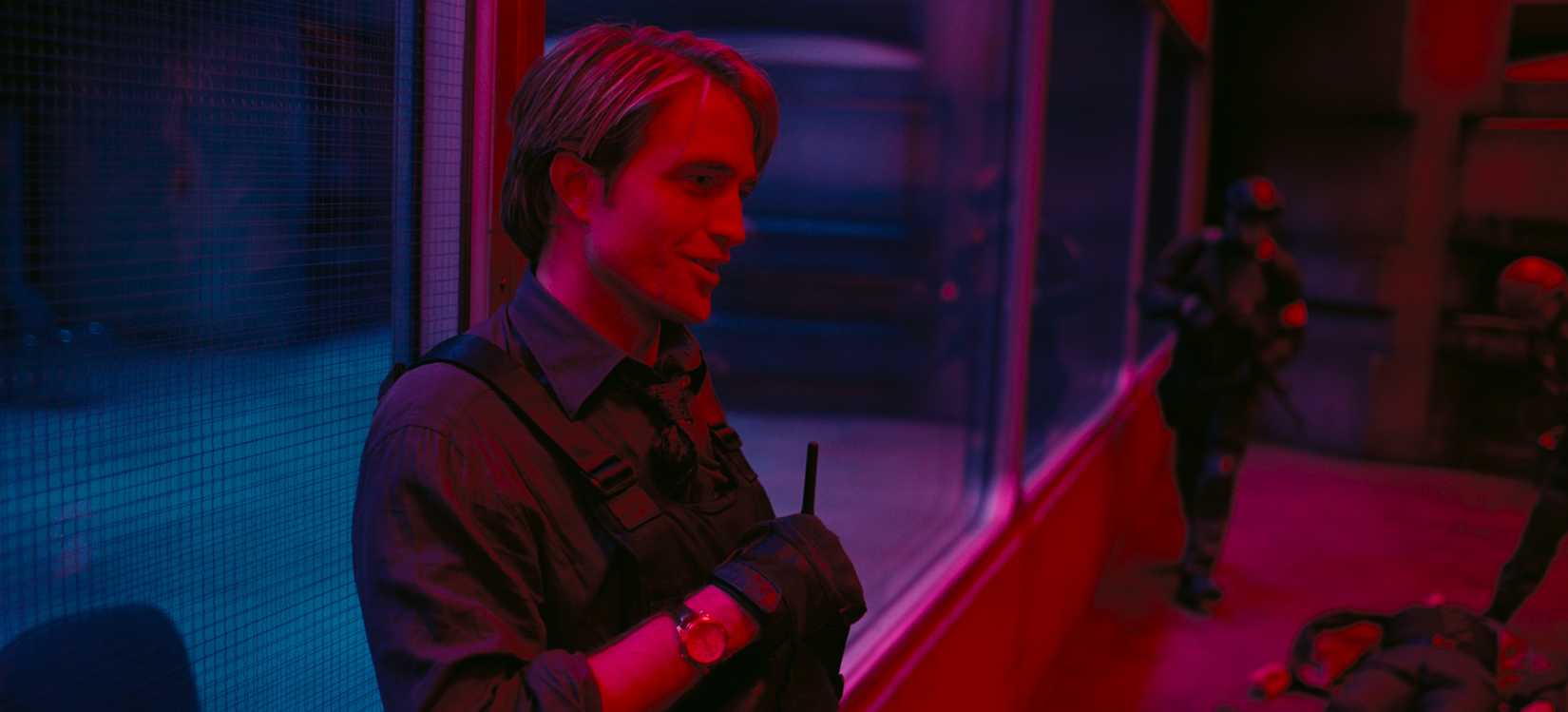
Robert Pattinson wearing a bullet-proof vest as Neil in Tenet washed with red and blue light
Image: Warner Bros. Pictures

Robert Pattinson’s Neil is one of the film’s brighter notes. Even when the plot’s intricacies leave actors guessing about motivation — an experience Pattinson reportedly shared during filming — he delivers a quietly magnetic performance that reveals more on repeat viewings. The relationship that develops between Neil and the Protagonist pays off in an ending that manages to be both thrilling and quietly resonant.

The finale assembles Tenet’s mechanics into a complex, multi-directional operation: multiple units moving through time in staggered sequences produce moments that are thrillingly choreographed if occasionally bewildering. Embracing the film’s premise rather than fighting it tends to be the most satisfying viewing approach.

I first saw Tenet at home during the height of the pandemic and bought the Blu-ray before I’d even watched it, confident Nolan would repay the faith. After the first screening I immediately wanted to watch it again — the film locks closed many narrative loops while leaving hints of farther-reaching possibilities. Returning to it five years later reignited that impulse to restart and follow its circuitry anew.


Source: Polygon

Share:

Related articles

Search games, news and articles…

Enter at least two characters

Enter at least two characters