David Bowie’s Rule-Breaking Sci-Fi Film Debut: 50 Years of a Mind-Bending Epic

When a global pop icon decides to pivot toward the silver screen, the roadmap is usually predictable. Some opt for self-referential camp, like Lady Gaga’s turn in Machete Kills; others lean into their musical prowess, as seen in Gaga’s work on A Star Is Born and the Joker sequel. Then there is the complete departure into prestige drama, exemplified by her role in House of Gucci. Beyoncé navigated similar waters with Austin Powers in Goldmember, Cadillac Records, and Obsessed. However, when David Bowie made his definitive cinematic debut on March 18, 1976, he bypassed these conventions for something far more avant-garde.
In later years, Bowie would eventually follow more traditional paths—utilizing his musical aura in Labyrinth or embracing high-concept character work in The Prestige. Even his brief appearance in Zoolander served as a playful nod to his celebrity. Yet his inaugural leading role remains a singular, puzzling anomaly in Hollywood history.
 Image: StudioCanal
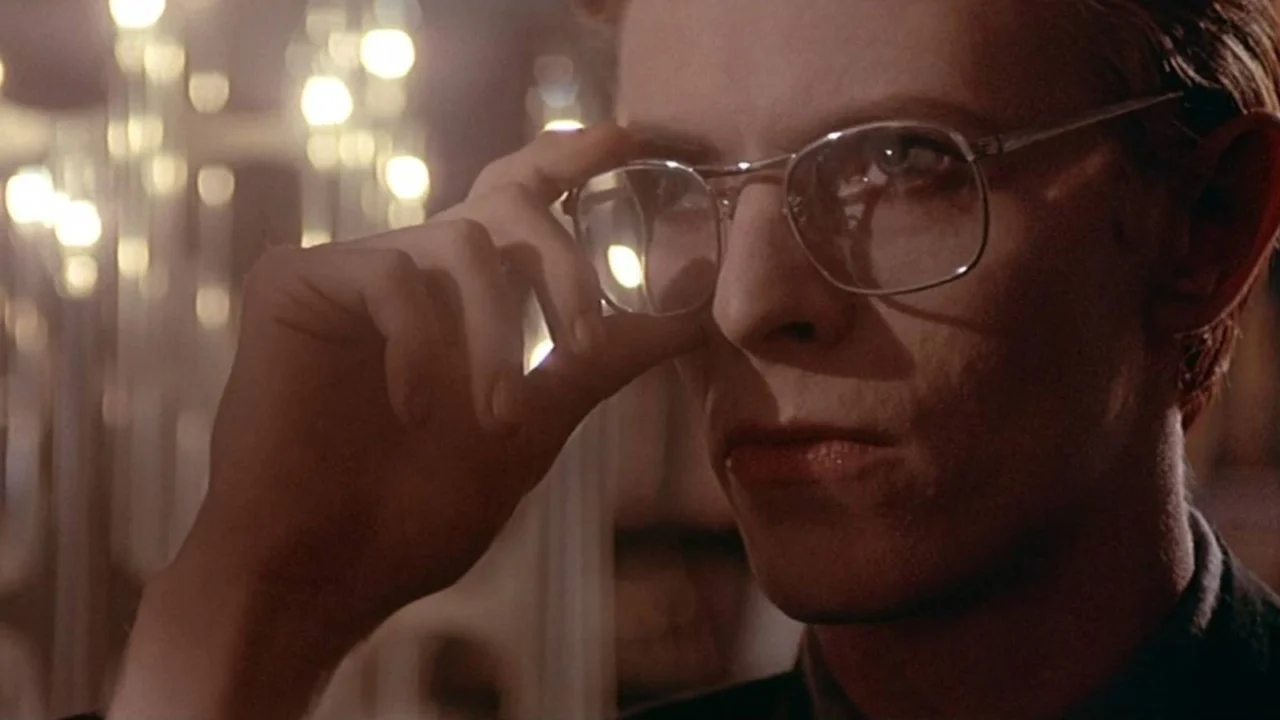
The Man Who Fell to Earth presents Bowie as a visitor from another world—a theme already woven into his discography. What makes Nicolas Roeg’s film so peculiar is its refusal to utilize any of Bowie’s music. This isn’t a cinematic extension of the Ziggy Stardust persona. Instead, Bowie portrays Thomas Jerome Newton, a desperate extraterrestrial who lands on Earth to secure water for his dying planet. His plan is calculated: amass a fortune by patenting advanced technology, then construct a spacecraft to transport resources back home.
While Newton leaves behind a family in the stars—seen only through haunting, sporadic flashbacks—he becomes entangled with a human named Mary-Lou (Candy Clark). Through her, he is seduced by the mundane narcotics of humanity: television, gin, and physical intimacy. The film suggests that these earthly distractions, combined with sinister government intervention, are what ultimately derail his mission.
Structurally, the story of The Man Who Fell to Earth could comfortably fit into a tight television hour. Instead, Roeg stretches it into a 140-minute odyssey. Though it was edited down to two hours for American audiences, causing critics like Roger Ebert to question if the narrative clarity suffered, the film’s elusive nature seems intentional. More footage likely wouldn’t have made it any more “readable.”
 Image: StudioCanal
Roeg employs a fragmented storytelling style that mirrors the protagonist’s own disorientation. While individual shots—aided by Bowie’s strikingly angular features—are masterpieces of composition, the connective tissue between them is often missing. We see Newton secure a patent attorney (Buck Henry), befriend a scientist (Rip Torn), and establish his empire, but the passage of time is blurred. His eventual capture and the subsequent waning interest of his captors are equally vague, occurring in a narrative fog.
This ambiguity makes the film a challenge, yet it captures a sense of “alien-ness” that few sci-fi films achieve. The stark beauty of New Mexico acts as a backdrop for Newton’s detachment. When asked what he’s doing on Earth, he simply replies, “Oh, just visiting.” He is a tourist in our reality, overwhelmed by the vices we take for granted. Through his eyes, human behavior looks like an alien contagion.
 Image: StudioCanal
Bowie’s casting is pivotal here. His innate mystique provides a focal point for a film that otherwise lacks gravity. He delivers a performance that is often more about presence and posture than emotional output, a choice that literalizes his status as a “shapeshifter.” This cold, detached approach was later mirrored by Scarlett Johansson in Under the Skin, another film that explores an alien’s gradual, tragic assimilation into human culture.
The Man Who Fell to Earth is undeniably somber, though it keeps the audience at a distance. Roeg highlights the Earth’s splendor only to trap his protagonist within its flaws. Had the film featured Bowie’s iconic soundtrack, it might have felt too hopeful or conventionally “cool.” Instead, it leaves us with the unsettling realization that even a starman can’t always save us—or himself.
Source: Polygon
Related articles
 Remedy Reveals Control Resonant Sales Figures for First Three Weeks
 Stranger Than Heaven: Snoop Dogg Shows Protagonist Makoto How to Rap in New Story Trailer
 GTA VI Artist Describes Aftermath of 2022 Leak: It Felt Like Someone Got Inside Your Head
 AISLPC Opens Preorders for Pocket AIS Retro Gaming Handheld
 The Witcher 4 Will Release in a Physical Edition, but with a Catch
 Survival Game Enshrouded Exits Early Access With Version 1.0 Release
 Steam to Add New Trophy System to Address Old Achievement Issue
 Steven Spielberg and Stanley Kubrick Sci-Fi Film A.I. Coming to Peacock