

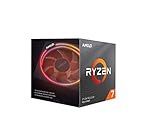
How far are you able to push the segmented 7nm silicon of Zen 2 past its rated specs? That’s the query we’ll be tackling at present as we put the most recent and biggest from AMD, particularly the Ryzen 7 3700X, on the check bench for a bout of electrical hubris.
The AMD Ryzen 7 3700X was initially touted by the pink staff as probably the most prolific overclocker of the Ryzen 3000 lot. With eight cores and a commanding TDP of 65 watts courtesy of the 7nm course of node, it presents by far probably the most lenient headroom for the avid overclocker – even by AMD’s personal account. But is there a lot heuristic frequency fiddling available with even this “crown jewel” of a chip?
AMD believes it has maximised its boosting algorithm, Precision Boost 2, with such efficacy and style (in the event you ignore all that squiffy BIOS stuff) that there’s frankly no efficiency leftover for lovers to eke out of its Zen 2 processors. At least not with no wholesome dose of liquid nitrogen.
“The other goal of our engineering effort is to absolutely maximise the performance of the product out of the box,” says AMD senior technical advertising supervisor, Robert Hallock. “By designing algorithms that extract the maximum silicon performance automatically (e.g. Precision Boost 2) without asking the user to tinker or risk their warranty. So, no, you’re not going to see a whole lot of manual OC headroom. That’s just performance an average person – who doesn’t know how to OC – can’t access. Why would we do that? It is not our intent to leave anything on the table.”
Read extra: These are the best gaming monitors round
It appears even AMD has its doubts concerning the overclocking proficiency of Zen 2. Yet we initially had excessive hopes for the Ryzen 7 3700X when it first graced our check bench.
Prior to Zen 2’s launch AMD had claimed that its upcoming 65W chips would be capable of “get a lot more” than the couple hundred megahertz out there on 105W components because of their lofty envelope overhead.
The Ryzen 7 3700X is the one processor above the Ryzen 5 vary that is ready to squeeze into the 65W TDP. Even with a somewhat slim energy envelope it is ready to function at a 3.6GHz base clock and 4.4GHz max enhance clock. For the document, that’s not max all-core. Precision Boost 2 will increase and reduces clock velocity in a scalar vogue as CPU threads are shifted process to process.

Overclocking Ryzen 3000
Precision Boost Overdrive (PBO) is a crucial characteristic out there to customers by way of the Ryzen Master software program. Along with computerized overclocking this permits for a 100 – 200MHz improve past your chip’s rated spec. But PBO doesn’t pressure frequency instantly. There are three limits retaining Ryzen 3000 processors from their final energy: PPT, TDC, and EDC. Precision Boost Overdrive removes these limits and replaces them with the utmost values.
- PPT is the overall socket energy. Typically that is restricted to 88W on the Ryzen 7 3700X. However, our first cease on this overclocking escapade is to crank this as much as 1000W. You can do that in Ryzen Master or within the BIOS. We opted for the latter.
- TDC represents the sustained present restrict. This determines the present delivered by way of the VRMs below steady load. The inventory 60A restrict may be cranked up all the best way to 360A.
- EDC is the height present restrict. This determines the utmost present delivered by way of the VRMs briefly bursts. The inventory 90A restrict simply gained’t do, so let’s go together with the max worth of 480A.
Also out there inside the MSI MEG ACE X570 BIOS is the choice to show the cTDP restrict all the best way as much as 128W. It’s not an choice clearly outlined with the Ryzen Master utility, and it might be outmoded by the aforementioned limits, however we turned all of it the best way up in any case. Probably advantageous.
Then it’s onto voltages. We began out with, what we initially believed to be, a beneficiant 1.4v CPU core voltage to Ryzen’s 4.4GHz max clock on all cores. Black display screen. Okay, 1.4125v at 44 multiplier. Black display screen. Following that very same stepping we went all the best way as much as 1.45v, the pink line. No luck, and we weren’t keen to push our sole Ryzen 7 assessment pattern past 1.45v solely days after launch. You cease caring after some time.
| Frequency (GHz) | Voltage (v) | Success |
| 4.4 | 1.4 |  |
| 4.4 | 1.4125 | |
| 4.4 | 1.4250 | |
| 4.4 | 1.4350 | |
| 4.4 | 1.45 | |
| 4.375 | 1.4375 | |
| 4.35 | 1.4375 | |
| 4.3 | 1.4375 |  |
No luck at 43.75, both. Nor 43.5. But, we lastly struck a wholesome steadiness with a x43 multiplier – or 4.3GHz clock velocity – at 1.4375v. Just somewhat beneath that pink line.
Even then it wasn’t completely steady throughout our punishing x265 v5.Zero encoding benchmark. And single-threaded functions suffered as a result of lack of the occasional enhance past 4.3GHz. So whereas some multi-threaded functions made marginal use of this all-core clock, few games or artificial benchmarks confirmed any enchancment in anyway.

But this isn’t the tip of our experiment. We additionally slotted the Ryzen 7 3700X into the Asus ROG Strix X470-F, pitting the second-gen Ryzen chipset towards its 12W X570 sibling.
After following all the identical steps above we discovered little or no distinction between the 2 chipset generations. The X470 is unable to over-provision to fairly the extent of the high-end X570, with the theoretical most values for PPT, TDC, and EDC maxing out far decrease, but Ryzen nonetheless saved its distance below load nonetheless.
The X470 remained steady at 4.3GHz with 1.4375v surging via its VRMs, and scored nearly identically in Cinebench R20. Only in X264 v5.0, did the X470 stumble, which equally induced a single crash on the X570. And regardless, with out persuasive numbers to say in any other case, neither chipset presents a very robust case for overclocking.
PCGN check bench: MSI MEG ACE X570, 16GB Trident Z Royal, Samsung 970 Evo 2TB, Nvidia RTX 2080 Ti, Corsair HX1200i, Corsair H100i V2, Philips BDM3275, BIOS ver. 7C35v12

Should I overclock Ryzen 3000?
The effectivity beneficial properties of the 7nm course of node are all however forgotten when you crank up the voltages and frequencies. Our Ryzen 7 3700X was gaining on its 14nm predecessor quick, and was inside simply 12 watts below load in x264 v5.Zero of the 12-core Ryzen 9 3900X.
Rather than destroy the facility effectivity beneficial properties that AMD has been chasing these previous few years, you possibly can as an alternative squeeze your reminiscence into the three,733MHz efficiency candy spot. Once enabled, this may also improve the Infinity Fabric clock to 1,800MHz.
After all, that is the soft-touch method that AMD itself recommends. The good thing about which is minor – very – when making the improve from a 3,200MHz equipment. But, in contrast to overclocking, there’s no draw back. You’ll probably by no means discover the one to three frames gained at 1440p and 4K, however we guarantee you it’s there…
“It’s more beneficial to enable PBO (Precision Boost Overdrive),” Hallock says, “overclock the fabric, overclock the memory. But that’s true of Ryzen 2000 Series, too.”
Upgrade: These are the best graphics cards at present
So what was all that pre-release spiel about if not simply to whet gamer’s appetites for the Ryzen 7 3700X? Maybe there’s extra to this story. But at present, even on the most recent AGESA replace and BIOS model, there’s little or no benefit to overclocking your Ryzen 7 3700X. And by extension, as a result of 65W chip’s proclaimed overclocking benefit, probably any and all remaining Ryzen 3000 processors, too.
With that I say go away these chips of their inventory configuration as Lisa Su supposed and begin gaming.

 Gabry Ponte releases festival anthem Pulse React
 Prime 1 Studio opened preorders for an 86.8 kg Queen Alien statue
 Mosimann and Gaetan Roussel Release New Single Soon
 Michelle Yeoh receives a star on the Hollywood Walk of Fame
 Bitcoin’s Growing Role in Corporate Strategies and Market Sentiment
 A Comprehensive Guide to Buying Property in Dubai for Investors in 2024
 Starfield update of September 13, 2023: fixes and new features