
Samurai Jack’s sword may be the greatest weapon in animation history

In a bygone era, a valiant Japanese emperor faced a nightmare when the malevolent, shape-shifting entity known as Aku descended upon his kingdom. To combat this encroaching darkness, the emperor sought the counsel of ancient deities—Vishnu, Odin, and Ra—who forged a mystical blade imbued with divine power. Armed with this relic, the emperor successfully vanquished Aku, sealing him away within the heart of a cursed, obsidian-like tree.
This legendary weapon eventually became the birthright of Samurai Jack, the emperor’s son. When Aku inevitably broke his prison and hurled Jack into a dystopian future, the demon seized control of the world. Years later, Jack emerged to challenge the tyrant, wielding his father’s blade as the sole beacon of purity capable of piercing Aku’s supernatural defenses.
Helmed by visionary creator Genndy Tartakovsky, the initial four-season run of Samurai Jack became a staple of Cartoon Network between 2001 and 2004. The saga was eventually revived in 2017 for a definitive fifth season. Throughout the series, the katana served as more than a simple plot device; it was the physical embodiment of Jack’s heritage, honor, and his personal crusade against evil.
However, the true mastery of Samurai Jack lay in its visual storytelling. The sword was a brilliant tool for highlighting the series’ distinct, minimalist animation style, proving that what was left unsaid—and unlined—often carried the most weight.
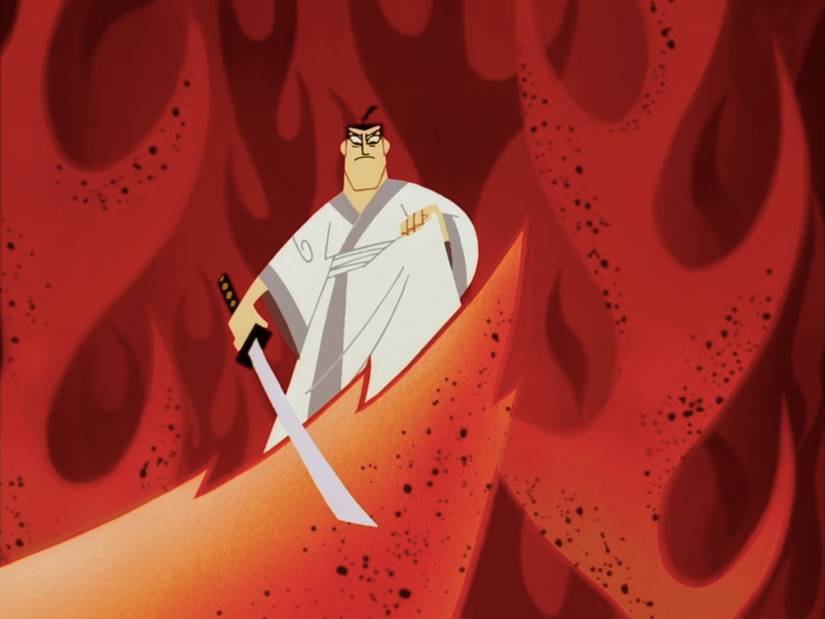 Image: Cartoon Network
The aesthetic of Samurai Jack was an intricate mosaic of influences. Tartakovsky and his team frequently drew inspiration from the elegant, painterly illustrations found in vintage Golden Books and the refined art direction of 1950s classics like Disney’s Sleeping Beauty. Additionally, the unconventional composition of the 1963 anime The Little Prince and the Eight-Headed Dragon provided a blueprint for the show’s emphasis on streamlined character designs and evocative, minimalist linework.
A hallmark of both Sleeping Beauty and that classic anime was their rejection of standard black character outlines. Instead, they utilized chromatic outlines—shades that complemented the local color of the subject—to create a softer, more dimensional look. Samurai Jack pushed this philosophy to its extreme by almost entirely abandoning outlines for its protagonist. By allowing Jack’s white attire to interact directly with the textured, painted backgrounds, the show created a striking contrast, requiring meticulous color theory to ensure the characters remained the focal point of every frame.
 Image: Cartoon Network
These stylistic choices ensured that whenever Jack’s sword appeared, it commanded the audience’s attention. Rendered as a simple, slightly curved silver rectangle—or occasionally featuring subtle tonal stripes to delineate its edge—the weapon acted as a piercing sliver of light across the dense, detailed environments. In the heat of combat, the blade became a kinetic blur, trailing through the air with a weight and speed that made every strike feel monumental, particularly during the iconic, slow-motion aftermath of a clean cut.
The 2017 revival offered a profound exploration of this bond, chronicling a broken, battle-weary Jack who had been deemed unworthy by the gods. Having lost his optimism, he was temporarily deprived of his sword, necessitating a journey to reclaim his honor before the weapon would once again recognize its master.
Watching Jack reunite with his blade remains one of the most poignant sequences in the series, perfectly setting the stage for a grand finale. After a decade and a half of anticipation, the conclusion served as a fittingly transcendent end to a show that transformed a simple blade into an enduring icon of animation history.
Source: Polygon
Related articles
 Gears of War 3 Can Now Be Fully Beaten on PC
 Bungie Outlines Marathon Development Plan Through March 2027
 Hideo Kojima Explains Why He Is Not Revealing Details About OD
 Buffy the Vampire Slayer Episode Inca Mummy Girl Turns 29
 Nolan North Expresses Readiness to Return as Nathan Drake in Uncharted 5
 Gameplay for Marvel Project COMET Leaks Online Ahead of Schedule
 Troy Baker Reflects on His Role in Mass Effect 3
 Insider Details Major Microsoft Changes Following Player Requests