
Samsung 860 Evo evaluate: Improved endurance, however simply as quick because the 850 Evo

For the previous three years, Samsung’s 850 Evo has been constantly one of many best SSDs cash should buy. It’s typically been costlier than the competitors, however its velocity, endurance ranking and beneficiant five-year assure have all helped it safe its place as one of many mainstays of any PC gaming construct. Finally, nonetheless, it appears to be like just like the 850 Evo’s time on the prime is about to finish, as Samsung’s simply changed it with the brand-new 860 Evo.
Or is it? A fast take a look at its specs will reveal the 860 Evo isn’t about to rewrite the rulebook relating to total velocity – certainly, Samsung’s claimed sequential learn velocity is simply 10MB/s quicker at 550MB/s whereas its sequential write velocity is a similar 520MB/s – so for those who’re primarily involved with stuffing as many MBs down your storage pipes within the time it takes to have a swig of tea as potential, then the 860 Evo in all probability doesn’t have a lot to give you over its cheaper, outgoing cousin.
Instead, it’s the endurance division the place the 860 Evo actually shifts the goalposts, rising the 850 Evo’s 75-300 terabytes written (TBW) ranking up to an enormous 150-2400 TBW. Admittedly, that 2400 TBW determine is just reserved for the highest 4TB capability (these settling for the entry-level 250GB and 500GB fashions shall be restricted to 150 TBW and 300 TBW respectively, whereas 1TB and 2TB consumers get 600 TBW and 1200 TBW), however that’s nonetheless a heck of an enchancment in comparison with what the 850 Evo first provided when it got here out on the back-end of 2014 (that’s, 75TB for the 120GB and 250GB capacities, 150TB for 500GB and 1TB homeowners,and 300TB for the 2TB and 4TB fashions). Let’s put that in a useful desk, we could?
| Samsung 850 Evo | Samsung 860 Evo | |
| 120GB | 75 TBW | – |
| 250GB | 75 TBW | 150 TBW |
| 500GB | 150 TBW | 300 TBW |
| 1TB | 150 TBW | 600 TBW |
| 2TB | 300 TBW | 1200 TBW |
| 4TB | 300 TBW | 2400 TBW |
Of course, an SSD’s endurance ranking is sort of inconceivable to check with out utilizing it long-term, so I’ll primarily be concentrating on what sort of learn and write speeds you may count on from the 860 Evo and whether or not it’s price stumping up the additional money for it. In this case, I’ve acquired the two.5in mannequin of the Samsung 860 Evo in a 2TB capability, however it’s additionally obtainable as an NVMe stick (which requires an M.2 slot in your motherboard) and mSATA type issue for laptops.
Much like its predecessor, the 860 Evo makes use of Samsung’s 3D V-NAND expertise (or vertical NAND) to pack in additional reminiscence layers than older 2D NAND units. By stacking cells vertically as a substitute of in a single aircraft, 3D V-NAND not solely lasts longer and makes use of much less vitality, however it additionally permits an SSD to learn and write information quicker and are available larger capacities.

The solely drawback with the 860 Evo is that it’s so near the 850 Evo in total zippiness that it primarily comes right down to a photo-finish-type state of affairs on which one’s really faster. For occasion, I examined each SSDs on the identical system (which contains of a three.6GHz Intel Core i5-8600Ok, 16GB of Corsair Vengeance 3000MHz RAM and an Asus Prime Z370-P motherboard, so is unlikely to carry both of them again) and put them via the identical checks in AS SSD and CrystalDiskMark.
The first check was AS SSD’s 1GB sequential check, which reads and writes 1GB of information in adjoining places on the SSD. Your SSD doesn’t sometimes behave on this method, however it’s a best-case state of affairs sort of velocity and sometimes the one which’s quoted by producers. In this check, the 860 Evo managed 524.5MB/s learn and 496.3MB/s write. The 850 Evo, in the meantime, got here in at 512.5MB/s learn and 498.6MB/s write.
Don’t get me unsuitable. Both units of outcomes are wonderful, however it hardly places the 860 Evo in an excellent mild when Samsung’s charging a lot extra for it, at the very least within the UK. Here, the 860 Evo prices £90 for 250GB and £162 for 500GB, whereas the 850 Evo prices £80 for 250GB and £122 for 500GB. In the US, in the meantime, the 860 Evo is definitely cheaper, coming in at $95 for 250GB and $170 for 500GB, whereas the now a lot scarcer 850 Evo prices $100 and $180 for a similar capacities.
AS SSD’s random 4K check didn’t assist put any distance between them both. This reads and writes 1GB of information cut up into 4K chunks throughout an SSD’s storage, and is rather more indicative of the sort of speeds you’ll really see in on a regular basis use. Here, the 860 Evo produced speeds of 40.3MB/s learn and 98.2BG/s write, whereas the 850 Evo edged forward with 41.7MB/s learn and 98.1MB/s write.
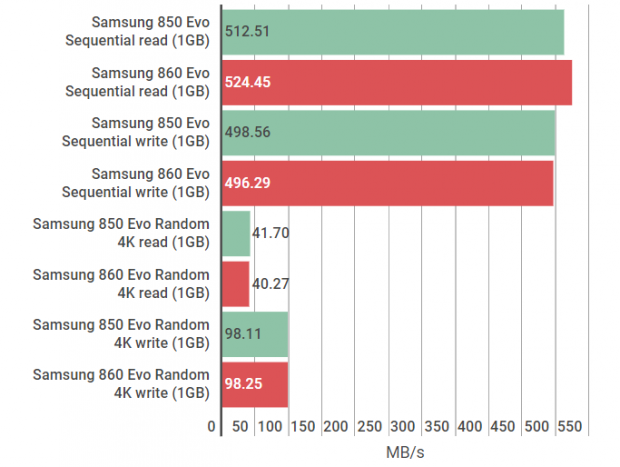
Even CrystalDiskMark’s intensive random 4K Eight-queue-Eight-thread check (which is nearer in workload to what you may see on a server or workstation) couldn’t assist settle the controversy, as each scored a write velocity of 360MB/s, whereas learn speeds got here in at 403.3MB/s for the 860 Evo and simply 401.1MB/s for the 850 Evo.
Really, then, the 850 Evo remains to be a wonderful purchase by way of total velocity, and present 850 homeowners don’t have any have to improve both. The 850 Evo additionally comes with the identical five-year assure because the 860 Evo, too, so until you’re going to be writing all these lots of and hundreds of TBs lined by the 860 Evo’s endurance ranking in lower than that point, UK consumers are in all probability higher off saving themselves a bit of money and sticking with the 850 whereas it’s nonetheless obtainable.
I’d in all probability nonetheless advocate the 850 Evo over Crucial’s new MX500 as nicely (which you’ll learn extra about in our Crucial MX500 review). While Crucial’s drive doesn’t cost as much because the 850 Evo and scored a nigh-on equivalent velocity within the sequential check, its random 4K outcomes had been 9% slower when it got here to studying in AS SSD, and 25% slower writing. For some, that could be price saving an additional tenner or so relying on what capability you go for, however I think about most could be completely happy paying a bit extra for these quicker write speeds.
So seize a Samsung 850 Evo whilst you can, is my recommendation to UK PC avid gamers. There’s no telling how a lot inventory will proceed to drift round now the 860 Evo’s out, so get one now earlier than it’s gone. Video editors and such will seemingly profit from the additional endurance provided by the 860 Evo, however for everybody else UK-based, the 850 Evo remains to be the SSD to beat. Those within the US, nonetheless, can safely ignore all that and go for the 860 Evo as a substitute. Unless you actually like paying greater than you should, in fact.
Related articles
 SpaceX unveils Starship V3: from tests at Massey to Mars flight in 2026
 How I Synchronized Character Coordinates on the Server in Lineage 2 using Node.js / Habr
 Lanmodo Vast M1: Flexible Car Night Vision Device for Safer Driving
 Spend $10 to become a Golden Member, you’ll save $420 when buying Lanmodo Newest Night Vision Dash Camera
 Here are all of the confirmed ray tracing and DLSS games so far
 Nvidia Ampere: every part you’ll want to learn about Nvidia’s RTX 3070, 3080 and 3090 GPUs
 Scan’s fashionable Core i7, RTX 2070 Super desktop is £150 off proper now
 World Of Warcraft: Shadowlands PC necessities requires an SSD