How Pokémon Inspired the Next Generation of Game Developers and Their Work
Nearly three decades after it first captivated the world in 1996, Pokémon remains a juggernaut of global entertainment, showing no signs of fatigue. Recent data from Gamesight highlights this enduring dominance: since 2018, Pokémon-related gaming content has amassed a staggering 1.4 billion hours of live viewership across YouTube and Twitch. Furthermore, a library of over 3.6 million YouTube videos has garnered more than 66 billion views. Over the last eight years, the franchise has consistently maintained a floor of 1.5 million hours watched every single month. It is a rare cultural phenomenon that transcends generational divides, maintaining a fervent fanbase year-round.
The franchise’s thumbprint on the modern gaming landscape is everywhere. Many of today’s leading designers—the architects of both current hits and future classics—cut their teeth as trainers long before they entered the industry. We sat down with eight developers from diverse studios to discuss their formative memories of the series and how those pocket monsters continue to influence their professional craft.
Note: The following interviews have been condensed for flow and clarity.
What is your most cherished memory of the Pokémon series?

Miles Winzeler, Senior Producer at Obsidian Entertainment (Grounded 2)
I remember trespassing into the Power Plant in Pokémon Red alongside my sister. We were hopelessly underleveled and terrified, passing the Game Boy back and forth as we pushed deeper into the unknown. Against all logic, we walked out having successfully captured Zapdos—a victory born of pure, childhood persistence.
Hannah Corcoran, Producer at Auroch Digital (Warhammer 40,000: Boltgun 2)
Pokémon was the wallpaper of my childhood—literally, I had a themed bedroom. It served as a vital bridge between my brother and me. I’ll never forget those long car journeys, huddled in the backseat with a Link Cable, trying to catch the flicker of passing streetlights just to see our non-backlit screens. It sparked my creativity early on; I spent years sketching my friends as Gym Leaders. When I eventually left for university, my Pokédex and plushies came with me as social icebreakers to find my tribe.
Lucas Gullbo, Game Developer & Co-founder at Something We Made (Toem 2)
The series and I are actually the same age—we both turn 30 this year. My journey started with the anime and cards, but Pokémon Gold was my true awakening. I remember the sheer shock of finding Lapras tucked away in Union Cave. I didn’t realize at the time that it only appeared on Fridays; I just felt like I had stumbled upon a genuine secret. That moment defined my love for exploration in games—the thrill of finding those hidden corners that make you feel like the very first person to see them.

Christopher J. Martínez, Technical Artist at Undercoders (Denshattack!)
Generation Five—Pokémon Black and White—represents the peak of the series for me. I received White Version for my birthday right when the Victini event was live. I stayed up all night, racing toward Castelia City just to claim my first Legendary. I called him “Tiny” and kept him in my party until the credits rolled. There was a unique mysticism to those limited-time events back then that I really miss.
Hector M. Padilla, Art Director at Jackbox Games (Legends of Trivia)
I fell victim to a playground myth about the “Crystal Onix” from the anime. When I eventually encountered a Shiny Onix in Pokémon Silver, its bizarre green tint convinced me I had found the legendary glass creature. I was certain my cartridge was a one-of-a-kind anomaly. It’s a hilarious memory now, but at the time, it felt like I had found the holy grail.
Alyssa Lutz, Senior Level Designer at Squanch Games (High on Life 2)
Pokémon actually taught me how to read. I was struggling with literacy when I got Pokémon Red, and I had to ask my cousin what a “parcel” was so I could help Professor Oak. Through the game, I internalised complex words like “paralyze,” “antidote,” and “ether.” My obsession with defeating the Elite Four was the greatest educational motivator I ever had.
Matthew Jackson, Co-founder at Toot Games (My Arms Are Longer Now)
I have a confession that still haunts me: I once overwrote my older brother’s Pokémon Sapphire save file just so I could start a fresh journey. He had a 100% completed Pokédex. If you’re reading this, Dan, I’m still sorry.
Hassan DuRant, Narrative Designer at Outerloop Games (Dosa Divas)
Starting kindergarten during my parents’ divorce was rough, but Pokémon gave me a lifeline. A boy saw me playing with green blocks, asked if I was building a Caterpie, and suddenly I had a best friend and a reason to want a purple Game Boy Color. Decades later, replaying Pokémon Crystal felt like visiting an old neighborhood. I realized that the trainers I was fighting shared the names of all the real-world friends I’ve made through this franchise over the years.
How has the series shaped your professional work in game development?

Miles Winzeler, Senior Producer at Obsidian Entertainment (Grounded 2)
Pokémon was my first lesson in “layered” game design. It balances explicit systems (type matchups) with deep, invisible mechanics (IVs and EVs) for the hardcore players. This philosophy—making a game accessible enough to walk through the door but deep enough to reward those who dig—is something I use daily. For Grounded 2, when we designed the hunt for Buggy eggs, we used the tension and reward of catching a Legendary Pokémon as our primary touchstone.
Hannah Corcoran, Producer at Auroch Digital (Warhammer 40,000: Boltgun 2)
I admire how the series iterates on its core loop while respecting its heritage. As a producer, I look at how different disciplines must align to create that kind of lasting player connection. Watching the fan communities today reinforces my belief that if you build something with heart, the players will sustain it long after the credits roll.
Lucas Gullbo, Game Developer & Co-founder at Something We Made (Toem 2)
The creature design in Pokémon is a masterclass in theming. I often think about how Game Freak merges biology, folklore, and history into a single silhouette. Whenever I’m concepting characters now, I ask myself if there is a behavioral or scientific “nod” I can include to give the design more weight and personality.
Christopher J. Martínez, Technical Artist at Undercoders (Denshattack!)
For many VFX artists, Pokémon was our introduction to stylized effects. Attacks like Thunderbolt or Flamethrower taught us about impact, color theory, and timing. Game Freak’s ability to make a move feel powerful despite technical constraints is incredible. They popularized a visual language of bold colors and punchy silhouettes that we still reference in modern VFX animation.
Showcasing the Ken Sugimori Influence:
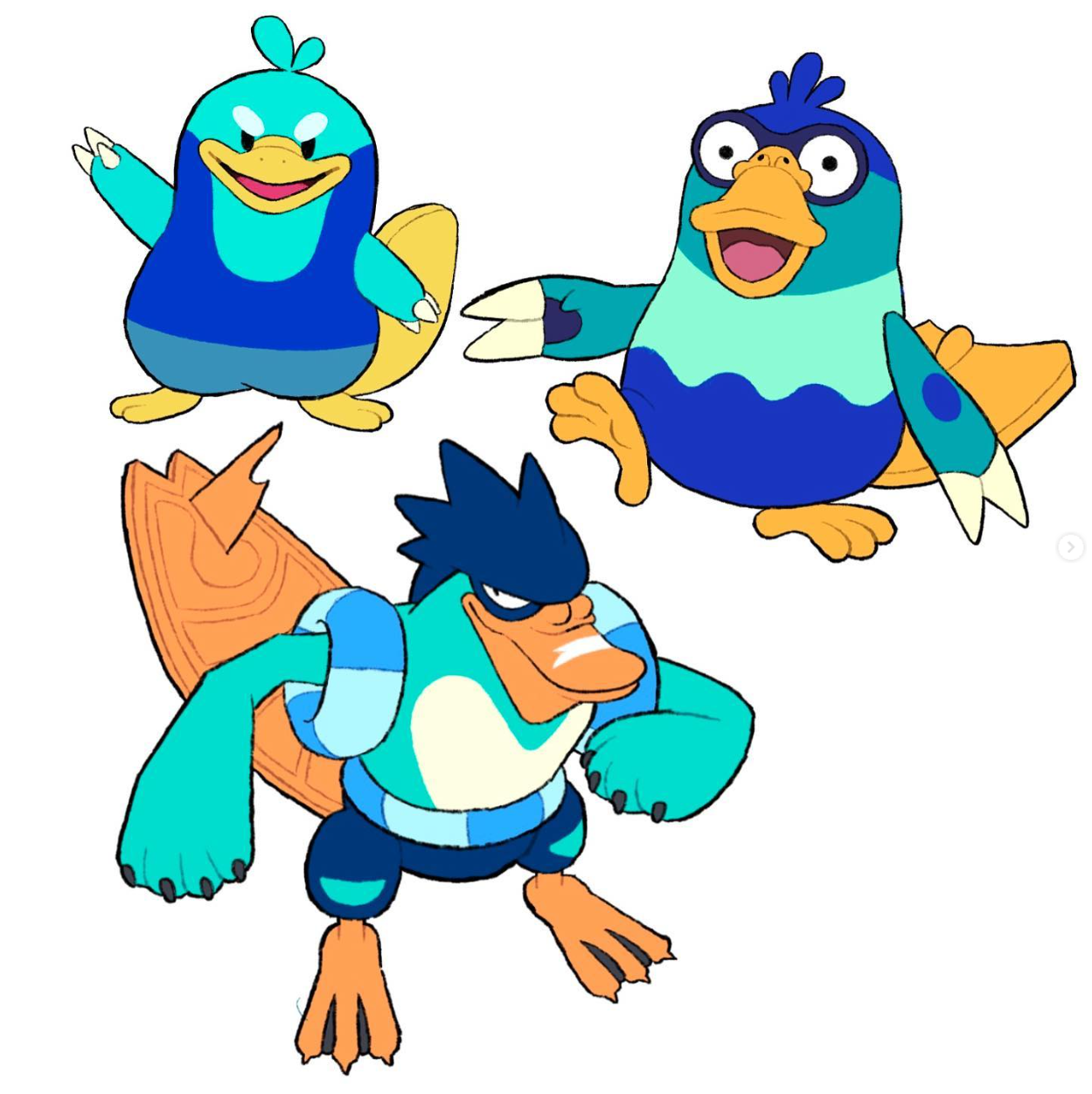


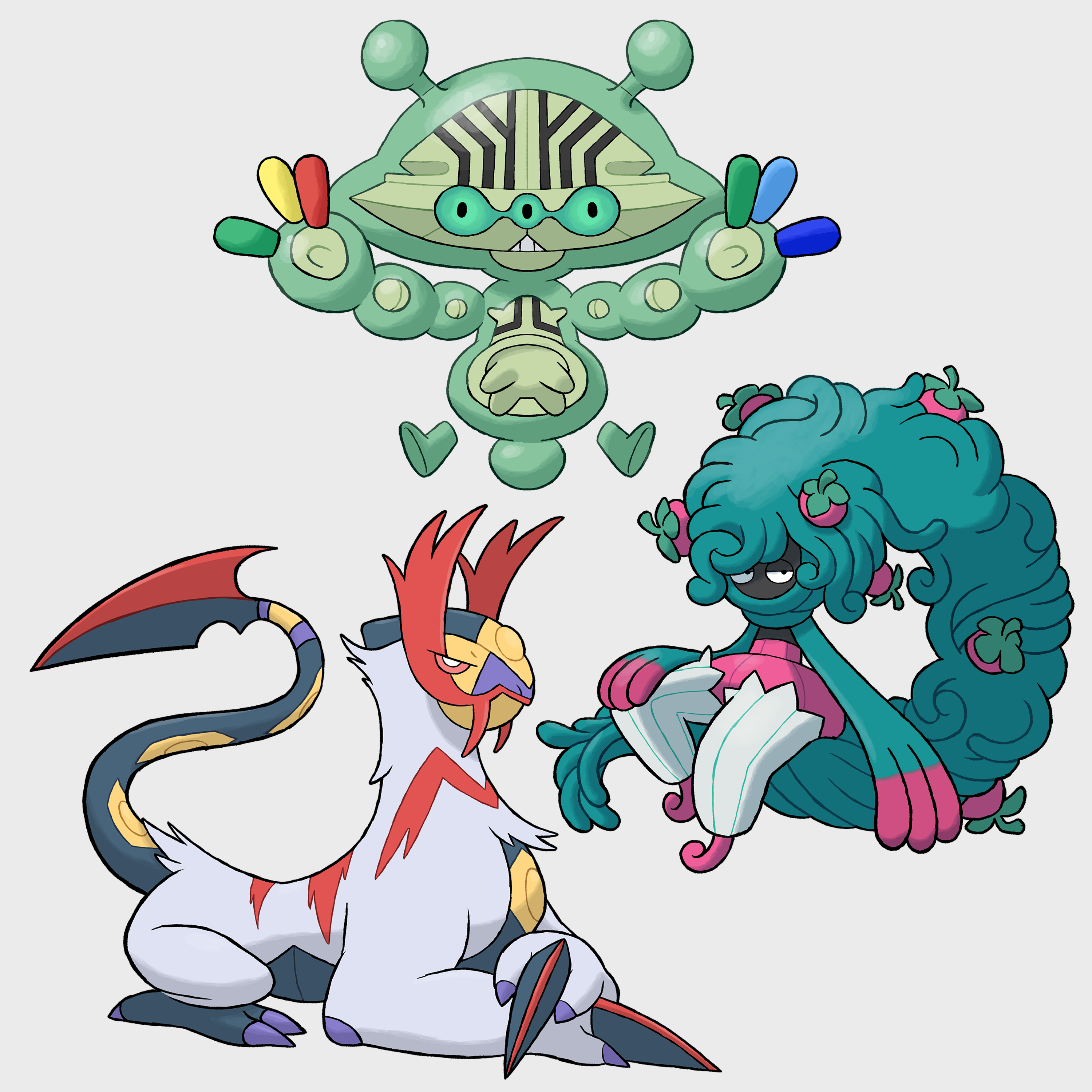
Creative creature designs by Hector M. Padilla.
Hector M. Padilla, Art Director at Jackbox Games (Legends of Trivia)
I essentially graduated from the “Ken Sugimori School of Art.” Pokémon taught me everything I know about shape language and character appeal. I still design original monsters as a creative exercise to sharpen my skills; it’s the foundation of my entire visual identity as an artist.
Alyssa Lutz, Senior Level Designer at Squanch Games (High on Life 2)
We often reference Pokémon’s elemental typing when discussing FPS combat. It’s a perfect loop: by giving enemies specific weaknesses, you force the player to engage with their entire toolkit rather than sticking to one weapon. It creates a dynamic, thinking-man’s combat experience that keeps the player’s brain active.
Matthew Jackson, Co-founder at Toot Games (My Arms Are Longer Now)
The series excels at injecting the absurd into the ordinary. That specific flavor of “weirdness in a normal world” is a major inspiration for the tone we strive for at Toot Games.
Hassan DuRant, Narrative Designer at Outerloop Games (Dosa Divas)
Pokémon taught me the power of the “mundane.” In Gen 2, the ability to call your mother on the phone didn’t help you win battles, but it made the world feel real. It reminded you that you weren’t just a sprite—you were a kid on a journey. Seeing a corporate office or a train station turned into a dungeon showed me that any environment can be fantastic if you frame it correctly. That realization led to my very first RPG projects and, ultimately, my career.
Source: Polygon
Related articles
 Insider Reports “Euphoria” Star Jacob Elordi Has Been Cast as James Bond
 God of War Creators Considered a Different Name for Kratos, but Pizza Jokes Derailed the Plan
 Shrek 2 Remastered System Requirements Call for RTX 50 GPU, Players Mock Specs
 A Mass Effect 5 Trailer Featuring Liara Seems to Have Leaked After BioWare’s Shutdown
 Fan-Made Port Brings The Legend of Zelda: Link’s Awakening Remake to Android
 Genshin Impact 7.2 Update Presentation Will Air at Unusual Time, Teaser Says
 Capcom Veteran Says Resident Evil – Code: Veronica Hurt the Franchise and Pushed RE5 and RE6 Toward Action
 Bleach Poster Released for Finale of “Thousand-Year Blood War” Anime