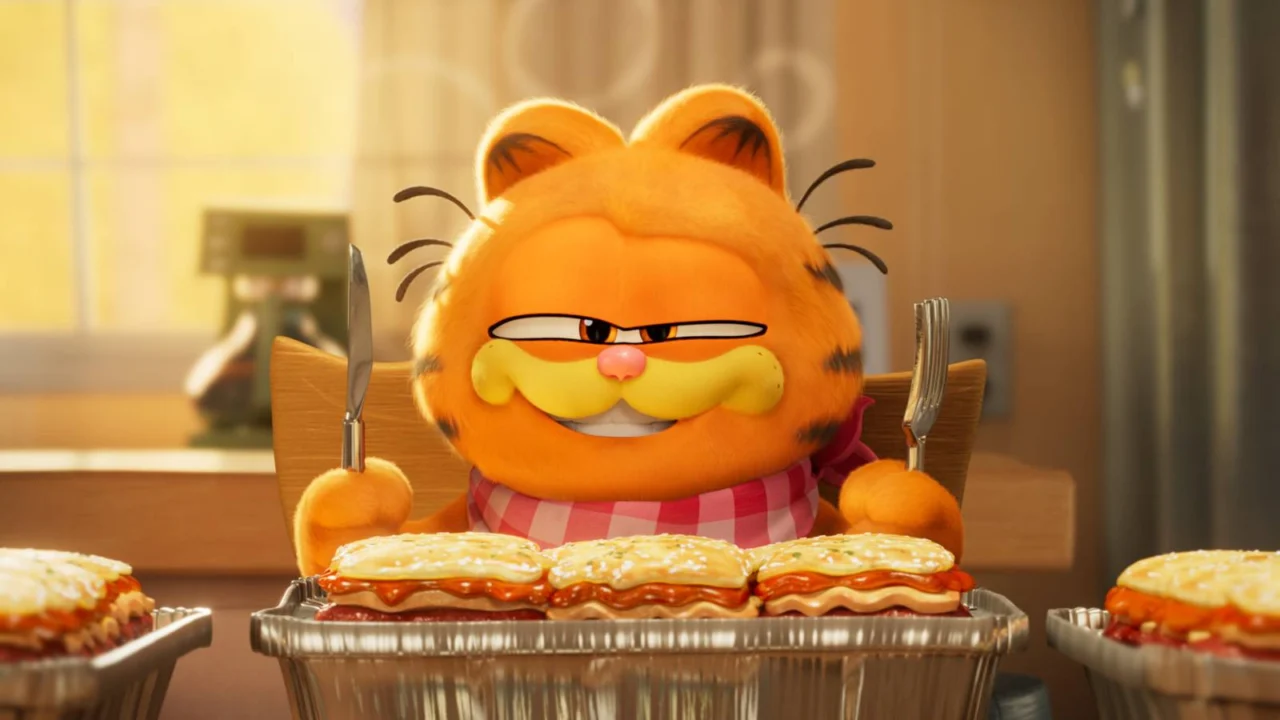
Garfield Comic Strip From 1989 Shifted to Psychological Horror With Its “Garfield Alone” Storyline
In 2012, Randall Munroe introduced the idea of “today’s lucky 10,000” in his webcomic xkcd. His premise is that any widely known fact or idea reaches roughly 10,000 new people each day. Nothing is truly something “everyone knows.” If a friend hasn’t heard of something you consider obvious, that’s no failing on their part. They’re simply one of the people who get to learn it today.
Anyone who follows online pop culture, especially on social media and microblogging platforms, can watch Munroe’s theory play out as new audiences rediscover old material.
One of the best examples comes from Jim Davis’s Garfield. Ninety-nine percent of the time, Garfield is a gag-a-day comic built on a few reliable punchlines: an orange cat who eats too much, a stupid dog, and their weird owner. The strip revels in the mundane, with jokes about coffee, laziness and gluttony. Then there’s the remaining 1%.
A handful of truly weird stories sit in the back alleys of what you might hesitate to call the Garfield canon. The 1984 graphic novel anthology His 9 Lives includes a prose detective story, a science fiction parody, a chase sequence and an effective horror short. The animated special Garfield in the Rough ends with an actual fight scene between Garfield and a wild panther.
The strangest story in the newspaper strip itself may be a G-rated horror arc often nicknamed “Alone.”
Missing: fat orange cat
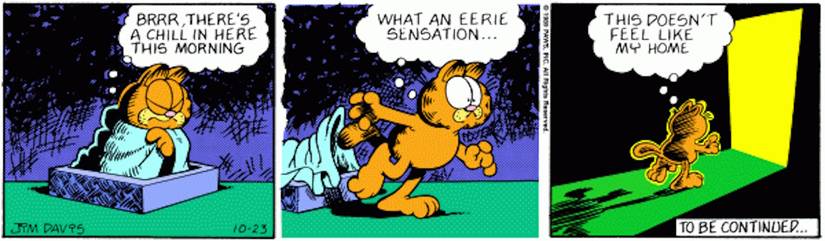
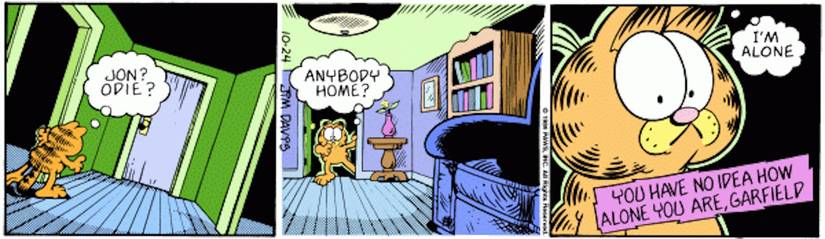
On Oct. 23, 1989, the week before Halloween, readers opened their newspapers to a very different Garfield. Davis’s usual flat layouts gave way to moody backgrounds and Dutch angles. Garfield wakes up alone in an empty house.
He soon discovers that Jon and Odie are gone and that the house looks as if it has been abandoned for years. No one has lived there for a long time, Garfield included. It’s as if Jon and Odie simply got up and walked out years ago. Did they leave Garfield behind on purpose? Is Garfield a ghost? Is this a post-apocalyptic Garfield alternate universe? What’s happening?
The Oct. 28 strip offers a partial answer. “After years of taking life for granted,” it reads, “Garfield is shaken by a horrifying vision of the inevitable process called ‘time.’ He has only one weapon… denial.”
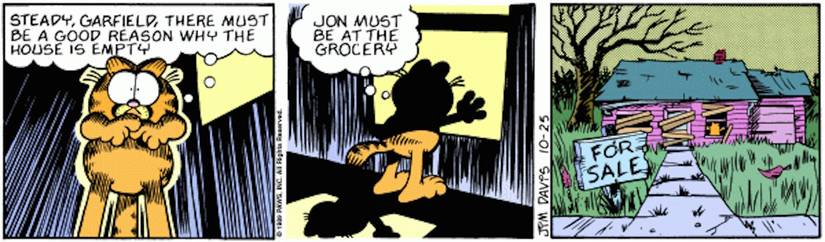
Garfield freaks out, and then he seems to return to the present with Jon and Odie. The end. The moral appears to be that you should prize every moment with your loved ones, in case you wake up in a dark future where none of you exist. It’s not a widely applicable moral.
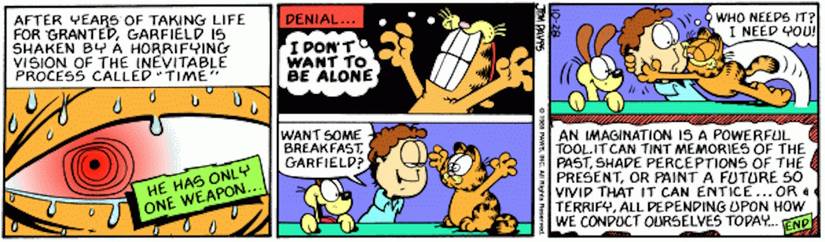
The strip’s narrator closes the arc this way: “An imagination is a powerful tool. It can tint memories of the past, shade perceptions of the present, or paint a future so vivid that it can entice… or terrify.”
The most obvious reading is that “Alone” was a nightmare. Afterward, the strip returned to its daily routine and has mostly stayed there for 37 years.
Fans haven’t let it go, though. Whenever “Alone” resurfaces online, a few more people independently decide the arc may never have ended. Under this theory, every Garfield strip for nearly 40 years has been an elaborate delusion, dreamed up by Garfield as he wanders a cold, abandoned house. The internet loves dark readings of children’s media, so the “Alone” theory will probably last as long as Garfield does.
Davis’s only public comment on the arc seems to have come in 20 Years & Still Kicking, a 1998 anniversary collection. That’s almost admirable. He threw the strips into the world like a live grenade and let them speak for themselves for nine years.
“During a writing session for Halloween, I got the idea for this decidedly different series of strips,” Davis wrote. “I wanted to scare people. And what do people fear most? Why, being alone. We carried out the concept to its logical conclusion and got a lot of responses from readers. Reaction ranged from ‘Right on!’ to ‘This isn’t a trend, is it?'”
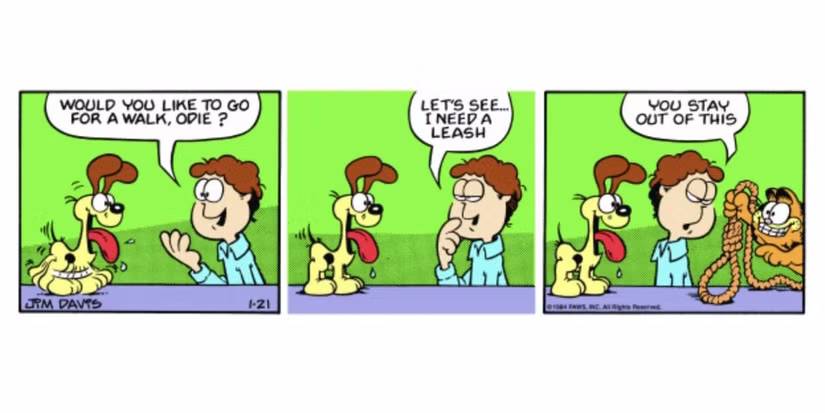
The experiment isn’t entirely out of character for Davis. He has always been honest that Garfield began as a commercial enterprise, but he has occasionally let some high weirdness into the comic. That tendency usually goes into “safer” media such as original graphic novels, though the strip itself can go to some dark places, as a January 21, 1984 installment shows.
For almost 40 years, “Alone” has stood alone. It’s a brief dip into surreal horror that makes Garfield feel like a different strip, and new fans will keep discovering it every few years. Maybe that’s the next cartoonist’s challenge: make a successful children’s comic for 11 years, then spend one week turning it into the scariest thing you can imagine.
Source: Polygon
Related articles
 No Rest for the Wicked Delayed to March 2027, Developers Promise Twice as Much Content
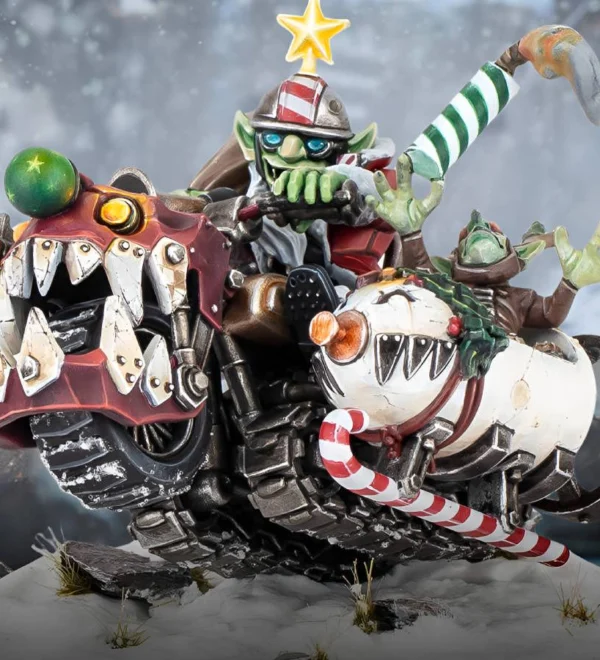 Warhammer 40,000 Creators Show Holiday Miniature of Red Gobbo on a Squigmobile
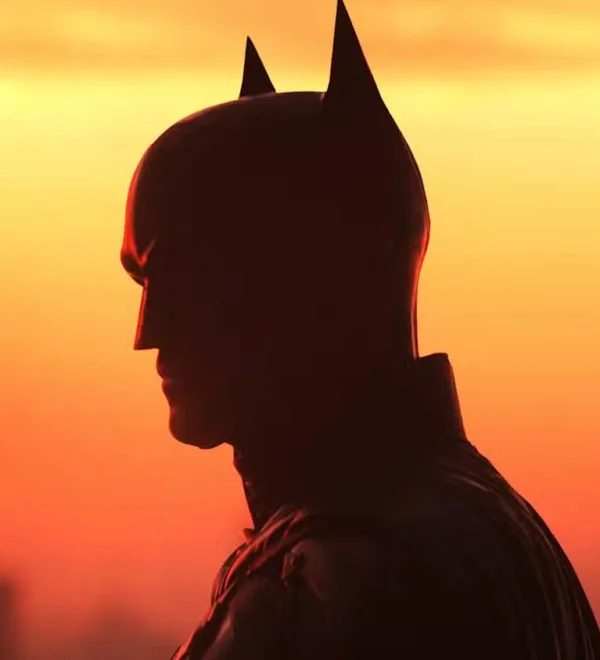 Steven Soderbergh Steps In to Finish Principal Photography on “The Batman Part II” as Matt Reeves Steps Away
 The Blood of Dawnwalker Patch 1.1 to Remove Regional Censorship and Add New Features
 Euro Truck Simulator 2 and American Truck Simulator Launch Halloween Event Return to Brackenreach With New Rewards
 Buffy the Vampire Slayer Launched Its Most Controversial Couple 26 Years Ago
 Battlefield 6 Is Temporarily Free, and a New UFO Easter Egg Has Drawn Criticism From Many Players
 Differences Between Coppola’s Apocalypse Now and George Lucas’s Original Vision for the Film