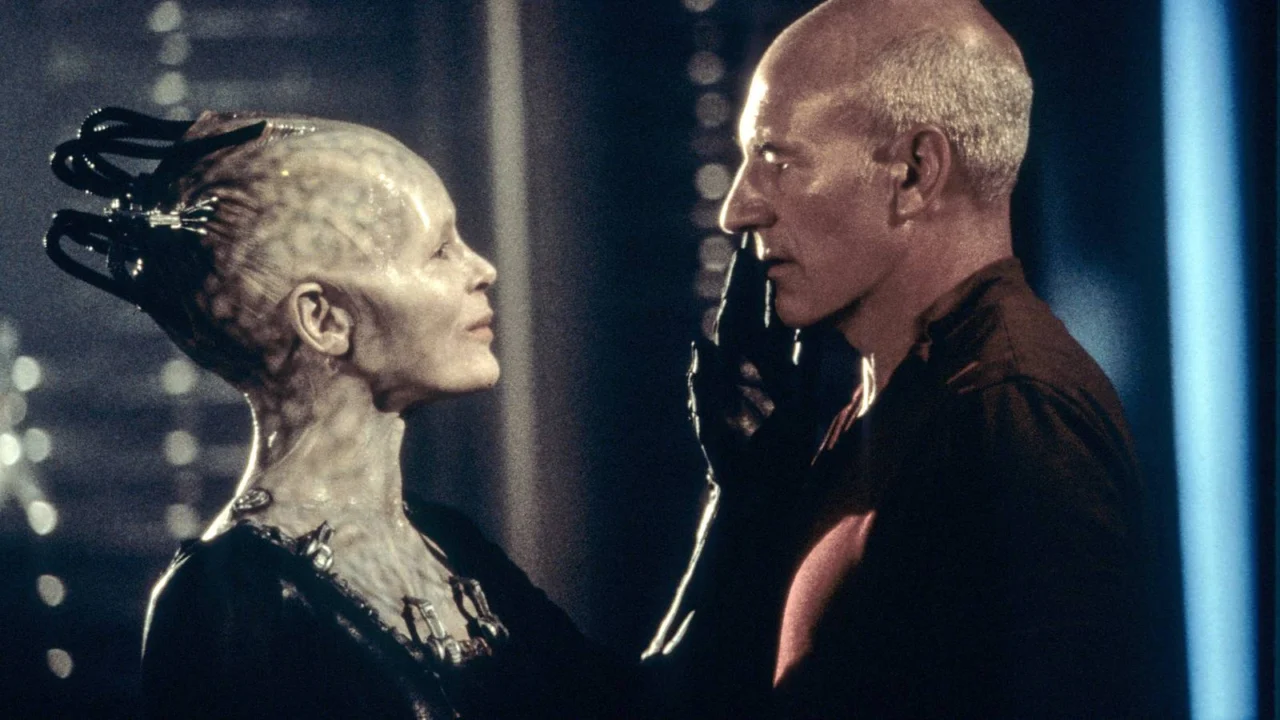
30 Years Before Disclosure Day, Star Trek Beat Steven Spielberg to the Punch

Toward the conclusion of Star Trek: First Contact, after Captain Jean-Luc Picard and his crew effectively thwart the Borg’s attempt to rewrite history, the film fulfills its titular promise. Zefram Cochrane achieves humanity’s maiden warp-capable flight, catching the attention of a passing Vulcan vessel. The resulting encounter in the Montana wilderness is remarkably understated—a stark departure from the typical bombast surrounding such monumental milestones. There is no frantic military response or chaotic fanfare; simply two distinct species stepping toward one another to begin a new era.
While this moment remains a cornerstone of Star Trek mythology, its true resonance lies in the filmmaker’s refusal to turn the event into a loud spectacle. For what is arguably the most significant turning point in human history, the scene remains profoundly intimate. It acknowledges that the act of connection itself is what truly matters. This pivotal bridge between terrestrial life and the cosmos eventually spawns the Federation and the hopeful, collaborative future central to the franchise. The series never posits that humanity suddenly achieved perfection, but it frames this encounter as an essential inflection point—the exact moment we shifted from a fractured collection of nations to a singular civilization ready to engage with the stars.
That specific sequence echoed in my mind throughout Steven Spielberg’s latest sci-fi offering, Disclosure Day. Though the two narratives appear distant on the surface—with First Contact fixated on time-travel escapades and Disclosure Day grounded in the contemporary ramifications of extraterrestrial revelation—they share a profound, singular curiosity: How does humanity evolve once we acknowledge we are not alone?
Taken together, these films serve as different meditations on the same transformative event. Disclosure Day finds its strength by treating alien existence not as a triumph of physics, but as a crisis of philosophy and culture. Spielberg is less interested in the mechanics of contact and more concerned with the existential shockwaves such a revelation would send through our social, economic, and religious frameworks. The film posits that discovery acts as a destabilizing force, challenging our long-held definitions of authority, identity, and our perceived status within the vast, uncaring universe.

Image: Universal/Everett Collection
There is a chilling scene where a character kneels before Emily Blunt’s protagonist, prompting her to snap, “I won’t be anyone’s god!” It is a fleeting moment, but it strikes at the core of the film’s thesis: when confronted with the incomprehensible, humans don’t just hunt for truth—we scramble to construct meaning. Spielberg appears skeptical that the immediate human response to alien life would be one of enlightenment; he suggests instead that it would be characterized by tribalism and intense public discourse.
The film suggests that disclosure would be a non-linear experience. While we might all receive the news at the same time, we would process it through deeply fragmented filters. Wonder is frequently eclipsed by distrust, political maneuvering, and entrenched ideology. It is a bleak, yet modern assertion that when reality fundamentally changes, humanity’s fractured nature dictates how—and if—we adapt.
This is where the contrast with Star Trek: First Contact becomes so evocative.
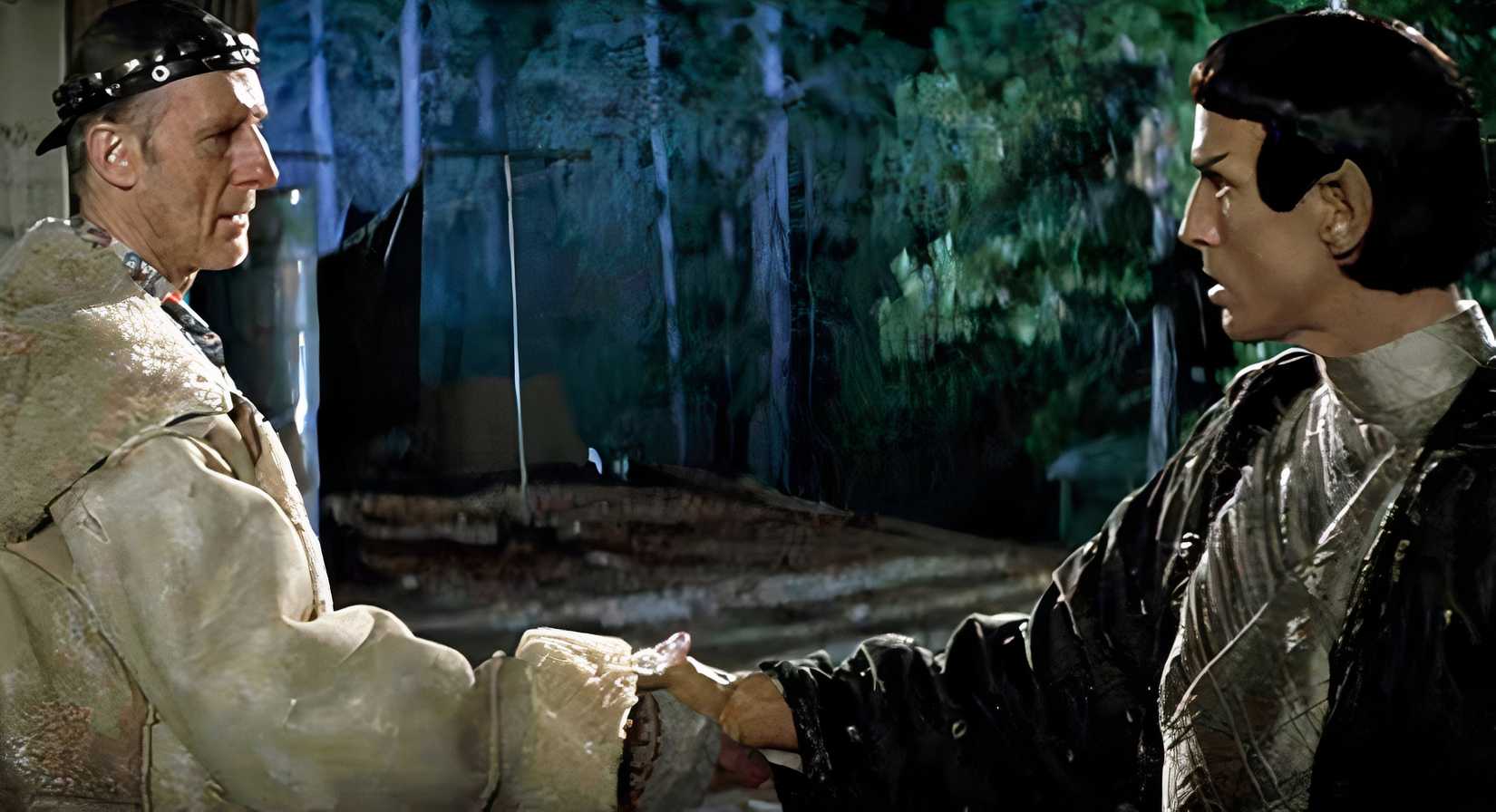
Image: Paramount Pictures
The Vulcan encounter reaches an entirely different conclusion. In the Trek timeline, contact acts as a catalyst for unity rather than a solvent for civilization. It initiates a long, arduous process of maturation. It doesn’t magically erase human flaws, but it does widen our perspective enough to acknowledge our place in a larger community. Star Trek offers a more optimistic horizon, assuming that given enough time and struggle, we eventually find the maturity to move past our self-imposed boundaries.
Ultimately, these two films approach the same classic science fiction dilemma from opposite poles. Disclosure Day views the revelation as a reckoning—a traumatic prompt to re-evaluate our systems of belief and power. First Contact, meanwhile, treats it as a dawn, the beginning of a generational effort to ascend. They are not merely competing visions, but rather two stages of the same arduous journey: the initial, disorienting shock of discovery, followed by the long, difficult labor of deciding who we are in the aftermath.
Disclosure Day is in theaters now.
Source: Polygon
Related articles
 Ubisoft Developed Zelda-Like Game Without Link Before Nintendo Canceled It
 Sony Registers Sly Cooper Trademark
 Sony Gauges Player Feedback Following PlayStation Disc Controversy
 Microsoft Canceled Three Halo Games, Insider Report Says
 The Twilight Zone Available to Stream for Free
 Ridley Scott’s Blade Runner Final Cut Streaming Free on YouTube
 Control Resonant Surpasses Past Remedy Game Sales on Steam
 Sci Fi Series Dark Matter 2015 Compared to Apple Show