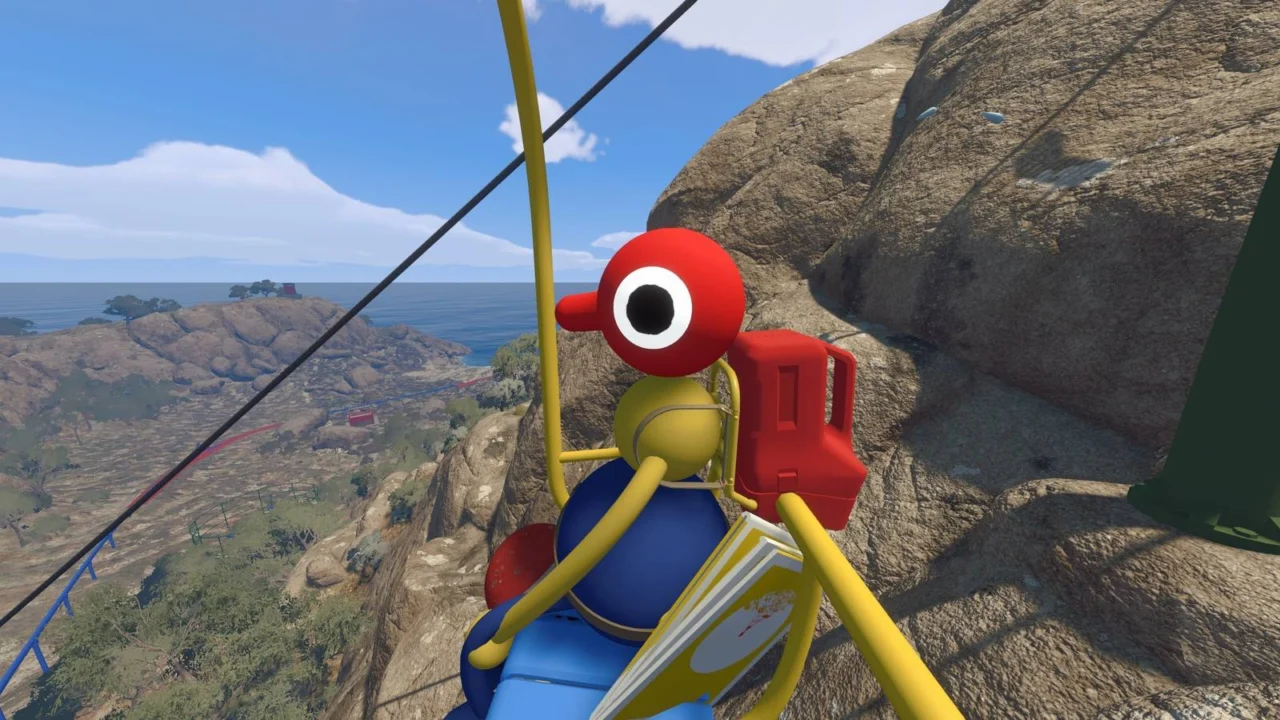
The Best Video Game Ending in Years Belongs to 2026’s Ultimate 10/10 Masterpiece
On the surface, Big Walk hardly seems like the sort of video game engineered to deliver a profound emotional punch. It presents itself as a laid-back cooperative adventure, tasking you and your companions with navigating an open-world island and solving environmental riddles. Any overarching narrative is largely organic, born from the shared banter and mischief between players. Yet, the crescendo of Big Walk left me utterly speechless. This brilliant narrative sequence anchors House House’s remarkable title, transforming a lighthearted multiplayer escapade into one of the most deeply affecting experiences I have ever encountered in gaming.
[Ed. note: Major spoilers for Big Walk follow.]For the majority of your journey, Big Walk follows a dependable rhythm. The exploration area features several towering structures, each holding a key secured by a mechanical lock. These keys are unlocked by gathering red gourds through various puzzles and placing them into the tower receptacles. Once every tower is conquered, a massive gate swings open, offering a glimpse of the mysteries waiting beyond the horizon.
Every obstacle leading up to this point serves a purpose. The game’s challenges demand seamless cooperation among your team. While verbal communication is standard, House House frequently disrupts your ability to see or hear one another. Certain trials erect soundless barriers between you and your allies, forcing you to find alternative ways to convey intent. Limited physical expressions become vital tools as you learn to express yourself through exaggerated arm waves and deep squats. Resourceful players might lean on walkie-talkies or laser pointers, but the core objective remains the same: synchronizing your problem-solving capabilities.
True to form for exceptional game design, the finale acts as the ultimate examination of everything you’ve practiced. Crossing through the final threshold and approaching a glowing orb transports your group into a surreal, multi-layered puzzle tower. The catch? Audio communication is completely stripped away. Worse still, the distinct colors that separate individual players are wiped clean. Unable to speak or even identify who is gesturing nearby, you must rely entirely on the trust and intuition built over hours of play.
That setup might sound frustrating on paper, but in practice, it felt remarkably intuitive during my playthrough. I quickly realized I no longer needed spoken words to coordinate with the two friends I had spent so much time alongside. Over the journey, I had internalized their unique physical mannerisms. When we needed to relay abstract symbols to solve a riddle, I instinctively understood what a frantic flurry of movement meant when I had misinterpreted a cue. Similarly, a triumphant toss of the arms signaled that I had successfully guessed correctly.
By that point, movement alone was enough to distinguish each person. My teammates noticed the same quirks. Early on, I picked up a decorative teapot intended for a puzzle and decided to carry it through the entire tower as an ongoing joke. Once we regained our voices after the ending, my companions confessed they knew I was the one hauling the pot because I had spent the entire campaign obsessively refusing to part with my laser pointer. Of course I was the stubborn player who dragged the teapot everywhere!
Finally, a game that lets me talk with my hands
Everything culminates in a surprisingly poignant sequence. Upon completing the final trials, you step outside the tower where normal sights and sounds are restored—color floods back into the world, and speech returns. Right outside sits a couch facing a projector screening the credits. My group instinctively gravitated toward it to decompress after the exhausting gauntlet. We celebrated our triumph, caught up on everything we couldn’t say inside the tower, and marveled at how well we recognized one another without words. It felt like reuniting with a lifelong friend after years apart; we could have talked for hours.
Yet, good things must eventually draw to a close, a sentiment Big Walk reinforces with its very last mechanical interaction. Your squad confronts a turnstile that blocks your forward path. A lit panel on the side displays three distinct hues, corresponding directly to the colored segments painted onto one specific teammate, signaling that it is their turn to move forward. They cross the threshold, gradually fading from proximity chat as they disappear into a blinding white light. One by one, each member steps through until nobody remains. Crossing into the light leaves you entirely alone, greeted only by a quiet splash screen expressing gratitude for playing.
It is difficult to capture the weight of this experience in text because it relies entirely on emotional resonance. The preceding hours are dedicated to forging genuine ties with your peers—solving cooperative challenges that test your coordination, passing the time with casual chatter among the trees, and creating hilarious, unforgettable memories. All of that momentum converges in a finale that honors those strengthened friendships and provides a tranquil space for reflection.
Sitting in silence after crossing that final boundary, my thoughts drifted past my absent squadmates to encompass all the meaningful relationships throughout my life. I thought of the friends I still see daily, those I’ve drifted away from, and the ones lost along the way. I carry pieces of all of them with me. Every shared memory, from childhood playgrounds to milestone celebrations, serves as a lasting reminder of the people who shaped my identity. That concept is woven directly into Big Walk from its opening moments; you cannot customize your own avatar—instead, your companions must paint your body segments for you. Those exact colors reappear at the final turnstile, indicating when it is your turn to step into the light. In your parting moments, you are quite literally defined by the identity your friends helped create.
Source: Polygon
Related articles
 Spider-Man: A New Day Grosses $1.67 Billion in 12 Days as Analysts Expect Record
 Modder Adds Requested Combat Mechanic to Assassin’s Creed Black Flag Resynced
 Modder Releases Prototype Files for Sleeping Dogs After 15 Years
 Enthusiast Ports Portal 2 to Web Browsers
 Husband-And-Wife Duo Releases Diablo-Inspired Incremental Game Demo With 98 Percent Positive Steam Reviews
 Robert Downey Jr Crime Thriller Returns to Free Streaming on Tubi
 Fallout Season 3 Adds Order of the Feather, Set Photos Indicate
 Take-Two Interactive Will Not Cut Costs Using AI, Says CEO