John Carpenter on the ‘Elaborate’ Dream That Inspired His First Graphic Novel & Its Heavy Metal Soundtrack: ‘It’s Unbelievable’
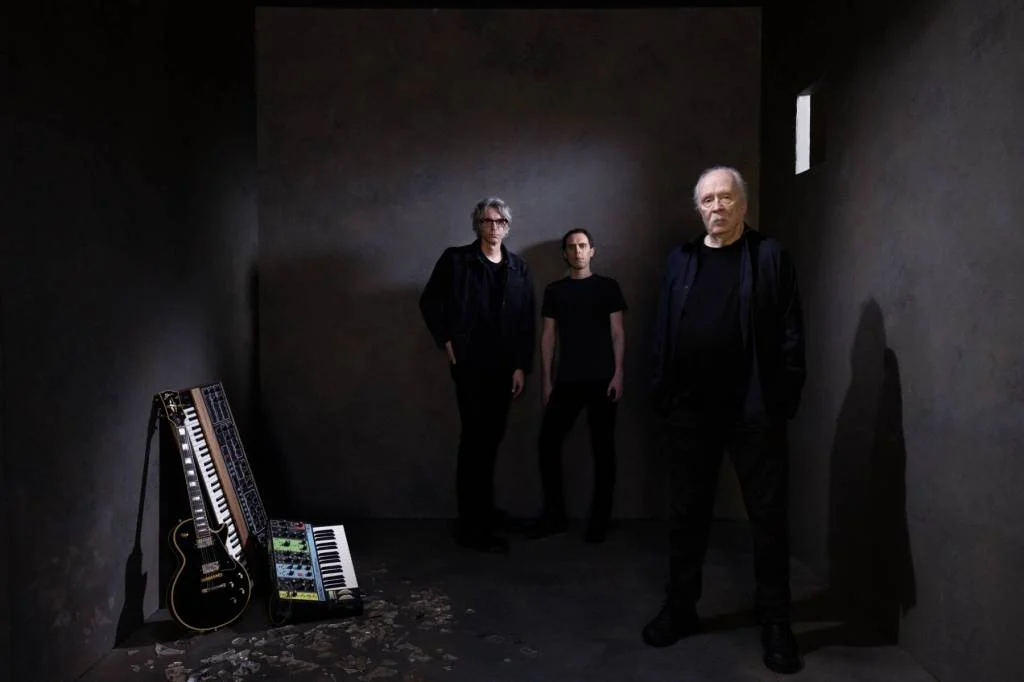
Daniel Davies, Cody Carpenter, John Carpenter
Sophie Gransard/Photo courtesy Biz3 Publicity
Trending on Billboard
It has been 16 years since legendary filmmaker John Carpenter directed a feature film, and a quarter of a century since the influential auteur composed an original score for his own cinematic universe. That drought ends this week with the release of Cathedral, launching Tuesday (Aug. 4) as a striking graphic novel followed by its accompanying companion album on Friday (Aug. 7).
Sparked by a remarkably vivid and unsettling nightmare Carpenter experienced a few years ago, John Carpenter’s Cathedral chronicles a trio of investigators who plunge into a harrowing, demonic underworld in search of the truth behind the brutal murder of a fellow officer inside an abandoned house of worship.
To bring this ambitious project to life—his first major visual endeavor since his 2010 motion picture The Ward—Carpenter reunited in the studio with his trusted creative inner circle: his son, Cody Carpenter, and his godson, Daniel Davies. While the trio’s previous efforts, including four volumes of the acclaimed Lost Themes franchise alongside various cinematic scores, leaned toward moody and minimalist atmospheres, the Cathedral project dials up the intensity. Carpenter, Carpenter, and Davies unleash thunderous heavy metal orchestration to match the graphic novel’s visceral, hellish imagery.
Developed alongside his wife, lifelong creative collaborator, and Storm King Comics founder Sandy King, alongside writer Sean Sobczak—featuring stunning artwork by Federico De Luca and Luis Guaragna, colors by Sian Mandrake, and lettering by Marshall Dillon—the graphic novel stands firmly as a gripping standalone narrative. Paired with the Sacred Bones Records release of the album, however, the endeavor transforms into an immersive multimedia spectacle, offering horror aficionados the closest experience to a brand-new John Carpenter film in over a decade.
Billboard sat down with John Carpenter and Daniel Davies (who fittingly dialed in from a backdrop overlooking a historic Gothic cathedral in Brussels) to discuss the surreal roots of the project, their dynamic relationship with heavy metal, and the relaxed pace of life for a certified cinematic legend.
John, word has it this entire concept materialized from a dream. Are your subconscious visions always this macabre?
John Carpenter: Not usually. Most of my dreams are rooted in everyday anxiety—frustration scenarios where I am trying to direct a scene, nobody is paying attention to me, the clock is ticking down, and I am utterly lost. But this particular dream felt like a fully realized, cohesive narrative, borrowing loosely from classical mythology. I woke up genuinely astonished by it, shared the outline with Daniel and Cody, and we immediately agreed we needed to write an album around it.
Daniel, what was your initial reaction when John first described the dream to you?
Davies: Just as John mentioned, it was so extraordinarily vivid. Our immediate instinct was simply, “We have to score this.” As he walked us through the sequence of events, the imagery naturally evoked specific emotions and suggested a distinct sonic identity. We just leaned into that inspiration and let the music grow organically.
At what point did the graphic novel adaptation enter the conversation?
Davies: That phase developed later. John started with a foundational narrative outline, which served as our blueprint while we composed the music.
Carpenter: The idea of making a comic book floated around in my head because my wife edits and publishes titles through Storm King Comics. I figured, why not turn it into a graphic novel? That phase materialized after the musical score was already finished, roughly around last year when scripting began. My wife Sandy and Sean [Sobczak] really expanded upon the character arcs and world-building far beyond my original outline, giving the comic much greater narrative depth.
Musically, this record feels decidedly heavier and more rock-oriented than your previous output. Did you intentionally set out with a heavy metal palette?
Davies: As John described those terrifying sequences in the narrative, the scenes naturally begged for soaring choirs, driving percussion, and massive guitar distortion. Our creative process is entirely instinctual; if a choice feels authentic to the story, we pursue it. Each of us brings musical sketches for different scenes to the table, and we refine them collectively. The narrative itself guided us down this heavier rock path.
Do you primarily improvise in the studio and piece the tracks together later?
Davies: Pretty much, yes. For instance, on a track like “Lord of the Underground,” John would specify, “We need a driving, aggressive riff here during the showdown between the protagonist and this demonic entity.” From there, he would sketch out a core motif, and we would build the arrangement around it.
The metal aesthetic fits the setting wonderfully, given the heavy Catholic iconography and macabre statues of martyred saints.
Carpenter: I suppose it really does.
In terms of personal music appreciation, would either of you classify yourselves as die-hard metalheads?
Carpenter: Heavy metal is simply one fascinating facet of the wider cultural landscape. I deeply love Metallica—their Black Album is an absolute high-water mark for me. But I wouldn’t say I am obsessive about the genre. What about you, Daniel? Would you consider yourself a metalhead?
Davies: Not necessarily, but much like John said, it is just one of many styles I appreciate. I don’t tend to compartmentalize music into strict genres; if something moves me emotionally, I embrace it. We love everything from Goblin and Metallica to Diamond Head and Ennio Morricone. Genre labels don’t matter nearly as much as how thoughtfully the composition is put together to achieve that weighty atmosphere.
How hands-on was the graphic novel creation process for you? Did you direct the storyboarding phase?
Carpenter: I provided a comprehensive outline that guided Sandy and Sean. They would sit across the room hashing out the plot beats, pacing, and character dialogue, while I sat nearby playing video games, occasionally chiming in if I felt strongly about a specific plot point. For the most part, they handled the heavy lifting themselves.
That sounds like an ideal working environment. What game were you playing?
Carpenter: Fallout 76.
You really cannot beat that setup. How much creative freedom did the illustrators have?
Carpenter: Complete freedom. I trust professionals to do their jobs. They certainly wouldn’t tell me which chord progressions to write, so I have no business micromanaging their artistic style. They are exceptionally talented artists, so I simply let them execute their vision.
In your introduction to the graphic novel, John, you mention that in a different era you likely would have turned this into a feature film. What has shifted in the industry that makes a cinematic adaptation unviable today?
Carpenter: The movie business has evolved drastically. [Spoiler warning ahead.] I might be mistaken, but I struggle to imagine a major studio financing a $100 million blockbuster where the heroic protagonist blinds herself in the final act. That sort of narrative risk simply doesn’t fly with modern executives. Historically, horror films have always been treated as low-budget ventures—very few achieve massive prestige-picture status outside of exceptions like The Silence of the Lambs. Studios rarely step up to fund uncompromising horror on a grand scale.
Building a convincing underworld and executing all those practical and digital effects would certainly require an immense budget.
Carpenter: Exactly, we would have to construct entire environments from scratch. Beyond the financial hurdles, honestly, I just don’t possess the desire to endure that grueling physical labor anymore.
That is entirely fair. If you can lounge around playing video games and craft a graphic novel instead, why would anyone want to report to a film set at dawn?
Carpenter: Truter words have never been spoken.
Do you have any plans to bring this material to the live stage, perhaps integrating visual elements from the graphic novel into a concert tour?
Carpenter: It is certainly a possibility, though we aren’t quite there yet. We will evaluate things as they unfold. We did perform live around Halloween last year at the Belasco Theater, didn’t we?
Davies: That’s right, the Belasco down in downtown Los Angeles. We actually debuted “Lord of the Underground” live on stage there.
Carpenter: That we did. In fact, a live recording of that performance is included on the album.
When you release a project like this, how closely do you monitor the critical reception or fan commentary online?
Carpenter: Not at all. I am personally proud of what we created, which makes outside validation unnecessary.
Davies: The general sentiment seems overwhelmingly enthusiastic, but I tend to avoid diving too deeply into reading reviews myself.
John, you have obviously spent far more decades making music than Cody or Daniel—do you ever feel like they have surpassed your musical capabilities?
Carpenter: They have surpassed me by a mile. Our skill sets are entirely different. Daniel is a masterclass guitar virtuoso, and Cody is a wizard on the keyboards. I cannot execute technical passages anywhere near their level; my musical chops are strictly moderate, and I am comfortable with that reality. I don’t pretend to stretch beyond my technical limits. Where I excel is dreaming up core melodies, hooks, and thematic structures. Daniel and Cody are absolute virtuosos, and somehow our respective strengths mesh together seamlessly.
Davies: We consistently bring out the absolute best in one another, and that collaborative synergy is precisely what resonates when people listen to our records.
What was your emotional reaction when you held the final printed copy of the graphic novel for the first time?
Carpenter: I held a finished copy in my hands just a couple of nights ago, and it is genuinely breathtaking. Studying the artwork up close proves just how exceptional these illustrators are. I am thoroughly thrilled with how it turned out.
Davies: As the illustrated pages rolled in during production, we were continually floored by the quality. Everything flowed effortlessly without friction. The entire undertaking felt uniquely inspired from conception to completion.
Are you currently writing new material? How frequently are the three of you retreating to the studio?
Carpenter: We might happen to be working on something brand new, and we might be pouring a tremendous amount of energy into it.
Davies: Exactly, composing music is our constant state of being. We are always working.
Earlier this year, you participated in a Grammy Museum panel alongside Claudio Simonetti. Would you ever invite someone like him into the studio for a collaboration?
Carpenter: Without hesitation. Sharing a stage or a studio session with Claudio would be an absolute blast.
I would happily pay good money to witness that.
Carpenter: There you go. Feel free to wire over the funds whenever you’re ready.
I will track down your Venmo. One of the most disruptive technological shifts impacting music, comics, and film today is artificial intelligence. What are your perspectives on leveraging AI for artistic creation?
Carpenter: I’m not even sure how I would approach it. Do you have any thoughts on this, Daniel?
Davies: We genuinely love the act of creating art ourselves, so right now I see zero personal appeal in utilizing AI. If an automated tool could function strictly as an assistant engineer—predicting when I might want a new track channel, for instance—that could be convenient. But when it comes to actual creative generation, if an algorithm builds the art, we didn’t make it. The fundamental joy of this craft lies entirely in the human process of making it. Therefore, I have no use for AI in that capacity.
You do it simply for the passion of the craft, not just to reach a finished product.
Carpenter: Precisely.
John, have you experienced any other graphic-novel-worthy dreams since working on this?
Carpenter: That information is strictly confidential.

Leave a Comment
Related articles
 Channing Tatum Denies Using Instagram Burner Account to Troll Ex Zoë Kravitz and Harry Styles
 Taylor Swift Announces New Single Patient Zero
 MAGA Festival Featuring Kid Rock Canceled After Selling 6 VIP Tickets
 Bunnie Xo Defends Dating Man 22 Years Younger Following Split From Jelly Roll
 Taylor Swift Updates Website With New Countdown After Dropping Cryptic Clues
 Lionel Richie Undergoes Heart Procedure and Cancels Three Upcoming Shows
 Travis Kelce Calls Taylor Swift Wearing a Gun on Her Waist in Law & Order Emmys Skit Kinda Hot
 Hayden Panettiere’s Cause of Death Revealed