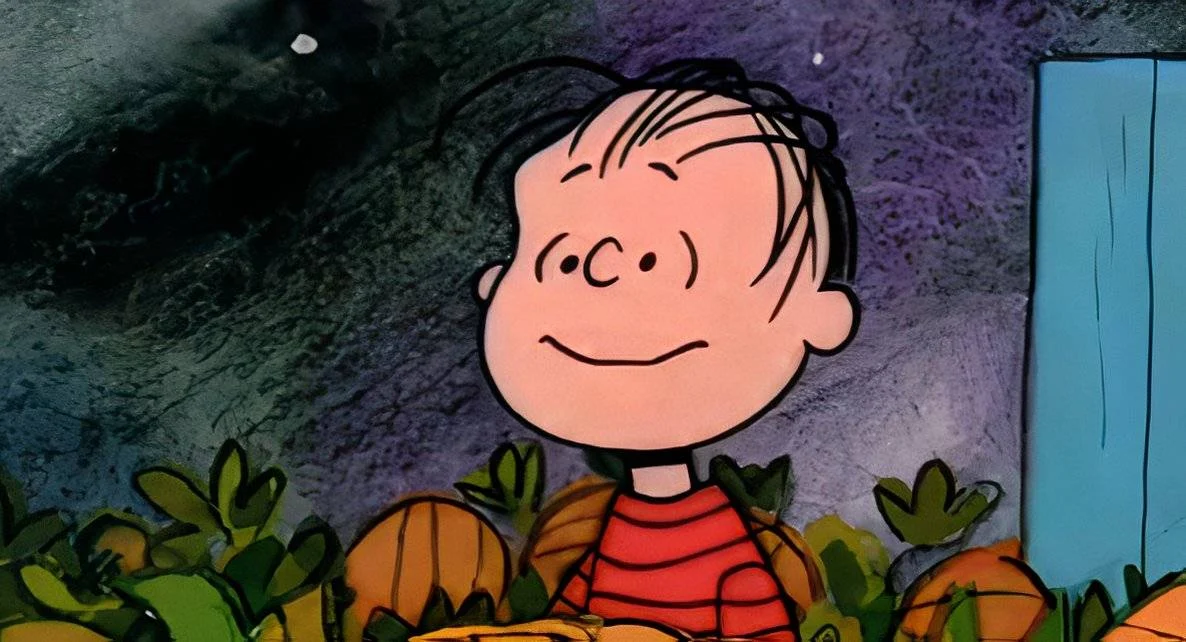
Five Best Halloween Peanuts Comics Without the Great Pumpkin
Halloween in Charles Schulz’s Peanuts often meant another run at the Great Pumpkin. Schulz introduced the running gag in 1959, and it worked a bit like his answer to Samuel Beckett’s Waiting for Godot. Linus van Pelt spent almost 40 Halloweens waiting for the Great Pumpkin to arrive, and it never did.
The roots of the joke seem to lie in a comic strip from Oct. 23, 1959. Charlie Brown complains to Patty that he couldn’t get a Halloween mask from the store, because the shop had already moved on to selling Christmas decorations.
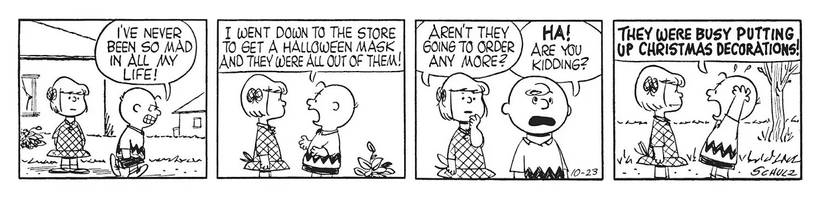
It’s striking to find that complaint in a strip from 67 years ago. We often assume the commercialization of Christmas has grown more aggressive in the 21st century, but it was already an issue when our grandparents were young.
The strip also helps place the Great Pumpkin as a parody of that commercialization. Over time, Schulz kept evolving the joke, and the Great Pumpkin gathered enough lore of its own to drift away from its origins. In its first appearance, a little kid mixes up Halloween and Christmas thanks to consumerism. By the ’70s, the gag had become more of a commentary on religious culture and blind faith, and Linus sometimes went door to door preaching on the Great Pumpkin’s behalf.
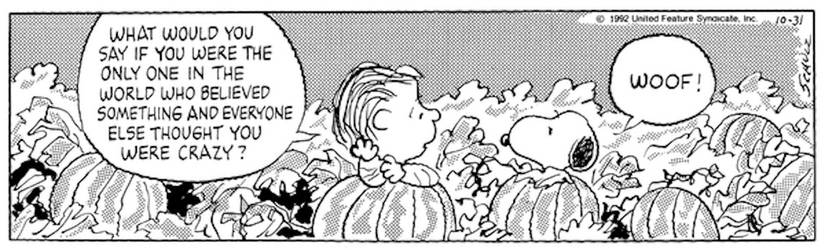
Each new run at the gag saw Linus double down, and he sometimes pulled in other characters like Sally and Marcie. Schulz ran a new Great Pumpkin story almost every year between 1959 and 1999. He skipped only 1972, 1974, 1978, 1992 and 1995. In some years, such as 1986, a single Great Pumpkin joke was the only nod Peanuts made to Halloween at all.
With that in mind, we went hunting for exceptions. Here are five of the best Peanuts strips celebrating Halloween that have nothing to do with the Great Pumpkin.
5. October 29, 1951
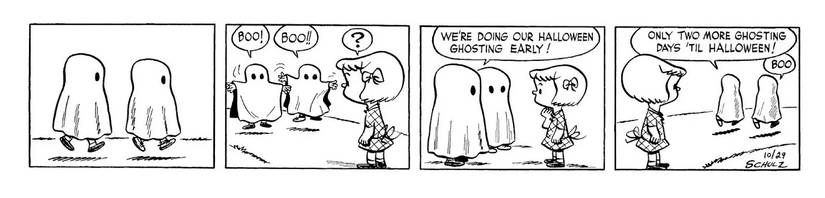
This is the first Peanuts Halloween strip. The comic was just over a year old, and its first year had no holiday strips at all. Even Christmas was just another day in 1950.
Early in the run, the humor mostly came from children doing childlike things, not from the character-driven bits that later defined the strip. This strip is a good example. You could probably assume Charlie Brown and Shermy are practicing their Halloween scares under those costumes, but there’s no real way to know. More importantly, after reading it, it has been hard not to call the period leading up to Halloween “ghosting days.”
4. October 30, 1952
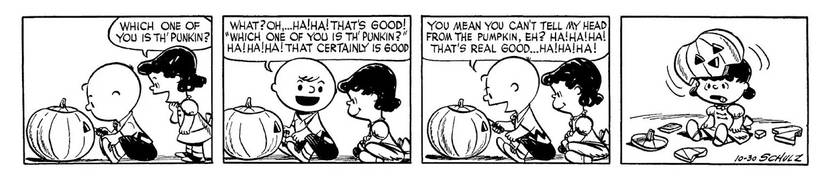
Lucy van Pelt arrived in March 1952 and quickly became one of the stars of Peanuts, crowding older characters like Patty and Violet out of the limelight. She was drawn as a toddler early on. She was always stubborn, but she didn’t develop her full mean streak for a few years. By roughly 1959, Lucy was well on her way to her final form as the neighborhood tyrant.
In her first couple of years, though, Lucy was fussier, more of a crybaby, and prone to making mistakes at her own expense. When she clashed with Charlie Brown in the early 1950s, he sometimes came out ahead or at least stood up for himself. The Oct. 30, 1952, strip is one of those cases. Lucy gets an incomplete jack-o’-lantern dropped on her head.
3. October 29, 1954
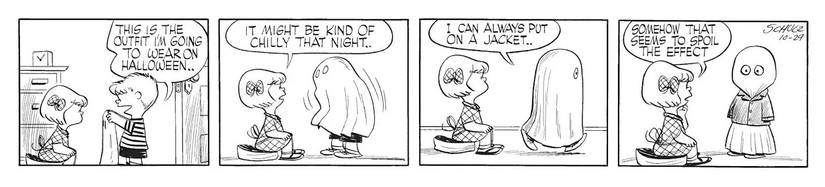
Three years after his debut as a baby, Schroeder was quickly aged up into more of a peer for the rest of the Peanuts gang. By 1954, he was roughly Charlie Brown’s age, while Charlie Brown had barely aged at all. Comic book time is a strange and unexplored science.
Schroeder appears in a 1954 Halloween strip that has nothing to do with classical music or its history, a rare sight as Peanuts went on. Patty tells him it might be chilly on Halloween night, so Schroeder tries on a jacket over his ghost costume, with mixed results.
The strip earns its spot because a jacketed ghost makes a fun visual. If you want a low-effort Halloween costume this year but still want pockets, it’s a deep cut and a solid pick.
2. October 31, 1974
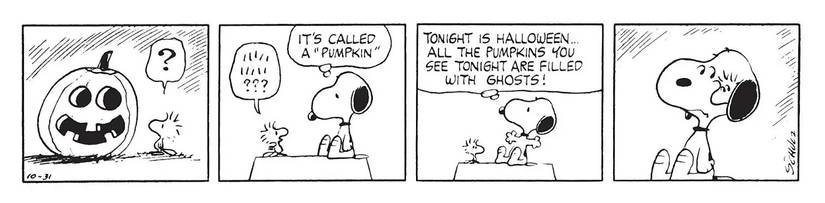
The Great Pumpkin showed up even less than usual in 1974. The only Halloween strip that year was a done-in-one between Snoopy and his pal Woodstock, in which Snoopy creeps out his bird friend with a 10-word ghost story.
Again, the pick comes down to the sight gag in the last panel. Woodstock hiding inside Snoopy’s ear is good for a laugh, and the strip rarely repeated it.
1. October 28, 1998
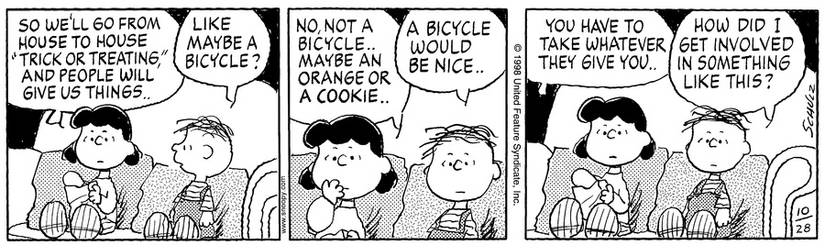
Rerun van Pelt, the younger brother of Lucy and Linus, is older than most Peanuts readers think. He first showed up in 1972 in a series of strips about his mother carting him around town on the back of her bicycle. Around 1995, Schulz pulled Rerun out of obscurity and put him on center stage, to the point where much of ’90s Peanuts reads like the Rerun Show.
In 1998, Linus is warming up for his usual Great Pumpkin shenanigans while Lucy prepares to take Rerun trick-or-treating for the first time. Rerun would like a bicycle and hopes he’ll get one. Lucy has to explain that you take whatever treats a given house will give you.
Rerun’s big running joke, besides his constant attempts to get a bicycle as a gift, is his wide-eyed confusion about the situation he’s in. Earlier Peanuts characters simply take the world at face value or make up their own rules as they go. Rerun prefers to point out the absurdities we all take for granted, both inside and outside the strip. It is sort of crazy that once a year, we send our children out to shake down the neighbors for candy.
Source: Polygon
Related articles
 Steam Frame Gets New Feature a Day After Player Asks Valve for Improvement
 Fans Launch Petition to Restore Classic Jiggle Physics After Blizzard Removes Them From WoW
 Cyberpunk 2077 Hits Record 2.8 Million Mod Downloads in 24 Hours on mod.io After Update 2.5
 Blizzard’s 2012 Action RPG Is Still the Best Co-Op Game on Game Pass
 Nintendo Switch 2 Hacked, Emulator Built, and Files From FromSoftware’s The Duskbloods Under Analysis
 Phantom Blade Zero Reviews Officially Surpass Every Soulslike of 2026
 Scientists May Help Make Hideo Kojima’s 40-Year-Old Dream of Blood-Scented Physical Game Editions a Reality
 Phantom Blade Zero Is the Perfect Martial Arts Game, For Better or Worse