Developer Diary — The Chinese Soviet Republic (formerly Communist China)
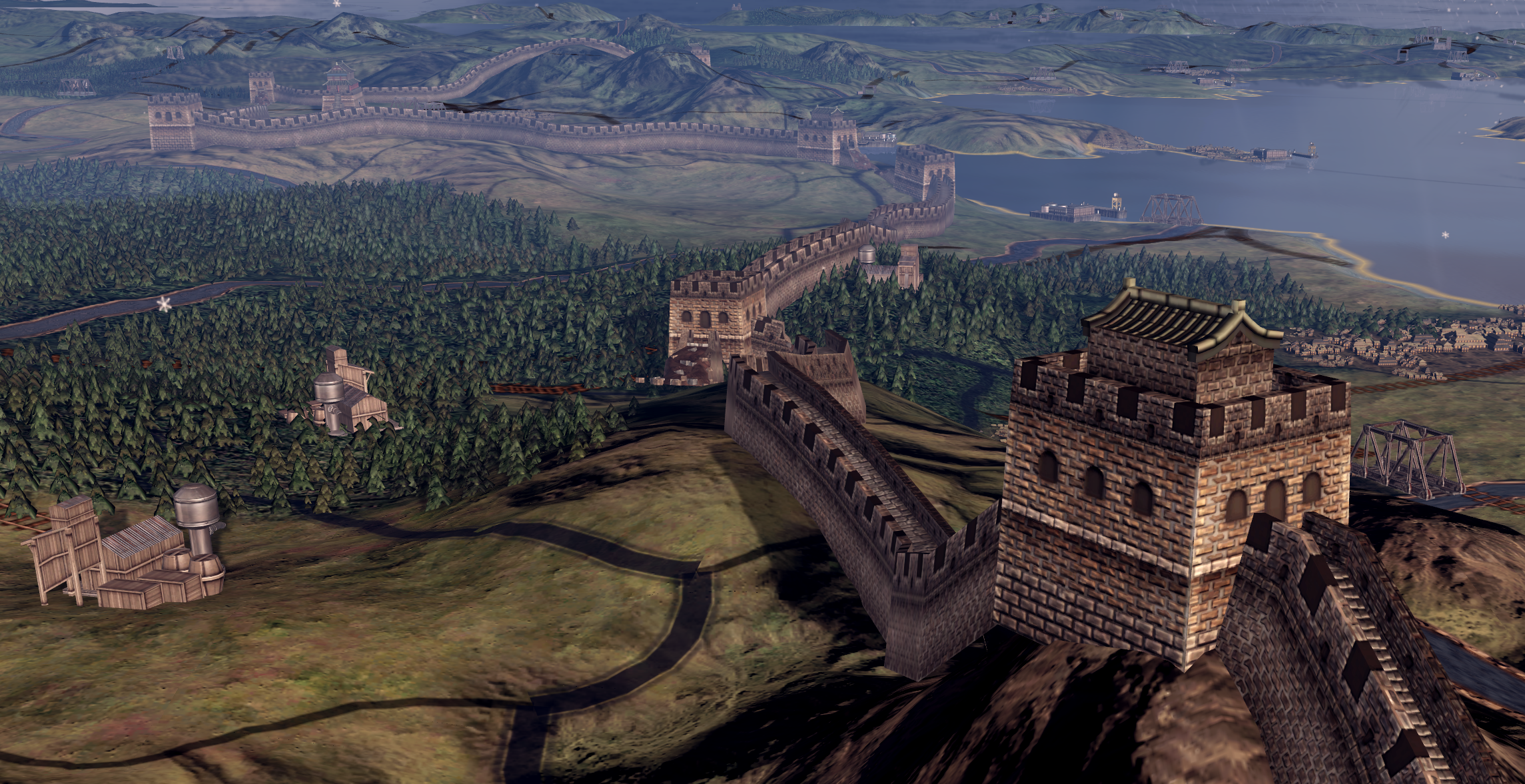
Dàjiā hǎo — welcome to the official Dev Diary for the Chinese Soviet Republic. I, PDX_Danne, together with PDX_berthier, will walk you through the changes coming to China in the No Compromise, No Surrender expansion.
At the opening of 1936 the Communist movement in China finds itself in a precarious state. The Long March shrank the Red Army from roughly 100,000 troops to under 10,000 by the time the survivors reached Shaanbei. Their new base is remote, austere, and difficult to develop — yet naturally defensible. From this austere foothold the Communists can rebuild, but fresh threats loom and former foes might prove to be uneasy partners.
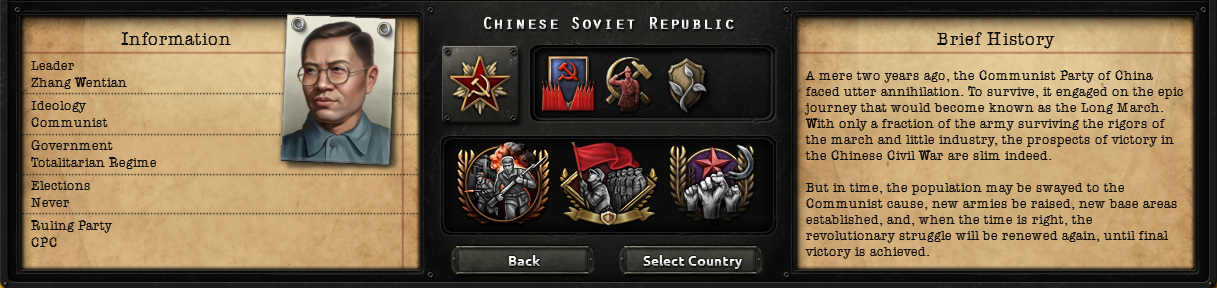
Politically, Zhang Wentian has assumed the role of General Secretary after Bo Gu’s strategy nearly destroyed the movement. Although Mao Zedong functions as the party’s de facto leader, several rivals remain ready to challenge his authority.
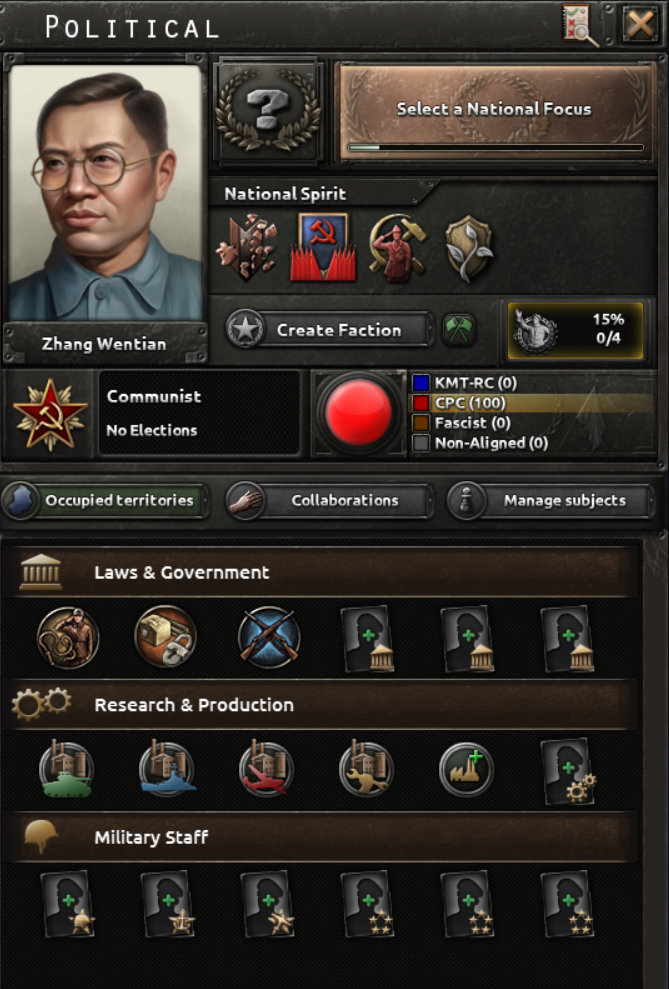
Examining the Chinese Soviet Republic’s National Spirits makes the situation clear: forced marches and constant pressure from the Nationalists have left the movement battered and resource-poor.
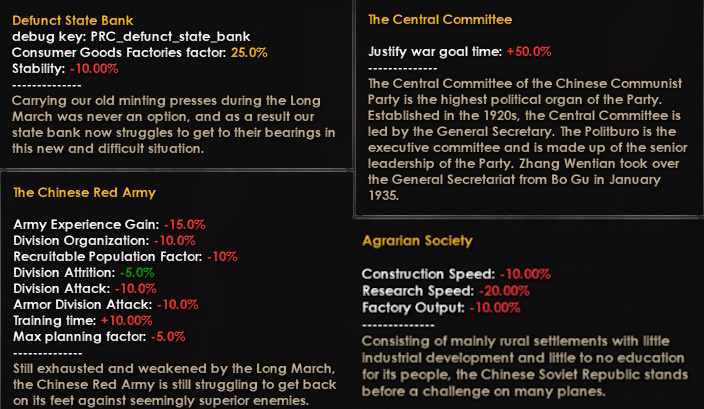
That hardship is deliberate — one of our design aims is to capture the underdog feel: you begin weak in manpower, industry, and technology, yet with careful play you can rise to contest the major powers. Before we dive into the focus tree, let’s look at some map updates — and who doesn’t love map changes?
Community feedback requested a more geographically faithful map of China. While gameplay constraints still require compromises, we’ve updated many provincial names, warlord territories, and terrain placements to better reflect reality. Mountain ranges and other features now sit closer to their true positions.
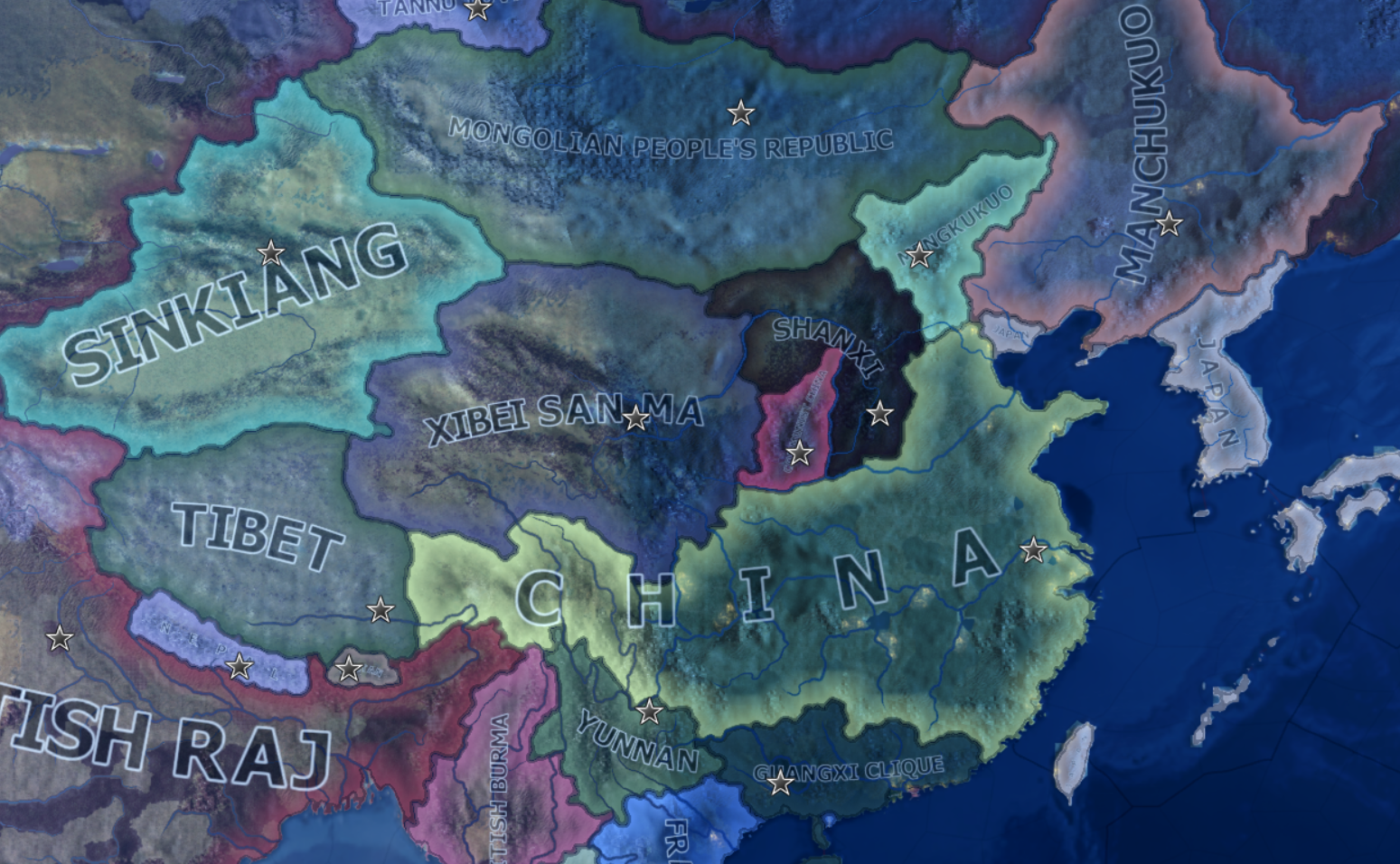
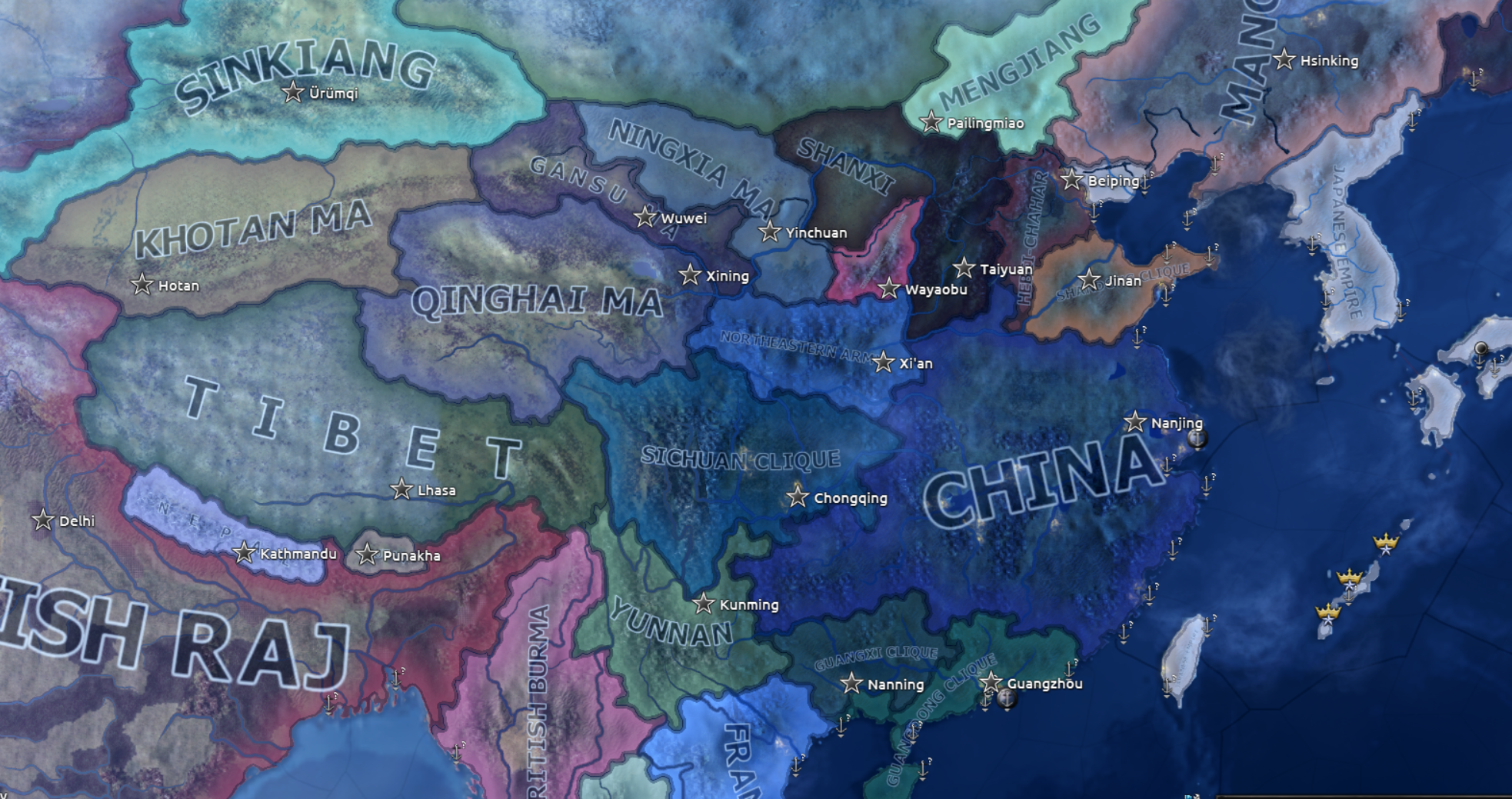 Old / New
Start positions have been adjusted accordingly: the Chinese Soviet Republic now controls territory that more accurately reflects the 1936 situation.
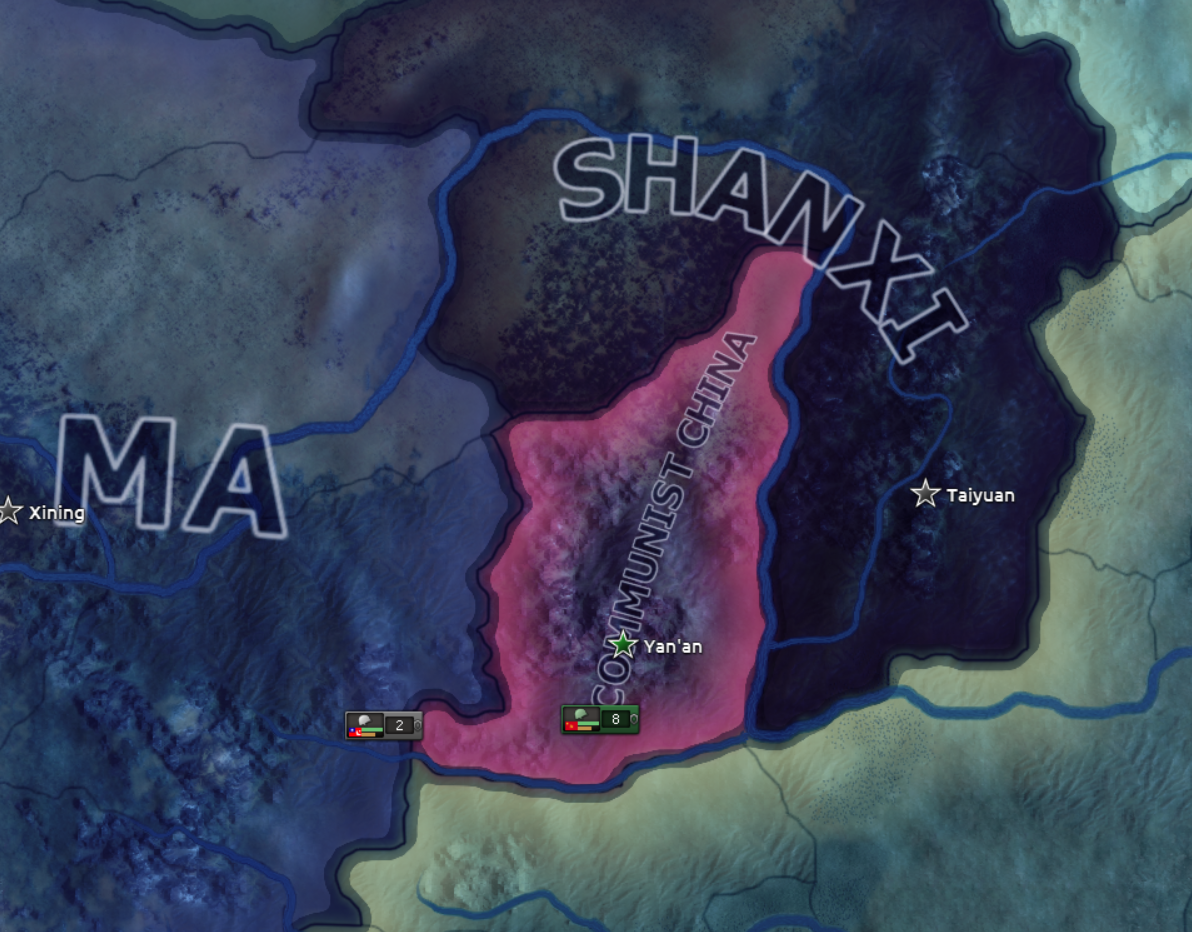
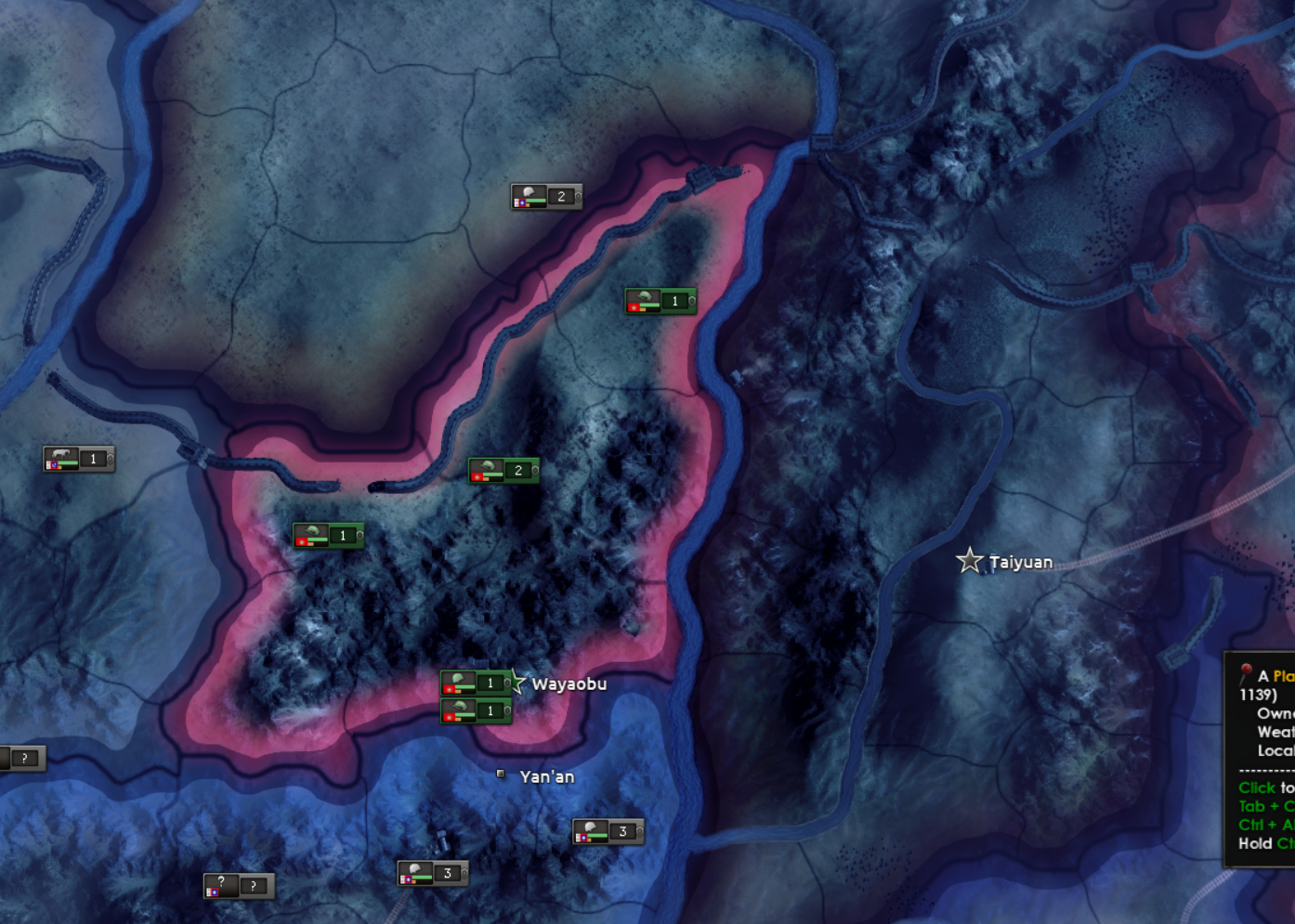 Old start position and new
Astute readers of our previous Dev Corner on China will notice the Communists now begin with two states. Don’t be misled — control over both regions was never complete historically; Kuomintang-aligned garrisons persisted in parts of the area. We model this with a state modifier named The Yulin Garrison, removable through specific decisions or focus effects.
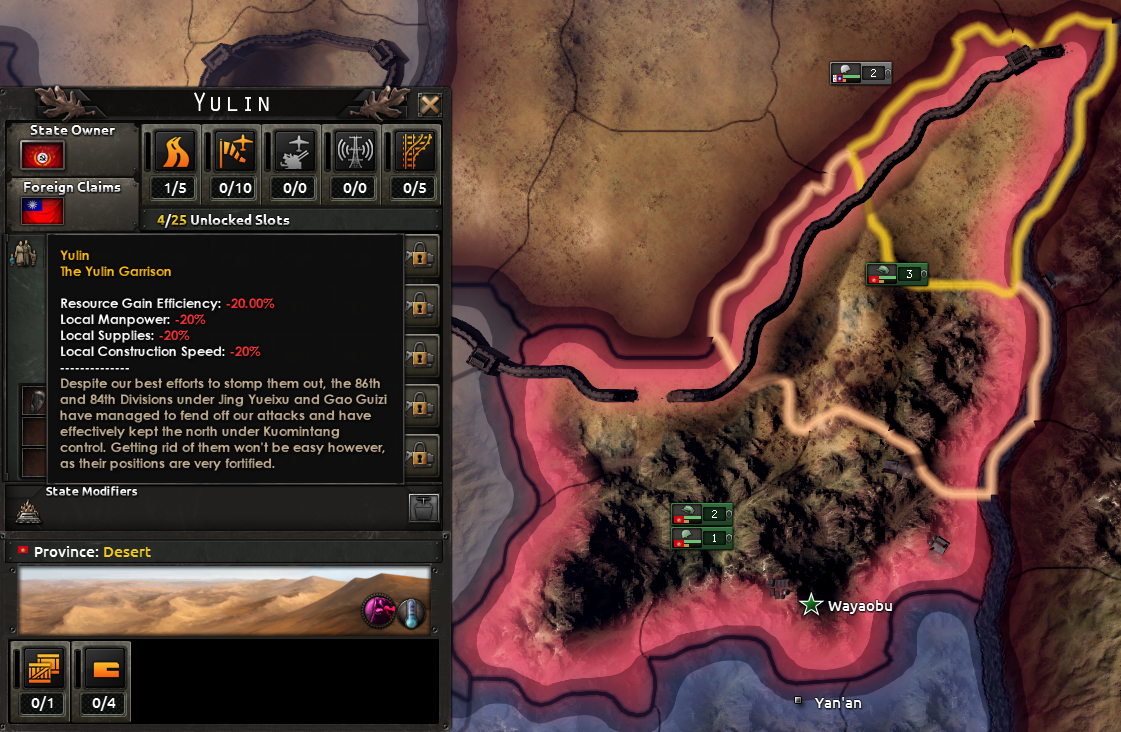
With the new starting map covered, let’s move on to the redesigned Focus Tree.
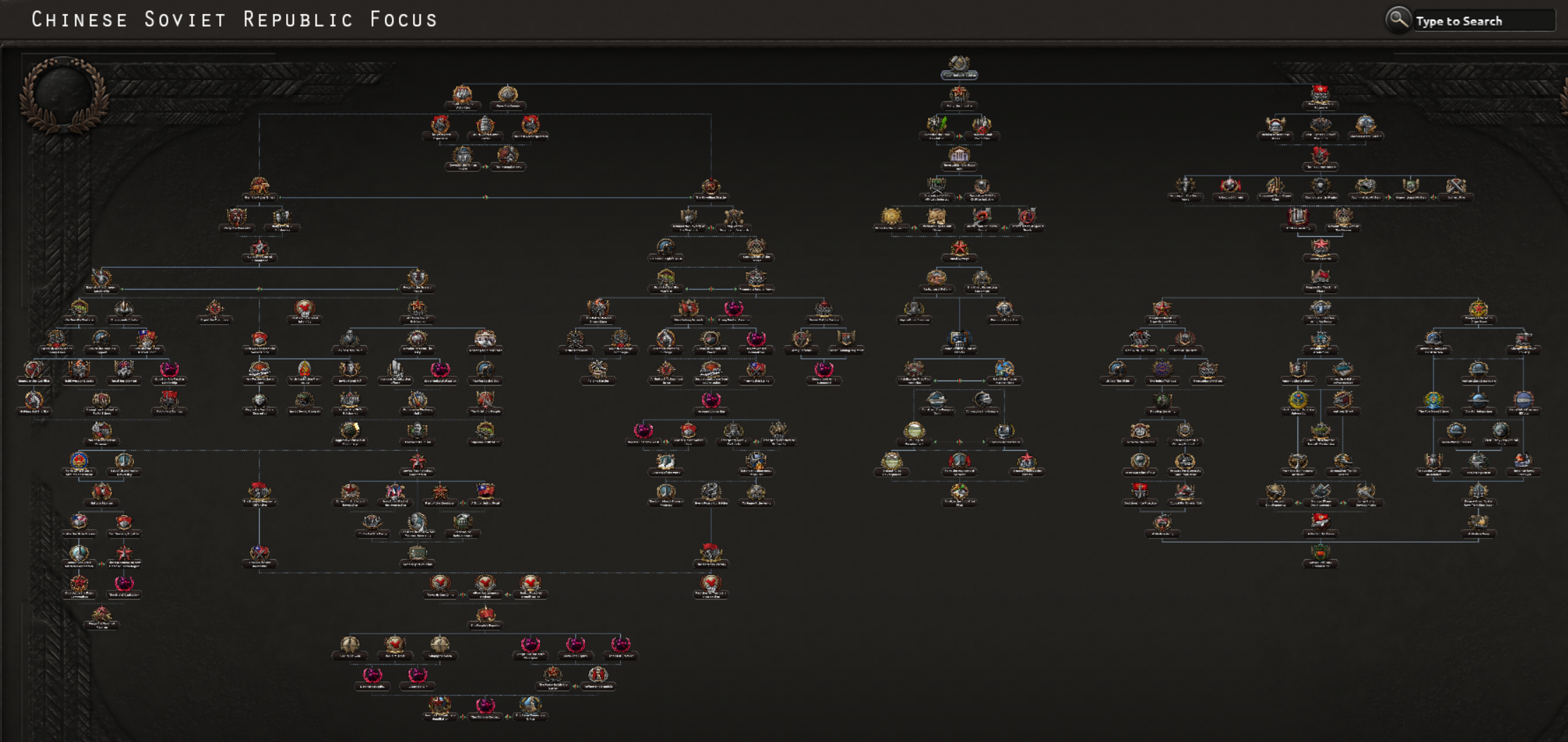
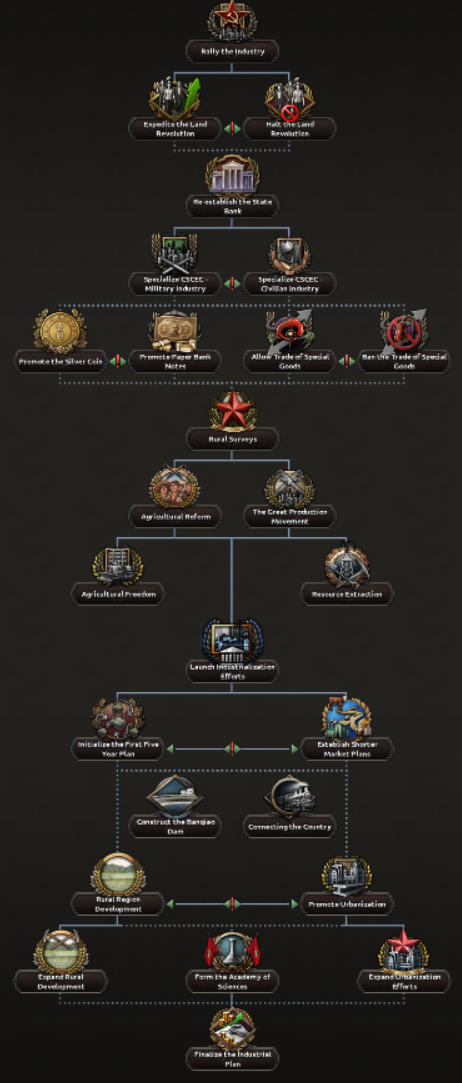 The industrial branch
The industrial base under Communist control in northern China is meager — intentionally so. You’ll feel like you’re constructing everything from the ground up.
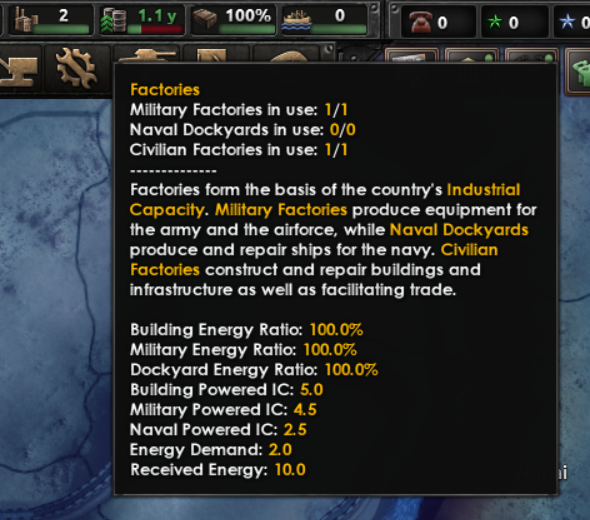
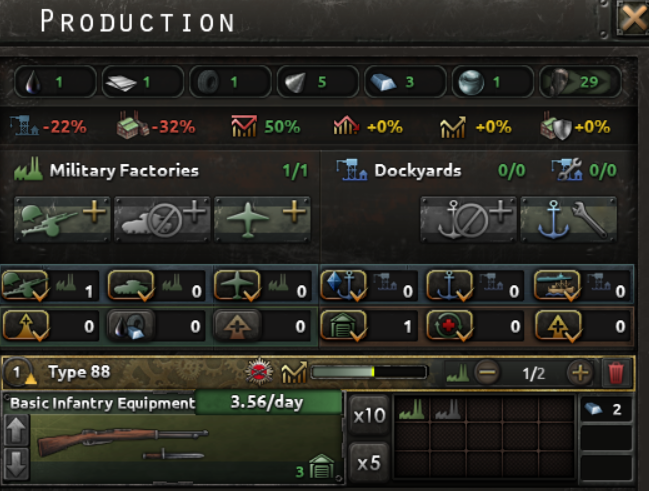 We want the sensation of building upward from near-zero resources.
But recovery is possible: the Chinese Soviet Republic can industrialize rapidly and begin a compounding growth that transforms it into a competitive economy.
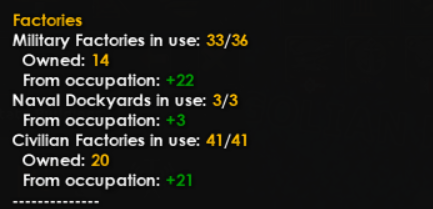
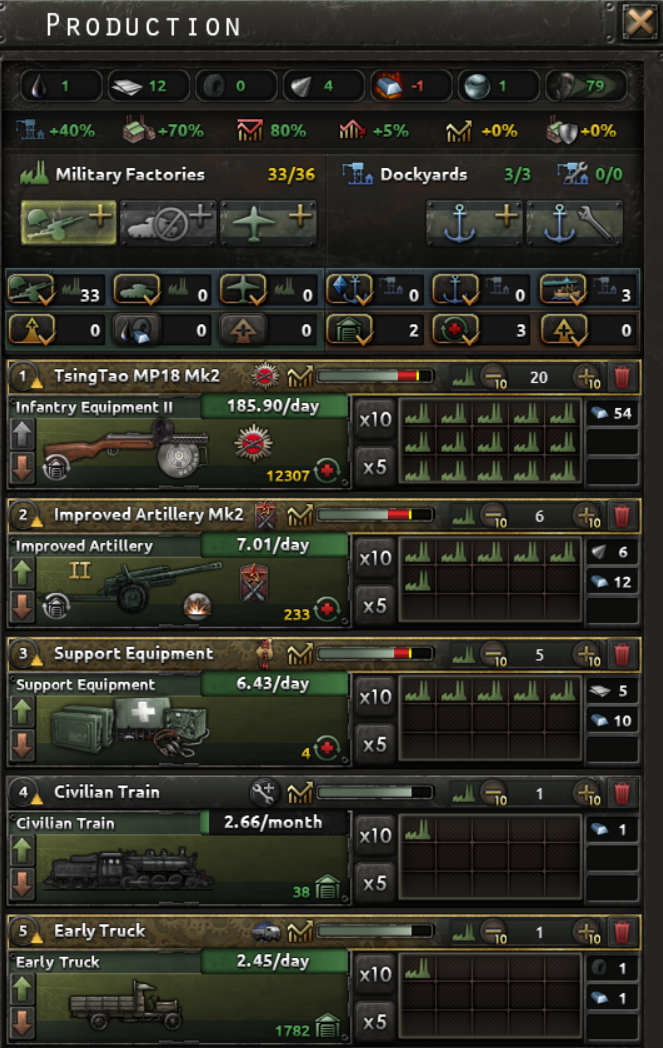 Example industrial build in 1945: a dramatic factory increase despite ongoing conflict.
Our industrial planning branch differs from similar trees for the Soviet Union or Germany: it introduces deliberate risk/reward choices. You’ll be able to pursue ambitious central planning projects that boost output if you meet their demands — but failure carries meaningful consequences.
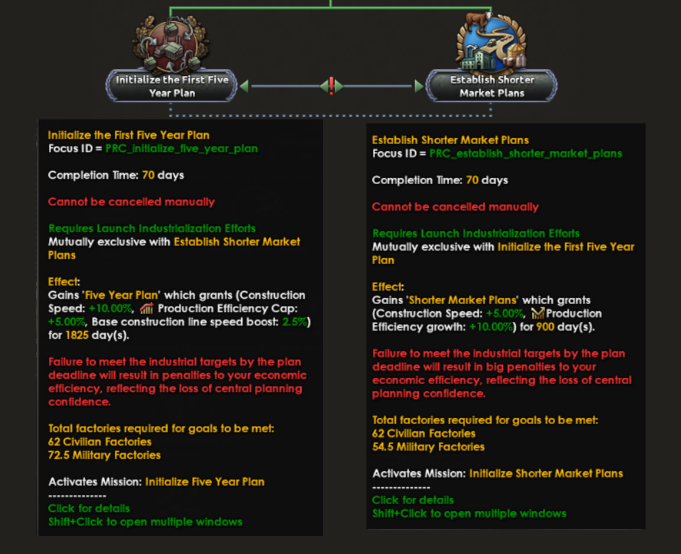
The focus objectives and prerequisites reflect those risks and rewards: execute them well and you’ll reap rapid gains; mismanage them and you’ll face setbacks.
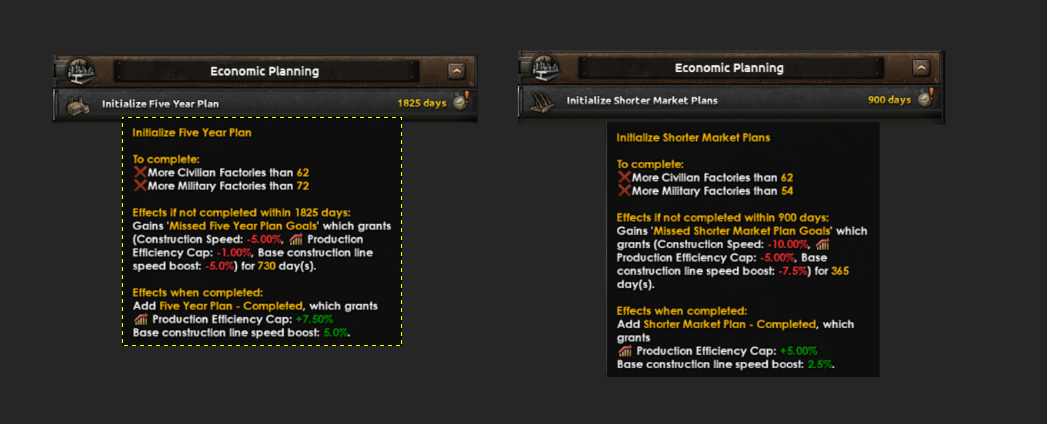 Example missions
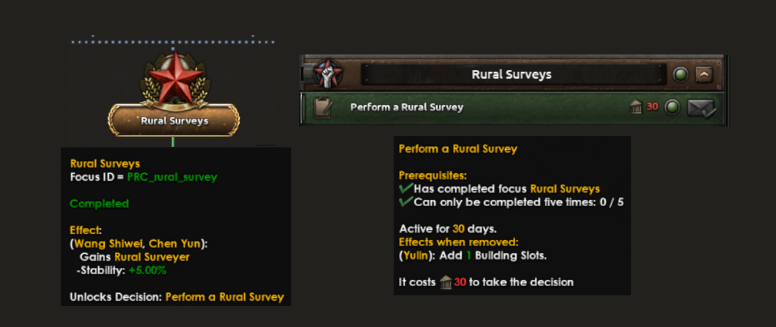
If you join the Second United Front with the Nationalists and various warlords, your expansion options can be temporarily limited — potentially stalling industrial growth. To address this we added the Rural Surveys focus (inspired by Zhang Wentian’s historical surveys), which unlocks decisions allowing you to spend Political Power to gain building slots. This lets you expand industrial capacity even when territorial gains are constrained.
We give the player a meaningful choice in economic direction: invest in strengthening rural areas or push toward urbanization. You start with the national idea Agrarian Society, which can evolve into Agrarian Reform, or — if you pursue urbanization — replace it with Urban Society later in the tree.
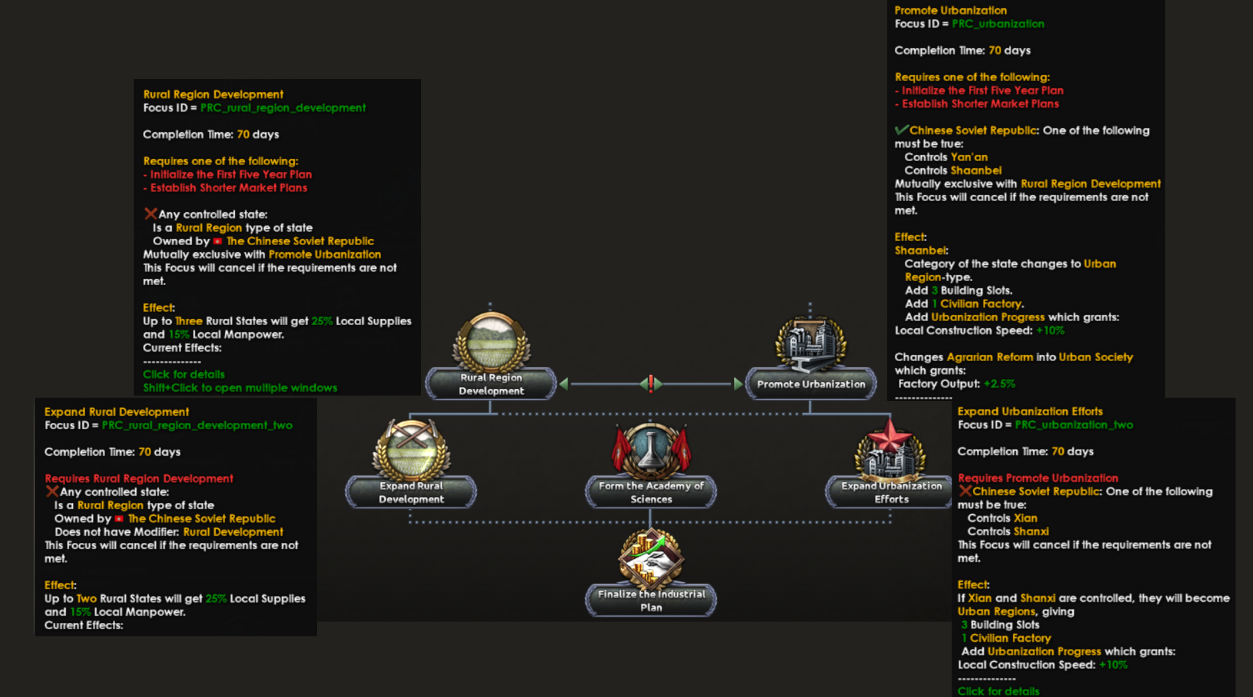
The numbers and balance remain a work in progress, but the choices are designed to shape long-term economic identity and bonuses.
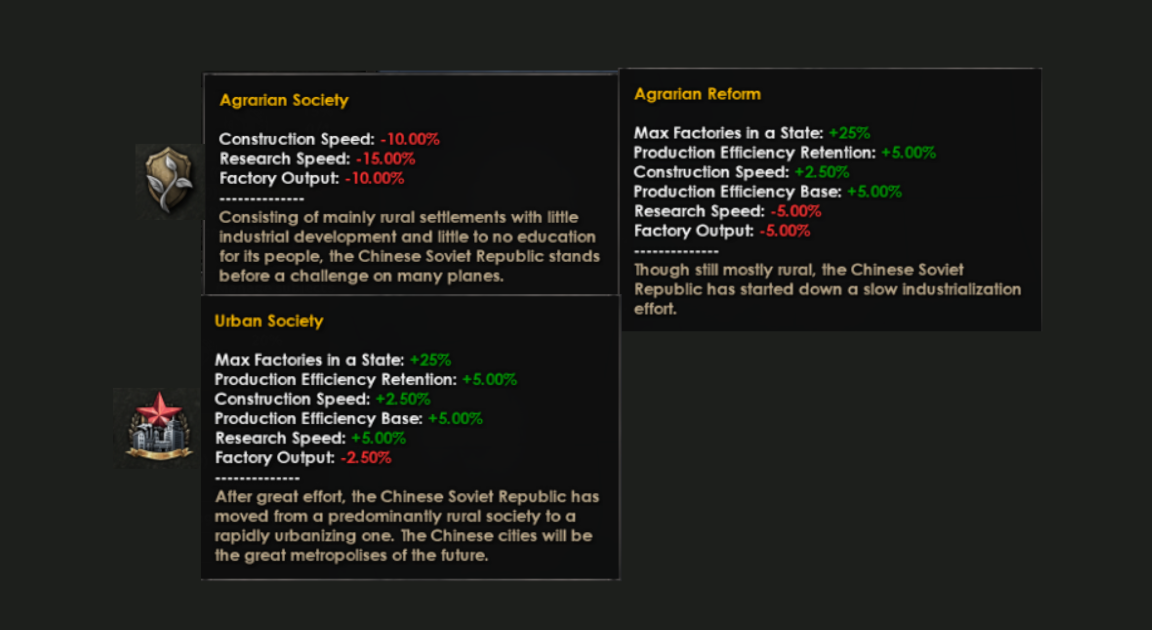 Idea progression (preliminary).
We expanded the roster of officers available to the Chinese Soviet Republic to better reflect the historical pool of commanders in 1936. While not exhaustive, the list emphasizes the most significant figures.
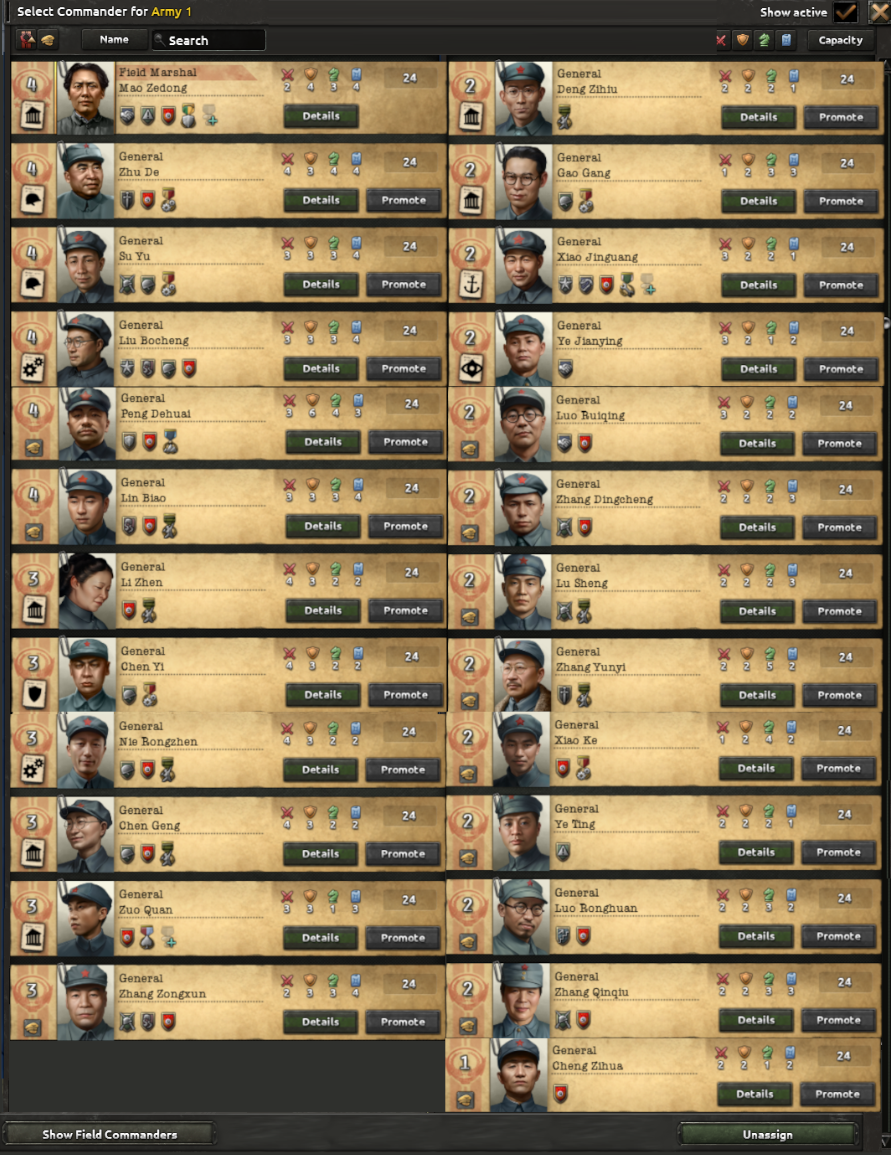 All starting generals. Note: He Long and Zhang Guotao begin off-map and can join later.
There are even a few admirals — though building a navy is a steep challenge for a landlocked base located about 1,200 kilometers from the nearest coast. We also tied the Long March’s legacy into specific leader traits: many commanders who survived the march receive a Survivor of the Long March trait to reflect their experience and symbolism.
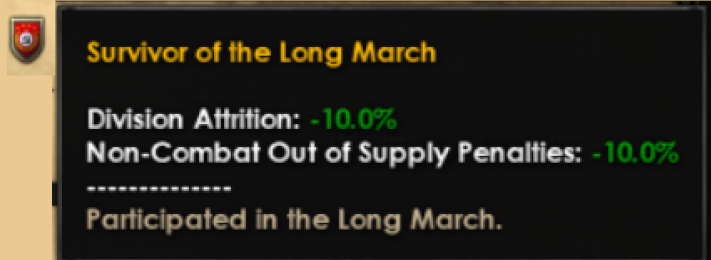 Survivor of the Long March trait
As noted earlier, the Long March left the Red Army severely depleted. Not all veteran formations and commanders have arrived in Shaanbei, which means your early game priority is rebuilding manpower, rearmament, and reorganizing the Army to secure survival and future offensives.
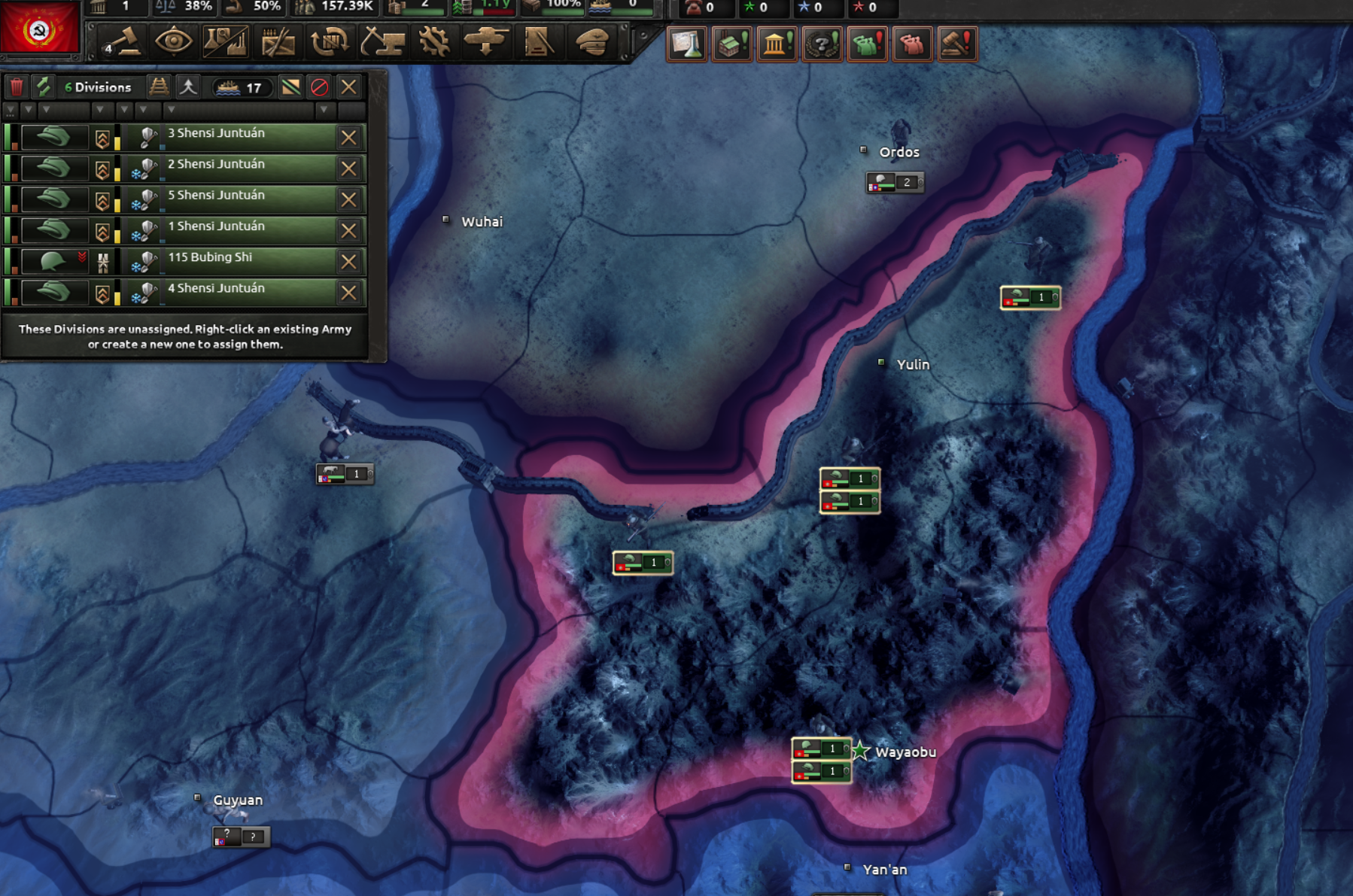
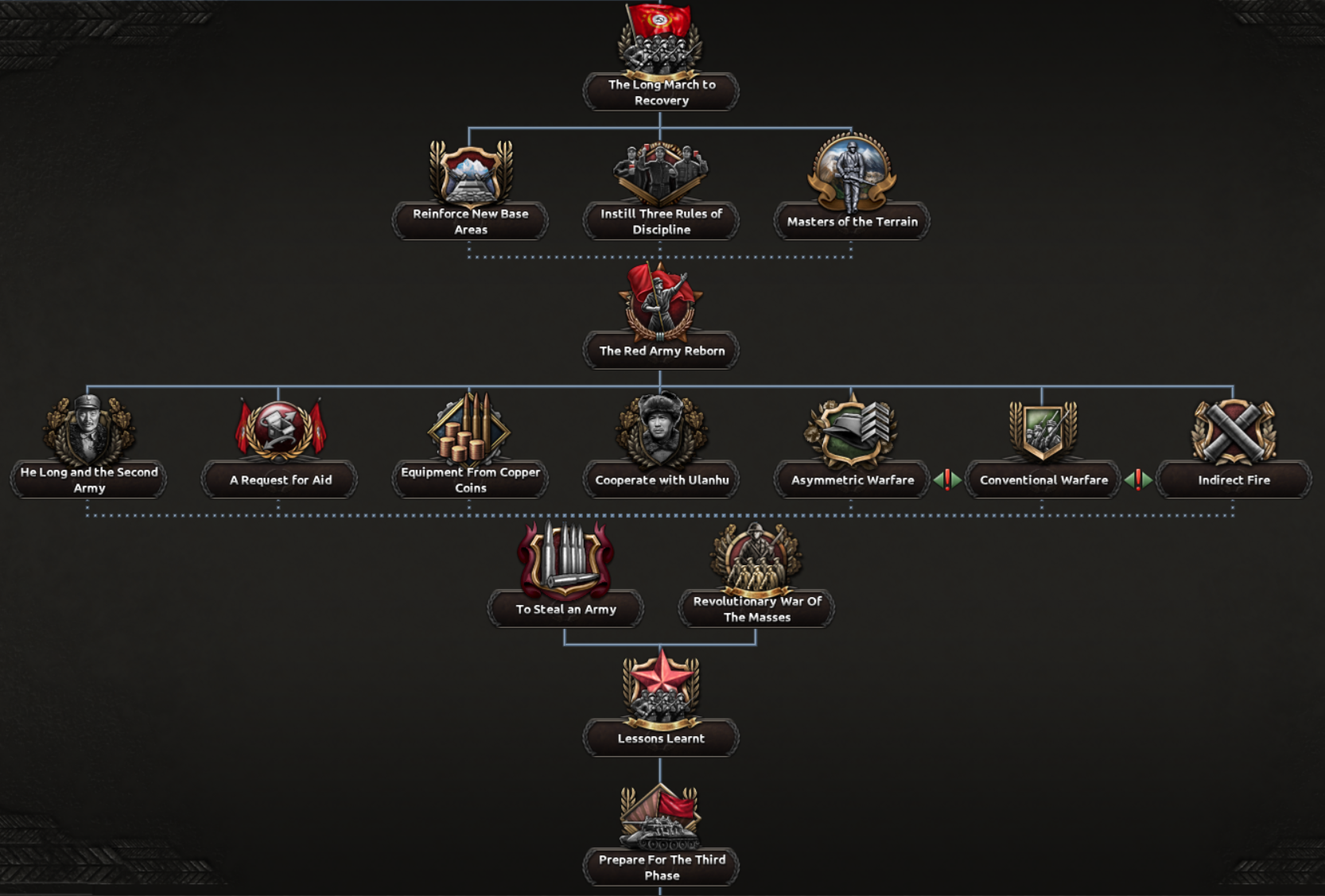
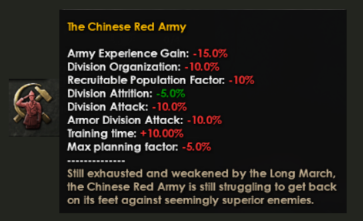 Early objectives: recover and rebuild.
Later you can form the People’s Liberation Army with its distinct branches and doctrines, unlocking deeper military options and capstone focuses.
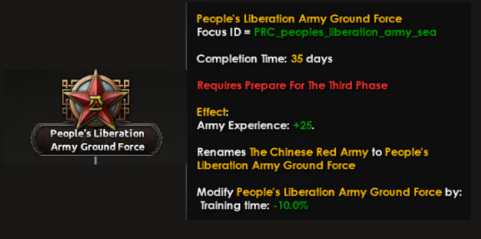
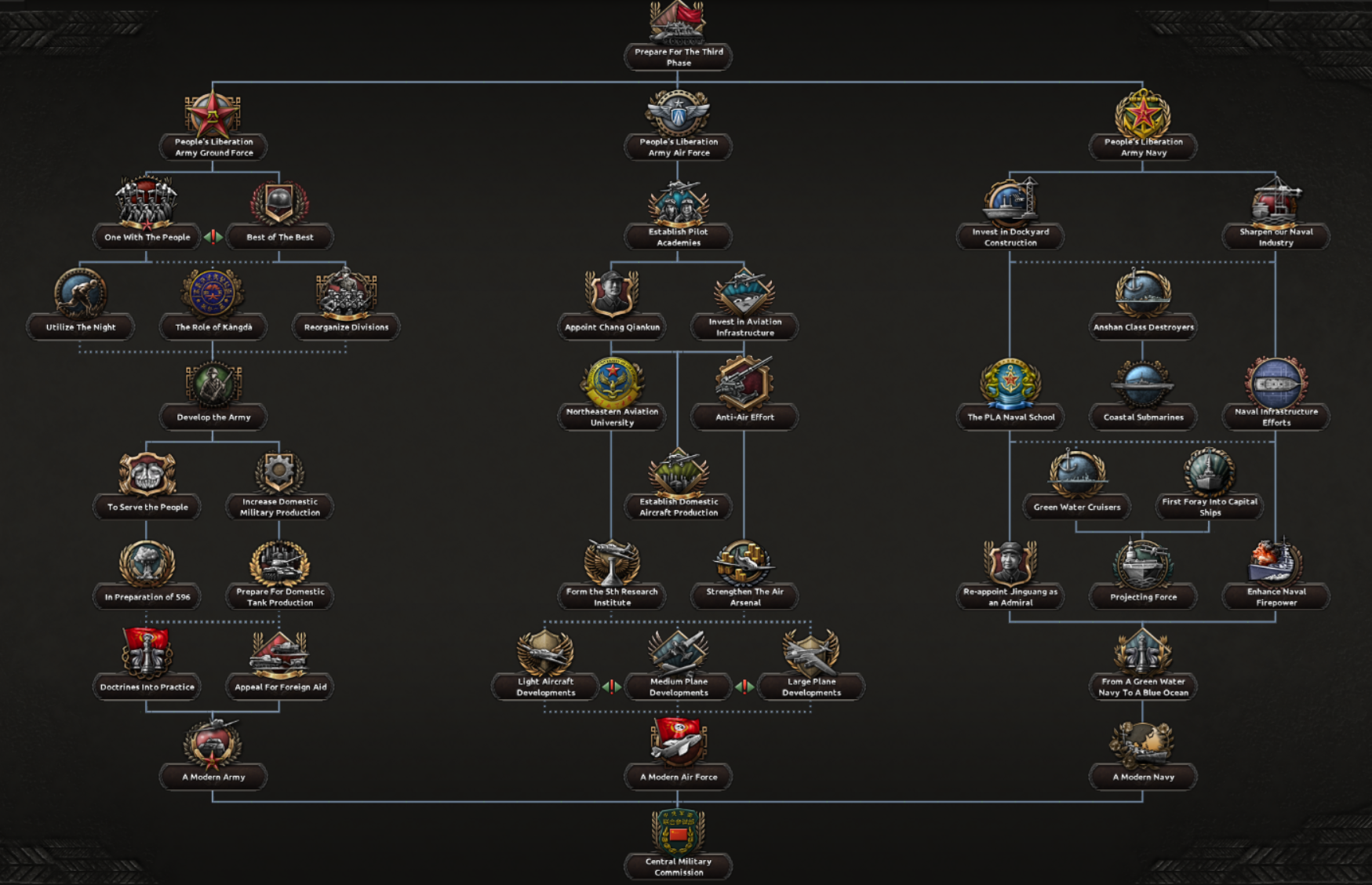 Late-game military branches
You’ll be able to choose between building a compact, professional force or mobilizing vast numbers of soldiers. To address the early armor gap versus mechanized powers, the tree includes catch-up options inspired by historical trends: early reliance on Soviet-supplied tanks (e.g., T-34 variants) before domestic armored production matures.
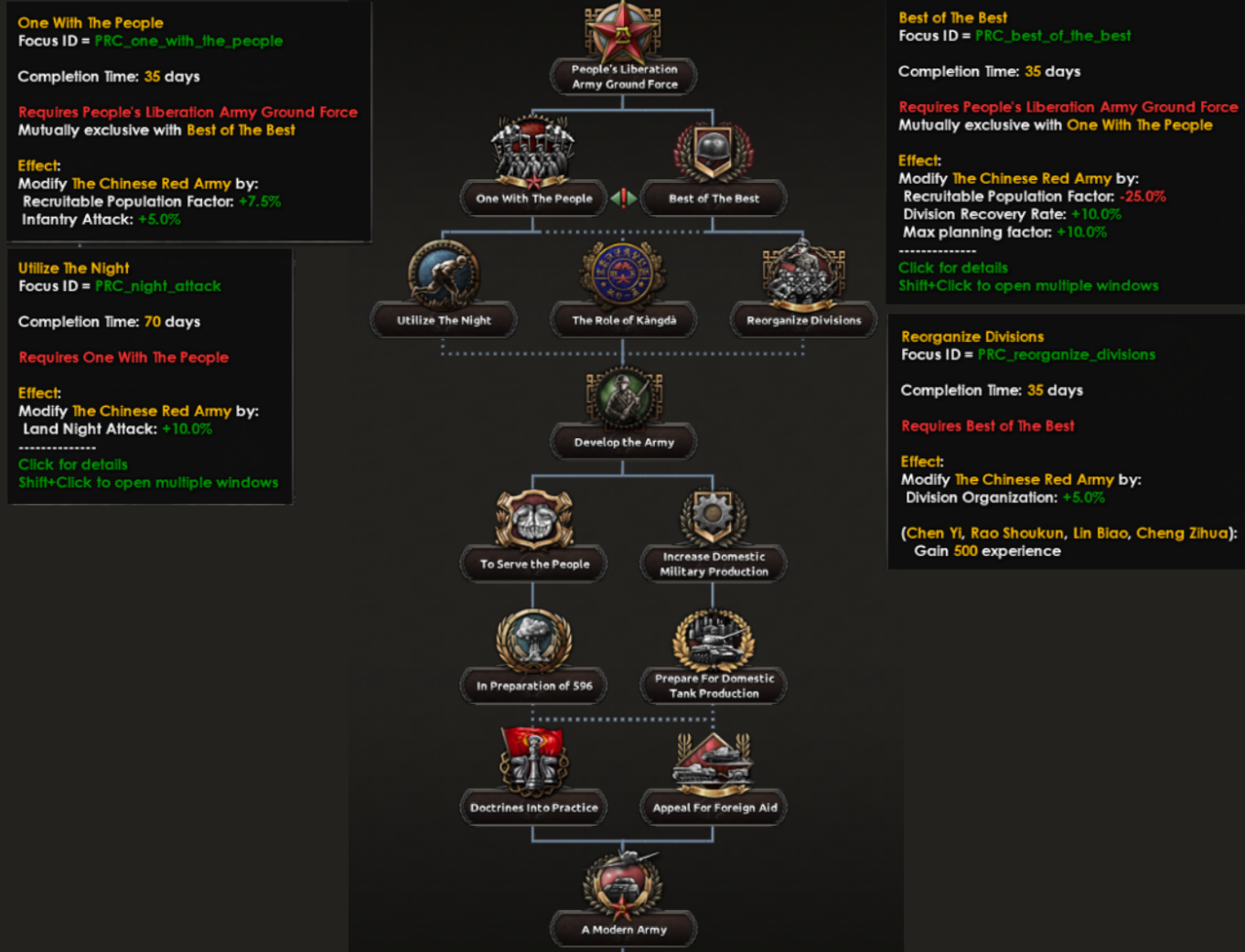
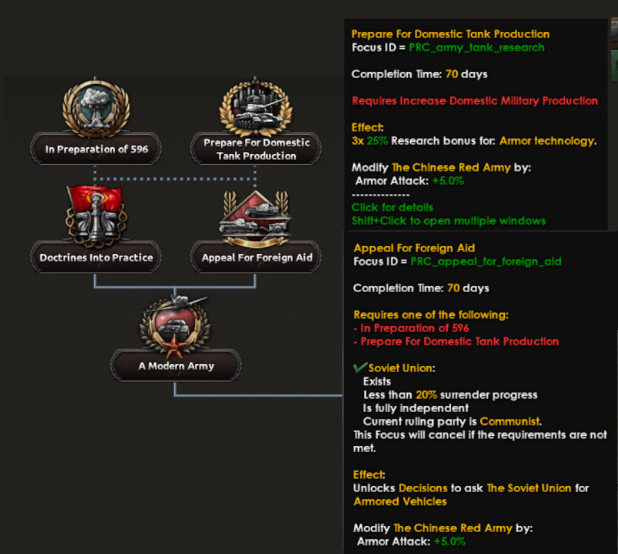
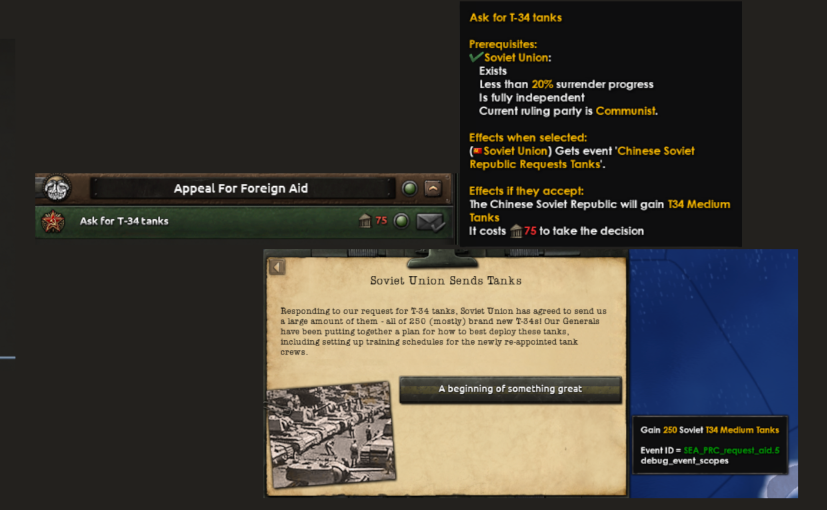 Tanks, tanks.
Naval roleplay — starting from zero — is a rare but rewarding fantasy. The naval branch of the focus tree reflects the historical catch-up of the People’s Liberation Navy: build dockyards, import vessels, and eventually develop domestic ship classes. Early options include construction priorities and Soviet-era designs purchased post-war.
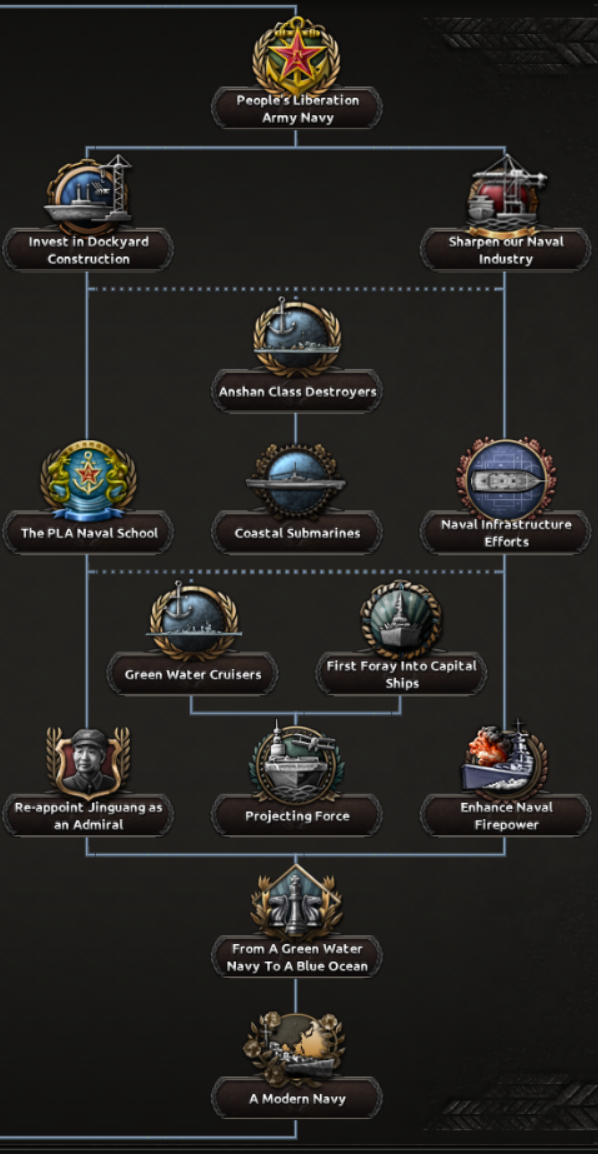
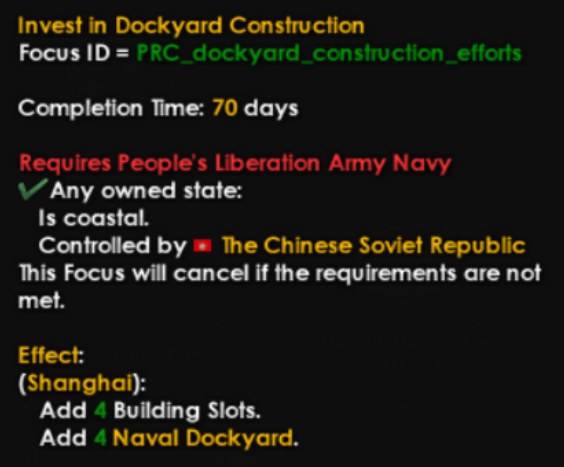
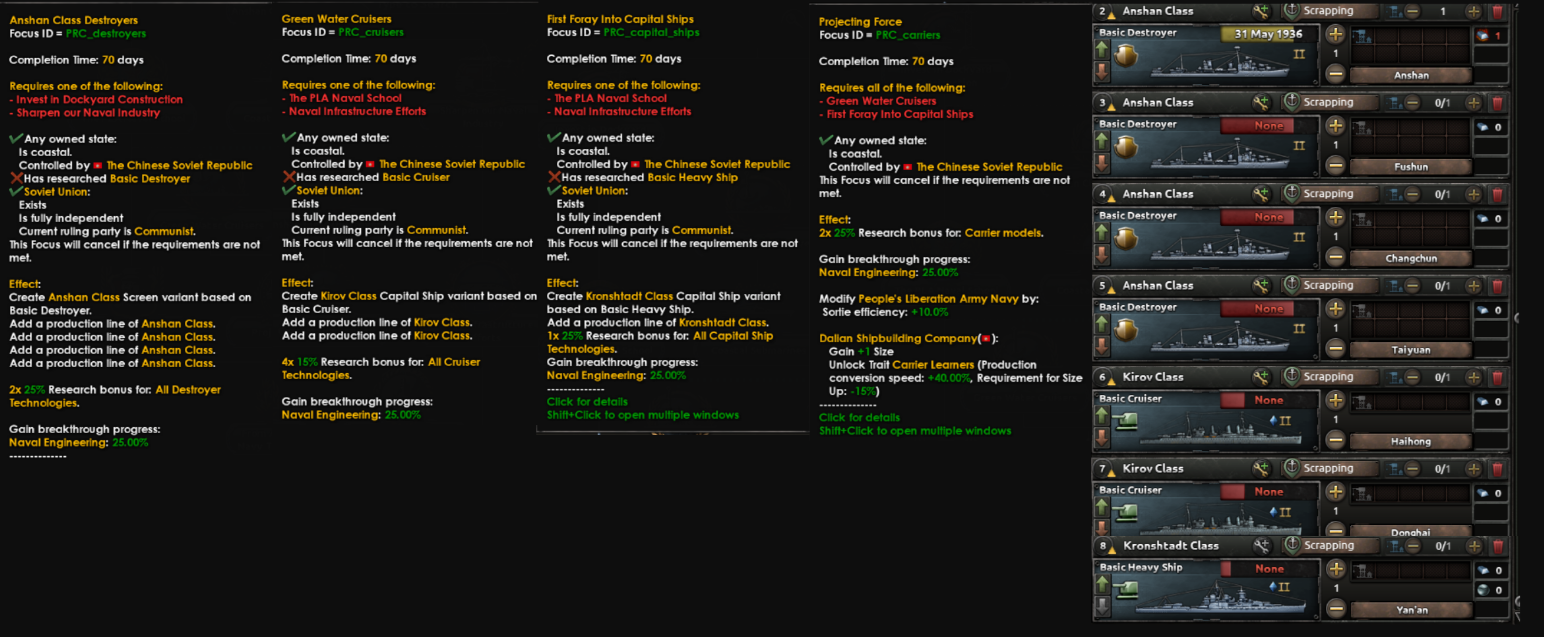 Soviet ships and early navy options
Aircraft availability in the 1930s–40s was limited. To address this, the tree emphasizes research bonuses and production unlocks so you can accelerate toward a competent late-game air force. You’ll find focuses that boost aviation research, enable production lines, and add radar and AA capabilities to compensate for early air shortcomings.
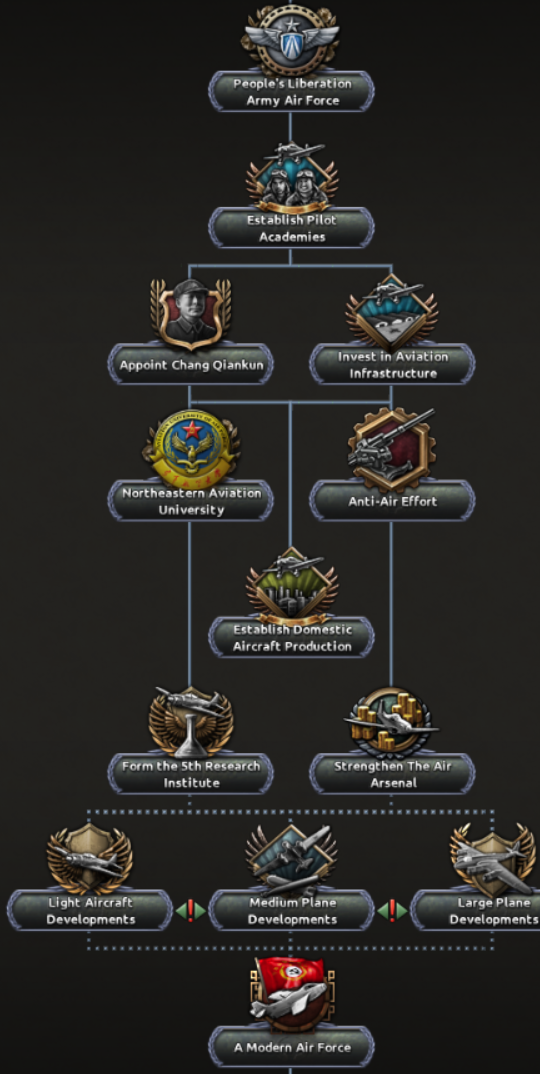
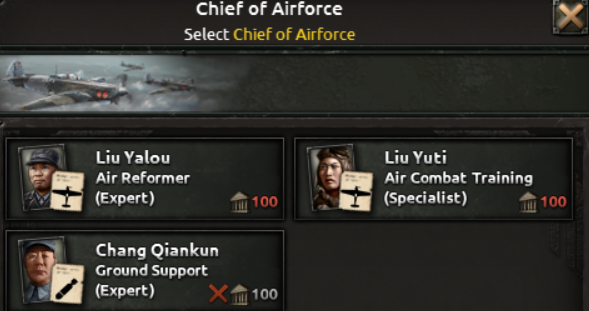
We also improved the list of potential air chiefs to more accurately reflect historical figures and roles.
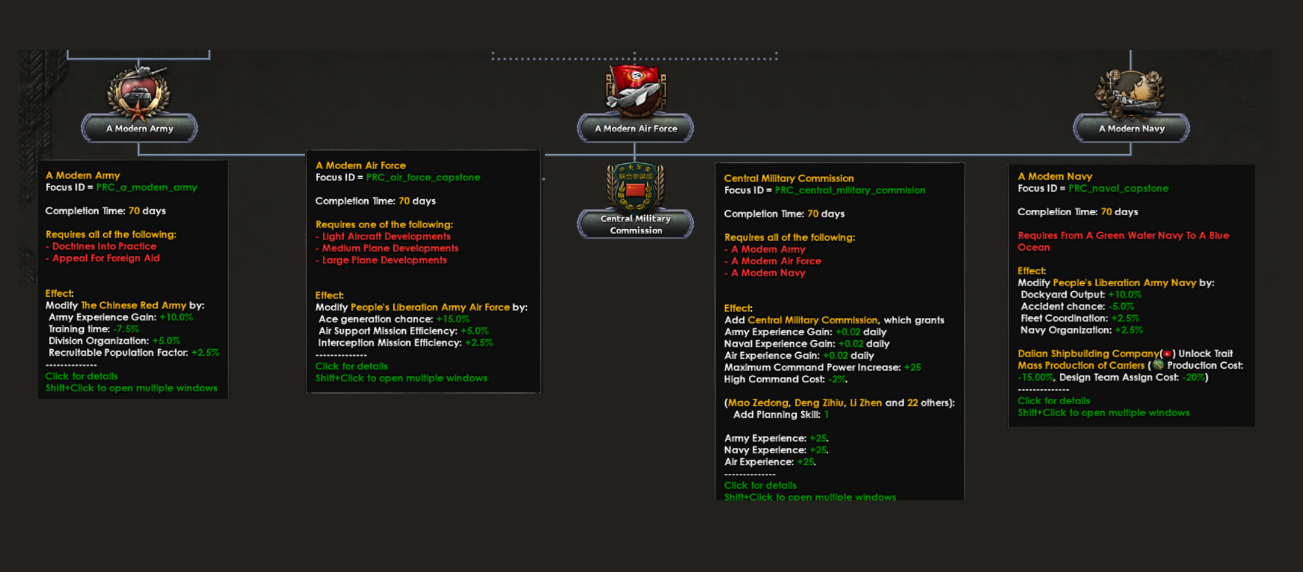 Capstone military focuses culminate in forming the Central Military Commission.
Below are examples of the unique and shared Military Industry Options (MIOs) available to the Chinese Soviet Republic — many of them exclusive to this nation.
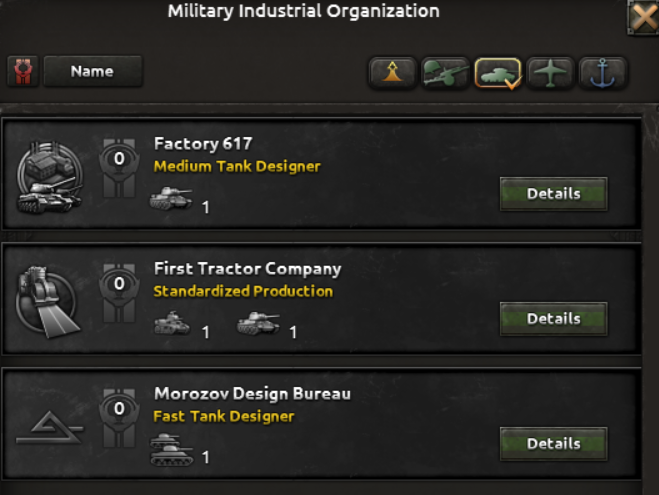 Tank MIOs
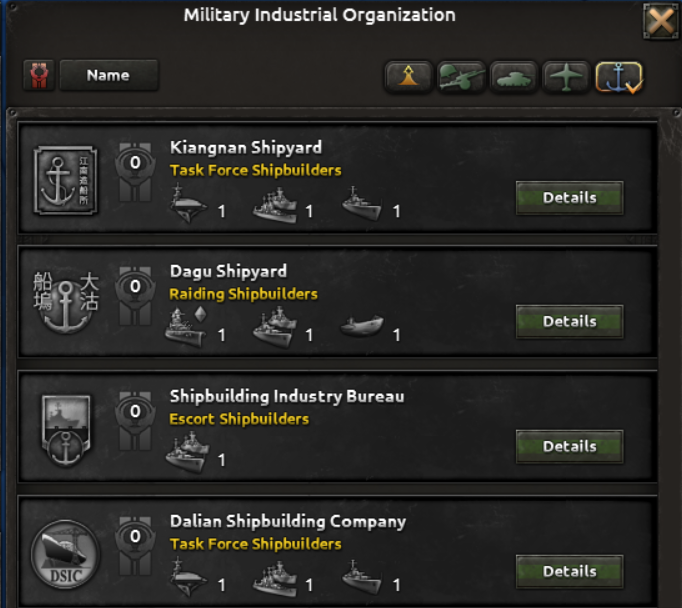 Naval MIOs
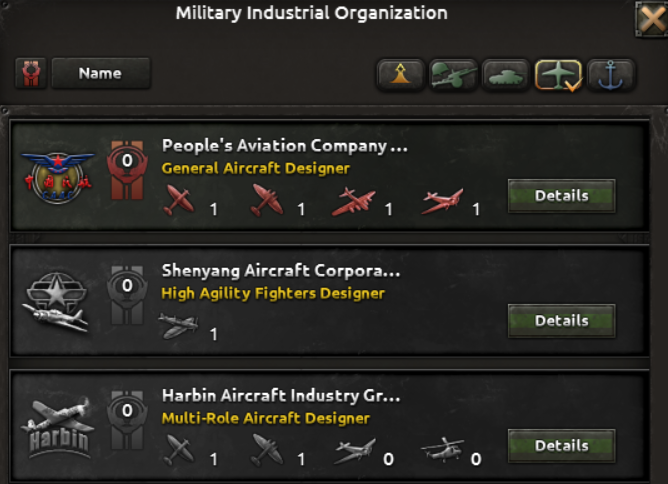 Aircraft MIOs
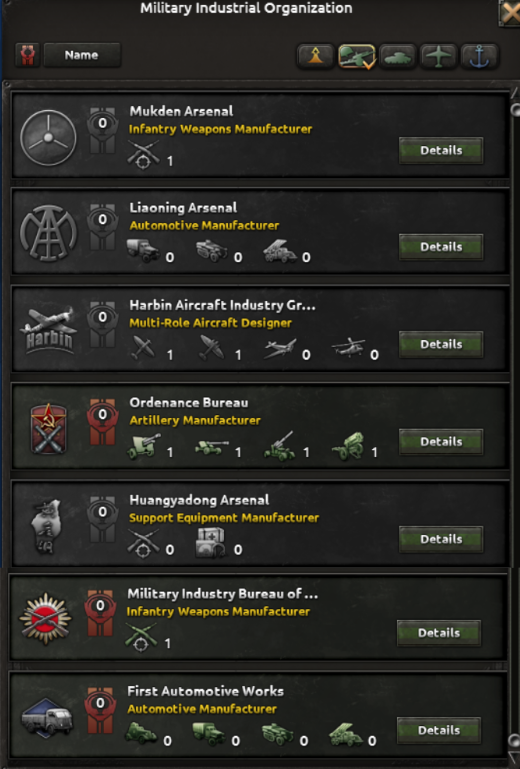 Material MIOs
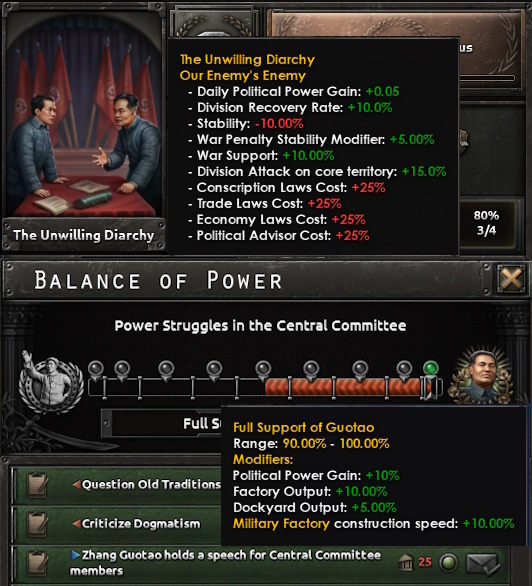
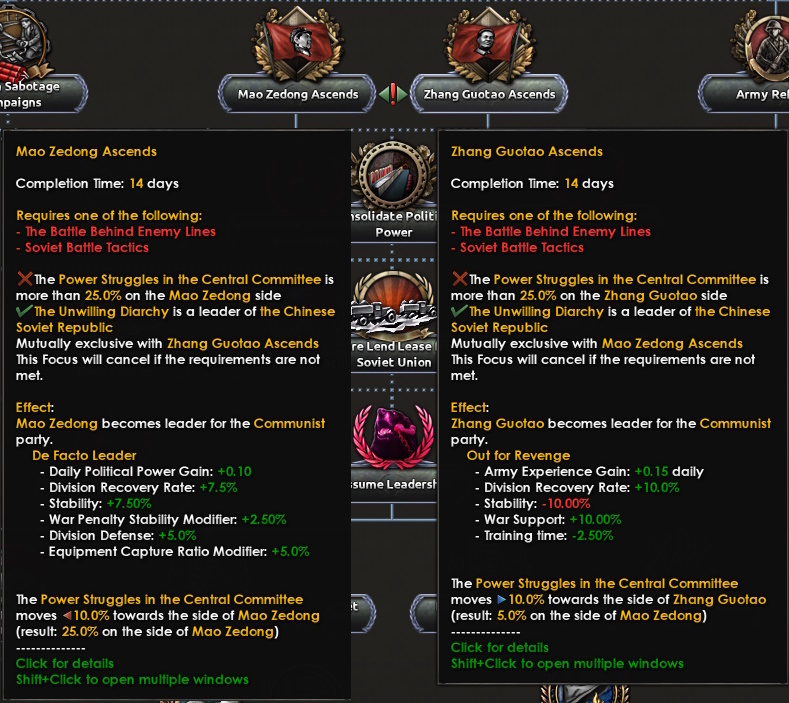
Although Mao held a strong position by early 1936, several factions still contested his authority. Our Balance of Power mechanic models the contest between Mao, the 28½ Bolsheviks, and other figures like Zhang Guotao. Each faction contributes different bonuses depending on its influence.
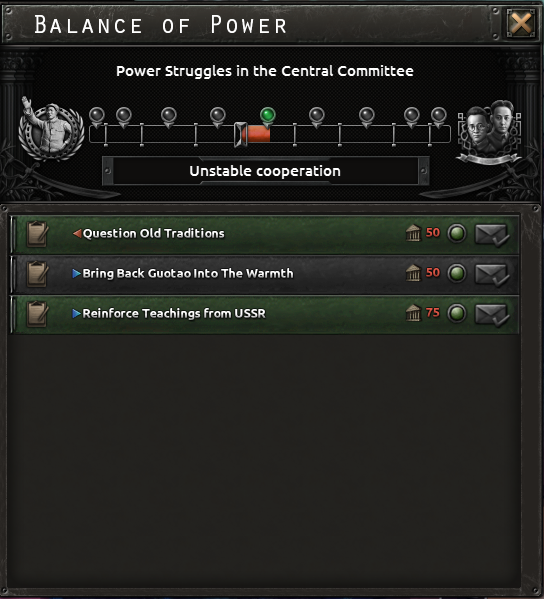
The primary opponents are the 28½ Bolsheviks (more on them below) and Zhang Guotao, who briefly attempted to set up a rival leadership in 1935. Each faction’s sway affects political bonuses and available paths in the focus tree.
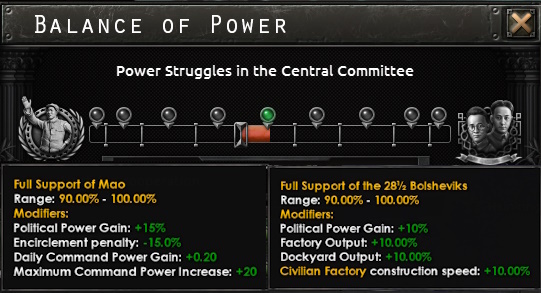
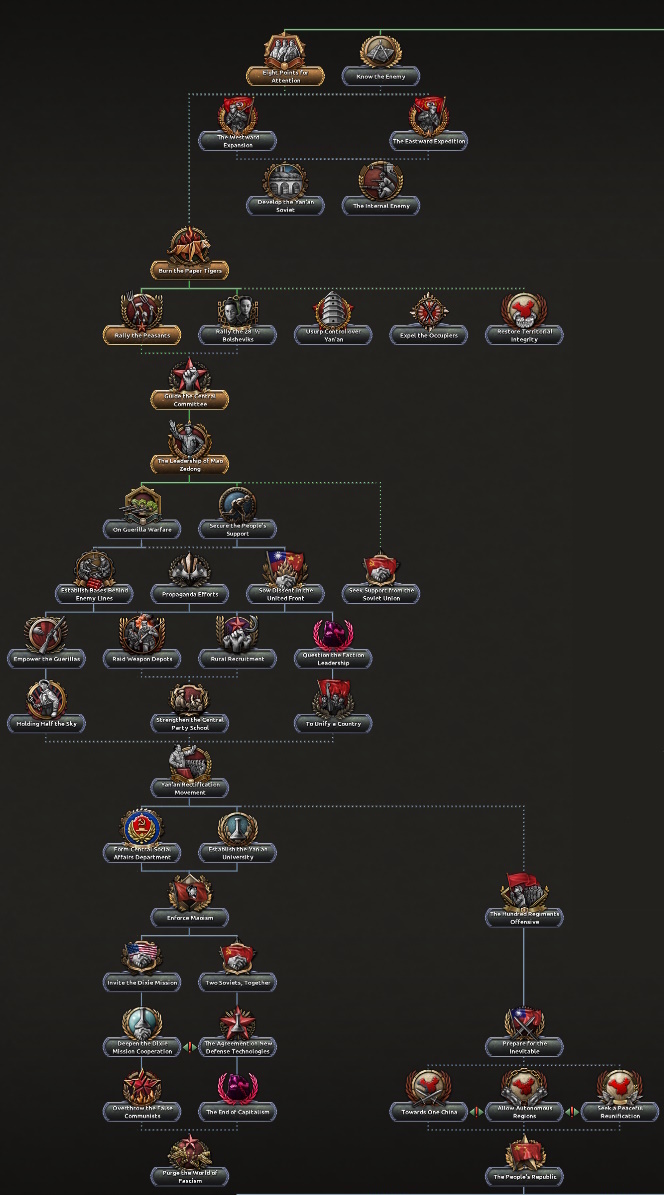
In the Historical path the Chinese Soviet Republic starts from a vulnerable position in 1936. Early expansion opportunities are limited and Imperial Japan looms. With careful play, however, you can grow militarily and industrially before Japan forces the larger conflict.
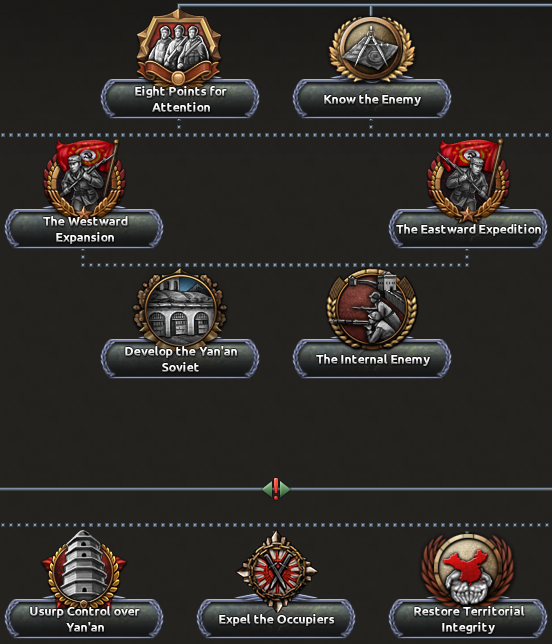
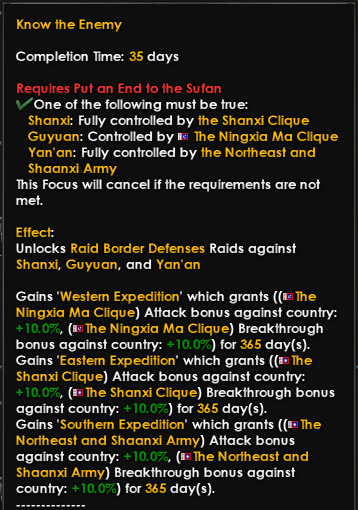
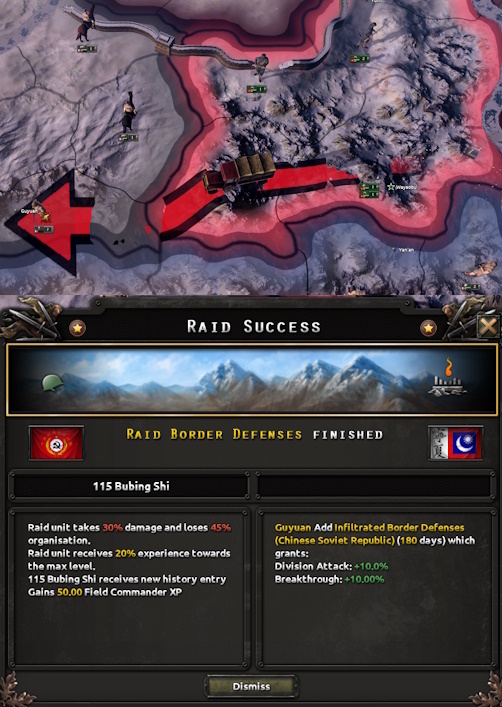
Paths such as The Eastward Expedition and The Westward Expedition let you wage local border wars, but expect stiff fighting from a fatigued Red Army. Know the Enemy grants tactical advantages against neighbors and unlocks Raid Border Defenses, which helps you seize neighboring provinces.
The Usurp Control over Yan’an focus behaves differently depending on timing: it can trigger a border war or grant a free state if you’re allied with the Nationalists. Patience and opportunism can both be viable options, especially with regional warlord interactions to the south.
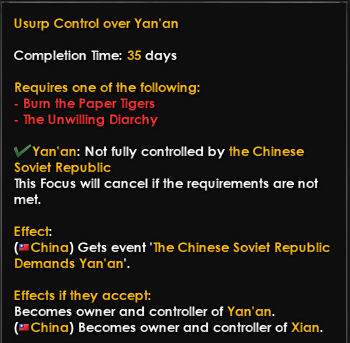
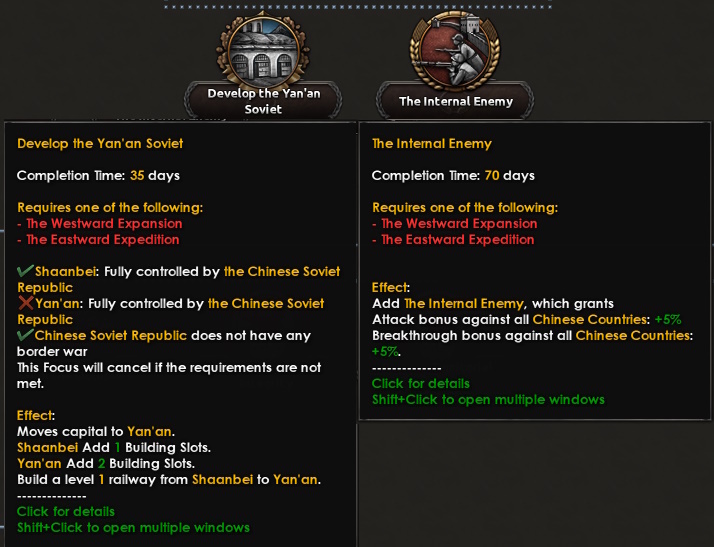
After consolidating Yan’an you can choose to develop these holdings or pursue a more expansionist strategy.
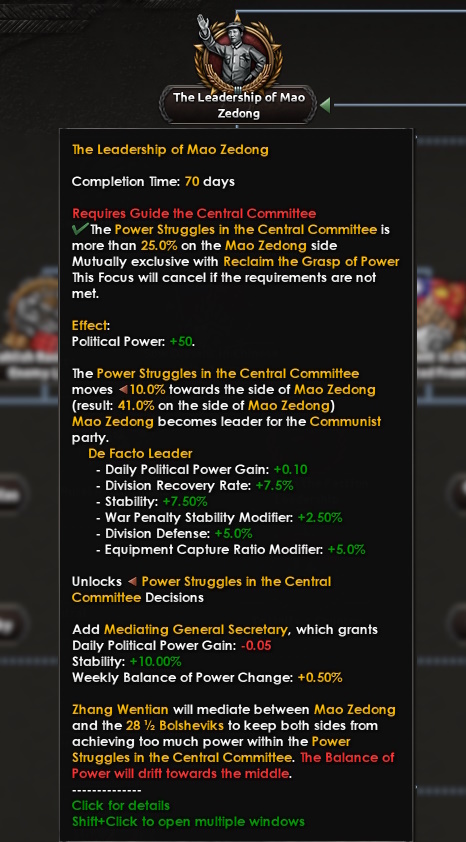
With Burn the Paper Tiger you may create a faction and invite the Nationalists, potentially becoming faction leader — though some warlords may refuse to join and the Nationalists could still usurp leadership. Focuses such as Rally the Peasants and Guide the Central Committee unlock decisions that shift the Balance of Power toward Mao, enabling Embrace the Change in Leadership and Mao’s consolidation.
To slow the Japanese advance you can adopt guerrilla doctrines inspired by Mao’s On Guerrilla Warfare, which strengthen militias and enable Guerilla Warfare decisions. These pair well with sub-doctrines such as Irregulars or People’s War.
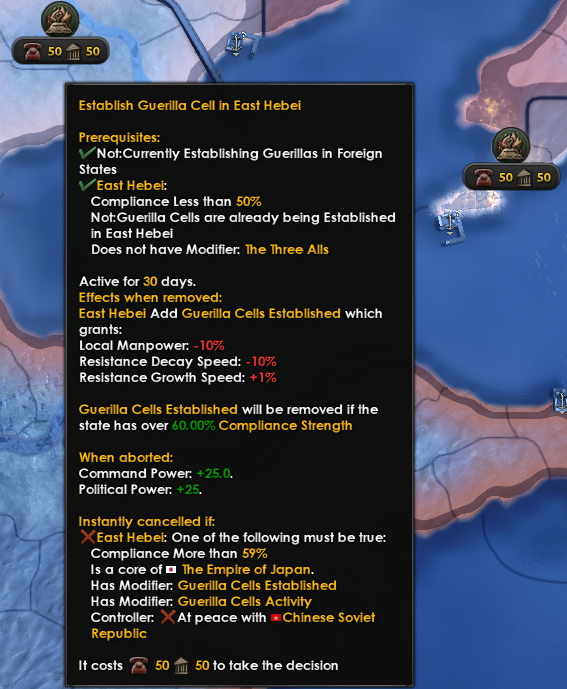
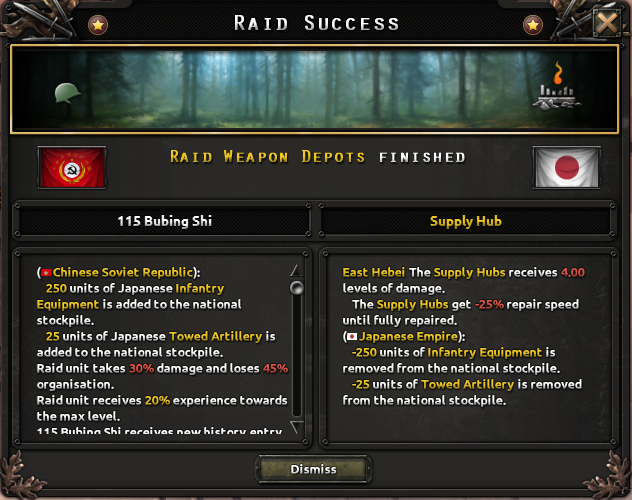
Further options let you establish bases behind enemy lines for sabotage and enable Raid Weapon Depots — a land operation that can yield foreign infantry equipment if successful, providing a vital supply source when domestic production is insufficient.
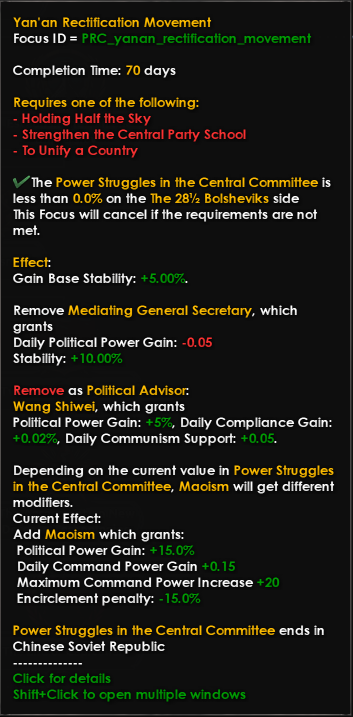
Completing the Yan’an Rectification Movement focus cements Mao’s leadership and grants him an upgraded leader trait depending on the Balance of Power. From there you can launch actions such as the Hundred Regiments Offensive and prepare for the eventual continuation of the Civil War.
This concludes the main Historical branch, but alternative political routes offer very different strategies and outcomes.
The 28½ Bolsheviks were Chinese intellectuals who studied in Moscow in the late 1920s and early 1930s. Leading figures such as Wang Ming and Bo Gu (the latter deposed in 1935) still hold influence within the party. If this faction gains control, the CCP’s policy slants toward a more urban, intellectual, and Soviet-aligned model.
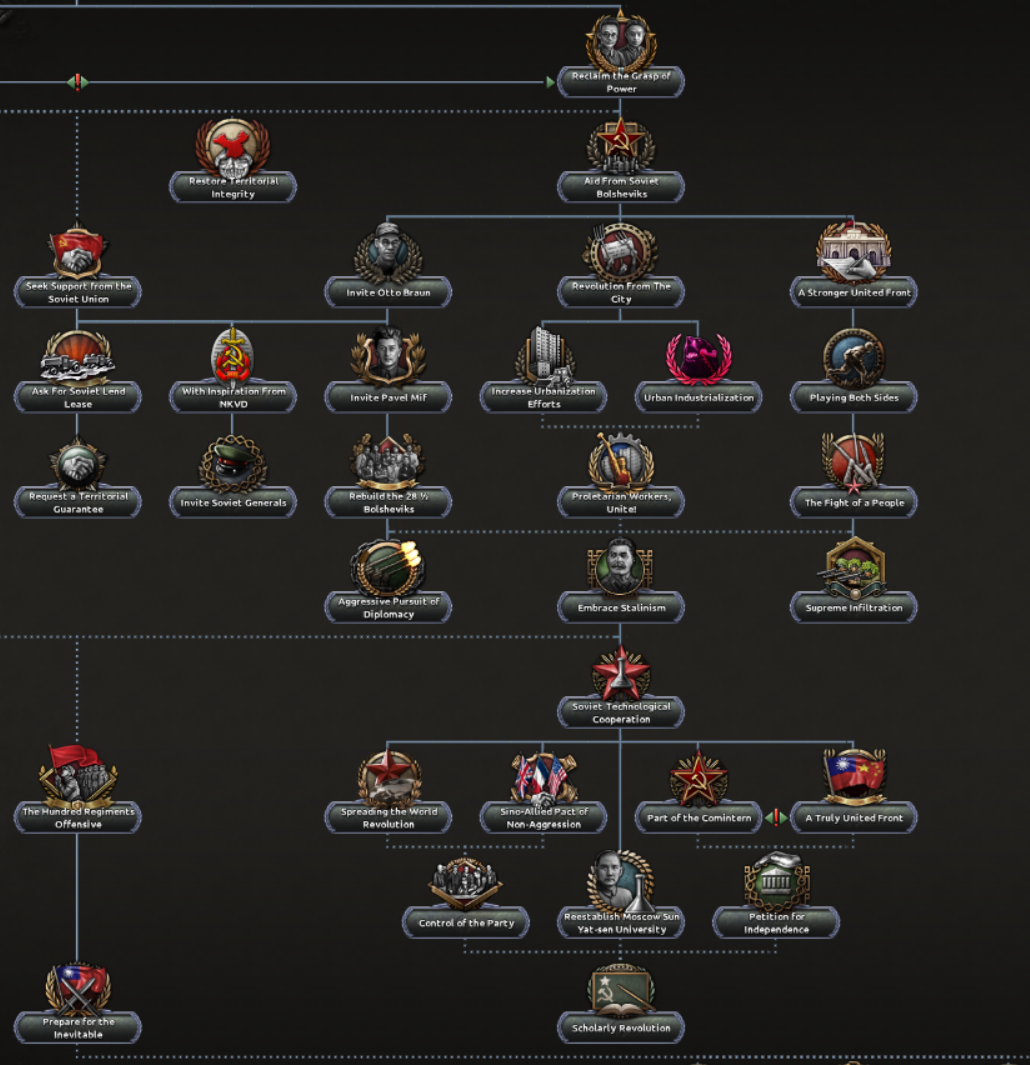 Focus paths for the 28½ Bolsheviks
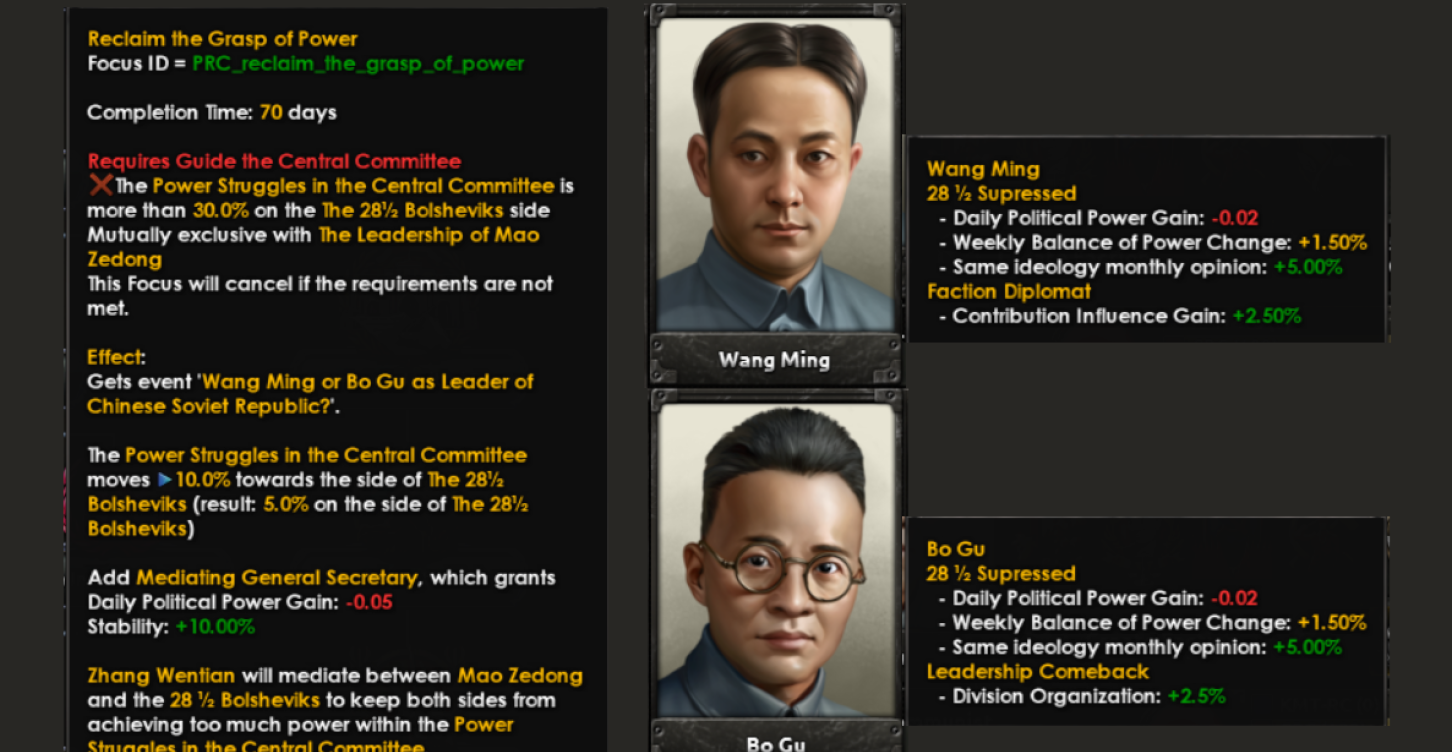 Bo Gu and Wang Ming
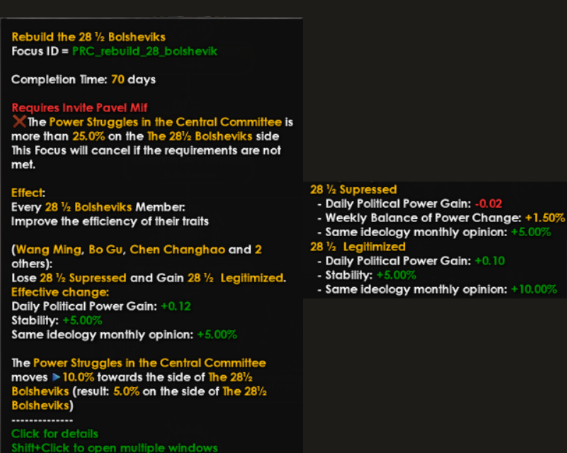 Focus to upgrade leader/advisor traits
The Bolsheviks unlock a unique faction-influence mechanic tied to the new Faction system: Influence The Faction. This decision chain lets you send figures like Zhou Enlai on diplomatic missions to increase faction influence within the Second United Front.
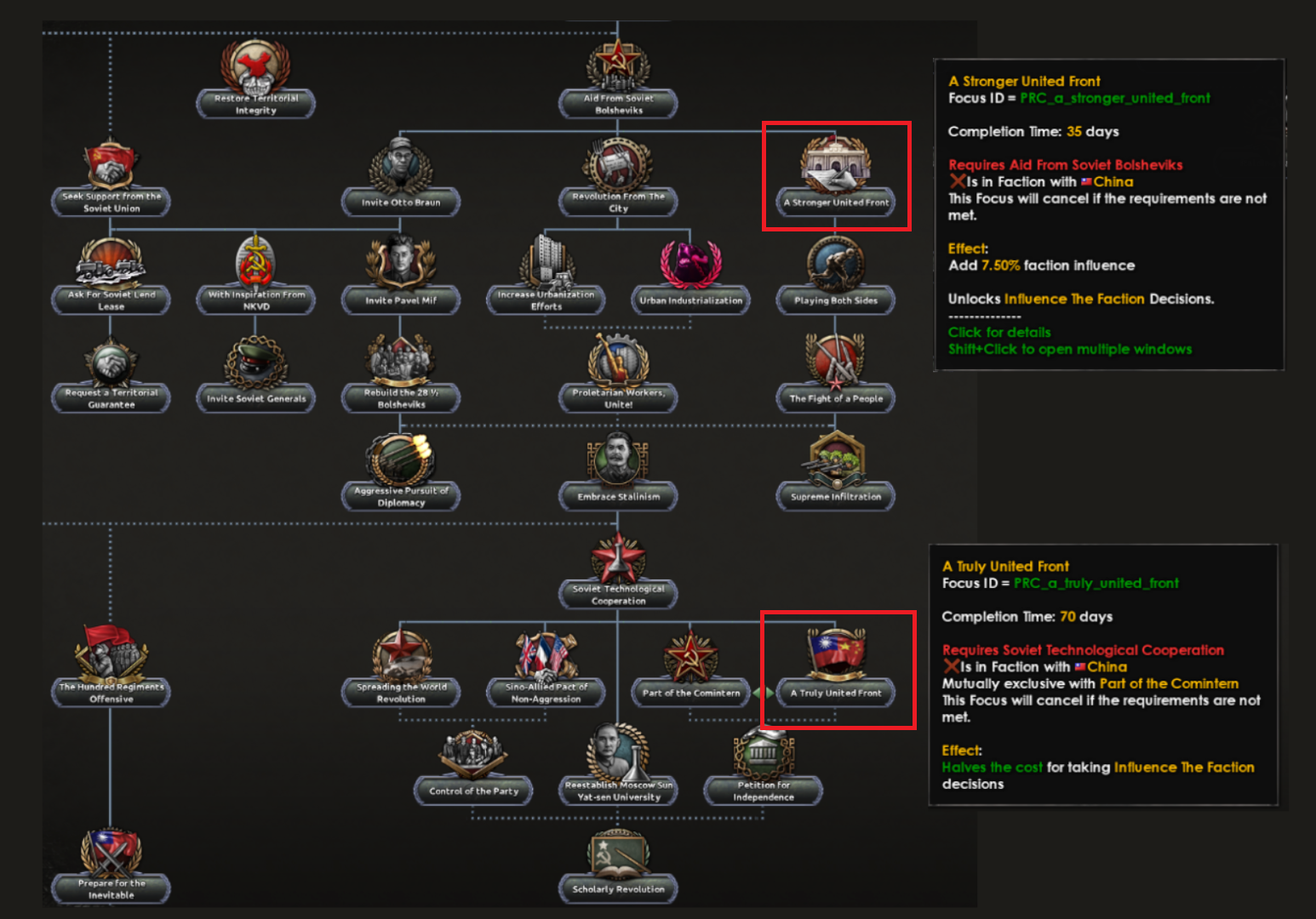
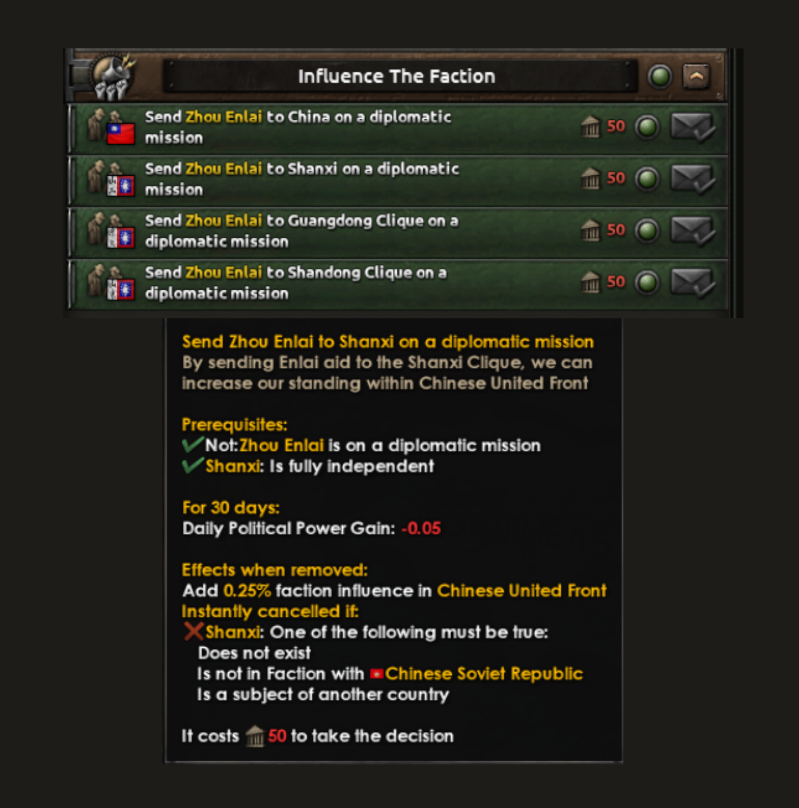 Tier one decisions
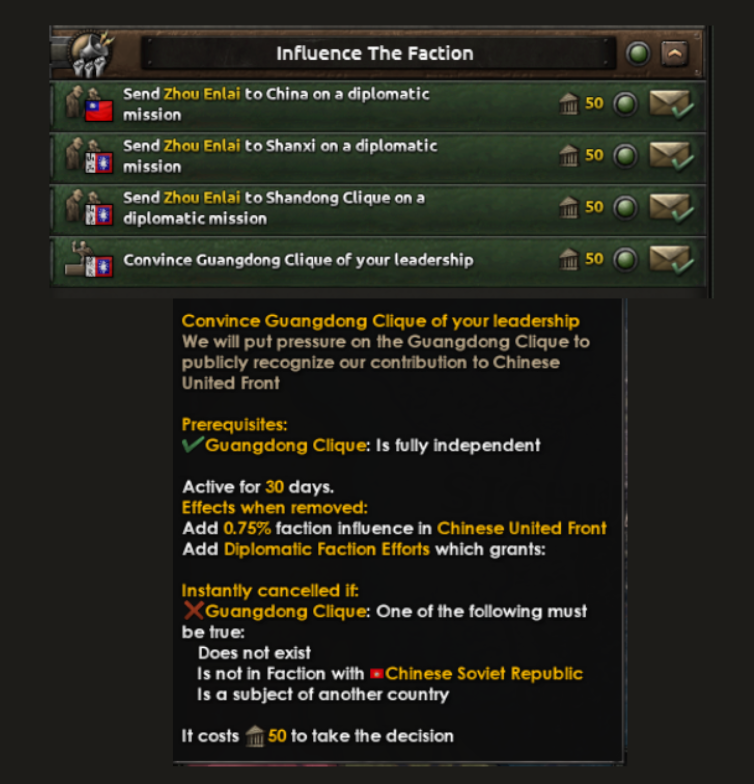 Tier two decision
While the Bolsheviks still have access to infiltration and guerrilla tools, those mechanics are weaker on this path — though further investment can reduce their cost. If you prefer diplomatic influence and closer ties with the Soviet Union, this branch offers a distinct and viable playstyle.
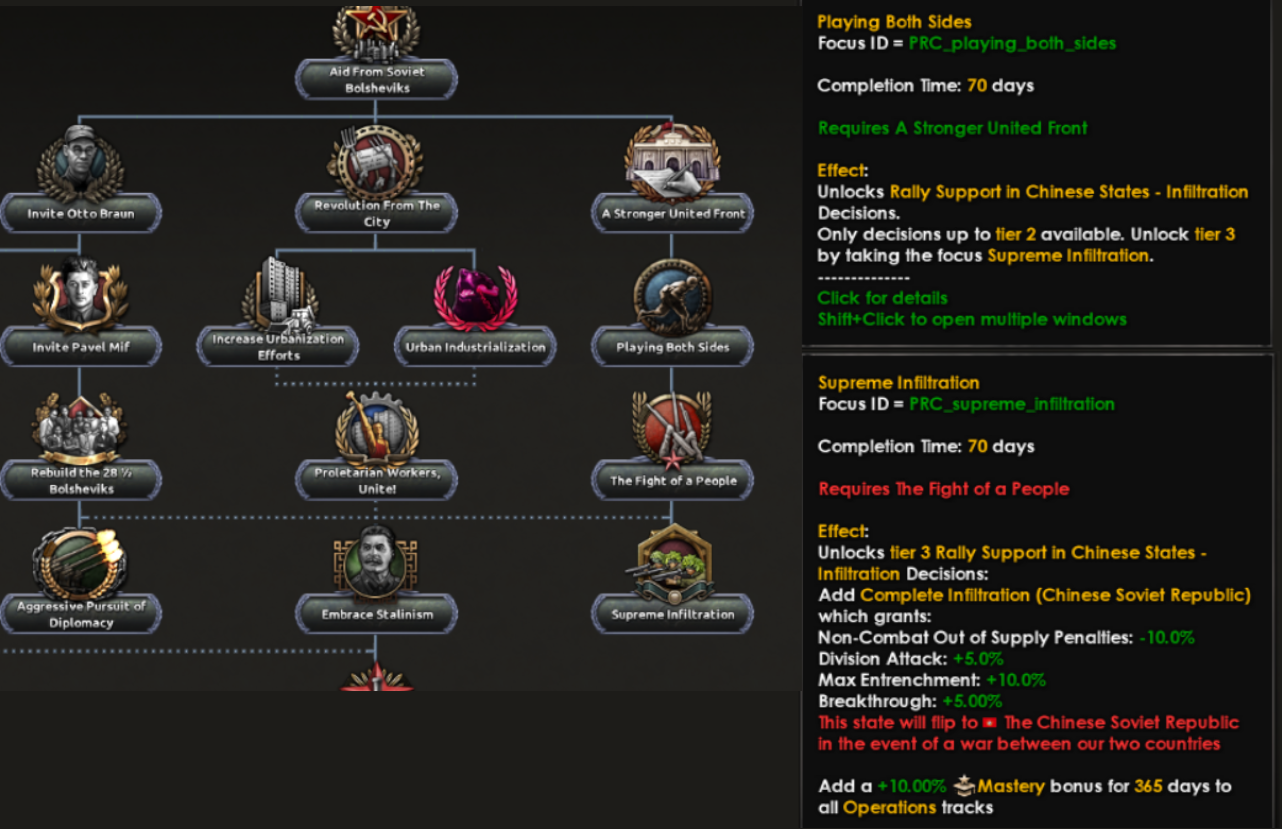 Diplomacy-heavy gameplay
The Unwilling Diarchy can only be formed after Zhang Guotao arrives in the Chinese Soviet Republic. This path sets up a power-sharing arrangement between Mao and Guotao, sidelining the 28½ Bolsheviks in the Balance of Power.
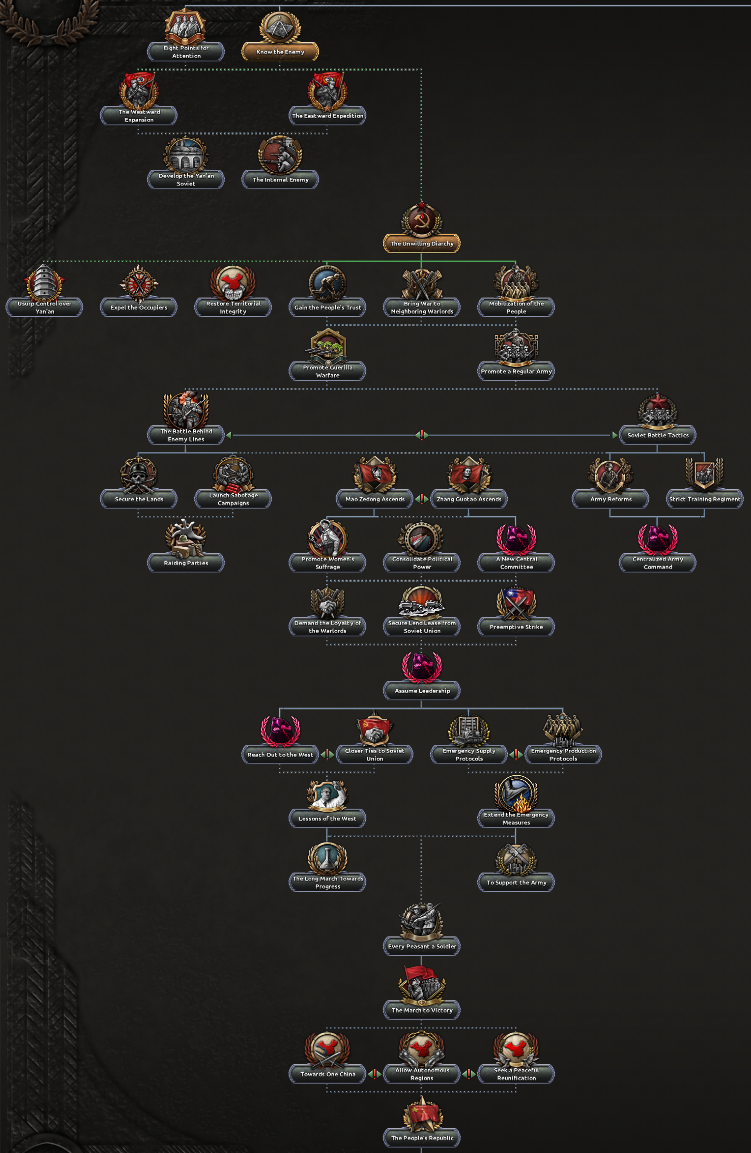
Choosing Gain the People’s Trust unlocks infiltration decisions, while Mobilization of the People grants militia units and additional manpower. You’ll then decide whether to emphasize guerrilla warfare and raiding enemy depots to supplement production, or to restructure the armed forces along Soviet lines into a conventional, modern army.
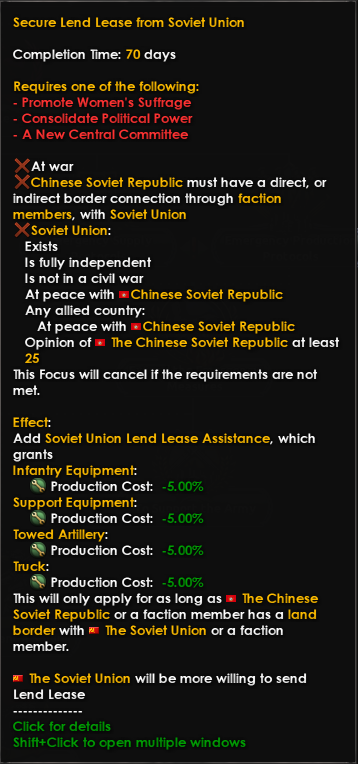
Once internal power is settled, options open to pressure or coerce regional warlords into joining your faction, launch a preemptive strike on a distracted Nationalist regime, or secure lend-lease from the Soviet Union to bolster materiel and industry.
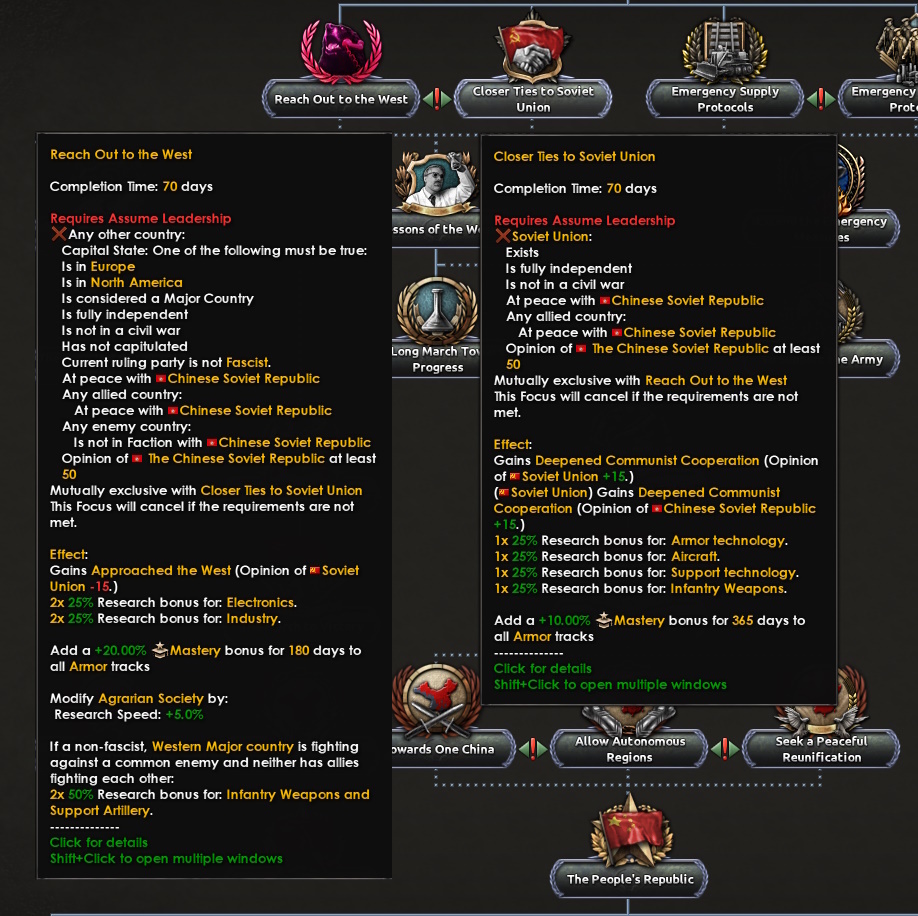
Later choices let you pivot outward: Reach Out to the West or pursue Closer Ties to the Soviet Union, each offering different benefits. Emergency protocols provide temporary or permanent boosts to logistics and production when you need them most.
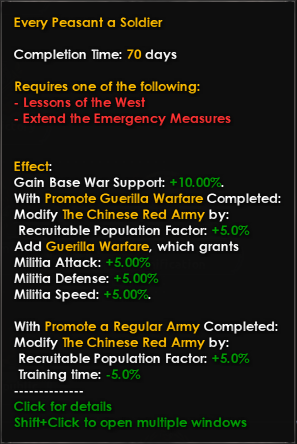
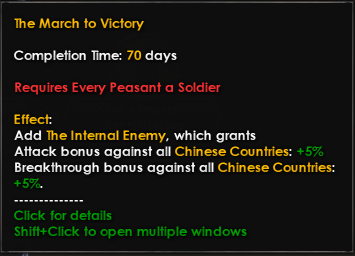
Near the branch’s end you’ll encounter decisive focuses such as Every Peasant a Soldier and The March to Victory, which prepare the nation for large-scale offensives and final unification efforts.
All political branches converge on a shared endgame focused on establishing the People’s Republic of China. Capstone focuses unlock coring and integration options, retaking territories, and post‑founding content such as promoting Zhou Enlai to First Premier and relocating the capital to Beijing.
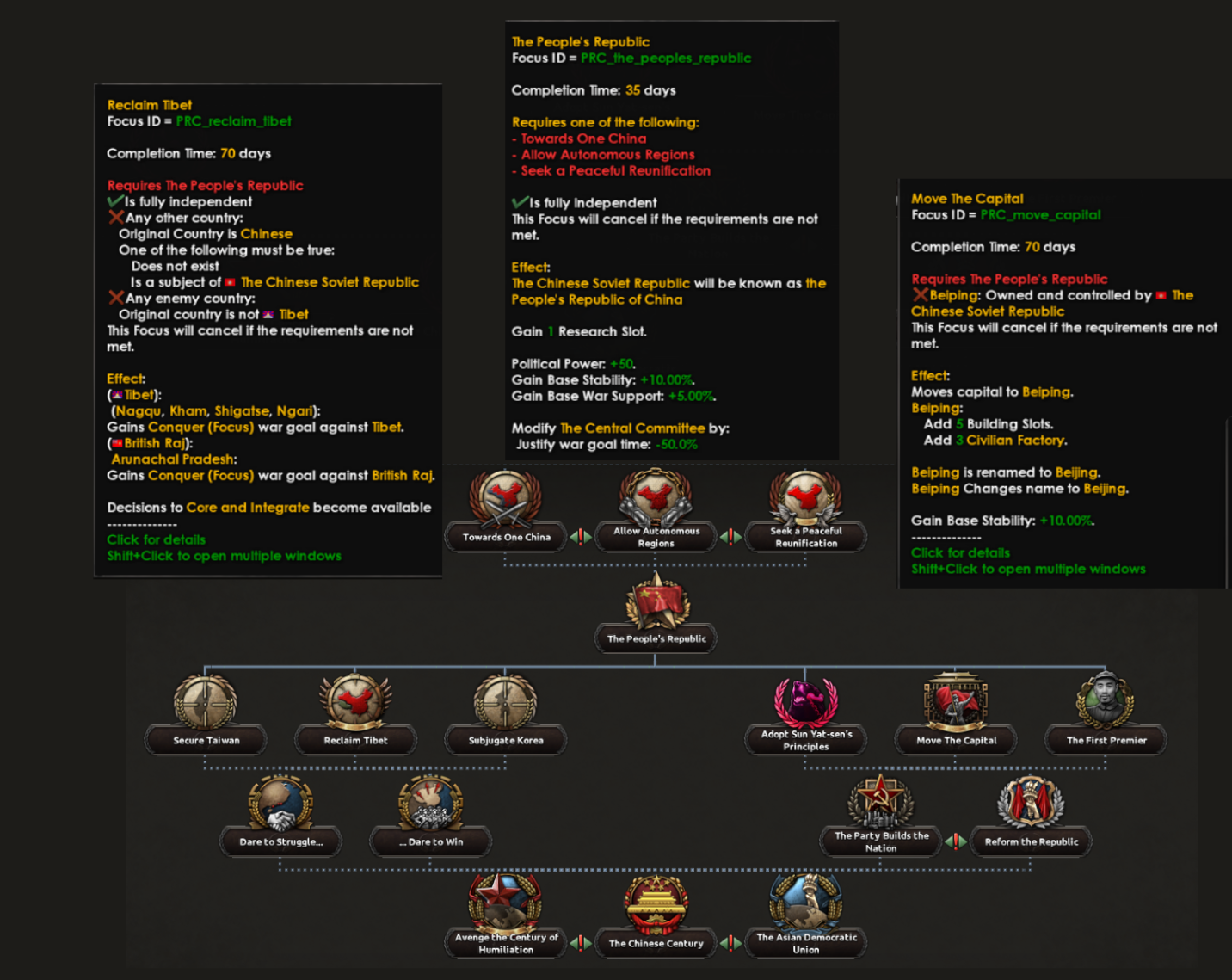 End game political branch
Overall, the Chinese Soviet Republic’s journey is about rebuilding from a fragile beginning while navigating warlord politics, the Nationalists, and the imminent Japanese threat. Whether you focus on cooperation in the Second United Front or pursue an independent path, the choices you make shape China’s future — and after the Japanese threat subsides, the struggle for internal dominance and national consolidation truly begins.
Related articles
 HOI IV Developer Diary | Romania: A Flawed Democracy
 Developer Corner & Open Beta: Energy #2
 Hearts of Iron IV Dev Corner | Strikes!
 Hearts of Iron IV Dev Corner: Old Canada Questions Before New Canada
 Hearts of Iron IV Dev Corner | Energy
 Steam Autumn Sale 2026
 HOI IV Dev Corner | The Great Depression
 Hearts of Iron IV | Patch 1.19.3