
A Legendary Director’s Time-Travel Masterpiece: 30 Years Ahead of Its Time

The dystopian horizon of 12 Monkeys hasn’t quite overtaken us yet. Directed by Terry Gilliam and released on December 29, 1995, the film’s timeline stretches toward 2035—leaving us a full decade of breathing room as we mark its 30th anniversary. However, the premise feels uncomfortably familiar: a virus is calculatedly unleashed in 1996, decimating the global population and forcing the few survivors into subterranean refuges. These remnants of humanity send “volunteers” to the desolate surface to scavenge for biological samples. While the COVID-19 pandemic of 2020 didn’t collapse civilization, the film’s depiction of a world derailed by a microscopic threat carries a haunting new resonance in the post-lockdown era.
Despite its apocalyptic backdrop, 12 Monkeys isn’t a clinical procedural in the vein of Steven Soderbergh’s Contagion. Instead, it is an exploration of existential vertigo and the disorientation of the modern age. Gilliam intentionally obscures the mechanics of his world, never fully explaining the ramshackle time-travel technology. We see James Cole (Bruce Willis) through a chaotic array of flickering, low-tech monitors as a committee of scientists tasks him with a singular mission: locate the virus’s origin to help engineer a future cure. For Cole, this isn’t a heroic journey—it’s a chance to reduce his criminal sentence.
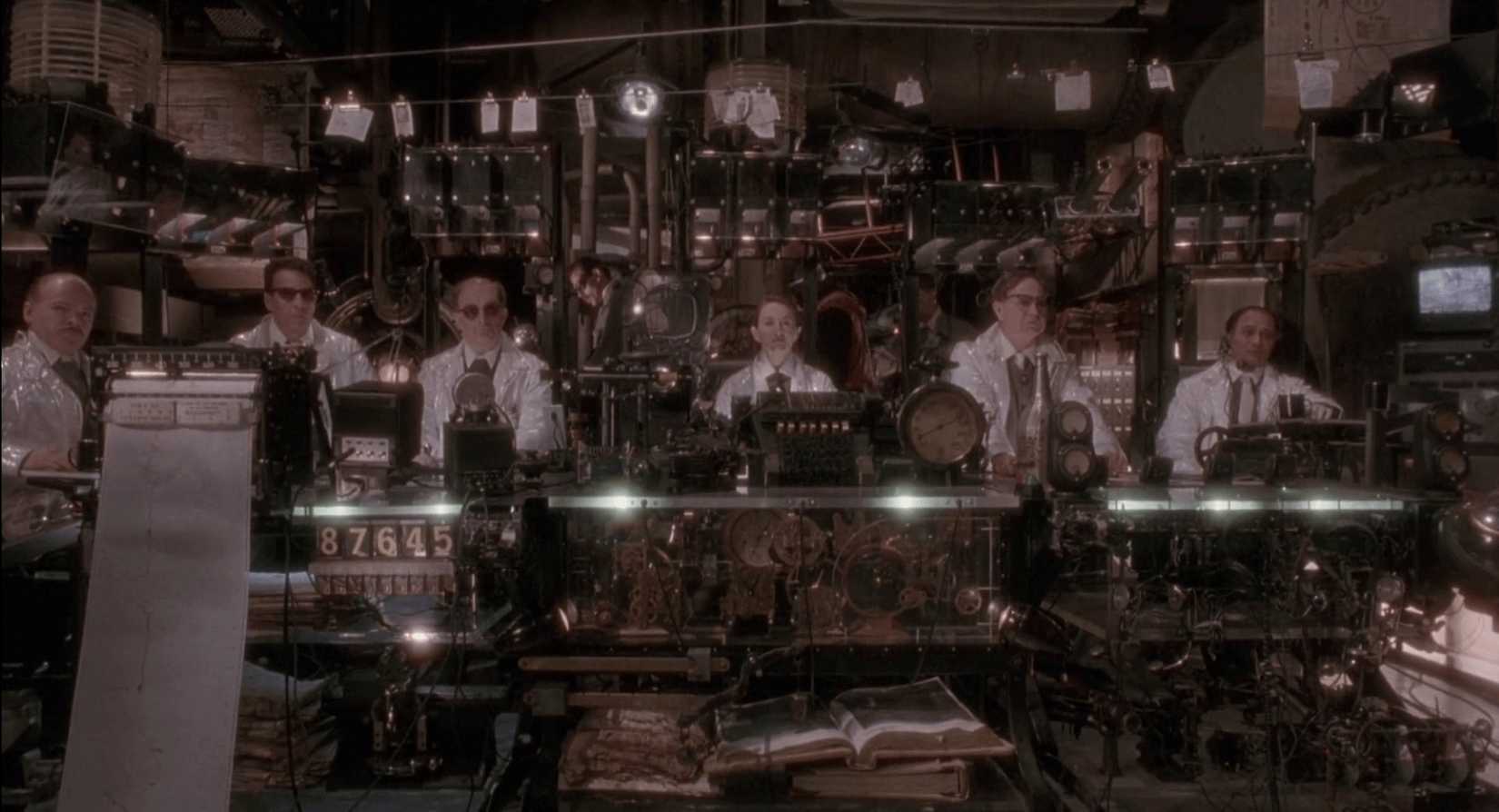
Cole’s identity as a prisoner adds a layer of unexplained grit to the narrative. The nature of his crimes remains a mystery, a narrative choice by Gilliam that compounds the film’s atmosphere of casual ambiguity. The act of time travel itself is presented as a glitchy, unrefined process reminiscent of the industrial clutter in Brazil. It is far from precise; Cole’s first trip drops him in 1990 rather than his intended target of 1996.
This chronological error leads him to Jeffrey Goines (Brad Pitt), the manic scion of a wealthy family and leader of the “Army of the 12 Monkeys,” and Dr. Kathryn Railly (Madeleine Stowe), a psychiatrist who attempts to treat his “delusions.” By the time Cole finally reaches 1996, the lines between reality and psychosis have blurred. As Railly begins to find evidence that Cole’s warnings are true, Cole himself starts to hope he is merely insane. The prospect of mental illness is far more comforting than the certainty of witnessing the end of the world for a second time—a trauma rooted in a childhood memory of a mysterious airport shooting that haunts his dreams.
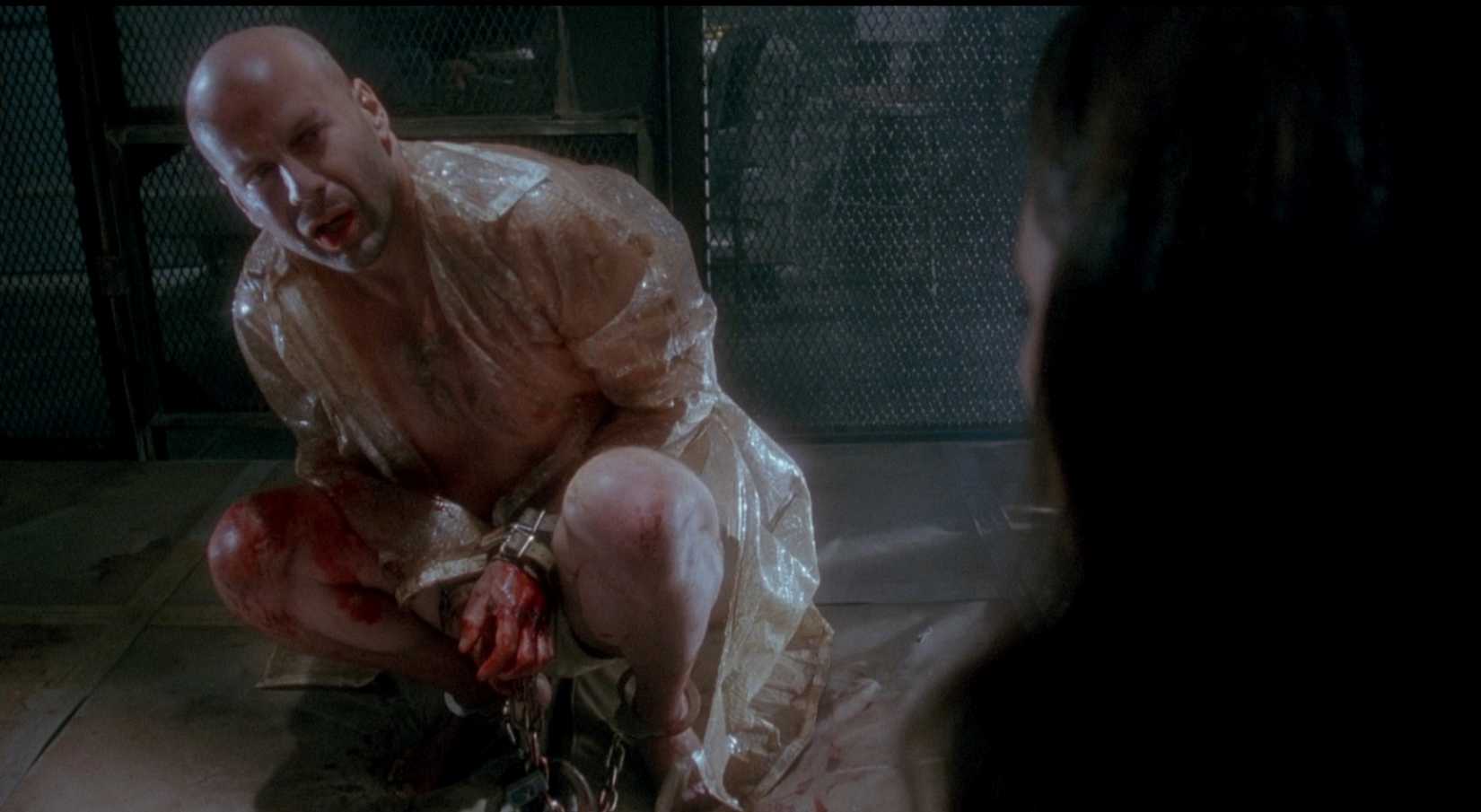
This remains one of Bruce Willis’s most profound performances. In 1995, he was at the height of his Die Hard fame, and Gilliam utilizes that action-star persona as a shorthand for the physical threat Cole poses. However, the true strength of the performance lies in Cole’s vulnerability. There is a raw, exposed-nerve quality to Willis here, perhaps best captured in the moment he weeps while hearing a simple pop song on a car radio, overwhelmed by the sensory richness of a world he knows is doomed.
Gilliam’s signature aesthetic—wide-angle lenses and “Looney Tunes” flourishes—prevents the film from ever truly feeling like a grounded psychological thriller. The world of 2035 feels just as vivid and “real” as the past, leaving the audience to wonder if the outcome can ever be changed. In a meta-commentary on the film itself, Cole and Railly hide out in a screening of Hitchcock’s Vertigo. Cole observes that the movie changes every time you see it because you have changed—a sentiment Gilliam mirrors through visual and musical cues, including dressing Stowe in a Kim Novak-inspired blonde wig.
The film also contains strange, coincidental links to other cinematic landmarks. At one point, Willis wanders the streets of Philadelphia muttering about seeing “dead people,” nearly four years before The Sixth Sense would redefine his career. Similarly, Brad Pitt’s frenetic performance as a consumerist-hating radical feels like a precursor to Fight Club. These echoes suggest that Gilliam and screenwriters David and Janet Peoples were tapping into a specific vein of pre-millennium tension—a mounting anxiety about whether we can trust our senses or the systems that govern us.

The foresight of 12 Monkeys extends into the digital age as well. Its refusal to provide neat explanations for its time-travel rules mirrors the modern experience of navigating internet disinformation. The plot, as understood by the characters, is a volatile mix of hearsay, fragmented data, and bleak speculation. Living as James Cole does is not unlike trying to parse the truth from a breaking news cycle on social media—confusing, contradictory, and relentlessly overwhelming.
This relatability likely explains why 12 Monkeys represented a rare moment of commercial dominance for Gilliam. While he has directed more avant-garde and visionary projects, this film remains his most effective bridge to a wide audience. It invites us into a fractured, unstable reality that, thirty years later, feels more like home than ever before.
Source: Polygon
Related articles
 Nvidia Confirms DLSS 5 Support for RTX 40 Series
 Miami Officials Criticize GTA 6 Marketing Over Vice City Comparisons
 Sony Announces Lineup for Tokyo Game Show 2026
 Uta Macross returns as a rhythm game for PC and mobile
 DLSS 5 Works on Budget Graphics Cards, Not Just RTX 5090
 Cosmic Horror Game Black Walls Features Inescapable Labyrinth
 Forgotten Island Premiere Set to Arrive in One Week
 8 Best Anime to Watch Like Solo Leveling