
Untitled Goose Game Developers Reimagining Multiplayer with Big Walk
During the peak of 2020, the prospect of reuniting with friends felt like a fading dream. As the global pandemic intensified, months of isolation fueled a growing dread that our solitary existence might become a permanent fixture. The creative minds at House House—the visionaries behind the mischievous Untitled Goose Game—were not immune to this atmospheric anxiety. Rather than succumbing to the gloom of lockdown, they channeled their restlessness into a digital sanctuary. They set out to recreate the simple, profound joy of getting lost in the wilderness with a group of companions. The fruit of that labor is Big Walk.
Scheduled for a release on PlayStation 5 and PC later this year, Big Walk is the exact brand of social remedy that players craved during the height of social distancing. It offers a tranquil cooperative journey where participants traverse a sprawling, vibrant landscape, unraveling environmental riddles along the way. While it deviates significantly from the structured loops of Animal Crossing: New Horizons, it strives to bottle that same communal magic, infused with the signature absurdist wit that defines House House’s portfolio.
Before its official debut, we gathered a team to venture into this digital frontier, guided by the developers themselves. What we discovered was a heartwarming cooperative odyssey filled with ingenious puzzles that demand genuine synchronicity. Even in a post-lockdown world, the game serves as a poignant reminder that simply “hanging out” in a virtual space can be a transformative delight when the environment is crafted with such sincerity.
Our hour-long expedition commenced in a cozy tutorial plaza. There, we met the developers, who inhabited the forms of the game’s distinctive, bulbous avatars. (House House purposefully leaves these creatures unnamed, hoping the community will develop its own nomenclature). After mastering the fundamentals—navigating the terrain, manipulating objects, and utilizing the proximity-based voice chat—we ventured into the vast open world. While the developers remained coy about the exact dimensions, they playfully likened the map’s scale to the legendary expanse of San Andreas.
The experience is strikingly non-linear. Big Walk prioritizes organic discovery over rigid objectives, functioning more as a sprawling social playground than a traditional checklist of tasks. As night fell, we were drawn to a luminous structure in the distance. Guided by players carrying glowing orbs, we navigated the darkness until the day-night cycle brought the morning sun. At a nearby station, we experimented with customization, painting each other’s segmented bodies in a display of chaotic creativity.
With the dawn, we scaled a nearby ridge and stumbled upon our first true enigma: a peculiar gourd trapped within a complex mechanical vice. Through trial and error and frantic vocal coordination over proximity chat, we realized we had to trigger four scattered pillars simultaneously. When the device finally hissed open, we claimed the gourd. Though its purpose remained a mystery, it instantly became a focal point for our group—a sacred object to be protected. This brand of emergent, player-driven storytelling is precisely what House House aims to cultivate.
 Image: House House/Panic
Our exploration revealed a world saturated with these “gourd puzzles.” Reaching one high-altitude prize required us to stack our bodies into a wobbling tower. Another chest required a teammate to hold a distant pressure plate, forcing us to communicate across the valley. One particularly intense segment involved two players describing abstract symbols inside a sealed room while those outside arranged corresponding tiles on a pegboard. Each encounter felt fresh, constantly reinventing the ways in which we had to rely on one another.
Eventually, our collection of gourds served a greater purpose. We discovered a mechanism that processed them into a raw metal key. Following subtle environmental cues—like a faint arrow etched into the machinery—we tracked down a series of cutting stations scattered across the map. It became clear that we weren’t just wandering aimlessly; we were engaged in a massive, open-air escape room that utilized the entire landscape as its puzzle board.
Despite this hidden depth, Big Walk excels at being a low-pressure retreat. At one point, we found a cluster of speakers playing lo-fi melodies. We spent several minutes hunting for a hidden switch before realizing there wasn’t one. The developers smiled as we eventually just sat down in the provided chairs, soaking in the atmosphere. It was a dedicated “chill zone,” existing solely for the sake of the vibe.
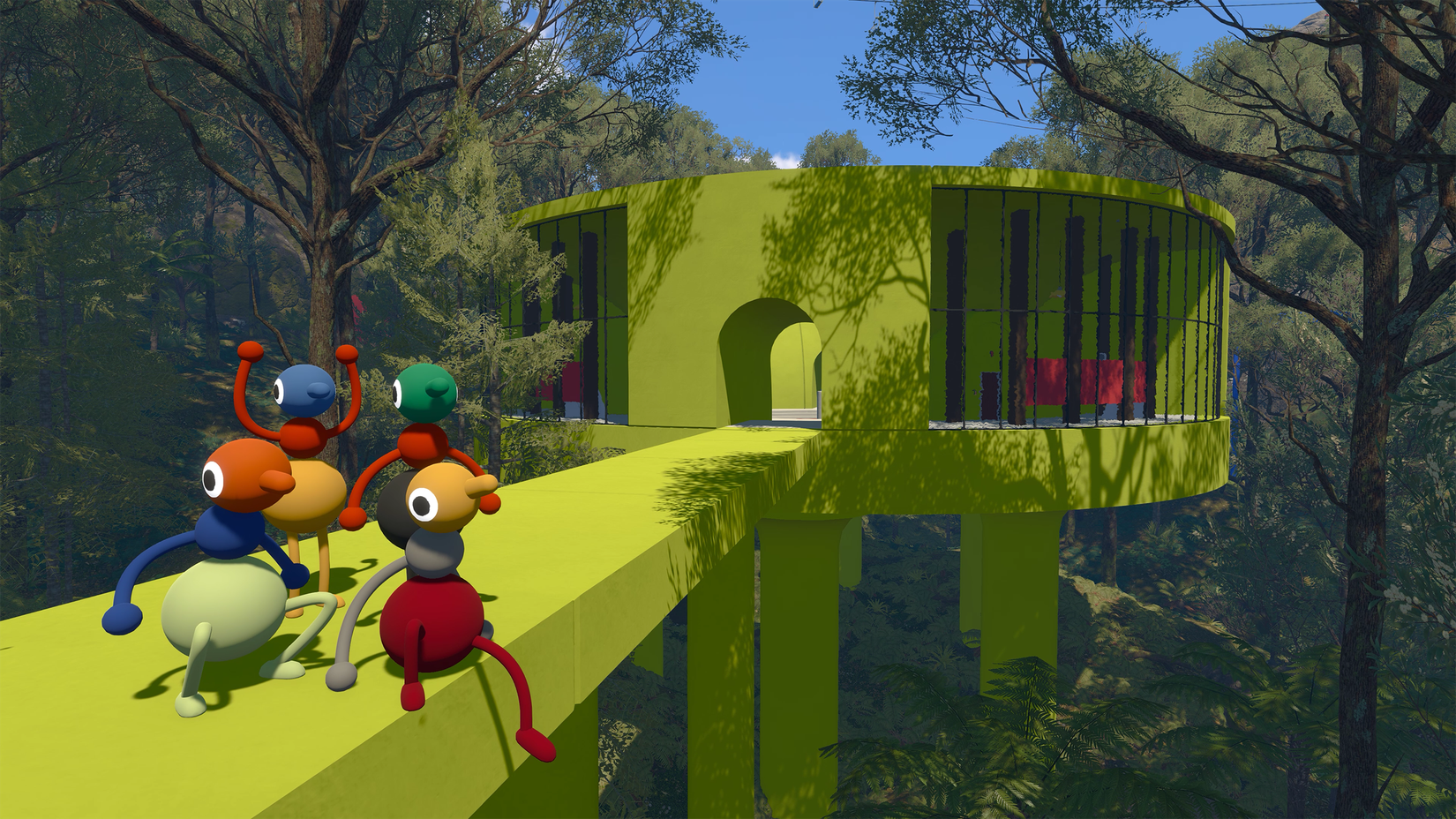 Image: House House/Panic
If Big Walk can maintain this balance of discovery and serenity, it will carve out a unique niche in the cooperative genre. While some might categorize it alongside other “friendslop” titles, its commitment to relaxation and unhurried exploration sets it apart as something far more meaningful.
The true essence of the game was captured when my aging PC suddenly crashed near the end of the session. As I frantically rebooted to rejoin my team, I received a string of messages. My colleagues weren’t annoyed; they were delighted. They had spent the downtime treating my idle character as a physics-based prop, carrying my “corpse” to various scenic vistas for group photos. In Big Walk, even a technical failure becomes an opportunity for spontaneous comedy.
Source: Polygon
Related articles
 Xbox Series X Runs PlayStation 5 Games Via Emulator
 Enthusiast Ports GTA 3, Vice City, and Liberty City Stories to Nintendo 3DS
 Daughter Asks Rockstar to Let Terminally Ill Father Play GTA VI Before Release
 Xbox Details Release Schedule for Nearly 40 Games This Week
 Ninjala 2 Drops PvP and Gacha for an Open World
 New Rumors Compare PS6 Performance to RTX 5080 and RTX 5090
 Trails in the Sky the 2nd Chapter Sets Sales Record for Nihon Falcom
 Hideo Kojima Addresses Whether Physint Will Release on PlayStation 6