Calvin and Hobbes Quote on Grief Endures 39 Years Later
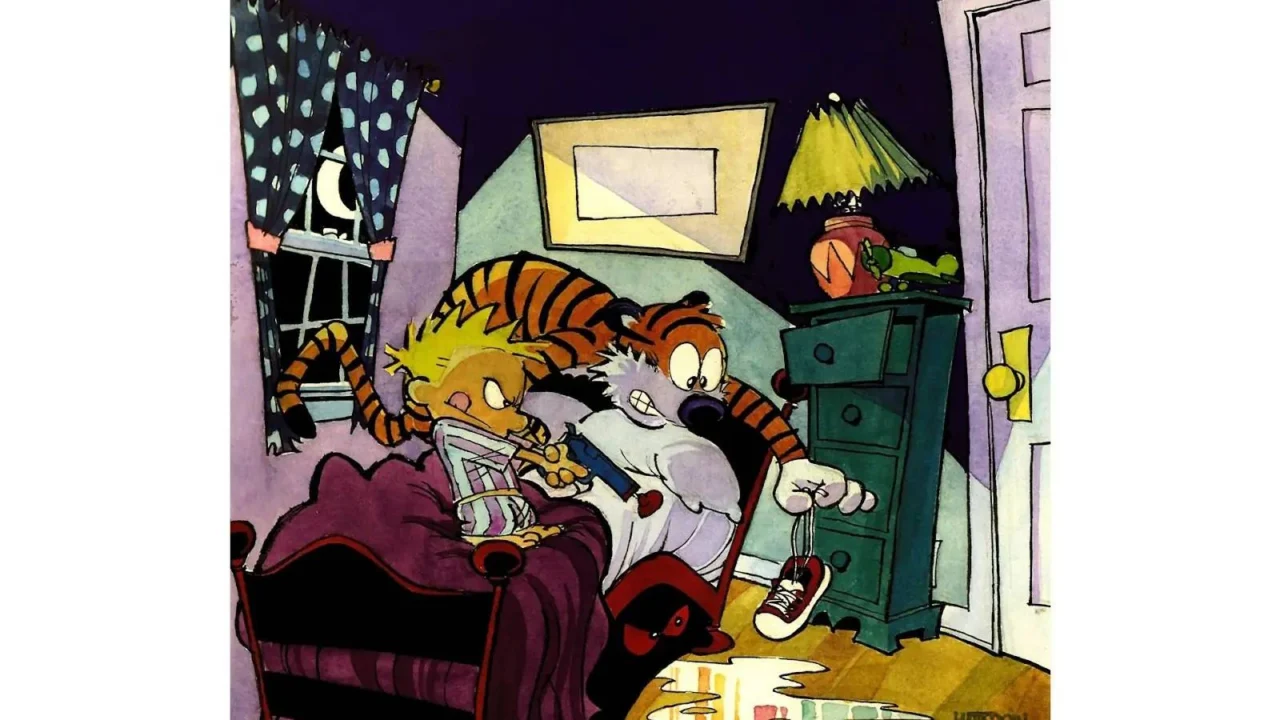
Bill Watterson’s Calvin and Hobbes was usually a comedy, set between an ordinary American suburb and Calvin’s imagination. But two stories about encounters with animals stand out for their quiet treatment of death: a March 1987 arc in which Calvin tries to save a baby raccoon, and a Sunday strip from later in the comic’s run.
He’s not gone
In The Calvin and Hobbes Tenth Anniversary Book (1995), Watterson wrote that he imagined Calvin’s home standing at the edge of a nature preserve or national forest. The setting gives Calvin a vast stretch of woodland to explore, with or without Hobbes, and helps explain the strip’s occasional interest in environmentalism.
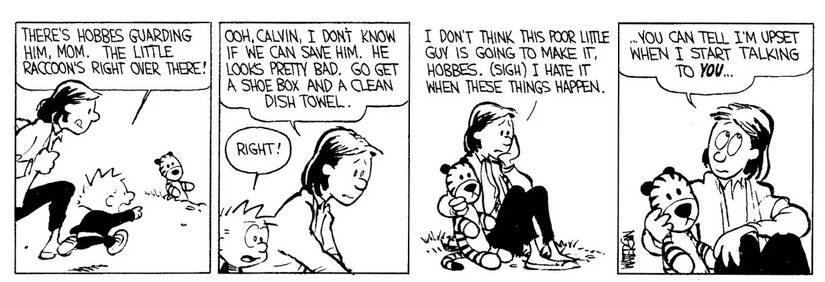
That woodland is also the setting for a story that began on March 9, 1987. Calvin and Hobbes find an injured baby raccoon with no sign of its parents. Calvin runs to get his mother, and they spend the next couple of days trying to nurse the animal back to health. The raccoon dies despite their efforts.
“At least he died warm and safe, Calvin,” his dad tells him. “We did all we could but now he’s gone.”
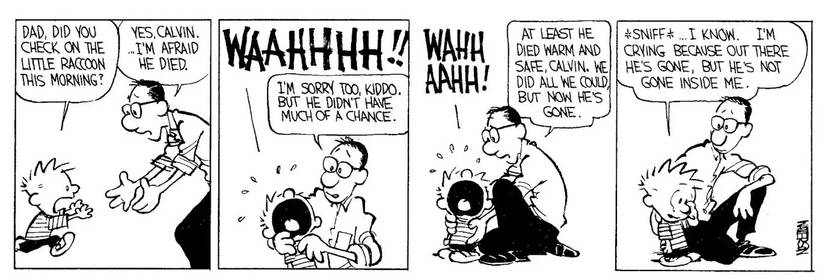
“I know,” Calvin says. “I’m crying because out there he’s gone, but he’s not gone inside me.”
The story is unusually sentimental for Calvin and Hobbes, especially in its portrayal of Calvin’s parents. They are often depicted as ambivalent about parenthood, but both offer him unqualified support during the raccoon arc.
The storyline also belongs to the first half of the strip’s run, before Watterson’s first sabbatical. After he returned to work in 1992, his ongoing feud with his syndicate seemed to sharpen the comic’s tone. The later strips still had moments of kindness and emotion, but they could feel subtly different from the earlier work.
Fragile, temporary, and precious
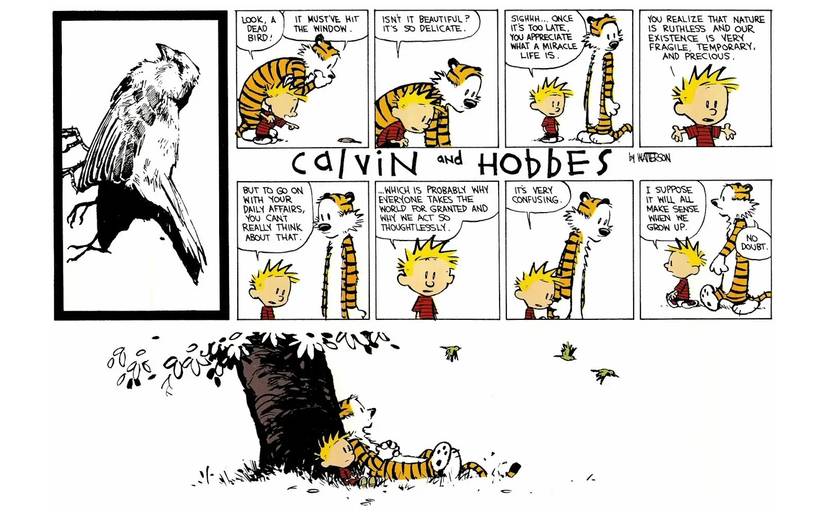
After his first sabbatical in 1991, Watterson changed his Sunday comics from their earlier panel grid to an “unbreakable” half-page format. The new format gave him more freedom to experiment with layouts.
One of those Sunday strips, published on September 19, 1993, opens with a dead bird lying on the ground, possibly after striking a window. Calvin and Hobbes find it during a walk through the woods and stop to study it.
“Once it’s too late, you appreciate what a miracle life is,” Calvin says. “You realize that nature is ruthless and our existence is very fragile, temporary, and precious. But to go on with your daily affairs, you can’t really think about that.”
Calvin decides the subject is confusing, but thinks it should make more sense when he grows up. He and Hobbes go off to sit beneath a tree, silent and lost in thought.
The strip has no conventional punchline. Its closest thing to a joke is Calvin’s belief that he will understand death better when he is older. Instead, the comic reflects on life and the meaning its ending can give it.
Watterson retired a little over two years after the bird strip ran. His Sunday comics from 1992 to 1995 show him pushing against the limitations of the newspaper comic strip, and the September 1993 installment is an example of what he could accomplish within it.
Source: Polygon
Related articles
 ARC Raiders Sales Figures Reported as Game Continues to Gain Popularity a Year After Release
 Photos of GTA VI Box Surface Online, Showing Reference to First Trailer Inside
 Rockstar Is Selling a Real-Life Car From GTA VI
 The X-Files Offers a 218-Episode Sci-Fi Alternative to Lanterns
 Developers of PvPvE Game Fragmentary Order Reveal System Requirements and First Alpha Test Details
 Fans Think They’ve Figured Out What PHYSINT, the Title of Hideo Kojima’s New Game, Means
 West Coast Customs of Pimp My Ride Recreates GTA VI Cars in Real Life
 VisionQuest Post-Credits Scene Explained: What It Means for Ultron and Jocasta