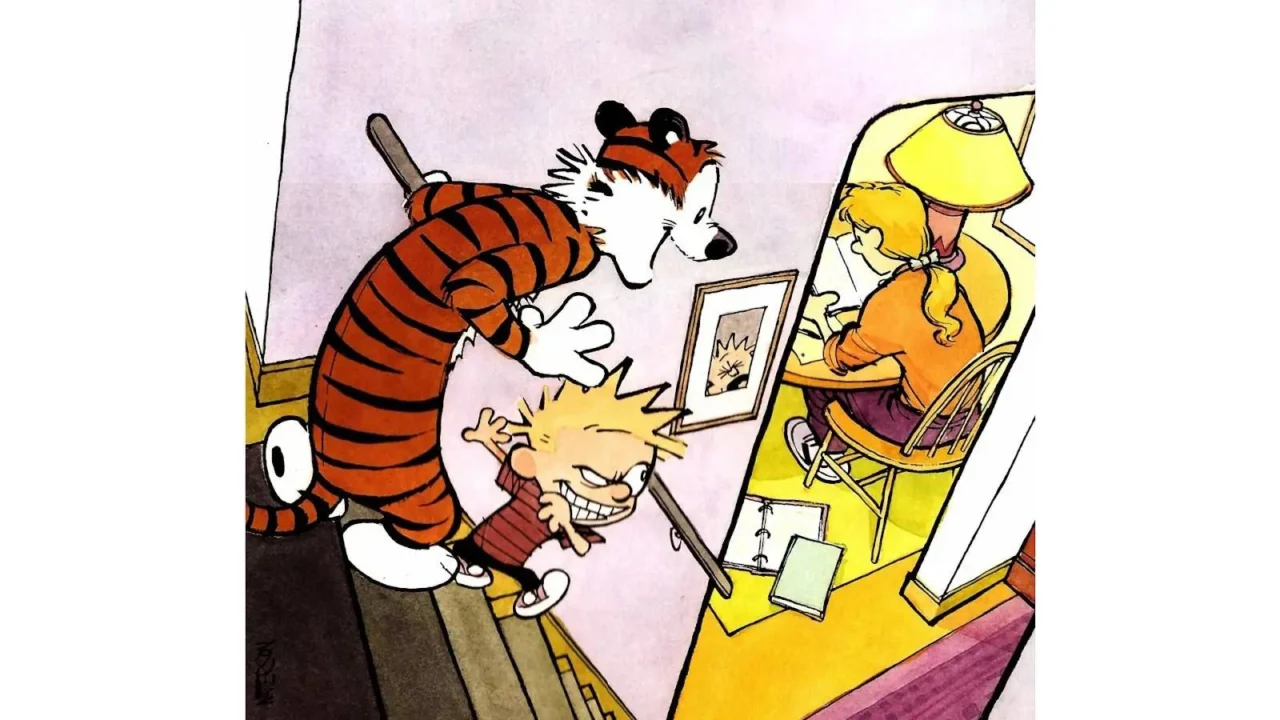
Calvin and Hobbes Comics Show Calvin’s Quirky Genius Through Vocabulary
Calvin and Hobbes arrived at the right time to influence a generation of creators, and many of them went on to make comic strips of their own. Along with other seminal ’90s newspaper comics like Bloom County/Outland, its linework, flexibility and imagination visibly inspired many of the artists behind the 2000s webcomics boom.
While rereading the strip, I started to wonder whether we underrate its effect on 21st-century writing. From the start of its run, one of Bill Watterson’s favorite running jokes was Calvin’s vocabulary. Calvin is ostensibly six years old and a lousy student, but he talks like he was raised on Word of the Day calendars.
That habit has left a distinct mark on 21st-century pop culture. Half the ’90s kids who became comedy writers and cartoonists inherited Watterson’s love of vocabulary-based punchlines. If you’ve read anything in the last 30 years where half the joke is five-dollar words delivering a 50-cent concept, you’re often looking at the work of someone who grew up on Calvin and Hobbes.
With that in mind, here are six of my favorite Calvin and Hobbes strips about the comic’s peculiar celebration of the English language. Calvin may not be able to focus in school, but at least he’s a human thesaurus. All six strips are by Bill Watterson and distributed by Andrews & McMeel.
6. December 22, 1985
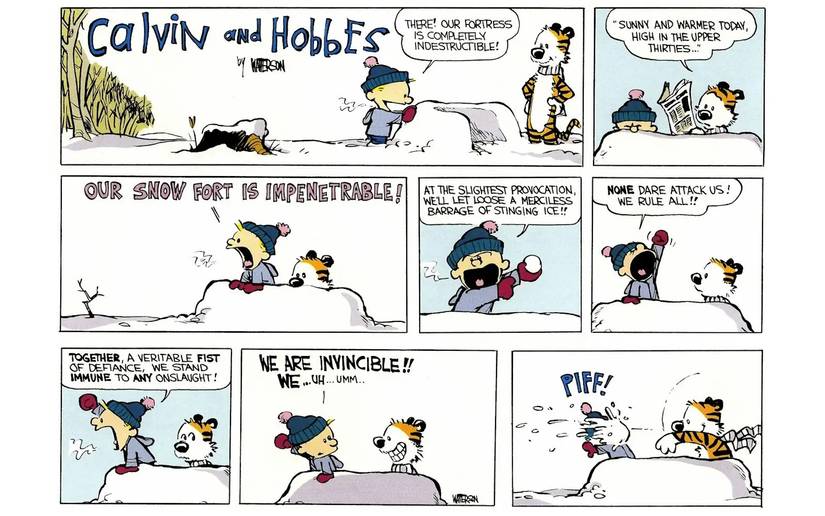
The strip’s love of language started early. This year-one Sunday strip taught a generation the phrase “fist of defiance.”
Calvin huddles inside his snow fort and brags to no one in particular that it can withstand any onslaught. His claim of invincibility ends when Hobbes pelts him in the face with a snowball.
5. August 13, 1990
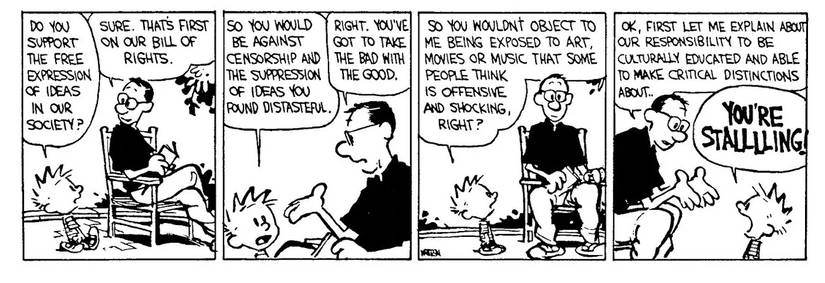
This is one of the rare Calvin and Hobbes strips you could call “ripped from the headlines.” It dates from the Tipper Gore-led furor over obscene lyrics in popular music, but it applies as well now as it did in 1990, if not more so.
Calvin confronts his dad over “the free expression of ideas in our society.” Then he springs a logic trap. If his father opposes censorship, why would he object to Calvin watching R-rated movies?
Calvin rarely gets one over on his dad in these exchanges. Here a six-year-old inexplicably pulls off a high-school-level debate tactic against a man who, according to Watterson, is an actual attorney.
4. November 1, 1990
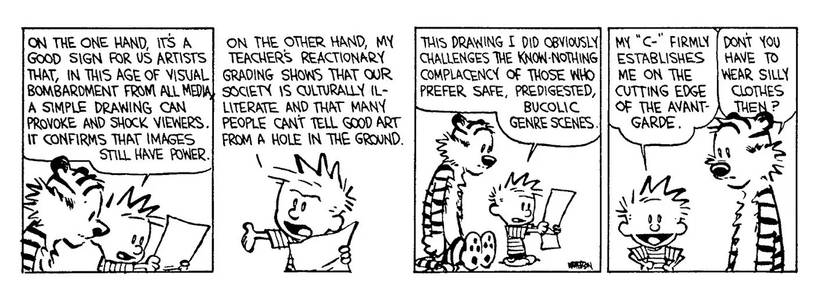
Calvin gets a C-minus on an art project at school. He tells Hobbes the grade comes from society’s cultural illiteracy. In his telling, he isn’t a goofy six-year-old who ignored the assignment. He’s a serious artist unappreciated in his time.
Watterson’s arts background shows up now and then over the strip’s run. His actual degree is in political science, but he has been drawing since he was a kid. It usually appears as Calvin unsubtly mocking the pretensions of the art world. The more famous version of the joke involves Calvin’s surreal snowmen, but I like this one more, since I too am on “the cutting edge of the avant-garde.”
3. November 18, 1990
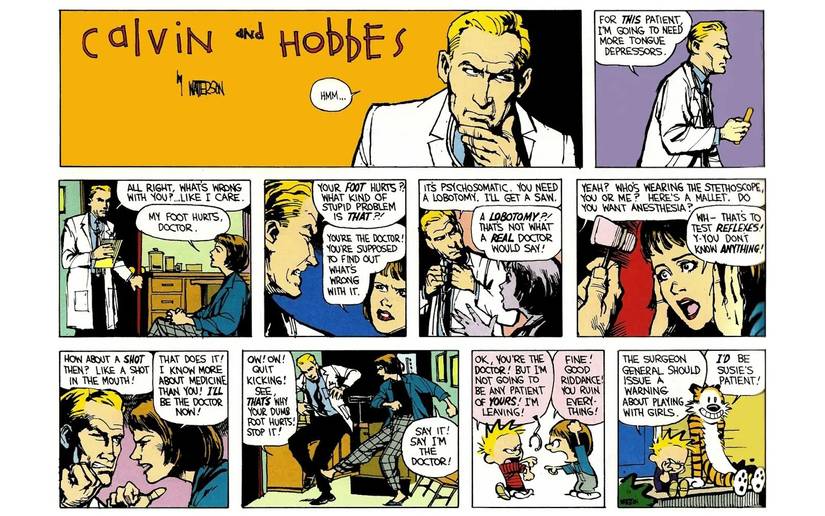
This is one of the higher-concept Sunday strips from the pre-sabbatical years. Watterson reimagines the strip as a 1950s romance comic and switches up his style to show a game of pretend between Calvin and Susie. They have two very different ideas of how the game should go.
This strip is where I first encountered the word “psychosomatic.” You can learn a lot from the comics page.
2. December 4, 1992
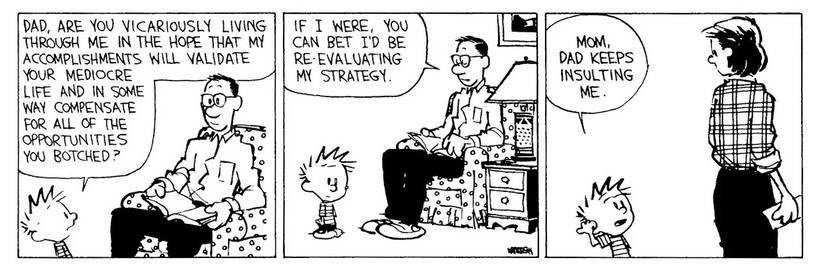
“Dad,” Calvin asks, “are you vicariously living through me in the hope that my accomplishments will validate your mediocre life and in some way compensate for all of the opportunities you botched?”
“If I were,” his father responds, “you can bet I’d be re-evaluating my strategy.”
My favorite part is the thousand-yard stare on Calvin’s dad in the first panel. It’s a hilarious question for a six-year-old to ask, and it hits close to home if you’ve ever taken part in youth-league sports. As long as kids have had organized gaming clubs, some parents have been far too invested in them.
1. November 10, 1995
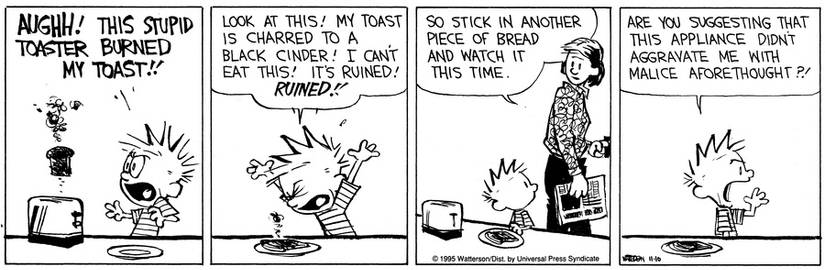
Calvin’s toast burns to a cinder, and he complains for two panels before his mother suggests it was his fault. “So stick in another piece of bread and watch it this time,” she says.
“Are you suggesting this device didn’t aggravate me with malice aforethought?!” Calvin yells back.
This strip and that phrase inspired the whole article. I’ve been saying “with malice aforethought” in sarcastic contexts for 30 years, and I only realized now that it’s entirely because of this comic.
Source: Polygon
Related articles
 Nintendo Switch 2 Hacked, Emulator Built, and Files From FromSoftware’s The Duskbloods Under Analysis
 Scientists May Help Make Hideo Kojima’s 40-Year-Old Dream of Blood-Scented Physical Game Editions a Reality
 Hacker Announces PlayStation 5 Kernel Exploit for Firmware 14.00 and 14.10
 PC Prices Rising Quickly and Sales Plunging as Market Faces Another Blow
 Players Urge CD Projekt RED to Buy Mass Effect and Dragon Age After BioWare Closure
 Netflix’s Live-Action Gundam Movie Starring Sydney Sweeney Reveals First Story Details
 EA Has Acquired and Later Closed Multiple Studios, Full List Shows
 Sony Steps Up Crackdown on PS5 Hacking, Putting Users’ PSN Access at Risk