The original Katamari Damacy, a PlayStation 2 release from 2004, always felt like a Nintendo-made oddity in spirit: delightfully simple in concept and absurdly charming in execution. Its premise is gloriously straightforward — roll a sticky ball and watch it grow — and the cheerful, papercraft-inspired visuals recall both the low-poly era and delicate origami. Once Upon a Katamari, the first new console entry in the series in 14 years, wisely preserves that core loop. It’s still “roll ball, make ball big,” but this time the world you traverse is richer and far more varied.
The framing story is playful without overstaying its welcome: the lanky, well-meaning King of All Cosmos accidentally obliterates the Earth and the stars while tidying his home. As the diminutive green prince — complete with a head that resembles a sideways salami — you must travel through time with your sticky Katamari to reassemble the universe’s history and restore the night sky. Roll ball, make ball big.
 Image: Bandai Namco via Polygon
Once Upon a Katamari shines because of its abundance of eccentric, lovingly crafted stages. The game offers ten distinctive maps, each inspired by a different historical era — think Edo-period Japan, the American Frontier, and the Jurassic — and every map contains multiple levels that riff on its theme. The Frontier map, for example, sends you through gold mines, a raucous saloon, and even a stage devoted entirely to rounding up an assortment of colorful tumbleweeds.
Completing a stage unlocks extra challenges: time trials, objectives that require collecting a specific object type, or tasks that push you to grow your Katamari as large as possible while grabbing only a few items. Timed runs are the most frequent, and they showcase the loop at its best. You begin tiny, rolling up dice and mahjong tiles while avoiding anything too big. As you gather items, the world gradually shrinks relative to you, and momentum builds. In the frantic final minute — with a blaring countdown — you’ll find yourself swallowing trees and a T. rex in a single, glorious surge of mass.
Though the basic mechanics remain familiar, Once Upon a Katamari introduces a few new touches. Visually it outpaces the PS2-era remasters — 2018’s Katamari Damacy Reroll and 2024’s We Love Katamari Reroll + Royal Reverie — delivering constant visual surprises: low-poly eels with comical underbites, stick-limbed cowboys who flail as you sweep them into your ball, and halved watermelons arranged like daisies. These little oddities are exactly why the series endures.
Controls come in two flavors. The “original” scheme uses both thumbsticks in a tank-like setup, which takes a little practice but rewards precision — a nod to longtime fans. The “simple” mode relies on the left stick alone and will feel more natural to most players, though the right stick still affects your position around the Katamari’s edge rather than granting free camera control. That fixed-camera feel is a deliberate throwback; it’s a small restriction, but it reinforces the series’ early-2000s design DNA.
Another new mechanic is the Freebie system: short-lived power-ups similar to those in kart racers. Magnets pull nearby objects in, a stopwatch freezes the timer, and other perks offer momentary advantages. The idea is promising, but the effects expire so quickly that they rarely feel consequential — more a teasing flourish than a game-changing tool. It’s an experiment that almost pays off, but it’s held back by an overly conservative duration.
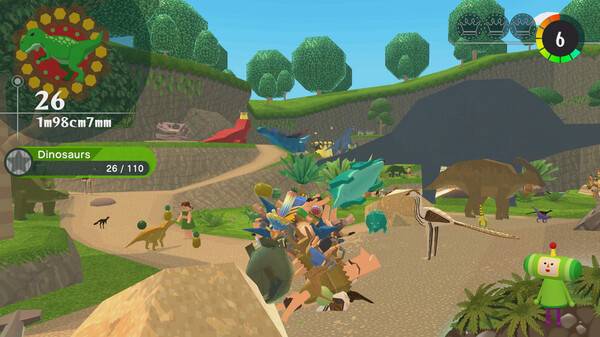 Image: Bandai Namco via Polygon
Collectibles have always been part of Katamari’s DNA — unlockable cousins, music tracks, and cosmetic trinkets that don’t change gameplay. This entry leans harder into that tradition by hiding three crowns in each stage; you must retrieve them to unlock further maps and levels. That requirement turns exploration into a checklist and sometimes dampens the carefree joy of discovery. It increases replay value, certainly, but in a blunt, old-school way that can feel more like busywork than a clever incentive. I’d still recommend Once Upon a Katamari, but I’d be more enthusiastic if more content were accessible up front — let players wander through all the charming environments without so much gatekeeping.
With the holidays approaching, Once Upon a Katamari is a warm, family-friendly diversion that’s easy to pick up and hard to put down. The progression gates are a minor irritant, but the game’s mood is exemplary: cozy, silly, and compulsively playful. Before you know it, an hour has passed and you’re hunched in the dark, rolling up jellyfish and squids while the clock runs out. Roll ball, make ball big.
Once Upon a Katamari will be released Oct. 24 on Nintendo Switch, PlayStation 5, Windows PC, and Xbox Series X. The game was reviewed on PS5 using a prerelease download code provided by Bandai Namco. You can find additional information about Polygon’s ethics policy here.
Source: Polygon